 Clear Cortex
UGC meaning: what UGC means in marketing
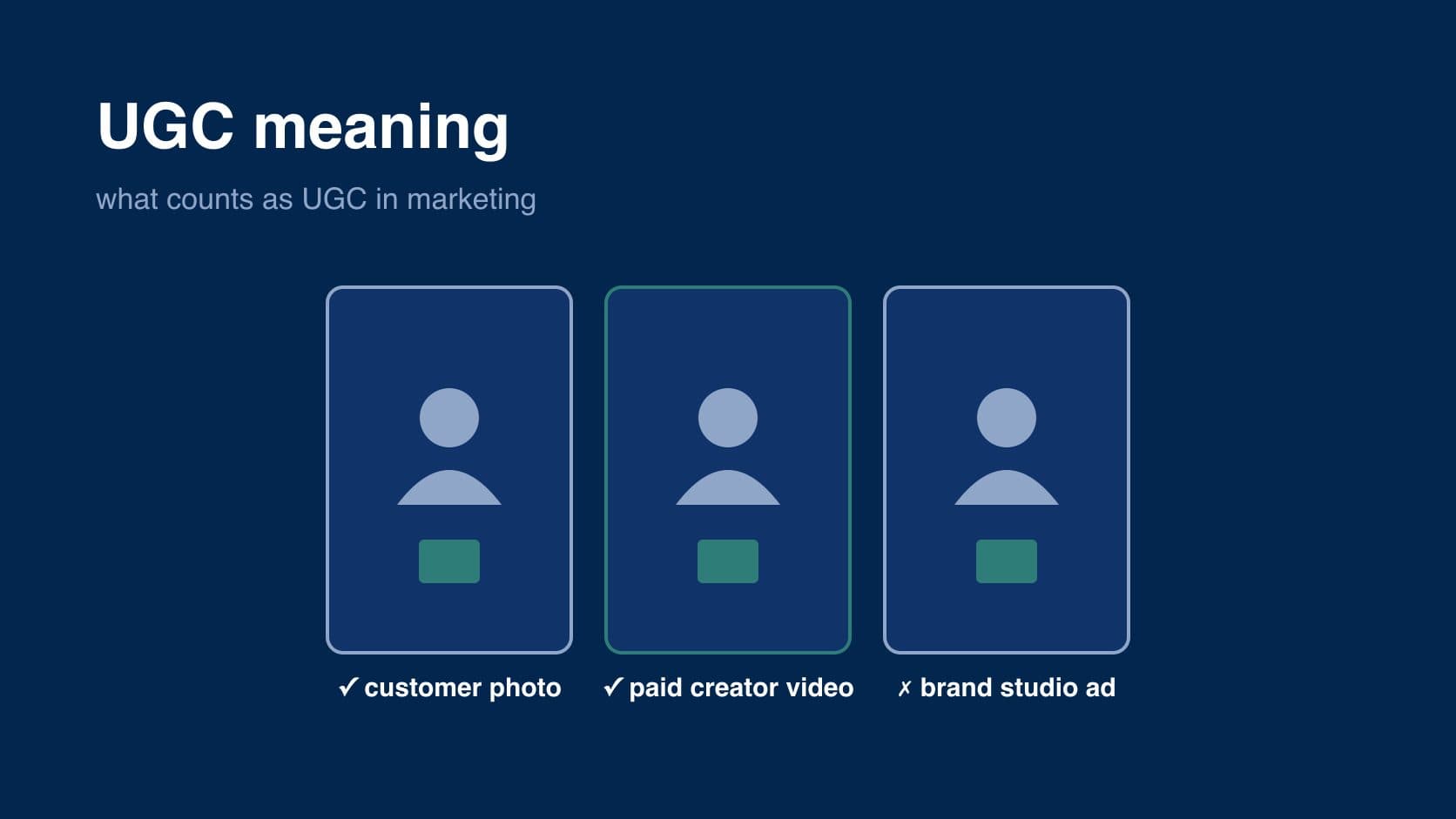
UGC meaning, in marketing: content about a brand or product made by someone outside the brand, usually a customer or a creator, instead of the brand's own team or agency. UGC is short for user-generated content, and in practice it means the phone-shot photos, videos and reviews that look like a real person talking, not a company selling.
the definition is easy. the hard part is the edges: which content counts, which doesn't, and why a video someone was paid to make still gets called UGC. this page draws those lines with examples first, then walks through everything the meaning implies in practice: the types, why it works, what it costs, who makes it and the rules. for the map of the whole topic, start with the UGC guide.
UGC meaning in one line
made by people outside the brand, about the brand. that is the test. who made it matters more than what it looks like, where it is posted or whether it is any good. a shaky phone video made by the brand's social team is brand content. a polished review made by a customer is UGC.
what counts as UGC
- a customer's tagged photo. someone buys a jacket, posts a mirror selfie and tags the brand. the textbook case.
- an unprompted TikTok review. a customer films themselves trying the product and says what they think, good or bad.
- a written review with photos. reviews on a product page or a review site were called user-generated content long before social media.
- a forum answer or comment. someone recommending your product in a Reddit thread is UGC in the original sense of the word.
- a paid creator's phone video. a creator is hired to film a review in the style of a customer. this is paid UGC: still UGC by name, because the creator is outside the brand, but it was briefed and paid for.
what doesn't count
- a brand's studio ad. shot by the brand's own team or agency, so it is brand content, however casual it is made to look.
- the brand's own staff posting as customers. not UGC, and in the UK and US it can break advertising rules if it is presented as an independent opinion.
- a product photo from the manufacturer. a retailer reusing supplier imagery is still brand content.
- a celebrity campaign. a famous face on a billboard is endorsement advertising, not user-generated content.
the grey area is the paid creator. the content is made outside the brand, so the industry calls it UGC, but the brand chose the script and the angle. that is why "UGC" now covers two quite different things.
the two meanings marketers use
organic UGC
made by real customers, unprompted and unpaid. the most believable kind, and the one you can't order. brands get more of it by making it easy to post and by asking, then they need written permission before reusing it.
paid UGC
made by creators for a fee, in the style of a customer. the brand owns or licenses it and usually runs it as ads. when a marketer says "we need more UGC" today, this is nearly always what they mean. practitioners are frank about it:
"Everyone talks about “authenticity,” but most of the UGC we are using is scripted, paid-for, and anything but real."
paid UGC is a production style rather than a deception, as long as it is labelled as an ad. the labelling rules are further down this page.
AI UGC, a third meaning
the newest use of the word: video in the same phone-shot style with a generated presenter instead of a person. by the strict definition it is not user-generated at all, since no user made it, but the industry calls it UGC because of how it looks. more on it below.
the types of UGC, by meaning
once you know the meaning, the types follow from what the content is trying to show. the common ones:
- unboxing. the moment of opening the parcel. it means "here is what actually turns up".
- review. a person giving their verdict to camera. it means "someone like you tried it".
- demonstration or tutorial. the product being used, step by step. it means "here is how it works".
- problem and solution. open on the annoyance, then the fix. it means "this solves something you have".
- before and after. the change the product makes. it means "this is the result".
- aesthetic or lifestyle shots. the product sitting naturally in someone's life. it means "this fits in a normal home".
each format is broken down second by second in UGC examples, and the photo and written formats are in what is UGC content.
why UGC works
the meaning is also the reason it works: it is made by someone outside the brand, so it reads as evidence rather than a claim.
- it blends into the feed. a phone video looks like what people chose to watch, so it is scrolled past less often than an obvious advert.
- it shows the real thing. size, colour in normal light, how it feels to use. the details a studio shot smooths over.
- it is social proof. seeing someone like you use a product lowers the risk of buying it.
- it is cheap enough to test. a brand can try several hooks and angles instead of betting a whole shoot on one.
it stops working when the outside voice is obviously fake: a script that no customer would say, or a creator who clearly never used the product.
how brands use UGC
the meaning stays the same wherever it runs, but the job changes:
- paid social ads. the biggest use by spend: TikTok, Instagram, Facebook and YouTube Shorts.
- organic social. reposting customer content on the brand's own accounts, with permission.
- product pages. customer photos and short clips next to the reviews.
- email and landing pages. a quote or a clip from a real customer beside the offer.
the channel-by-channel version is in UGC content.
what UGC costs
organic UGC costs effort rather than money: asking, collecting, getting permission. paid UGC is priced per video, and prices vary a lot. one buyer tested the market directly:
"same brief, same brand, same product, sent to 14 creators: 15s tiktok native quotes came back $180 to $650."
the base fee is only part of it. paid ad usage, long licence windows and running ads from the creator's own handle all add to the price. one practitioner's rule of thumb for open-ended rights:
"paid usage with no end date (perpetual) should cost a lot more, think 2.5x to 4x your base fee."
the full breakdown is in UGC creator and how to get UGC.
UGC vs influencer marketing
the meanings overlap but the deal is different. with influencer marketing, the brand pays for the person's audience: the post goes out on their account. with UGC, the brand pays for the content: it runs on the brand's account or as an ad, so the creator's follower count barely matters. one marketer, writing about what is replacing paid influencer posts, put it in a line:
"Not influencers, just people who make good content for a flat fee."
the side-by-side is in UGC creator meaning.
UGC creators
a UGC creator is the person behind paid UGC: someone who makes customer-style photos and videos for brands, for a fee. they deliver files, not posts. many have small accounts or none to speak of, because their portfolio matters more than their audience. if you are hiring one, what is a UGC creator covers how to find, vet and brief them. if you want to become one, see UGC content creator.
UGC ads
a UGC ad is UGC put behind ad spend. the meaning is unchanged; what matters is the first two seconds, because that is where people decide to keep watching. brands usually test several opening hooks on the same video, and sometimes run the ad from the creator's own handle through TikTok Spark Ads or Meta partnership ads. the playbook is in UGC ads.
AI UGC
AI UGC keeps the look and drops the shoot: a generated presenter, a product image, a script. it makes trying an idea cheap. one store owner who switched to it for testing summed up what it changed:
"Ai didn't make my ads better, it made being wrong cheap, that's the whole thing tbh."
it is good for testing angles and bad at the thing that gives UGC its meaning, a real person's real experience. AI UGC covers both sides.
rights and disclosure
the meaning has two legal consequences. first, organic UGC belongs to the customer who made it: a tag is not permission, so ask in writing and say where it will run. second, paid or gifted UGC is advertising. in the UK, the ASA and CMA guide recommends a clear label such as "#Ad" or "Advert", upfront, and advises against vaguer words like "gifted" or "collab". in the US, the FTC asks for the connection to be disclosed in the video itself, not only in the caption. details, checked November 2026, are in what is UGC.
frequently asked questions
what is the UGC meaning in social media?
on social media, UGC means posts about a brand made by people outside it: customers tagging a product, reviewing it or showing it in use. brands repost the best of it, with permission, and pay creators to make more in the same style.
what is the UGC content meaning?
"UGC content" means the actual material: the videos, photos and reviews. it repeats the word content, but it is how most people say it. the formats are listed in what is UGC content.
what is the UGC video meaning?
a UGC video is a short vertical clip, usually filmed on a phone, of one person talking to camera about a product: an unboxing, a review or a quick demo. it is the most common kind of UGC in advertising.
what is the UGC meaning on TikTok?
on TikTok, UGC usually means creator-style product videos, both posted by customers and made by paid creators for brands to run as ads. TikTok Shop and Spark Ads have made it the platform's default ad style.
what is the UGC meaning on Instagram?
the same idea: Reels and posts about a product made by customers or creators rather than the brand. brands often reshare them to Stories or run them as partnership ads.
does UGC mean the content is unpaid?
not any more. originally it did. today most UGC used in marketing is paid creator content, and that is fine as long as it is labelled as an ad.
is a review UGC?
yes. a written customer review is one of the oldest kinds of user-generated content, and review sites used the term before social media existed.
what is the opposite of UGC?
brand-generated content, sometimes called branded or professional content: anything made by the brand's own team or its agency, from studio ads to product photography.
what does UGC mean in a job advert?
a brand wants someone to make customer-style videos or photos it can use itself. the deliverable is the files, not a post on your account.
where to go next
- what does UGC stand for: the acronym, and the other things UGC can mean.
- what is UGC content: the formats it comes in.
- UGC examples: the ad formats that keep working, and how each is built.
the summary
- UGC meaning: content about a brand made by people outside it.
- counts: customer photos, unprompted reviews, written reviews, forum recommendations, paid creator videos.
- doesn't count: the brand's own ads, staff posing as customers, supplier imagery, celebrity campaigns.
- three kinds now: organic (unpaid customers), paid (creators for a fee) and AI (a generated presenter). most marketers mean paid.
- paid means ad. label it, and get permission before reusing anyone's organic content.
if you want UGC-style creative without a shoot, Clear Cortex's Marketing Studio has UGC, review and unboxing presets: add a product image and a presenter image and it makes a UGC-style image or clip. the labelling rules apply the same way. see AI UGC in Clear Cortex.