 Clear Cortex
What is UGC? A plain-English explainer, with the types of UGC
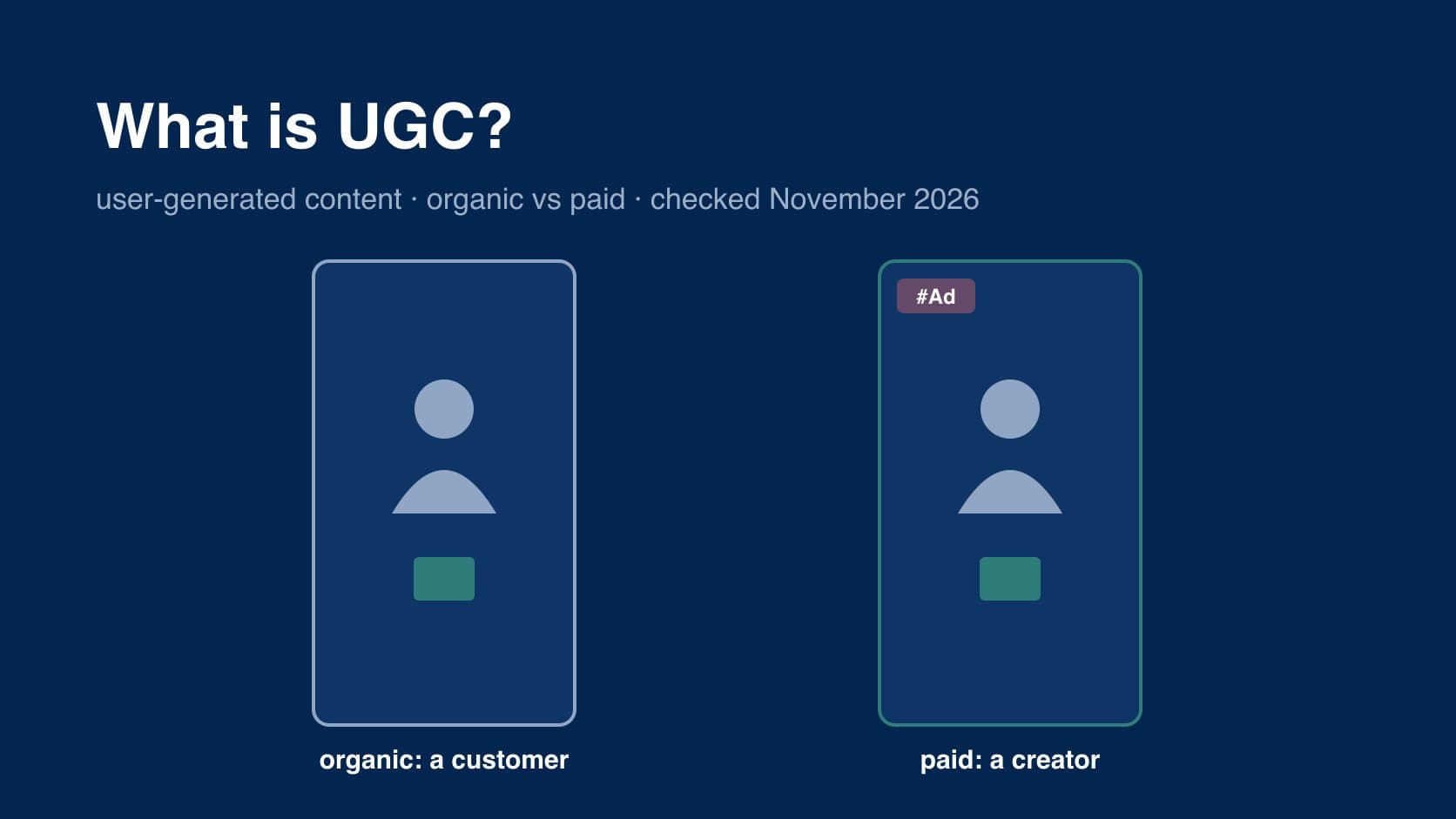
UGC stands for user-generated content: photos, videos, reviews and posts about a product made by the people who use it, not by the brand that sells it. in marketing today the term covers two quite different things, real customer content and paid creator content made to look like it, and most confusion about UGC comes from mixing the two up.
this guide covers what UGC means, why brands want it, where it shows up, and the permission and disclosure basics you need before using any of it. the guides linked at the bottom go deeper on each part.
the short answer
- what does UGC stand for? user-generated content.
- what does UGC mean? content about a brand or product made by someone outside the brand, usually a customer or a creator, rather than by the brand's own team or agency.
- what is UGC content in marketing? mostly short, phone-shot video and photos that a brand reposts, puts on its product pages or runs as ads, because it looks like a person talking rather than a company selling.
- what does a UGC video mean? usually a vertical clip of one person, filmed on a phone and talking straight to camera about a product: an unboxing, a review or a quick demo.
what UGC means in marketing today
the phrase was first used for anything a platform's users posted: forum threads, blog comments, product reviews, holiday photos. on social media it narrowed to content about brands, and in the last few years it narrowed again. when a marketer says "we need UGC" now, they nearly always mean one of these:
organic UGC
a customer bought the product and posted about it of their own accord: a tagged photo, an unprompted TikTok, a review with pictures. nobody paid for it and the brand did not direct it. this is UGC in its original sense, and it is the most believable kind because it is exactly what it looks like.
paid UGC
a brand pays a creator to make content in the style of a customer. the creator may never have heard of the product before the brief arrived. the brand chooses the script, the angle and the hook, and usually owns or licenses the result to run as ads. this is what "UGC creators", "UGC ads" and most UGC agencies sell, and it is what most marketers mean by the word now.
practitioners are open about the gap. from a thread asked by someone running marketing for Shopify stores:
"Everyone talks about “authenticity,” but most of the UGC we are using is scripted, paid-for, and anything but real."
that is not a scandal. paid UGC is a production style, the same way "documentary style" is a production style, and audiences understand ads. the trouble starts when paid content is passed off as an independent customer's opinion. that is where the disclosure rules below come in.
AI UGC
the newest version: video in the same style, with a generated presenter instead of a person. it removes the shoot entirely, which makes testing cheap, and it brings its own set of problems. it has its own guide: AI UGC: what it's actually for.
UGC examples
a few everyday examples make the definition concrete. all of these are UGC:
- a customer's photo of a new sofa in their living room, tagged to the shop that sold it.
- a 30-second TikTok of someone trying a skincare product for the first time and reacting.
- a written review with three photos on a product page.
- a creator, paid by a coffee brand, filming their morning routine with the brand's grinder, which the brand then runs as an ad.
and these are not, even though they can look similar: a brand's own studio shoot, a TV advert with actors, or a post the brand's social team made in-house. the test is who made it, not how it looks. more on the edge cases in UGC meaning, and every ad format broken down in UGC examples.
the types of UGC
most UGC falls into five types. a brand usually wants a mix, because each one does a different job:
- aesthetic or product-focused. the product looking good in a real setting: on a shelf, in a bag, on a desk. no talking needed. it works as a scroll-stopper and on product pages.
- unboxing. hands opening the package and lifting the product out. it shows the packaging, the size and the first reaction, which is what a buyer can't see online.
- voiceover. footage of the product in use with someone talking over it, face never shown. the easiest type to make and to re-cut with a new script.
- review or demonstration. a person to camera, using the product and saying what they think. the closest thing to a recommendation from a friend.
- problem and solution. open on the annoyance, then show the product fixing it. the type most often used as a paid ad, because the problem is the hook.
each one is broken down second by second in UGC examples, and what is UGC content? covers the photo and written formats too.
influencers vs UGC creators
the two get mixed up because they both post videos about products. the difference is what the brand is paying for.
- an influencer is paid for their audience. the content goes out on their account, to their followers, and the follower count sets the price.
- a UGC creator is paid for the content itself. the brand runs it from its own account or as an ad, so the creator's following barely matters. many have very small accounts.
some people do both, and a brand can pay a creator extra to run ads from the creator's own handle. the rest is in UGC creator meaning and what is a UGC creator?.
why brands use UGC
it looks like the feed. people scroll past things that look like adverts. a person holding a product in their kitchen looks like everything else in the feed, so it gets a second or two more attention than a studio shot. most of the value of the format comes from that.
it answers the questions a product page can't. someone else using the product shows its real size, how it looks in normal light and whether it holds up. one ecommerce operator put it like this:
"A polished product page can explain the offer, but a real photo, review, or customer video can answer the quieter questions: does it look like that in normal lighting, is the size accurate, does it hold up, would someone like me be happy with it?"
it is cheap enough to make lots of. a phone video from a creator costs a fraction of a studio shoot, so a brand can test several hooks and angles instead of betting on one. paid social now rewards that kind of volume, which is a big part of why UGC moved from community marketing into the ad budget.
social proof. seeing a person who looks like you use something lowers the risk of buying it. this is the oldest reason and still the strongest.
the same operator adds the catch, and it matters for paid UGC in particular:
"Once it feels like an actor reading a script, it is basically another ad with worse lighting."
where UGC shows up
- paid social ads. TikTok, Instagram and Facebook Reels, YouTube Shorts. the biggest use by spend. see UGC ads for how brands run it.
- a brand's own social accounts. reposted customer content, with permission.
- product pages. customer photos and short videos in the gallery or next to the reviews.
- reviews. a written review is UGC too, and review sites were where the term was used before social media.
- email and landing pages. a quote or a clip from a customer next to the offer.
the formats repeat across all of these: unboxings, reviews, problem-and-solution clips, before-and-after, tutorials. they are laid out one by one, with what makes each work, in UGC examples.
what a UGC creator is
a UGC creator is the person behind paid UGC: someone a brand hires to film customer-style content. they usually deliver short vertical videos, usually 15–60 seconds, plus photos or raw clips, and they are paid per piece rather than per follower. many are not influencers at all and post little of their own. if you are hiring one, start with UGC creator, which covers deliverables, pricing and red flags.
what UGC costs
organic UGC is the cheapest content a brand can get, but you can't order it. paid UGC is where the money goes, and the price of a single video swings widely with the creator, the length and the rights. buyers on marketing forums report anywhere from $60–120 a video on a freelance marketplace to $150–400 going direct. agencies and platforms charge more in exchange for doing the sourcing and admin, and the extras (paid usage, whitelisting, exclusivity) can matter more than the base fee. how to get UGC compares every route on cost, speed and control.
rights and permission: the basics
this is the part people skip, and it causes the most trouble later. not legal advice, but the basics are simple.
a customer posting it is not permission
a customer who tags you still owns their photo or video. reposting it, putting it on your site or running it as an ad needs their permission. the usual practice is to ask in writing, in a comment or a DM, say where you will use it, and keep the reply. putting it behind ad spend is a bigger ask than a repost, so say so if that is the plan.
paid content needs usage terms
with a paid creator, the contract should say where the content can run (organic only, or paid ads), for how long, and whether it can run from the creator's own account. those choices change the price, and the window is the term most often left out. one person asking other founders how they handle it:
"Been talking to a bunch of indie brand founders lately and everyone seems to be handling this the same way contracts in Gmail, assets scattered across Dropbox, no idea when usage rights expire."
the licensing side is covered in more detail in UGC ads.
paid content has to be labelled
if a creator was paid, or given the product for free, the content is advertising and has to say so. checked November 2026:
- UK. the ASA and CMA's influencers' guide (October 2026 edition) says payment includes money, free products and any commercial relationship, even an unsolicited gift with no obligation to post. it recommends a clear, upfront label such as "#Ad" or "Advert", and advises against "gifted", "collab", "sponsored" and "in partnership with". the creator, the brand and any agency are all responsible for the label.
- US. the FTC's Disclosures 101 for influencers says to disclose any material connection, including free or discounted products, and to put it in the video itself, not only in the description. "ad" and "sponsored" are acceptable; "sp", "spon" and "collab" are not.
the ASA guide also says a review has to reflect the reviewer's genuine experience. a creator who never used the product should not say they did. that matters for paid UGC, where the script is usually written before the creator has opened the box.
how brands get UGC
there are five routes: your own customers, creators hired directly, a UGC platform, a UGC agency, and AI. they differ a lot on cost, speed, control and how authentic the result is. how to get UGC compares them honestly. if you go the creator route, what is a UGC creator covers what they do, how they differ from influencers and how to brief one.
the UGC guides
- the UGC guide: the map of the whole topic, with every page in one place.
- UGC examples: the formats that keep working, and why.
- UGC ads: hooks, scripts, testing, Spark Ads and partnership ads, and usage rights.
- what is a UGC creator: for brands hiring one.
- how to get UGC: customers, creators, platforms, agencies and AI compared.
- AI UGC: what generated UGC is good and bad at.
frequently asked questions
what does UGC stand for?
UGC stands for user-generated content. in marketing it means content about a brand made by people outside the brand, usually customers or paid creators. the letters have other meanings too, such as India's University Grants Commission, covered in what does UGC stand for?.
what is a UGC video?
a UGC video is a short vertical clip, usually filmed on a phone, of one person showing or talking about a product: an unboxing, a review, a quick demo or a problem-and-solution. it is made to look like something a real customer would post rather than a polished advert.
is UGC paid?
it can be either. organic UGC is posted by customers for nothing. paid UGC is made by creators for a fee, and it is the kind most brands run as ads. paid or gifted UGC has to be labelled as advertising.
who owns UGC?
the person who made it. a customer keeps the rights to their own photo or video even after tagging a brand, so the brand needs written permission to reuse it. with paid creators, the contract sets what the brand can do with the content, where, and for how long.
how long is a UGC video?
most are 15–60 seconds. short versions suit ads and the first scroll; longer cuts suit product pages and demos. what matters more than length is the first two seconds, because that decides whether anyone watches the rest.
what is UGC on TikTok and Instagram?
on TikTok and Instagram, UGC usually means product videos in the platform's native style: vertical, talking to camera, captions on. brands repost customers' videos, run creators' videos as ads, or run ads from the creator's own handle through TikTok Spark Ads or Meta partnership ads.
what is the UGC definition?
a simple definition: UGC is any content about a product or brand that was created by someone other than the brand itself. that includes reviews, photos, videos and social posts, whether the person was paid or not.
can a brand make its own UGC?
strictly, no: content the brand makes itself is brand content, even if it is filmed in the UGC style. what brands can do is hire creators, or use AI tools to produce the style, and label the result honestly as an ad.
the summary
- UGC stands for user-generated content. content about a product made by people outside the brand.
- there are two kinds now. organic content from real customers, and paid creator content made in the same style. most marketers mean the second.
- brands use it because it looks like the feed, answers buyers' practical questions and is cheap enough to test in volume.
- a tag is not permission. ask in writing before you repost or run a customer's content.
- paid or gifted content is an ad. label it clearly and upfront, in the content itself.
if you make UGC-style ads in Clear Cortex, the Marketing Studio presets for UGC, review and unboxing videos take a product image and a presenter image. the same studios also work with footage you already have. the labelling rules above apply either way. see AI UGC in Clear Cortex.