 Clear Cortex
AI dropshipping: where AI actually helps a store, and where it doesn't
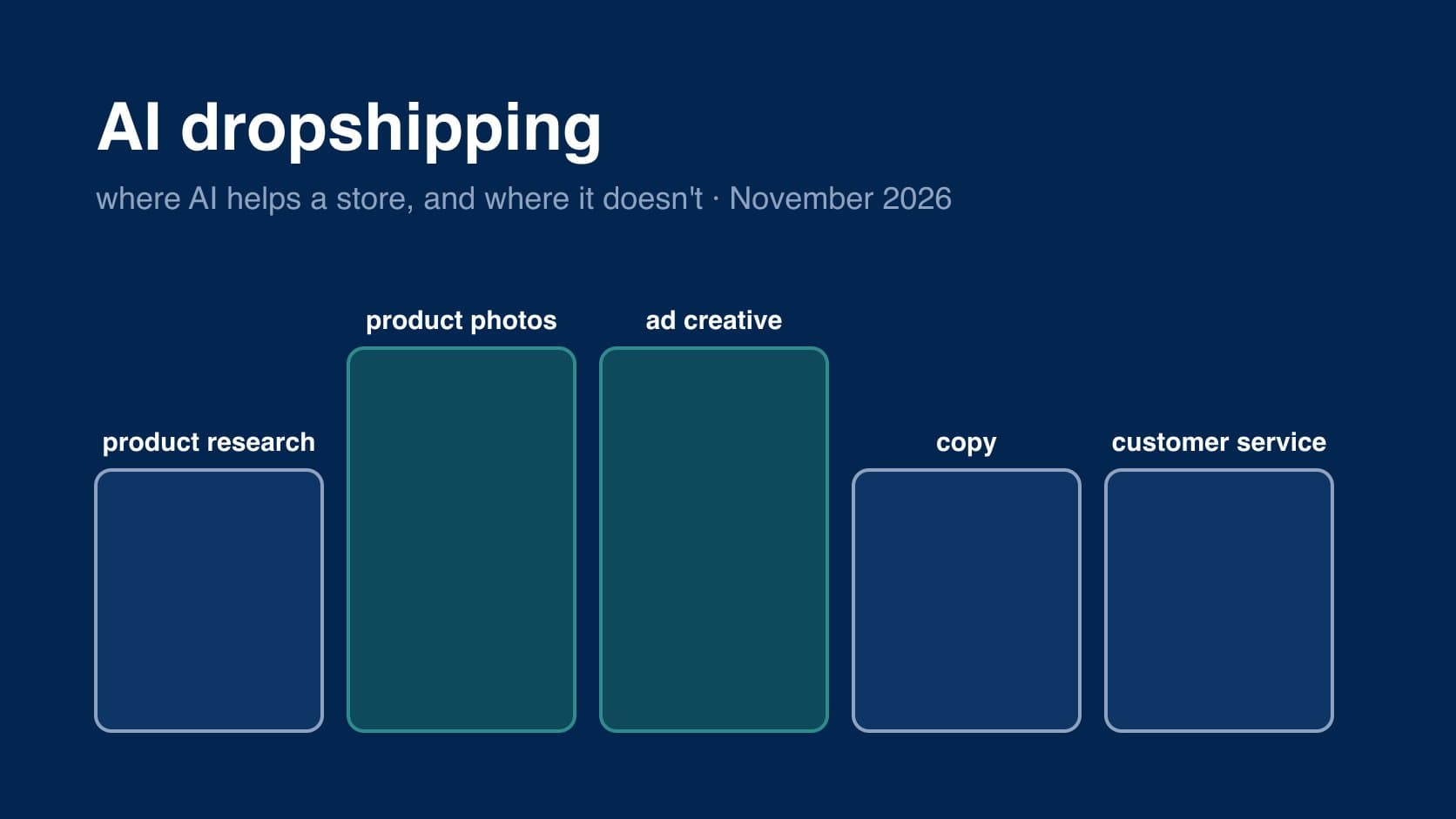
"AI dropshipping" gets sold as a store that runs itself. it isn't one. what AI actually does is make some of the jobs in a dropshipping store faster and cheaper — a few of them a lot faster — while leaving the decisions that make or lose money exactly where they were.
this is a map of those jobs: product research, product photos, ad creative, copy and customer service. for each one, what AI is good for and where it stops. most of the depth goes on ad creative and product imagery, because that is where a dropshipper spends most of their time and most of their money, and where AI has changed the most.
the short answer
- ad creative: the biggest change. AI makes it cheap to produce many UGC-style video variations of one product, so you can test hooks and angles before spending on a real shoot.
- product photos: useful for clean shots, lifestyle scenes and listing images from a supplier photo. the limit is accuracy — the image has to show the thing that arrives.
- copy: good for first drafts of product pages, ad text and email. every claim still needs checking.
- customer service: good for drafting replies and handling "where is my order". bad at refunds, angry customers and anything it can't look up.
- product research: helpful for sorting and summarising. it cannot tell you what will sell, because nobody can.
and the rules don't change because a model made the ad. misleading claims, fake testimonials and undisclosed AI content all get ads rejected, and some of them break the law. that part is near the end.
product research
what AI is good for here: reading. it can summarise a pile of reviews of a competing product into the three complaints people keep making, cluster comments by theme, draft a list of angles a product could be sold on, and turn a supplier's broken-English description into something you can read. that's real time saved.
what it can't do is find a winning product. a model has no view of what is about to sell, and anything a research tool surfaces is, by definition, visible to everyone else using it. one seller put the result plainly:
"I initially started with traditional dropshipping, but I quickly realized the available winning products were completely saturated, outdated, and overdone."
the honest use of AI in research is to shorten the reading, not to replace the judgement. the real test of a product is still an ad in front of real people, which is why the creative section below is the long one.
product photos and listing images
a dropshipper usually starts with the supplier's photos: the same white-background shots every other store selling that product is using. AI image tools can take one of those and produce a clean studio shot, a lifestyle scene, a flat lay, a close-up of a detail, or the product in someone's hand. for a store that never holds stock, that is the difference between a listing that looks like everyone else's and one that looks like a brand.
what it does well
- backgrounds and settings. putting a product on a kitchen counter, a desk or a bathroom shelf, so the shopper can see it in use.
- consistency. one look across a whole collection, instead of a mix of supplier styles.
- ad stills. square and 4:5 images for feed placements, made from the same source photo as the listing.
where it goes wrong
the image has to show what the customer will receive. AI is very good at making a product look better than it is: a nicer texture, a cleaner finish, a size that is hard to judge, a logo or label that has quietly changed. someone who tested this on their own product put the problem in one line:
"Making a beautiful scene is easier than making an accurate product photo."
so check every image against the real product, or at least against the supplier's photo, at full size. look at text on the packaging, the number of parts, the colour and anything that shows scale. an image that shows something the product isn't is a misleading ad in the eyes of a regulator, however it was made — more on that below.
ad creative: where AI changes the most
for most dropshipping stores, the ad is the business. the product is usually available to anyone; the store is a template; the thing that decides whether it sells is whether the video stops someone scrolling and makes them want it. that is the part AI has made dramatically cheaper.
why dropshippers test so many ads
nobody can tell in advance which ad will work. the hook, the angle, the person on screen and the first second all change the result, often by more than the product does. so the standard approach is to put several ads live against one product, let the platform spend a small budget across them, and keep what sells. it's the question new store owners ask first:
"How many creatives would you test before deciding on a winner?"
and once something works, it stops working. an audience sees the same ad too often and the results fall, so winners need replacing on a rolling basis. a practitioner describing the volume this takes:
"you're not making one ad, you're making 40+ variants a quarter to fight creative fatigue."
the cost of that volume used to be the shoot. a real creator video means briefing someone, shipping them the product, waiting and reviewing — before you know whether the product is worth selling at all. one dropshipper explained why that breaks the early stage:
"The problem is that real UGC costs money and takes time. By the time you brief a creator, wait for the content, review it, and get something usable, you've burned a week and a few hundred dollars on a product you haven't validated yet."
that is the gap AI fills. from one product photo you can make a set of variations — different hooks, different presenters, unboxing versus review versus a straight product shot — in an afternoon, and test them before paying for anything bigger.
why UGC-style video works
UGC-style means video that looks like a customer or creator filmed it on a phone: someone talking to camera, holding the product, opening the box. on TikTok and Reels it fits in with everything around it, and a face talking in the first second tends to get a moment of attention a polished product shot doesn't. new store owners are asking the same question about it:
"Are people seeing better results with UGC content, more polished product creatives, static images, something else entirely?"
the honest answer is that it depends on the product, and that is what testing is for. but UGC-style is the format most dropshippers start with, because it's cheap to vary and it shows the product being used. what UGC is and where it came from is covered in what is UGC; hooks, scripts and testing are in UGC ads.
what AI UGC is bad at
generated presenters have got good at faces and movement. they are still weaker on voice, on hands handling a product, and on anything that needs the product to physically do something convincing. and audiences have started to recognise the look:
"Now I think the bigger challenge is creating content that people don't immediately recognize as another AI generated ad."
so treat AI video as the testing layer, not the whole plan. use it to find the hook and the angle that work, then decide whether the winner is worth a real creator, a better edit or simply more variations of the same idea. our longer take on what generated UGC is good and bad at is in AI UGC.
how to test without fooling yourself
- change one thing at a time. same product, same offer, different hook. otherwise a win tells you nothing you can repeat.
- give it time. results swing day to day for reasons that have nothing to do with the ad.
- don't flood the budget. too many ads on a small daily spend means none of them gets enough impressions to judge.
a seller who got this wrong after a good run:
"I panicked. Changed the creatives. Adjusted the targeting. Touched the budget. Made everything worse."
and the version that isolates the variable properly, from a different store:
"Recently, I’ve started using the same product image while changing the messaging so I can isolate what is actually working."
platform specs in one place
the creative only works if it fits the placement. the short version, as checked November 2026:
- TikTok, Reels, Stories and Shorts: 9:16 vertical, 1080×1920. the app's buttons and caption cover the edges, so keep text and the product inside the safe area. the pixel margins for all three are in TikTok safe zones.
- Facebook and Instagram feed: 4:5. Meta recommends 1440×1800; 1080×1350 is the same shape.
- Marketplace and square placements: 1:1, at least 1080×1080.
if you only export two versions of each ad, make them 9:16 and 4:5. the full placement table is in Meta ad specs, and the step-by-step for making the video itself is in how to make an AI video.
copy: product pages, ad text and email
AI writes a passable first draft of a product description, a set of ad headlines or an abandoned-cart email in seconds, and it's good at producing variations to test. it is also very willing to invent: a battery life, a material, a "clinically proven", a number of happy customers. none of that is acceptable unless you can back it up.
the rule is simple: AI drafts, you check every factual claim against the supplier's spec sheet and remove anything you can't prove. the UK's advertising code requires a marketer to hold documentary evidence for objective claims before the ad runs. "the AI wrote it" is not evidence.
customer service
a chatbot or AI-drafted replies can take most of the routine load: order status, returns policy, sizing questions, tracking links. for a small store that is hours a week back.
the limits are the cases that cost money. refunds, damaged items, chargebacks and angry customers need a person, and a bot that confidently gives a wrong delivery date makes things worse. dropshipping adds a specific risk here, because delivery depends on a supplier you don't control. in the US, the FTC's Mail Order Rule says that if you don't state a shipping time you must have a reasonable basis to ship within 30 days, tell the customer about a delay and offer them the choice to cancel, and refund promptly if you can't ship. an AI reply that promises "3–5 days" when the supplier takes three weeks is the kind of thing that rule is about. give the bot your real shipping times, and have it hand over to you when it doesn't know.
the risks: ad policies, claims, rights and disclosure
AI makes it easy to produce an ad that breaks the rules without meaning to. these are the ones dropshippers hit most often. all checked against the official sources in November 2026. this is a summary, not legal advice.
platform ad policies
TikTok's misleading and false content policy (last updated April 2026) prohibits ads that "promise or exaggerate results concerning a product's effect", before-and-after comparisons of a product's effect, and promises of instant results. it also says that if TikTok identifies AI-generated content that has not been disclosed, the ad will be rejected or restricted. TikTok Ads Manager has an AI-generated content disclaimer for ads containing images, video or audio that are fully AI-generated or significantly modified by AI.
Meta's advertising standards prohibit ads that promote products or offers using deceptive or misleading practices, including exaggerated claims about a product. Meta adds an "AI info" label to ads made or materially edited with its own generative AI tools, and moves it next to "Sponsored" when the image contains an AI-generated photorealistic person. Meta reviews ads before and after they go live and can restrict accounts that keep breaking the rules, which for a store that lives on one ad account is the real risk.
misleading claims
in the UK, the ASA's position is that the advertising code is media-neutral: the rules apply however the content was made, and the advertiser is responsible for any AI output they use. CAP's guidance on AI in ads specifically warns about images showing a product's effect that don't reflect real results — and says that adding an AI disclosure does not fix a misleading ad. if the product in the video does something the real product doesn't, the label won't save it.
fake reviews and testimonials
this is the one that matters most for AI UGC, because the "review" format is a person saying they used the product. in the US, the FTC's Consumer Reviews and Testimonials rule (in force since 21 October 2024) prohibits fake reviews and testimonials that misrepresent someone's experience of a product, and allows civil penalties for knowing violations. the FTC's own Q&A says the rule has no blanket ban on AI-generated avatars in marketing, but an avatar giving a testimonial is prohibited if the testimonial itself is fake. in the UK, fake consumer reviews became a banned practice under the DMCC Act from 6 April 2025, and the advertising code requires evidence that any testimonial is genuine.
in practice: an AI presenter demonstrating the product or explaining its features is a format. an AI presenter saying "I've used this for a month and it changed my skin" is a testimonial from someone who doesn't exist, and that is the line not to cross.
product rights and likeness
supplier photos belong to whoever took them, and a listing on a marketplace is not a licence to use them in your ads. many suppliers are happy to grant it; ask, and keep the answer. don't sell or advertise branded goods you aren't authorised to sell, and don't put a real person's face or a celebrity likeness into an AI ad without their permission — the ASA has warned that a convincing AI "endorsement" from a real person is likely to breach the code.
disclosure
two different labels get confused. the first is the AI label: TikTok requires it for realistic AI content in ads, and Meta applies its own in the cases above. the second is the ad label: if you pay a real creator, or run ads from their account, UK and US rules both expect the paid relationship to be clear. the detail on that is in the disclosure section of UGC ads. when in doubt, label.
make a UGC-style ad from a product photo
if you want to try the testing approach above, Clear Cortex's Marketing Studio turns a product photo, and optionally a presenter image, into a vertical UGC-style video. the review and unboxing presets give you different formats from the same photo, and product shot makes the clean studio version for listings and feed ads. results land in a project folder, in 9:16 for video and 1:1 or 4:5 for stills, so the variations for a test sit together. the rules in the section above still apply to whatever you make.
the summary
- AI doesn't run the store. it speeds up the jobs, not the decisions.
- ad creative is where it helps most. cheap variations make it possible to test hooks and angles before paying for a shoot.
- product images have to match the product. a better-looking image of something different is a misleading ad.
- AI drafts copy and replies; you check the facts. especially claims and delivery times.
- an AI presenter can show a product, not claim to have used it. fake testimonials are banned in the UK and the US.
- label AI content where the platform asks. undisclosed AI content gets TikTok ads rejected.
guides in this series
this page is the overview. the guides below go deeper on each part.
- what is UGC: what it means, why brands use it and where it shows up.
- UGC ads: hooks, scripts, testing, Spark Ads and usage rights.
- AI UGC: what generated UGC is good and bad at.
- how to make an AI video: from brief to export.
- TikTok safe zones: where the app covers your ad, in pixels.
- Meta ad specs: Facebook and Instagram sizes by placement.