 Clear Cortex
How to get UGC: customers, creators, platforms, agencies or AI
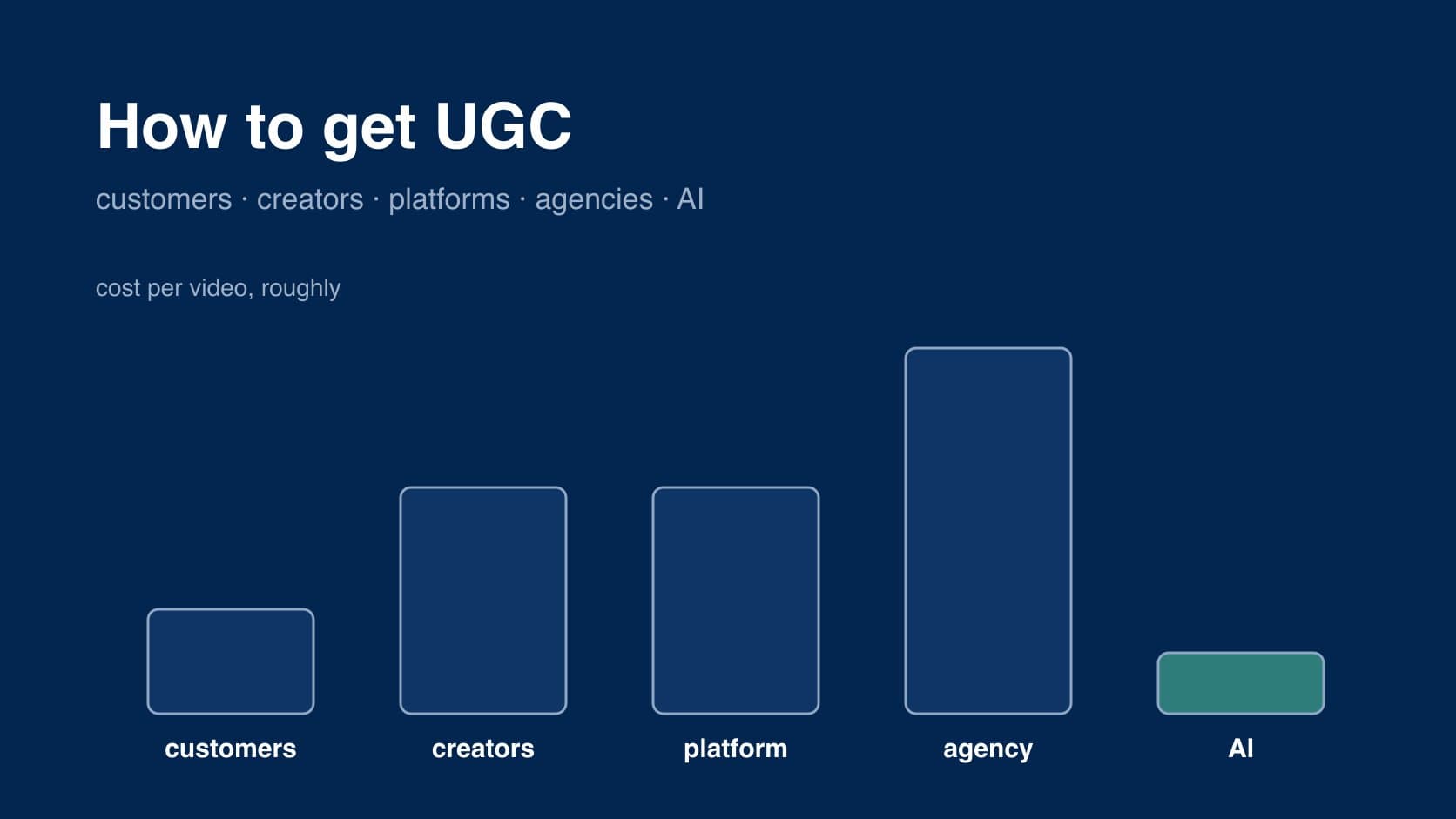
a brand can get UGC five ways: from its own customers, from creators it hires directly, through a UGC platform, through a UGC agency, or by generating it with AI. none is best. they trade cost, speed, control and authenticity against each other, and the right one depends on how many videos you need a month and what you will do with them.
if you are still pinning down what counts as UGC, start with what is UGC. this guide assumes you know you want it and are deciding where it comes from.
the five routes compared
| route | cost per video | speed | control | authenticity |
|---|---|---|---|---|
| customers | lowest (product, incentives) | slow, unpredictable | low | highest |
| creators, direct | low to medium | days to weeks | high, if you brief well | high in style; paid |
| UGC platform | low to medium | one to two weeks | medium to high | high in style; paid |
| UGC agency | highest | weeks, in batches | medium; they run it | high in style; paid |
| AI UGC | lowest per attempt | minutes | highest | lowest; no real person |
"authenticity" here means how close the content is to what it appears to be. a paid creator's video can look exactly like a customer's, but it is still a paid video, and it has to be labelled as one when it looks organic.
1. from your customers
the original kind: people who bought the product post about it, or send you photos and videos when asked.
how. ask for it. a post-purchase email asking for a photo or a short clip, a card in the box, a review form that takes images, a hashtag on the packaging, and a reply to everyone who tags you asking permission to use it. an incentive (a discount, an entry to a draw) raises the response rate, but it also makes the content incentivised, which has to be disclosed if you use it as an ad or a review.
good at. trust. it is genuinely what it looks like, and it is the best material for product pages and reviews.
bad at. volume, quality and hooks. customers don't film for the first two seconds, and you cannot brief them.
the question someone running marketing for Shopify stores asked is a fair one:
"When did we stop trying to get actual customer content? Is it just too hard now?"
it is harder than paying for it, not impossible. most brands should run this alongside whatever else they do, because it costs little and feeds the product page.
gifting sits between customers and creators: send product to people who ask, in return for content. new brands get a lot of these requests. one jewellery founder:
"Is it worth sending out free products to these people or is it just a waste of money/stock?"
it can work for cheap products. for expensive ones, a small paid fee with agreed deliverables is often cheaper than stock sent to people who never post. and in the UK a free product counts as payment, so anything posted has to be labelled as an ad.
2. from creators, directly
find UGC creators on TikTok and Instagram, brief them and pay them per video.
good at. price and control. no middleman, and you choose every face.
bad at. admin. every creator is a contract, an invoice and a file transfer. one founder who priced it out:
"12 videos lands at $2,160-$7,800 but you're managing 8 contracts, 8 payment schedules, chasing files in 8 dms."
direct works best when someone in-house owns it and you need a steady, moderate volume. what a UGC creator does, what they charge and how to brief one is in what is a UGC creator.
3. from a UGC platform
a marketplace where you post a brief, creators apply, and the platform handles payment and file delivery, often with set price bands per format.
good at. taking the admin out of the direct route, and more predictable prices.
bad at. quality control, which is still your job. one buyer's verdict after testing several:
"the 'marketplace' part is a UI. the quality is the vetting."
expect to spend real time rejecting applicants, and budget per usable video rather than per delivered one.
4. from a UGC agency
an agency sources the creators, writes the briefs, manages revisions and edits, usually on a monthly retainer for a set number of videos.
good at. taking the whole job off your hands, and often bringing a strategy layer: which angles to test, which hooks to write.
bad at. small volumes. the retainer pays for account management, strategy and editing whether you need ten videos or forty. one founder who took several agency calls:
"at 10 assets a month you are paying 4 salaries to coordinate 10 iphone videos."
the useful way to judge an agency is to work out what you are actually buying. the same founder who priced the direct route put it well:
"in 2026 you're paying for one of three things. talent sourcing, brief-to-delivery speed, or a strategy layer. pick the one you can't do in-house."
an agency makes most sense when you need high volume, have no one in-house to run creators, or want the testing strategy as much as the videos.
5. with AI
generate UGC-style video with an AI presenter instead of a person: a product image, a presenter, a script, and a vertical clip comes out.
good at. cost per attempt and speed. a new hook or angle takes minutes, which makes it a strong tool for finding out what to say before paying people to say it. one store owner who switched for testing:
"Ai didn't make my ads better, it made being wrong cheap, that's the whole thing tbh."
bad at. the human moment the format is built on, and lasting power. one advertiser who ran a real and an AI version of the same script found them close for two weeks, and then:
"Week three is where things fell apart for the AI version."
platforms also require realistic AI-generated media to be labelled, and an AI presenter cannot honestly claim to have used the product. the full picture, including what practitioners report, is in AI UGC.
AI is not automatically the cheap option at low volume either. the same store owner:
"if you're at less than about 15 creatives a month it's honestly not worth the subscription, just pay a creator."
which route to choose
- a few videos a month, someone in-house to manage them: creators directly, plus customer content for the product page.
- a steady stream, little time for admin: a UGC platform.
- high volume, no in-house team, want strategy too: a UGC agency.
- testing lots of angles and hooks fast: AI to find what works, then real creators to make the winners. this is the hybrid most practitioners describe.
- always: ask customers. it is the cheapest UGC there is and the most believable.
whichever route you pick, the rules on usage rights and disclosure are the same. they are covered in UGC ads.
the summary
- five routes: customers, creators directly, a platform, an agency, AI.
- customers are the most authentic and least controllable. ask anyway.
- direct gives the most control for the money, but every creator is admin.
- platforms remove admin, not vetting. agencies remove both, at a price that only works at volume.
- AI makes testing cheap, but not the human moment, and it needs labelling.
back to the overview: what is UGC. in Clear Cortex, the Marketing Studio's UGC, review and unboxing presets take a product image and a presenter image, and the studios work with footage you already have too, so the AI route and real creator footage can sit in the same project: UGC video in Clear Cortex.