 Clear Cortex
AI marketing agency: what they do, and what to ask
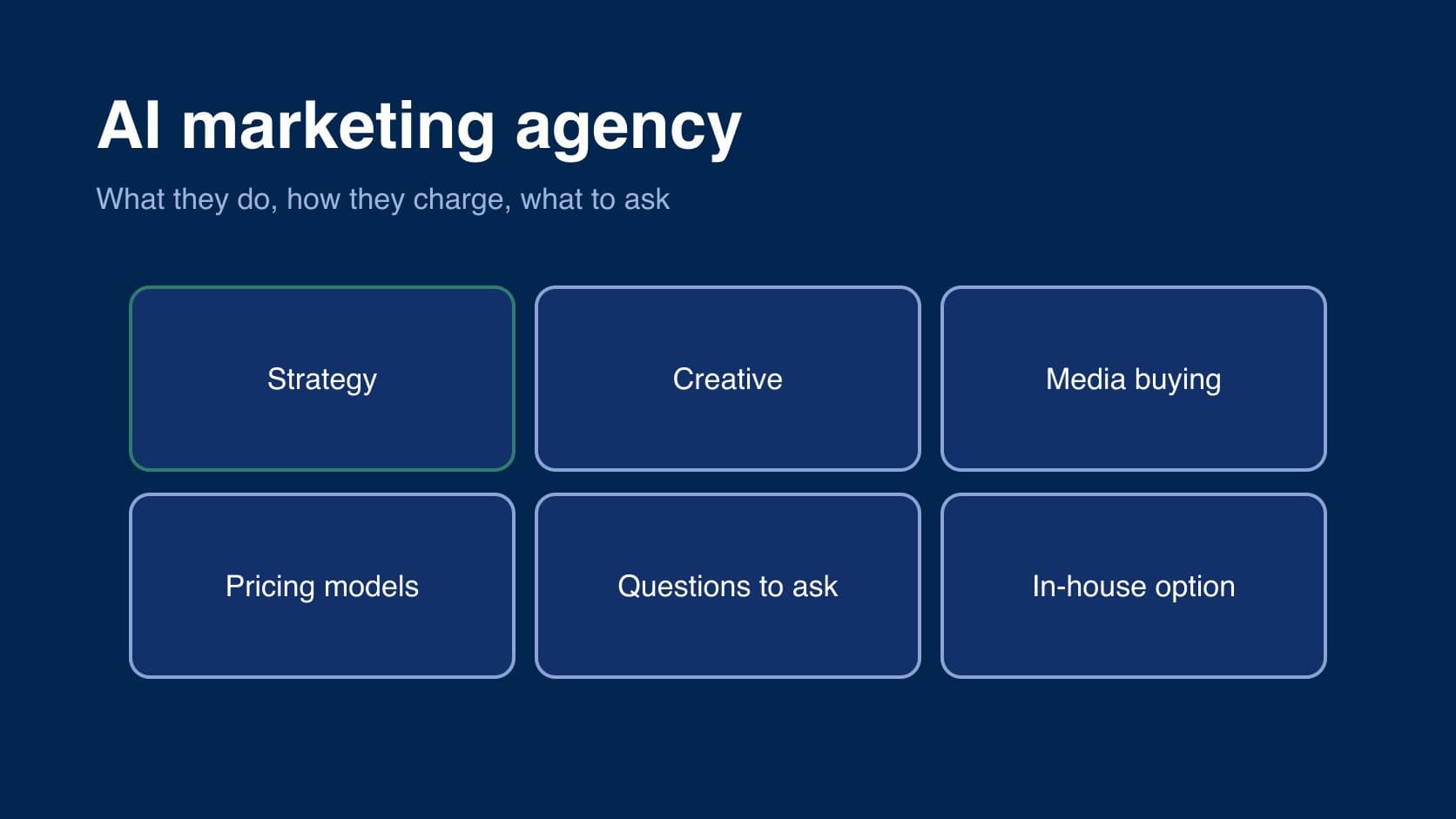
an AI marketing agency is a marketing agency that uses AI tools in the work it does for you: planning, writing, making ads, running campaigns and reporting on them. the label covers everything from a traditional agency that has added a few tools to a small team built around them from day one. what you are still buying is people — their judgement about your market, your customers and your ads.
this page is for a business deciding whether to hire one. it covers what these agencies actually do, where AI changes the work (mostly in making the ads), how they charge, what to ask before you sign, and the in-house alternative. the guides at the foot go deeper on each kind of agency.
the short answer
- what they do: the same jobs as any marketing agency — strategy, creative, media buying, content and reporting — with AI speeding some of them up.
- where AI helps most: creative production. images and video ads that once needed a shoot can now be made and varied from a product photo.
- where it doesn't: knowing your customer, choosing the offer, and deciding what to spend. those are still human calls.
- how they charge: a monthly retainer, a fee per project, a percentage of ad spend, or a mix.
- the alternative: keep strategy and buying in-house and use AI tools to make the creative yourself.
what an AI marketing agency does
strip away the label and the jobs are the ones every agency does. what changes is how long some of them take.
strategy and planning
who you are selling to, what you are saying to them, and which channels you are saying it on. AI can summarise reviews, competitor ads and comment threads into themes faster than a person can read them. it can't decide which of those themes your business should stand on. that part is the reason to hire anyone at all.
creative production
the ads themselves: product images, short videos, UGC-style clips, banners and copy. this is where AI has changed the most, and where an AI-first agency will usually claim its edge. more on it below.
media buying
setting up and running campaigns on Meta, TikTok, Google and the rest: budgets, audiences, bids and testing. the platforms' own automation now does much of the targeting, which is why so much of the work has shifted towards feeding them good creative.
content and social
organic posts, articles, email and community management. AI drafts quickly; someone still has to make it sound like you and check it is true.
reporting
what the money did. AI tools can pull the numbers together and write the summary. whether the numbers mean what the summary says is worth checking yourself.
how agencies use AI for creative production
creative is the bottleneck for most agencies, because every client needs a steady supply of new ads and every ad used to mean a shoot. one agency owner put it plainly:
"we're an agency working with niche businesses that are not in the same niche so naturally a big bottleneck is creatives, specifically videos."
AI image and video models have changed that part of the job more than any other. here is where they now sit in an agency's workflow.
product images
from one product photo, image models like Nano Banana Pro, GPT Image 2, Seedream and Flux can make a clean white-background shot, a lifestyle scene, a flat lay, a close-up of a detail or a banner. an agency can produce a full set of listing and feed images without booking a studio.
video ads
video models like Seedance, Kling and Hailuo turn a product image, and optionally a presenter image, into a short clip: a review, an unboxing, someone talking to camera with the product in hand. that is the format most paid social now runs on, and it used to be the slowest and dearest thing to make. the formats themselves are covered in UGC ads.
variations for testing
the real change is volume. nobody knows in advance which hook or angle will sell, so the useful thing is to put several genuinely different versions live and let the spend find the winner. cheap production makes that possible for a client who could never have paid for that many shoots. what makes a creative work in the first place is in ad creative, and how AI fits into it is in AI ad creative.
where AI stops
a model will happily make a product look better than it is, invent a claim, or produce something that looks like every other AI ad in the feed. the agency's job is to stop that: check every image against the real product, cut claims nobody can prove, and know when an idea deserves a real shoot instead. if an agency can't tell you how it checks AI output, that tells you something.
an AI agency, or an agency that uses AI?
by now almost every agency uses AI somewhere, so the label on its own tells you little. the useful question is which jobs it uses AI for and what that changes for you. faster turnaround, more variations per month, or a lower cost per asset are real differences. a new logo and the same process are not.
and some things AI can't make up for. one in-house marketer's view, from a thread on agencies versus hiring:
"I always say - business context is why we hire in house and don't rely on agencies."
an agency learns your business from the outside. that is not a reason never to hire one, but it is the gap any agency, AI or not, has to close.
how AI marketing agencies charge
the pricing models are the same as for any agency. which one you are offered tells you how the agency thinks about the work.
- monthly retainer. a fixed fee for an agreed scope — a set number of ads, posts or hours a month. predictable, but check exactly what the scope includes and what counts as extra.
- per project. a fee for a defined piece of work: a launch, a batch of ads, a website. good for testing an agency before committing.
- percentage of ad spend. common for media buying. it pays the agency more as you spend more, which is worth thinking about when they recommend raising the budget.
- per asset. a price per image or video, more common with creative-only and UGC agencies.
- performance-linked. part of the fee tied to results. rarer, and the definition of a result matters more than the percentage.
if an agency says AI makes its work faster, it is fair to ask whether any of that saving reaches you.
what to ask an AI marketing agency
- which jobs do you use AI for, and which do people do? you want a specific answer, not "everything".
- how do you check AI images and video against the real product? accuracy is where AI ads go wrong.
- how many genuinely different creatives do I get a month? different angles, not one ad in five colours.
- who owns what you make? the files, the ad accounts and any presenter likenesses should be clear in the contract.
- how do you label AI content? platforms and regulators have rules; a good agency knows them. the detail is in the disclosure section of UGC ads.
- what does reporting look like, and how do I leave? notice periods and account access matter most when things go badly.
the longer checklist, for any kind of agency, is in how to choose a digital marketing agency.
the in-house alternative
the same tools an AI agency uses are available to you. for many smaller businesses the sensible split is to keep the strategy and the ad account in-house, where the business context already lives, and to make the creative with AI tools rather than outsourcing it. the question people ask is the right one:
"For brands spending at this level is it normal to rely on outside creative agencies or how do you do it?"
there's no single answer. an agency makes sense when you need skills you don't have and can't learn in time, or volume you can't produce. doing it in-house makes sense when you know your customer best and the only missing piece is the production. if you're unsure what that production costs in ad spend terms, Facebook advertising cost explains what drives it, and social media campaign examples shows what good campaigns look like.
where Clear Cortex fits
Clear Cortex is not an agency and doesn't offer agency services. it's the creative-production part: product images and video ads from one product photo, with leading image and video models — Nano Banana Pro, GPT Image 2, Seedream, Flux, Seedance, Kling, Hailuo — in one place. an agency can use it to make more variations for its clients; an in-house team can use it to make the creative itself instead of outsourcing it.
in Marketing Studio you choose a preset — review, UGC, unboxing, product shot, lifestyle, flat lay, banner and more — add the product photo and get the ad. the AI Workbench gives you the models directly, and Film Studio adds camera, colour and lighting choices for more cinematic clips.
frequently asked questions
what is an AI marketing agency?
a marketing agency that uses AI tools in its work — usually most visibly in making ads, writing copy and reporting. the strategy and judgement are still people.
is an AI marketing agency cheaper?
it can be, if AI genuinely cuts the agency's production time and it passes that on. ask how its pricing differs from a traditional agency's, rather than assuming.
can AI replace a marketing agency?
it can replace some of the production an agency does. it can't replace knowing your market or deciding where to spend. whether you need an agency for those depends on whether anyone in your business can do them.
what should an AI marketing agency deliver?
the same as any agency — results against agreed goals — plus, if AI is the pitch, more creative variations and faster turnaround than you would get otherwise.
the summary
- same jobs, faster in places. strategy, creative, buying, content and reporting.
- creative is where AI changes the most. images and video ads from a product photo, in enough variations to test.
- the label means little on its own. ask which jobs AI does and what that changes for you.
- know the pricing model. retainer, project, percentage of spend or per asset, and what each rewards.
- in-house is a real option. keep the context and the account; use AI tools for the production.
guides in this series
this page is the overview. the guides below cover each kind of agency, and how to choose one.
- what is a marketing agency: what they do, and the main kinds.
- digital marketing agency: the services, and how they charge.
- how to choose a digital marketing agency: the questions to ask before you sign.
- content marketing agency: articles, video and social, made for you.
- social media marketing agency: organic posting, community and social ads.
- performance marketing agency: paid media, judged on results.
- paid social marketing agency: ads on Meta, TikTok and the rest.
- influencer marketing agency: creators, briefs and usage rights.
- e-commerce marketing agency: marketing for online shops.
- creative marketing agency: ideas, design and the ads themselves.