 Clear Cortex
Facebook advertising cost: what you pay and what drives it
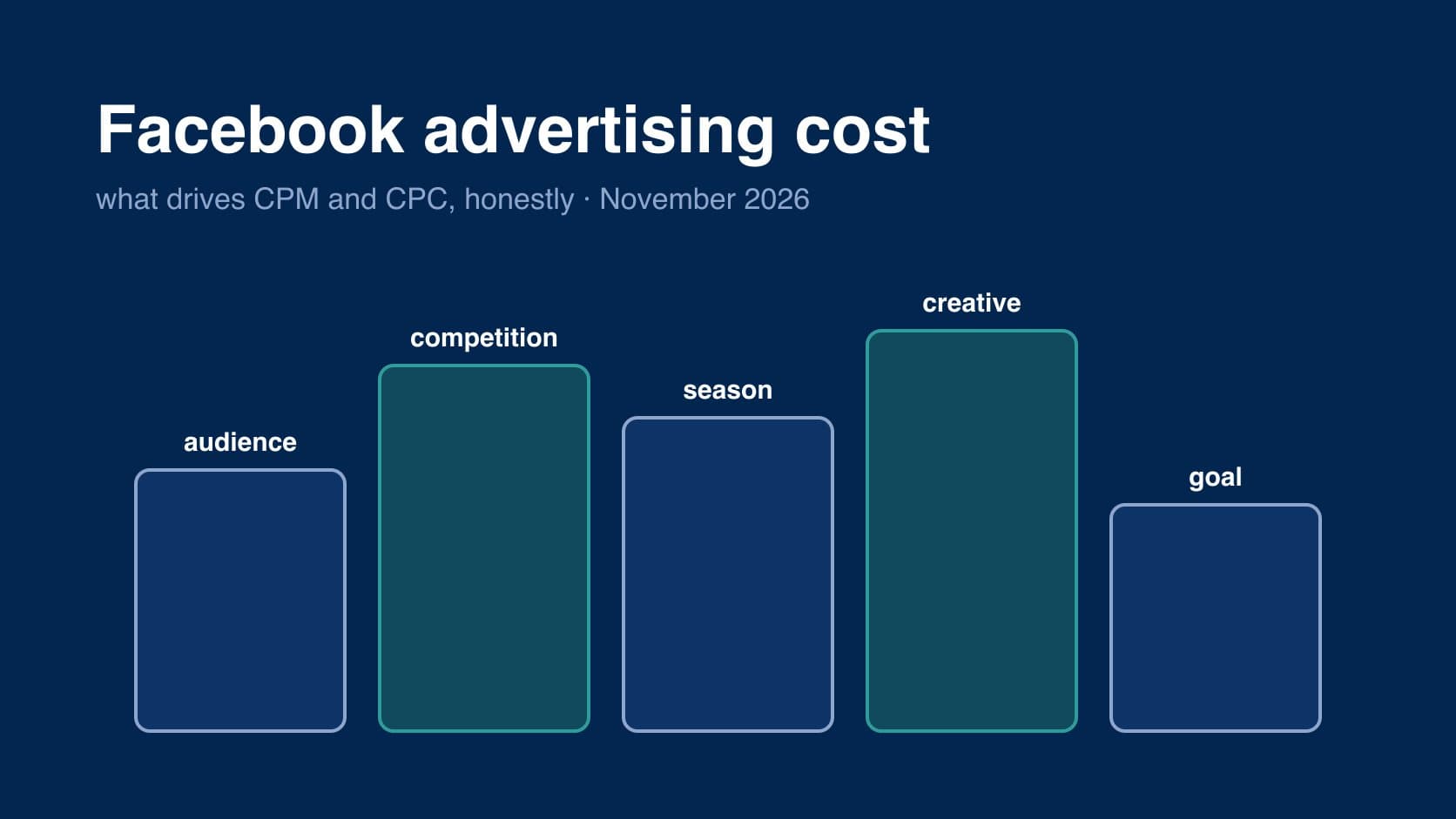
Facebook advertising costs whatever you decide to spend. you set a budget, and Meta's auction decides how many people that budget reaches and what each click or lead ends up costing. so the real question is not "how much does a Facebook ad cost" but "what will I pay per click, per lead or per thousand people reached, and what moves that number".
below: how Meta prices an ad, the most recent named benchmark figures we could check, and the levers you control. no invented averages. this is part of the social media specs hub. checked November 2026.
the short answer
- you set the spend. there is no fixed price per ad; you pay for impressions or results inside a budget you choose.
- the latest named benchmark (US, in dollars): LocaliQ's Facebook benchmarks, updated 23 September 2026, put the average cost per click at $0.60 for traffic campaigns and $1.80 for lead campaigns, and the average cost per lead at $27.39.
- the spread is wide. in the same report, cost per lead runs from $12.30 (career and employment) to $61.56 (dentists).
- what you control most is the ad. Meta's auction rewards ads it predicts people will act on, and penalises low-quality ones.
how Meta prices an ad
every time there is a chance to show someone an ad, Meta runs an auction between the advertisers who want that person. Meta's own description says the system "looks at a number of factors equally to determine which ad is displayed", rather than simply taking the highest bid. two of those factors are about the ad itself:
- estimated action rates — how likely Meta thinks this person is to do what your campaign is optimised for: click, sign up, buy.
- ad quality — assessed from several sources, including checks for low-quality attributes such as withholding information, sensationalised language and engagement bait.
Meta says that "together, estimated action rates and ad quality measure ad relevance". its page also lists what the system weighs when it assesses an ad: the objective, the budget, the duration, the audience and the creative.
the consequence for cost is simple. a more relevant ad wins auctions it would otherwise lose, at a lower price. a weak one pays more for the same people, or does not get shown to them at all.
what the benchmarks say
Meta does not publish average costs. the most recent named benchmark we could check is LocaliQ's Facebook Ads Benchmarks, last updated 23 September 2026. it is in US dollars, it reads as US accounts, and the page does not say how many campaigns it covers or over what period, so treat it as a reference point, not a target. UK costs are not broken out.
| metric | traffic campaigns | lead campaigns |
|---|---|---|
| average click-through rate | 1.93% | 2.70% |
| average cost per click | $0.60 | $1.80 |
| average conversion rate | — | 8.54% |
| average cost per lead | — | $27.39 |
the industry spread matters more than the averages:
- traffic CPC: from $0.34 (arts and entertainment) to $0.86 (finance and insurance).
- lead CPC: from $0.73 (career and employment) to $5.70 (dentists and dental services).
- cost per lead: from $12.30 (career and employment) to $61.56 (dentists and dental services).
two cautions. first, the report's own prose names the wrong industries as the most expensive for lead CPC; the figures above are from its tables. second, the objective changes everything: a traffic campaign buys clicks and a lead campaign buys form fills, so their costs per click are not comparable.
what about CPM?
CPM is the cost per thousand impressions, and it is the number that moves first when the auction gets more crowded. we could not find a CPM average with a method attached, so we are not quoting one. what practitioners report is how much it moves. one advertiser targeting Spain described the gap between new and established campaigns:
"For example, targeting Spain: ABO testing campaigns: €15–20 CPM Established CBO campaigns: usually around €8–10 CPM (sometimes even lower)"
and another, asking what a brand new account should expect, got the framing right before asking:
"I know CPM varies based on audience, competition, creative quality and a bunch of other factors, so I’m not looking for one magic number."
your own Ads Manager is the only CPM that counts. run a small test, read the CPM, and plan the budget from that.
what drives the cost
the objective
Meta charges for what you optimise for. traffic objectives find people who click cheaply; lead and sales objectives find people more likely to convert, and they cost more per click to reach. compare cost per result, not cost per click, across objectives.
the audience and the season
a narrow audience that many advertisers want costs more per impression. so do busy periods, when more advertisers bid for the same people. one Meta ads operator's diagnostic, for when CPM rises while click-through holds steady:
"This usually points to auction pressure."
the placement
Feed, Stories, Reels and the rest are priced separately in the same auction. from a post on why campaigns stop scaling:
"Feed, Reels, Stories, and Audience Network can have wildly different CPMs and CVRs."
check the placement breakdown before blaming the ad. each placement also needs its own shape; an ad cropped badly into Stories pays full price for a worse impression. the sizes are in Meta ad specs.
the creative
this is the lever you hold most directly, because it feeds both estimated action rates and ad quality. the same post on campaigns that stop scaling has a rule of thumb for it:
"If CTR is dropping but CPM is stable, that's creative fatigue."
fresh creative, and more of it, keeps the ad relevant. it is also why so many brands test UGC-style video against polished studio ads; the UGC ads guide covers that.
how to set a budget
- pick the result you are paying for — a lead, a sale, a visit — and the most you can pay for one and still make money.
- run a small test for long enough to get a real cost per result, not just a CPM.
- compare it with the ceiling. if it is under, scale gradually; if it is over, change the creative or the offer before the targeting.
and keep the click cost in perspective. from a post on high CPCs on Meta:
"Most importantly: Don’t optimize for CPC alone."
if you make the creative in Clear Cortex, testing more variations is mostly a matter of exporting them: the image studio makes 9:16, 4:5 and 1:1, and the video studio makes 9:16 and 1:1.
the summary
- you choose the spend; the auction sets the unit costs.
- Meta weighs relevance — estimated action rates and ad quality — not just the bid.
- LocaliQ (US, September 2026): $0.60 traffic CPC, $1.80 lead CPC, $27.39 cost per lead. industry spread is wide.
- no trustworthy CPM average exists; measure your own.
- the creative is the cost lever you control most.
all placement sizes and safe zones are in the social media specs hub.