 Clear Cortex
Social media campaign examples: six structures and why they work
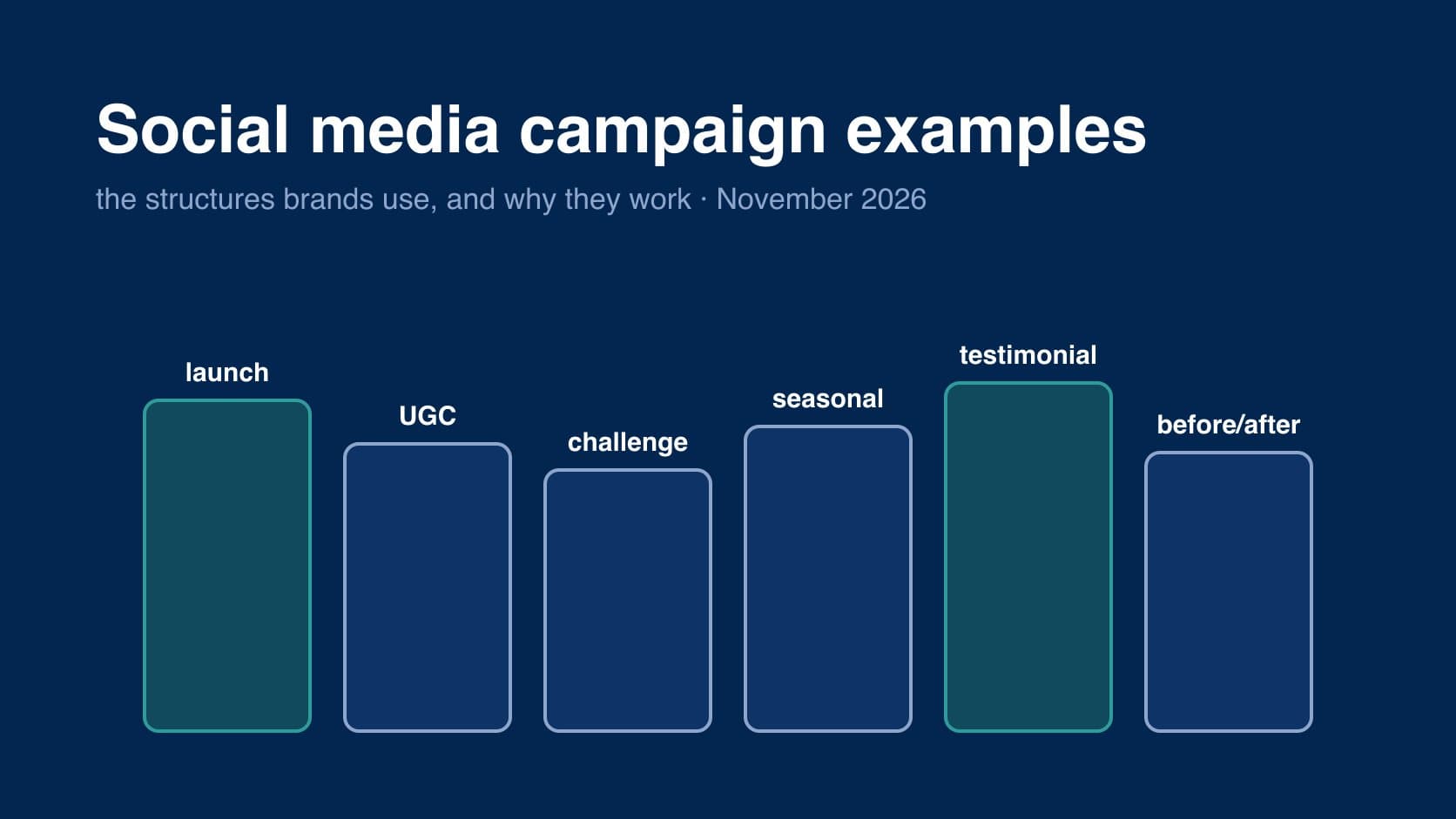
most social media campaigns are one of a handful of structures. the brand, the product and the creative change; the shape underneath — how the campaign earns attention, then trust, then action — repeats. pick the right shape and the creative brief nearly writes itself.
below are six campaign structures, what each one looks like as posts and ads, and why it works. no famous-brand case studies, because a structure is something you can reuse and a retold success story usually is not. the sizes for each platform are in the social media specs hub. checked November 2026.
the short answer
| structure | the shape | why it works | best for |
|---|---|---|---|
| launch | tease, reveal, proof, reminder | builds anticipation, then gives a reason to act now | a new product, feature or drop |
| UGC | real customers or creators talking to camera | reads as a recommendation, not an ad | always-on paid social |
| challenge | a simple prompt others copy and post | the audience makes the content and spreads it | reach on TikTok and Reels |
| seasonal | a date, a deadline and an offer | the calendar supplies the urgency | retail moments and gifting |
| testimonial | one customer, one problem, one result | specific proof beats general claims | retargeting and considered purchases |
| before and after | the problem, then the result, side by side | shows the outcome in a second | visual results: home, cleaning, design |
people who make ads for a living describe the same short list. from a workflow post on making UGC video ads:
"Problem to solution, testimonial, before and after, or storytime."
1. the launch campaign
the shape: a few days of teasing (a detail, a countdown, a question), a reveal post and ad, then proof — first reactions, first reviews — and a reminder before any launch offer ends.
why it works: it turns one announcement into a sequence, so people who missed the reveal still meet the product, and the proof phase answers "does it actually work" while interest is high.
what to make: a 9:16 teaser for Stories and Reels, a reveal in 9:16 and 4:5, and a proof cut built from whatever real reactions come in. plan for the launch ads to tire; a launch is a burst, and the creative that opened it rarely carries it a month later.
2. the UGC campaign
the shape: real customers or paid creators filming themselves using the product, in their own words, on their own phones. run as organic posts, as Spark-style or partnership ads, or both.
why it works: it looks like the content around it, so it is watched as a recommendation rather than skipped as an ad. one small brand owner put it simply:
"I run a small DTC brand and UGC ads are the thing that actually converts for us."
what to make: several creators and several hooks per product, so you can test angles rather than faces. real examples, with what each one does, are in UGC examples, and running them as paid is in the UGC ads guide.
3. the challenge campaign
the shape: a simple, copyable prompt — a move, a format, a before-and-after, a "show us yours" — that people film and post themselves, usually with a sound or hashtag that ties the entries together.
why it works: every entry is content the brand did not make and an introduction to the entrant's own followers. reach comes from the audience, not the ad budget.
what to make: one clear example video that shows exactly what to do in the first seconds, and a prompt simple enough to copy without instructions. if it needs explaining, it will not spread. the risk is that nobody joins in, so seed it with creators you have briefed before going public.
4. the seasonal campaign
the shape: a campaign pinned to a date — a holiday, a sale weekend, the start of a season — with an offer and a visible deadline.
why it works: the calendar supplies the urgency and the reason to buy now, so the creative does not have to manufacture it. the catch is that everyone else is advertising on the same dates, so attention costs more. one advertiser's experience:
"I made some sales around Valentine’s Day and Father’s Day, but the results were never really consistent."
and a reminder that a seasonal dip is not always the ad's fault:
"If they spiked this week, half this sub probably posted the same day saying everything died, because it's a platform or seasonal thing, not your ad rotting."
what to make: creative ready before the date, not on it, and a version without the date for after. how the auction gets pricier in busy weeks is in what Facebook advertising costs.
5. the testimonial campaign
the shape: one customer, one problem they had, one result they got — on camera, as a quote card, or as a screenshot of a real review.
why it works: people check before they buy, and a specific story from someone like them answers the question an ad cannot answer about itself. from a thread on building trust for a new store:
"Customers today often check reviews, social proof, previous buyers, brand presence, etc."
what to make: real testimonials only, with permission. a scripted or invented "customer" is a fake review, and both regulators and the platforms treat it that way. testimonials work hardest in retargeting, on people who already know the product and need a reason to trust it.
6. the before-and-after campaign
the shape: the problem, then the result, side by side or as a cut — a room, a garden, a car, a logo, a cluttered drawer.
why it works: the whole argument lands in one frame, which suits a feed people scroll in a second.
what to make: the same angle and lighting in both halves, so the change is the only difference. a caution: Meta's advertising standards restrict before-and-after imagery around health, weight and appearance, so for those categories check the policy before you build the campaign around it.
how to choose a structure
- something new to announce: launch.
- a result you can see: before and after.
- a product people need convincing about: testimonial, then UGC.
- a date that matters to your buyers: seasonal.
- a product that is fun to show off: challenge.
- ads running all year: UGC, refreshed often.
most brands end up running two at once: an always-on UGC or testimonial layer, and a launch or seasonal burst on top. whichever you pick, export each piece in the shapes the placements need — 9:16 for Stories, Reels, TikTok and Shorts, 4:5 for feed. if you make the creative in Clear Cortex, the image studio exports 9:16, 4:5 and 1:1; the video studio exports 9:16 and 1:1.
the summary
- six structures cover most campaigns: launch, UGC, challenge, seasonal, testimonial, before and after.
- each one earns attention, then trust, then action, in a different order.
- proof must be real. invented testimonials are fake reviews.
- run an always-on layer and a burst on top.
sizes, lengths and safe zones for every placement are in the social media specs hub.