 Clear Cortex
How to find out whether it's the hook without paying for four more videos
48 people asked which part of the ad was broken.
i went looking for a straight answer to one question — when an ad stops working, how do you know it is the hook and not something else — and counted 48 versions of it across ten rooms. the replies name a cause almost every time. almost none of them name a way to tell.
the questions themselves say why:
"how many meaningfully different hooks do you test before deciding the product or offer is the problem?"
"is it the hook, the offer, the product page, pricing, website speed, checkout process, audience targeting, or something else?"
"when fatigue hits, what do you refresh first, the creative, the hook, or the person you're aiming it at?"
"when a winning asset finally hits a wall, do you prefer small, iterative adjustments to hooks and thumbnails, or do you dive straight into an entirely new concept?"
that second one lists seven suspects for one dead ad. the person asking it is not confused about what a hook is. they are stuck on something harder: seven things could be wrong, changing any of them costs money, and nothing in the account tells you which one to change first.
so here is the whole thing: why the usual test answers nothing, what an isolated test actually looks like, the three places in the funnel that tell you the hook was never the problem, and a worked example on one ad. about fifteen minutes. nothing held back and there is no gate on any of it.
The reason four new videos usually teach you nothing
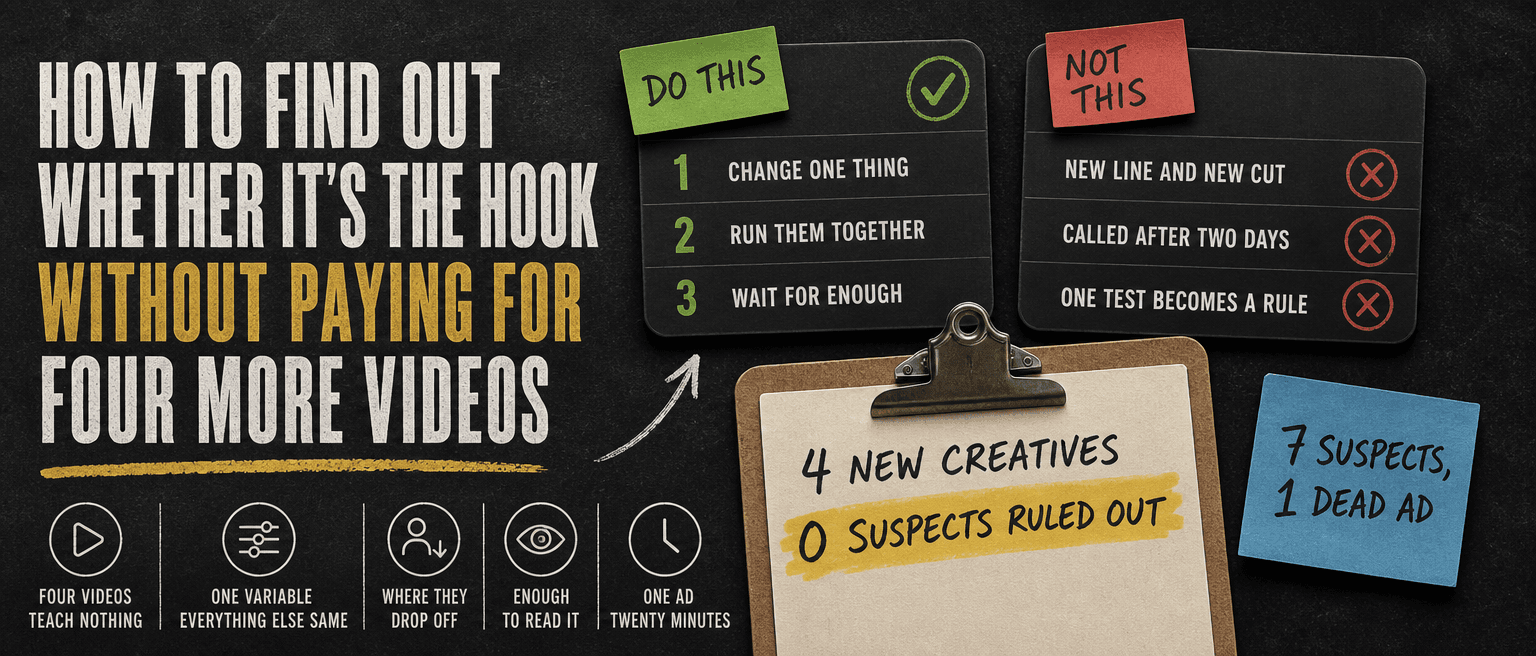
the standard move when an ad dies is to order more creative. four new creatives, four new openings, run them against the loser and see what happens.
here is what actually shipped when you did that.
each of those four videos has a different opening line. it also has a different opening shot, because the line changed and the visual had to match. it probably has a different pace in the first two seconds. and if you briefed them separately, at least two have a different person in them.
that is not four hook tests. that is four new creatives. you changed three or four things at once, four times over. when one of them wins you have learned that ad number three works, which is worth something — but you have learned nothing about the opening, and you will be in the same position in a fortnight when ad number three dies too.
this is the part that makes the cost hurt. the reason people order four creatives is to find out what is wrong. four creatives at a couple of hundred each, and the thing you paid to find out is still unknown.
What an isolated test actually is
one variable. everything else identical.
if you want to know whether the opening line is the problem, the test is the same creative, the same person, the same product shots, the same pace, the same call to action, the same landing page — with a different first sentence. one change.
that sounds obvious written down and it is genuinely hard to do, because most of the ways people make creative do not produce that. a brief to a creator produces a new creative. a prompt to a model produces a new creative. getting the same video with one line changed means either re-cutting an existing creative or building the thing in pieces so a piece can be swapped.
it is worth the awkwardness, because it is the only test whose result means anything. if the variant wins and the only difference was the first sentence, the first sentence was the problem. if it does not, the first sentence was not the problem, and you have ruled out one of your seven suspects for the price of one creative instead of four.
two rules that keep it honest:
- run them at the same time, in the same place. a test against last month's numbers is a test against last month's auction, not against your variant.
- change the thing you claim to be changing. if the new opening line needed a new opening shot to make sense, you are testing both, and the result cannot separate them. either accept that and call it a concept test, or find a line that works over the same footage.
Where the numbers already tell you it is not the hook
before you buy anything, the account usually knows. you are looking for the place people fall out, and there are three, and they point at different suspects.
almost nobody watches past the start. people were served the ad and left immediately. that is the one case where the opening genuinely is the prime suspect — it is the only part of the ad most of them saw.
plenty watch, almost nobody clicks through. the opening did its job. it stopped them, they stayed, and then they decided not to go. the opening is not what failed here. what failed is what the ad asked them to do or what it promised — the offer, the thing being sold, the reason to act now.
plenty click, almost nobody converts. the ad worked. everything after the click did not. this is the page, the price, the delivery promise, the checkout. changing the first sentence of the video cannot fix a checkout, and it is remarkable how often four new creatives get bought to solve exactly this.
so the drop-off point is your free diagnostic, and it costs nothing. it will not always be clean, and when two of them are bad at once you have two problems rather than an ambiguous one. but it eliminates suspects before you spend, and eliminating suspects is the whole job.
How many you need before the answer counts
this is where most isolated tests still fail, and it is not a creative problem.
two ads, both shown to a few hundred people, one converts three times and the other once. that is not a result. that is the same coin landing differently twice, and if you act on it you will refresh the wrong variable and conclude the method does not work.
you need enough conversions on each side for the difference to be readable. the honest version is that most accounts testing on small budgets cannot buy a clean answer on a single variable, and should know that before they start rather than after. the practical response is not to give up on testing — it is to test fewer things with more behind each one. one variable, two versions, enough budget on each that a real gap would show. that beats four variants sharing the same money and returning four shrugs.
and if the numbers will never be there, say so out loud. a test you cannot afford to read is a purchase, not a test.
A worked example, end to end
a product creative has been running three weeks. it was the best ad in the account and it has stopped converting. the instinct is four new creatives.
instead, twenty minutes:
first, where do they leave. the ad is being served and the great majority leave almost immediately. very few get far enough to click. that points at the opening and away from the page, the price and the checkout — three suspects gone before anything is bought.
second, has anything else changed. the ad is being shown to more people than it was three weeks ago, and it is costing more to show. that is worth knowing, because "the ad got worse" and "the same ad is now being shown to a colder room at a higher price" look identical in the result and have completely different fixes.
third, one creative, one change. re-cut the same creative with a different first sentence. same footage, same person, same everything after the first two seconds.
fourth, run both together until there are enough conversions to read, not until the end of the week.
three outcomes, and all three are worth the price of the one creative:
- the variant wins — the opening was the problem, and you now know the shape of a better one, which is worth more than the single winning ad.
- the variant loses and both are bad — it was never the opening. spend the next creative on the offer or the page, and you did not spend four.
- both do fine — the original had not died at all; it was a bad week. this happens more than people admit, and it is the cheapest possible answer.
What usually goes wrong
the variant quietly becomes a new ad. someone changes the line, then improves the cut "while they are in there". the result is unreadable. write down the one thing you are changing before anyone opens an editor.
the test gets called early. two days in, one side is ahead, and it goes to the winner. two days is almost never enough conversions, and early-stopping is how accounts accumulate confident beliefs that are wrong.
a rule gets made from one test. one line beat another line, on one product, for one audience, in one week. that is a fact about that ad. it is not a rule about openings, and treating it as one is how people end up with a document of rules that contradict each other.
the seven suspects get changed all at once. new creative, new page, new price, same week. if it recovers you will never know why, and you cannot do it again.
The honest answer
when an ad stops working, the useful question is not what is a better opening. it is which of my seven suspects can i eliminate without spending anything, and what is the cheapest single thing that separates the rest.
the drop-off point eliminates most of them for free. one asset with one change eliminates the next. four new creatives eliminate nothing, which is why the account that orders them is usually back in the same place a fortnight later with less money.
none of this needs a bigger budget. it needs the test to change one thing, and it needs you to be able to make the same creative twice with a single difference — which, for most stacks, is genuinely the hard part.
that last part is the thing i am building. one place where the creative is assembled from pieces, so swapping the first two seconds is a swap rather than a reshoot, and the version you tested is still there next month when you want to know what you actually changed. if you want to see it when it lands: https://clear-cortex.com/early-access?src=x-is-it-the-hook