 Clear Cortex
How to choose between daily Reels and paid ads without wasting a month
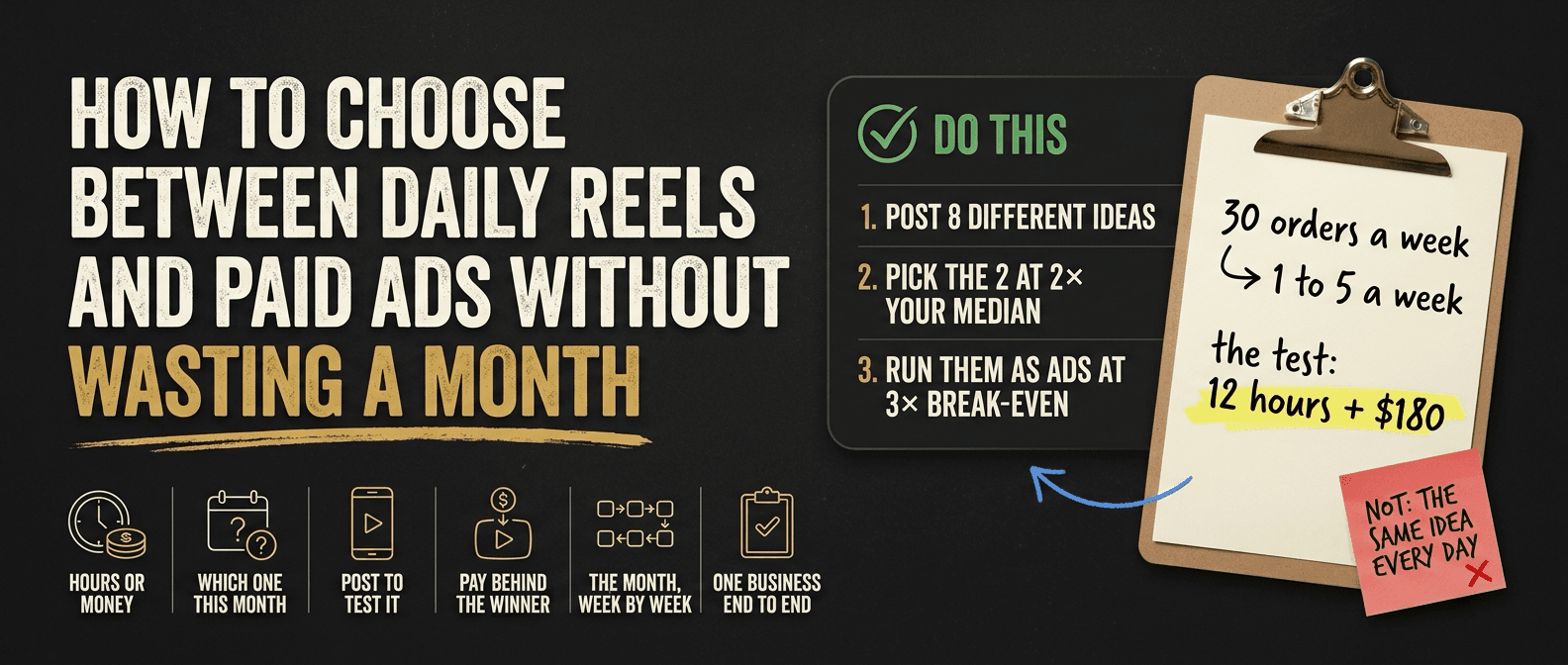
30 orders a week fell to between 1 and 5.
that was a one-person business selling hand-painted pet portraits on fridge magnets. free listings had been bringing in around thirty orders a week, and then, more or less overnight, they stopped. the instagram account started in their place brings in one to five. the owner paints, packs, ships, answers the messages and runs the account alone, and wrote down the choice in front of them as a list. the first two options on it were these:
"would you: double down on instagram and start posting consistently (daily reels, better storytelling, etc.)?"
"invest in paid ads?"
the other two were moving to tiktok and keeping on with influencers. the fear was spending months on the wrong one.
i went looking for how people make this call and counted 14 separate threads where someone running a business was trying to choose between posting and paying for ads. almost all of them frame it as one or the other. here is how some of them put it:
"would you recommend that i focus more on organic content + influencer marketing first and run ads alongside it, or is it completely fine to start paid ads this early?"
"can i post these expensive agency creatives organically now and run them as paid ads later?"
"so far we've relied purely on organic growth, but i want to try paid ads for the first time."
"i'm really stuck on content ideas now, and i don't know what to do next to grow my traffic organically, without paid ads."
"what should i focus on first to increase sales without burning out?"
and i found two write-ups from people who had run both at any volume. they said the same thing, and it is the thing nobody in the 14 threads was asking: "organic reach is a free testing ground for paid."
the good news is that this is not a fork. organic and paid are two steps of one creative test, and they work better in a particular order than either does alone. organic content is the cheap way to find out which video people stop for. a paid campaign is the way to find out whether the people who stop will buy, and to scale the ones that do. a small brand can run both in one month, in that order, without a big budget and without posting every day for the sake of it.
one boundary before the method, because i have written the neighbouring pieces and this is not them. whether your margin can carry ads at all yet, and how to set up a first campaign, are separate. this one is about the next month: how to split it between organic and paid, and how each one feeds the other.
so here is the whole thing. what organic and paid each actually cost you, one check that says which the month is mostly for, how to use organic content as a free creative test, how to put a small campaign behind the video that won it and read it in sales, the month split week by week, and the pet-portrait business run through it with real numbers. nothing is held back and there is no gate on any of it.
the cover on this piece was made in clear cortex for about 8p, on the cheapest model that could spell the headline. that's the studio i'm building, and it's the only ask in this piece: https://clear-cortex.com/?src=x-post-or-pay-top
Organic and paid buy the same thing with different money
start with what each one actually buys, because the choice looks much harder than it is when they are treated as two different kinds of marketing.
they buy the same thing: a person scrolling past your video. organic pays for that with your hours — the filming, the editing, the caption, working out what to make next. paid ads pay for it with money. what you get at the other end is the same: somebody sees the video, and either stops or does not.
the difference is not reach. it is control. when you post organically, meta (or tiktok) decides how many people see it, and you find out afterwards. most videos go to a few people and stop. now and then one goes much further, and you cannot make it go further on purpose — the video that took off cannot be told to take off again tomorrow, at twice the size. when you run it as an ad, you set the budget. you can put $10 behind a video or $100, and the same creative reaches roughly ten times the audience. you can switch the campaign off on the day it stops working.
that one difference decides what each is good at.
organic is good at testing creative. each video is a cheap draw. you can afford to test ten different ideas in a fortnight on hours alone, and meta will hand most of them to a few people and one or two of them to a much bigger audience. that is noisy, but noise is fine when the job is narrowing ten creatives to two. it is also why the advice to post consistently is half right: the volume is what makes the test work, but only if the volume is ten different ideas rather than the same one ten times.
paid is good at proving and at scaling. a fixed budget behind one video, sent to a cold audience who have never heard of you, gives you an answer in the only number that pays the rent: sales. and when the answer is yes, it is the one route where you can scale on purpose. one person who had run a business on posting alone put the ceiling plainly: "i know i can't scale past a certain point on organic alone, and i need a predictable paid acquisition channel."
so neither one is the better use of a month. organic is better at the first half of the job and paid is better at the second half. the trouble starts when one of them is asked to do the other one's half — posting every day and hoping the account turns into a sales channel, or paying to test ten untested creatives in one campaign, which is the expensive way to do organic's job.
there is one more thing worth saying about the two currencies, because it is what makes the split possible for a small business. most people in this position are short of one and not the other. someone whose orders have dropped is short of money but has hours, because the work the orders used to bring has gone. someone with full order books has money coming in and no hours. it is worth knowing which you are before you plan the month, because the cheap half of the job should be paid in whichever currency you have spare.
Which one the next month is for
the month is not either/or, but it does have a centre of gravity. three questions decide it, and you can answer them in ten minutes.
question one: has any video you have posted already done clearly better than the rest? look at your last ten or so and find the median — the middle one by views. a video that did more than twice the median, and that people watched most of the way through, is a candidate creative. if you have one or two, the month leans towards paid, because organic's half of the test is already partly done. if every video sits around the median, the month leans towards organic, because you have not found the creative yet and paying to find it is the expensive route.
question two: what is one sale worth to you, after the cost of making and sending it? that number is the most you can pay for a conversion and break even — your break-even cost per purchase — and it is what every paid read below is measured against. one person launching a single product wrote theirs down: "landed cost is ~10-12/unit€ , so gross margin is roughly 26-28€ before any ad spend." that is the right number to have in front of you, and it is the whole budget calculation in one line. if you do not know it, work it out before spending anything. whether that number is big enough to make ads worth running at all is its own question, and i have written about it separately. this piece assumes it is at least worth finding out.
question three: how many orders could you actually fulfil? this is the one people skip, and for anyone making things by hand it is the ceiling on how far you can scale. if each order takes an hour or two of your time, there is a number per week past which more ad spend just means a queue. the useful version of that number is the most you have ever fulfilled in a week without things falling apart. paid ads can take you up to it. they cannot take you past it without changing how the work gets done.
so:
- no video has stood out yet — the month is mostly organic. two weeks testing different ideas, then a small paid campaign on the best one or two.
- one or two videos already stood out — the month is mostly paid. put the budget behind those now, and keep posting alongside to find the next creative.
- you are already at your ceiling — neither. more reach is not your problem this month.
in both of the first two cases you end up doing both. the only difference is how much of the month goes to each, and which comes first.
Post to test the creative, not to grow the account
if the month starts with organic, the organic content has a different job from the one most advice gives it. the usual advice is about the account: post daily, build a following, tell better stories. that might be worth doing over a year. for this month, the job of each video is to test one creative idea for an ad, and a video that does nothing has told you something useful too.
that changes three things about how you post.
one: test different ideas, not the same idea more often. "daily reels, better storytelling" is a plan about frequency and polish. frequency only helps if each video is asking a different question. for a handmade product, different ideas look like: the finished piece next to the photo it was painted from; the making of it, start to finish, sped up; the moment a customer opens it; the price and what you get for it, said straight to camera; the problem it solves, if it solves one. those are five reasons to stop scrolling. five versions of the same reveal with different music are one.
the same write-up that called organic a free testing ground made the point about ideas in two lines: "a great creator with a bad hook will get 2K views." "an average creator with a killer hook will get 50K." the hook — the idea in the first seconds of the video — is doing most of the work, which is good news for anyone who is not a natural on camera.
the different versions do not all have to be filmed. if one of the ideas is the finished piece in a setting — on a kitchen fridge, wrapped as a gift — this is one product photo turned into several genuinely different scenes, step by step: https://clear-cortex.com/playbooks/one-product-six-ways?src=x-post-or-pay-mid
two: read each video against your own median, not against anyone else's. a small account's numbers are all small. what matters is which of your creatives did better than your others. for each one, write down views, how much of it people watched, saves, shares, and any messages it brought. a video at twice your median views, with more of it watched than usual, is the kind of result the write-up meant when it said they "flag those as "ad-worthy" and the brand scales them through paid."
three: let the numbers say no, and do not let them say yes. i went through this properly in the piece on picking a winning ad, and it applies to organic results even more. views, watch time and saves are soft numbers. they can tell you a creative does not work — if almost nobody watched past the first second, it will not sell to the people who left. they cannot tell you it sells. a video can travel a long way because it is funny or sweet and still bring no sales, and a pet portrait is exactly the kind of thing people share without buying. so the videos that do well are candidates for an ad, not winners. the paid test is where they get their real answer, in conversions.
what goes wrong here, usually: posting the same idea every day because it did well once, which turns a test into a habit. or reading a single video that took off as proof — one going far can be luck, and the paid test in the next section is what tells luck from a real ad. or treating the videos that did nothing as wasted. they were not. they cost hours, and they told you which creatives not to put budget behind.
Put the budget behind the video that already won
this is the half of the job organic cannot do, and it is cheaper than most people expect, because you are not paying to find the creative. organic already did that. you are paying for one answer: do the people who stop for this video buy?
use the post itself, not a copy of it. meta lets you run an existing instagram or facebook post as an ad, either from the boost button on the post or by choosing the existing post when you build the ad in ads manager. the likes and comments it earned stay on it, so the ad arrives in front of a cold audience with some proof that real people liked it. boosting is the quick route. ads manager gives you more say over what the campaign optimises for, and the thing you want it to optimise for is purchases — conversions, not more likes. setting that campaign up properly is its own piece; the point here is only that the post you already have is the ad.
that is also the answer to the question about posting agency creatives first and running them as ads later: "can i post these expensive agency creatives organically now and run them as paid ads later?" yes, and the order is the useful part. the ones that earn it on the free side go to the paid side. the ones that do not, you never paid to promote.
size the test for a no, not for a yes. this is the part that keeps the paid step cheap. take what one sale is worth to you — your break-even from the last section — and give each candidate creative three times that in ad spend, over three to five days. i worked out where the three comes from in the piece on when to switch an ad off. the short version: an ad that converts as well as you need it to will usually bring at least one sale inside three sales' worth of spend. if it brings none, that is a real no — it happens to an ad that is genuinely good enough only about one time in twenty. give it just one sale's worth and an ad good enough to keep comes back empty more than a third of the time, which is how good ads get switched off.
proving that one creative is better than another takes far more money than that — roughly ten conversions each. you do not need to prove it is the best. you need to know whether it can sell at all, and three sales' worth answers that.
read it at the end of the three, and only at the end. three results:
- no sales. off. the creative was liked and it does not sell, which is worth knowing for the price of three sales. do not make more like it.
- one or more sales, at or under your break-even. keep it running. this is now an ad, and the next step is scaling the budget a bit at a time, up to the ceiling from question three.
- sales, but well over your break-even. the video stops people and the sale is not happening. that is usually the page, the price or the offer rather than the creative, and it is worth checking before you make another video.
then let the paid test tell you what to post next. this is the half of the loop people miss. a paid campaign gives you something organic never does: which idea converted, not just which idea got watched. if the making-of video sold and the reveal did not, the next fortnight's organic content is more making-of ideas, in different forms. organic finds candidates, paid picks the ones that sell, and what sold tells organic where to look. that is how the two feed each other. it is the reason the write-ups from people who had run both put them in that order, and why one of them added that the strongest organic ideas, adapted into ads, "helped reduce customer acquisition costs by 60% on average." i cannot check their 60%. the order they describe is the part worth copying.
The month, split week by week
here is the whole thing as a plan, for the case where no creative has stood out yet. if one already has, start at week three with it and run weeks one and two alongside for the next one.
weeks one and two: test eight to ten different ideas organically. not daily for the sake of it — four or five a week is plenty if each one is a different reason to stop. decide the ideas before you film any of them, so you do not drift into making the same one again. after each video has been up for a few days, write down its numbers next to your median.
end of week two: pick one or two. the videos at roughly twice your median views, with more of them watched than usual. if nothing gets there, take the best one anyway and say so in your notes — a weak candidate tested for three sales' worth is still the cheapest answer available. if nothing even clears your median, the ideas need rethinking before any budget goes behind them.
week three: run the one or two as ads. one small meta campaign, sent to a cold audience, three sales' worth of budget behind each, over three to five days, optimising for purchases. keep posting new ideas alongside, at a lower rate. the organic testing does not stop because the paid campaign started.
week four: read and decide. each ad lands in one of the three results above. whatever sold keeps running, gets scaled slowly, and gets the next fortnight's videos pointed at its idea. whatever did not is switched off and filed as a real no.
the cost of the paid half is one multiplication, and it is worth doing before you start:
candidate creatives × 3 × what one sale is worth to you = what the paid half of the month costs
for most small brands that is a few hundred at most, which is much less than a month of ad spend on a campaign that never knew which creative to run. the organic half costs hours. if you have the hours spare, it is the cheaper half by a long way.
what usually goes wrong with the plan: skipping week three because a video did well and the views feel like success; running week three with the budget spread across six creatives instead of two, so none gets enough to say anything; and stopping the organic testing the moment an ad works, so that when the ad tires there is no tested creative waiting behind it.
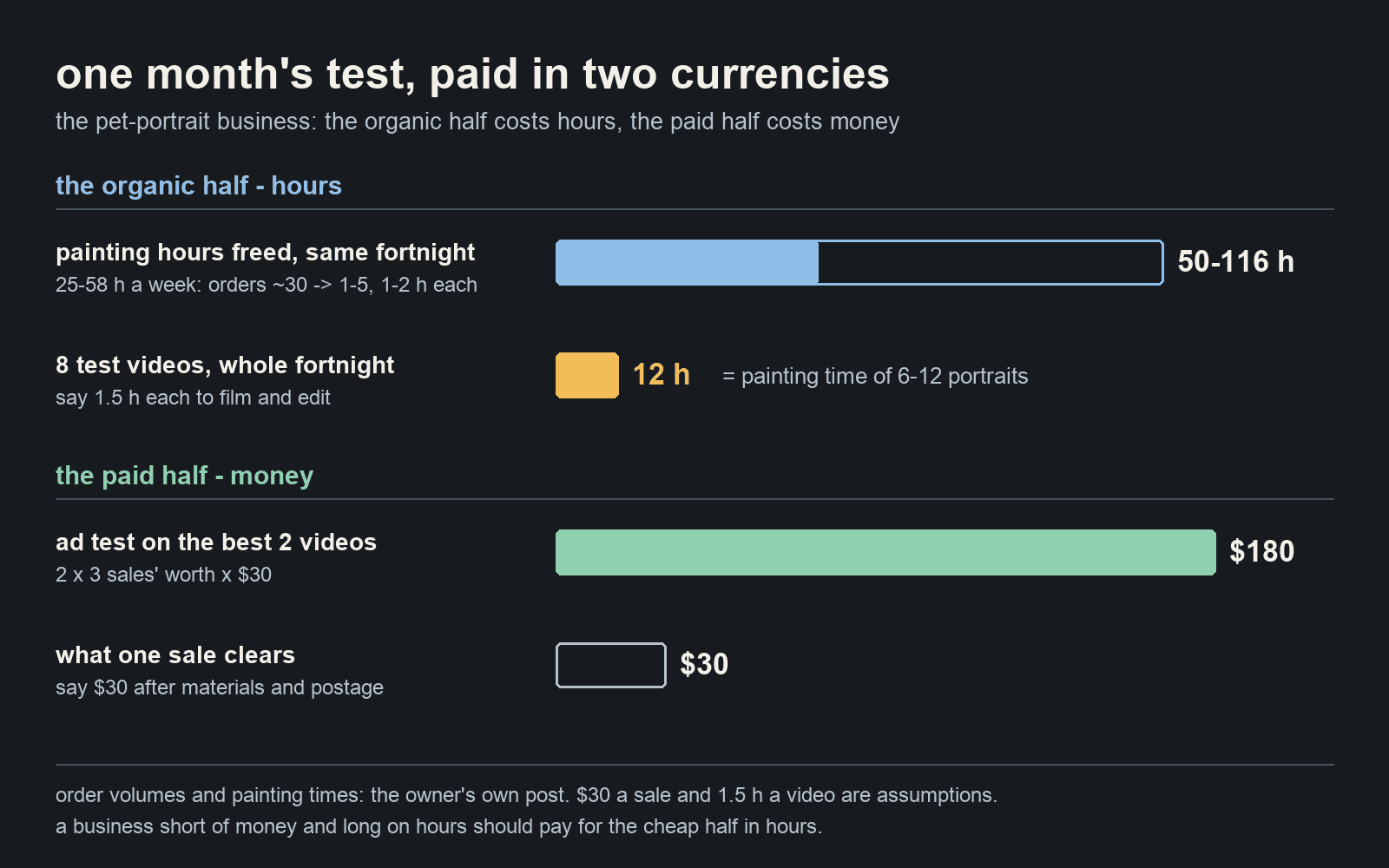
The pet-portrait business from the opening. Order volumes and painting times are from the owner's own account; the $30 an order and 1.5 hours a post are assumptions, marked "say" in the text.
One business, worked end to end
this is the business from the opening line, and it is worth running properly because the owner wrote down most of the numbers. one thing first, in the owner's favour: the product has already proved it sells. more than three hundred magnets since january, more than two hundred orders from free listings alone, at around thirty a week. what stopped was the free reach, not the demand. someone who had watched free listings dry up the same way described their first reaction to it: "i was lowering prices for no reason." the price was not the problem there either.
the two currencies. each portrait takes one to two hours to paint, and then time to cure and glaze. at thirty orders a week, that was thirty to sixty hours of painting. at one to five orders a week, it is a few hours. so the hours the orders used to take have mostly come back — between about 25 and 58 hours a week, depending on the order count and the portrait. this business is short of money and long on hours, which means posting is the cheap half here, not the expensive one. the owner's other worry was being spread too thin across painting, filming, editing and everything else, and that worry is right about doing everything at once. it is not a reason to avoid posting. it is a reason to give the posting a job with an end date.
what one order is worth. the post did not give a price or a cost, so this part is an assumption: say each order clears $30 after the magnet, the glaze, the packaging and the postage. that is the break-even cost per order for every paid read below.
the ceiling. about thirty orders a week, because that is what the business has fulfilled before with one person doing everything. paid ads can take it back towards that. past it, the owner would need to change how the painting gets done, and that is a different problem.
weeks one and two. eight different posts, say an hour and a half each to film and edit: about 12 hours over the fortnight, which is the painting time of six to twelve portraits — and a small slice of the hours that came back. the ideas, all from the product already being made: the portrait next to the pet photo; the painting sped up from first stroke to glaze; a customer opening one; the price and turnaround said plainly; the magnet on a fridge with the dog walking past; why a magnet rather than a canvas; the revision step, where the customer gets to approve it before the glaze; and one about who they make a good present for. that is eight reasons to stop, not one reason eight times.
end of week two. say the making-of video and the photo-next-to-the-portrait post both clear twice the account's median, and the rest sit around it. those two are the candidates.
week three. each runs as an ad from the existing post, in one small meta campaign optimising for purchases, at three orders' worth: 3 × $30 = $90 each, $180 for the pair, spread over three to five days. the owner keeps posting new ideas at a lower rate alongside.
week four. say the making-of ad brings four orders on its $90 — $22.50 an order, under the $30. it keeps running, at a slightly higher daily budget, and the next fortnight's posts become more making-of ideas: a different breed, a harder photo, a time-lapse of a revision. say the photo-next-to-the-portrait ad brings no orders on its $90. if it really were as good as it needs to be, that would happen only about one time in twenty, so it is switched off and filed as a real no: people love seeing it and it does not sell. the owner found that out for $90 instead of by running it for a month.
where that leaves the business. after one month, it has one ad that sells at $22.50 an order against a $30 margin, an idea to point the next round of posts at, and a list of ideas that do not need paying for. the paid half cost $180. the posting half cost about twelve hours, out of a week that had twenty-five or more of them spare. the ad can be scaled gradually until orders approach the thirty a week the owner knows can be painted. and the original question — instagram or paid ads — turns out to have been the wrong shape. the answer was instagram first, to find the ad, and paid ads second, to sell with it.
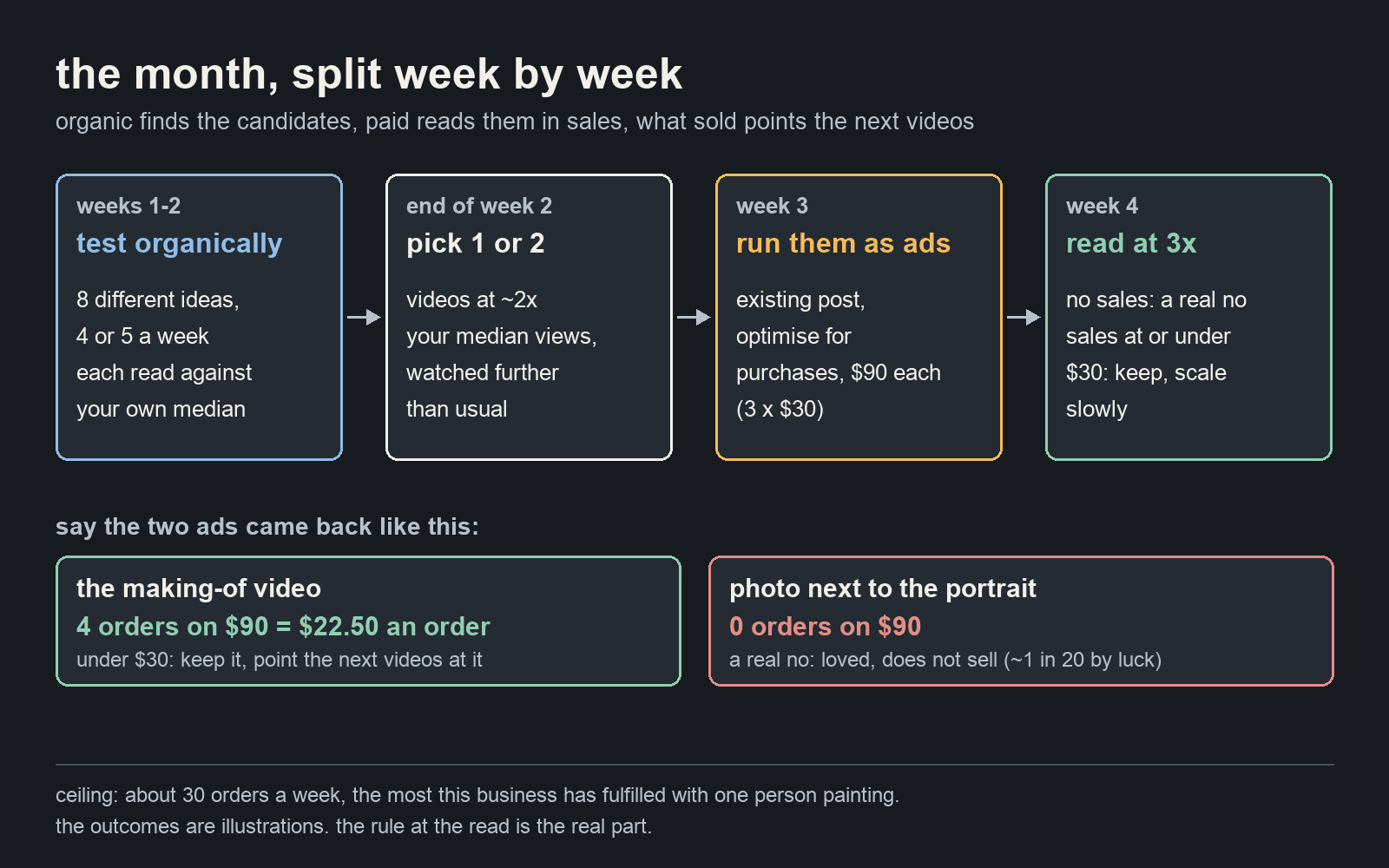
The four outcomes are illustrations, marked "say" in the text. The rule at the read is the real part: no orders after three orders' worth is a no; orders at or under break-even is an ad.
The part i cannot prove
how organic posts are distributed, and how a boosted post or a campaign is delivered, is platform behaviour, from the platforms' own documentation and from what people describe. none of it is my measurement. i do not run a handmade business or an account at this spend, and the worked example is someone else's business, read from what the owner wrote about it. the price, the margin, the hours per post and every outcome in weeks three and four are my assumptions, and the article says so where they appear.
"twice your median" is a rule of thumb, not a statistic. organic reach is noisy enough that a single post can clear it by luck, which is exactly why the paid read exists. the one-in-twenty and the more-than-a-third assume orders arrive at random at a steady rate. meta's real delivery is lumpier than that, especially in the first day or two of a new ad, and an audience that has already seen the post organically may not behave like a cold one.
and there is one thing i genuinely do not know. how often does a creative that does well organically also convert when it is paid for? the two write-ups i found say often enough to be worth the order, and one put six of fifteen videos through as ad-worthy for one brand. but both came from people selling content services, and neither said how many of those six then sold. if a pet portrait goes far because it is sweet, it may be the clearest case of a post people love and do not buy. if you have run your best organic videos as ads and kept count of how many converted, i would rather have your numbers than be right.
if any of this is wrong, say so. a correction is worth more to me than agreement.
the plan only works if there are ten different ideas to post in the first place. that's the part clear cortex helps with — new scenes for an ad from the product photo you already have, for pence: https://clear-cortex.com/?src=x-post-or-pay-end