 Clear Cortex
How to get clients from ads without paying for leads that never book
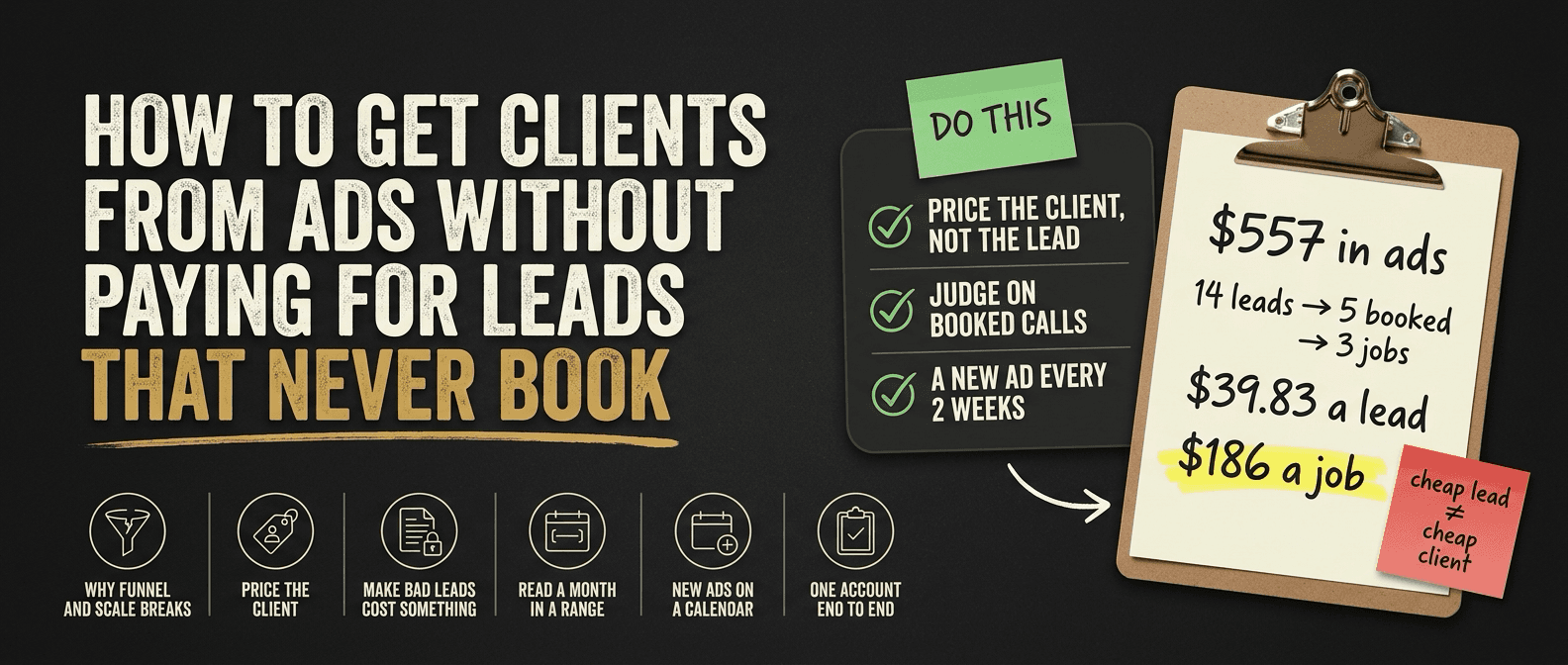
$557 in ads, 14 leads, 3 jobs, $15k in work.
that was one month for a kitchen cabinet painter: one small local campaign, one ad set, three ads, a ten-mile radius. the person running it posted the numbers under a title most people in this business would be happy to put their name to: "$557 in ad spend $15k in closed jobs for a local kitchen cabinet painter (30-day case study, no fancy funnel)." it is a good month. the question i want to ask of it is the one almost nobody asks: is that a system, or is it a month?
i went looking for how people running paid ads for a service business talk about this and counted 8 separate threads asking some version of it. in four of them, the leads were already coming in. the problem was what the leads turned into.
here is how they put it:
"how do you build a predictable client acquisition system?" — from somebody moving from freelancing to running an agency, who listed the options as "cold outreach, content, networking, paid ads, partnerships, etc.?"
"i know i can't scale past a certain point on organic alone, and i need a predictable paid acquisition channel."
"generating leads isn't necessarily the issue - it's making sure we're attracting homeowners who actually have the budget and are serious about moving forward."
"what is a good target CPL, CAC, and CPM?"
"has anyone else noticed similar creative fatigue or changes in lead quality recently?"
the usual answer to the first question is a funnel. ad, form or landing page, booked call. get the cost per lead down, then scale it. i think that answer is wrong for a service business, and it is costing people money in a place the ad account never shows. the funnel is the easy part — the painter's had no landing page at all. what breaks is everything the advice assumes around it. it scales on cost per lead, which is the one number in the chain that does not predict clients. it treats a good month as a system, when a small business wins too few clients a month for any single month to mean much. and it assumes the ads that worked keep working, when on a small local audience they are the first thing to run out.
one boundary before the method, because i have written the neighbouring pieces and this is not them. what to do when an account is already stuck, whether the problem is the ad or the landing page, when and how to raise a budget — those are separate. this one is for a service business or a small agency that gets clients from paid ads, or wants to, and wants next month to look like this one.
so here is the whole thing. why the funnel-and-scale advice breaks, the four numbers to write down before you spend, how to make a bad lead cost something to send, how to read a month without fooling yourself, and a calendar for new ads — then the painter's month, worked end to end. about an hour with your last three months of leads, your calendar and a calculator. nothing is held back and there is no gate on any of it.
the cover on this piece was made in clear cortex for about 8p, on the cheapest model that could spell the headline. that's the studio i'm building, and it's the only ask in this piece: https://clear-cortex.com/?src=x-predictable-clients-top
Why the funnel-and-scale advice breaks
start with what a paid campaign for a service business actually is, because the advice skips a step.
an online shop's campaign ends at the sale. meta sees the purchase, the purchase is the conversion, the conversion is the money, and the number it optimises is the number you care about. a service business's campaign ends at a lead, and the lead is what meta counts as the conversion. the money arrives two or three steps later — a booked call or an estimate, then a signed client — and those steps happen on your phone, in your calendar and in your inbox, where the ad account cannot see them. so the campaign spends its budget, and gets judged, on the one step it can see — and that step is the cheapest and least informative in the chain.
that is where the advice goes wrong, three times over.
first, it scales on the wrong number. getting the cost per lead down sounds like efficiency, and every test people run to get there points the same way. the easy ways to get it down are the ways that make a lead easier to send: a shorter form, a pre-filled form, a vaguer offer, a wider audience. every one of those lowers the cost per lead by adding people who were never going to book. the renovation question above is exactly that: the leads were coming, and the people behind them did not have the budget. a campaign tuned on cost per lead will find more of those people, because they are the cheapest leads there are.
second, it reads a month as a system. a shop doing a hundred orders a month can tell a good week from a bad one. a painter doing three jobs a month cannot tell a good month from a lucky one, and neither can an agency signing two clients a quarter. the numbers are too small. scaling because it worked in march is acting on a conclusion drawn from three events, and three events will happily give you one in april with nothing changed. more on that in its own section, because it is the part that makes people pull the wrong lever.
third, it assumes the ads keep working. a local service campaign runs into a small audience — the painter's was 170,000 to 200,000 people inside ten miles — and a small audience sees the same three ads again and again. the creative that worked in month one is tired by month three, and the first thing that slips is not the number of leads, it is who they are. the person asking about fatigue above described exactly that: the leads had not dropped much, but the share of them worth calling back had. a funnel with no supply of new ads is a funnel with a date on it.
and scaling makes all three worse at once. more budget on a small audience spends further down it, into people less likely to book, so the leads get cheaper per click and dearer per client. the cost per lead might hold. the budget goes up and the calendar empties.
so the honest answer to "how do you build a predictable client acquisition system" is that the funnel is not the system. the system is four numbers you track outside the ad account, leads that cost something to send, a way of reading small numbers before you call a test, and a steady supply of new creative. the rest of this piece is those, in that order.
Price the client, not the lead
here is the fix for the first problem, and it is four numbers.
one: what a client is worth to you. not the invoice — what is left of it after the cost of doing the work. for a trade, that is the margin on the first job, plus repeat work if you genuinely get it. for an agency, it is a realistic number of months a client stays, times the margin on the retainer.
two: what you will pay to win one. decide this before you spend a penny of ad budget, as a share of number one. it is a business decision, not an ad decision, and nobody else can make it for you. this is your ceiling, your cost per client.
three and four: your two rates. out of every ten leads, how many book a call or an estimate? out of every ten calls, how many sign? take them from your last three months — your calendar and your own records, not the ad account, which has never seen either step.
now multiply the two rates together, and multiply your ceiling by the result:
your ceiling per client × (share of leads that book × share of bookings that sign) = the most you can pay for a lead
that is your target cost per lead, and it is the only one worth having. "what is a good target CPL" has no answer you can borrow from somebody else's vertical, because it is set by your price, your margin and how well you close. a lead worth $40 to one painter is worth $120 to another who closes twice as often on jobs half as big again.
and once you have it, cost per lead stops being the number you optimise. the number you optimise is cost per client, which is cost per lead divided by both rates. here is why that matters, with two made-up setups for the same business. say setup one gets leads at $40, and one lead in eight becomes a client: that is $320 a client. say setup two adds two qualifying questions to the form and the leads cost $90, but one lead in three becomes a client: $270 a client. in the ad account, setup two looks more than twice as expensive per conversion. in the bank account it is cheaper for the same spend, and it got there with fewer than half the sales calls — which for a business where the owner is also the person who rings the leads back, is the cost that actually runs out first.
the painter's poster tracks the right numbers, and said so: "i track this against benchmarks i've built specifically for this kind of business (cost per lead, cost per booked estimate, etc.), and i'm in the account daily." cost per booked estimate is the number that sits one step nearer the money, and it is the one to steer on.
one thing the ad account can do for you here, which i covered in the piece on stuck accounts: by default a lead campaign optimises for leads, so it goes looking for the cheapest people who will fill in a form. meta's documentation describes a lead campaign that optimises for a later stage instead, if you send your booked or signed stages back to it. i have not tested it, so take it as the platform's claim. but whether or not you use it, your own record of which leads booked is what makes this whole section possible, and nothing on the platform side replaces it.
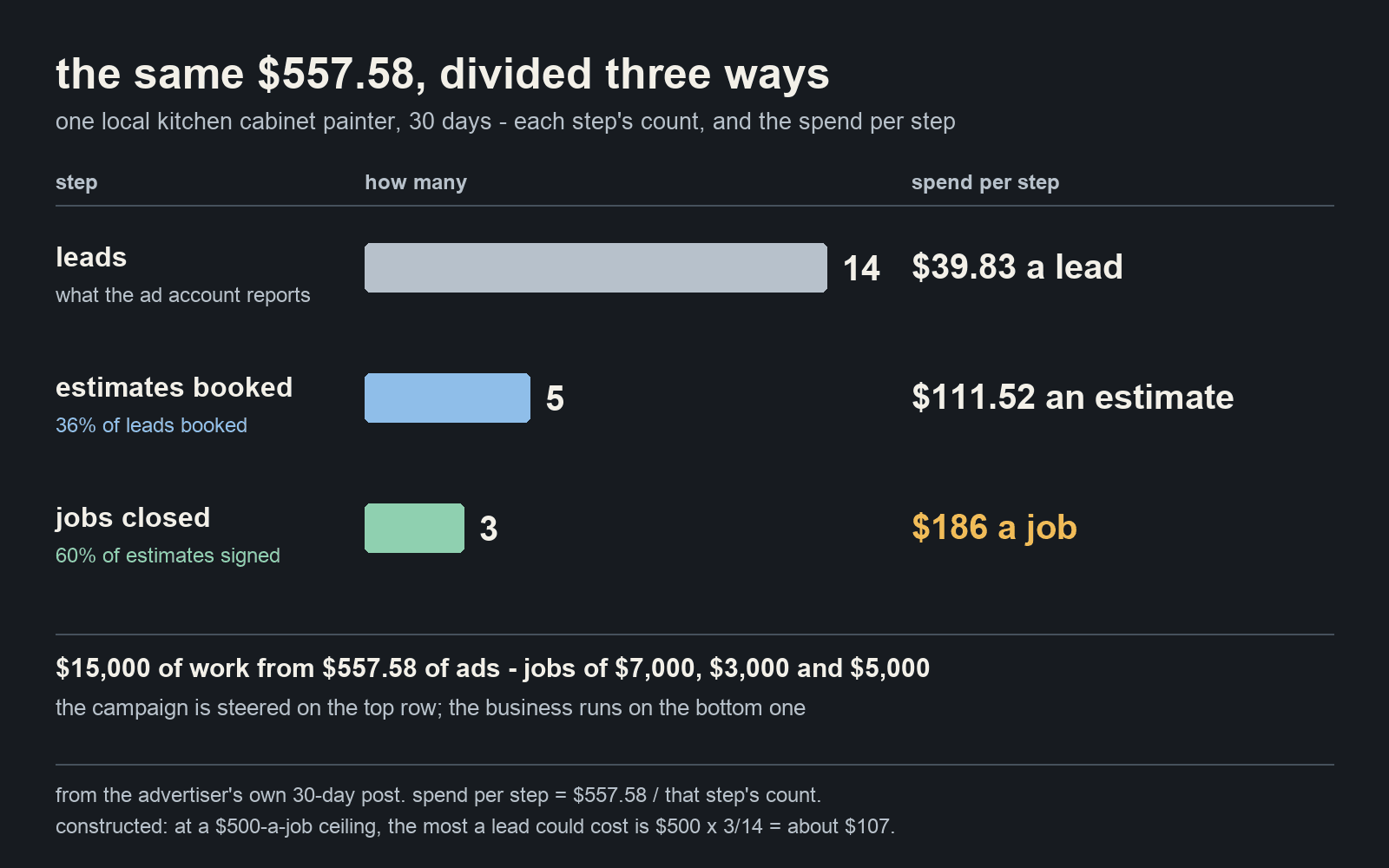
From one advertiser's own 30-day write-up. Cost per estimate and cost per job are spend divided by each count.
Make a bad lead cost something to send
the second fix is the one the room keeps asking about, and the answer is uncomfortable: to improve lead quality you have to let the cost per lead rise, on purpose.
every way of filtering out the people who will not book adds friction, and friction costs leads. treat each one as a test, one at a time, so you know which one did the work. the questions people ask about this are the right ones, and the answer to almost all of them is yes:
put the price in the ad. "do you mention the starting price heavily in the ads?" — for a job that starts at thousands, yes, in the copy and in the first seconds of any video. a homeowner who sees the starting price and still fills in the form has done the qualifying for you. the ones it puts off were never going to book, and every one of them was a lead you paid for and a call you would have made.
ask the qualifying question on the form. "add budget/qualification questions?" — one or two. a budget range, a timeline, the postcode. not five; each question costs some of the good leads as well as the bad ones, and you want the smallest filter that works.
make the form slower to submit. meta offers a form type with a review step before submitting, aimed at higher intent. it is the platform's option and it does what it says — it costs some volume. whether it is worth it is a cost-per-client question, not a cost-per-lead one.
narrow the audience before you widen it. the painter's poster said narrowing their interest targeting was the single biggest lever for lead quality, not just for volume. on a small local campaign that is believable: a narrower audience is fewer, better-matched people.
ring them back fast. the cheapest quality fix in the list does not touch the ad. the painter's setup sends the owner a notification the second a lead comes in, so they can call while the person is still on their phone. a lead who hears back in five minutes is a different lead from the same person called back tomorrow.
the thing that usually goes wrong is the week after. you add a question, the cost per lead goes up by half, meta reports fewer conversions for the same spend, the dashboard turns red, and the test gets switched off before a single extra booking has had time to arrive. so set the test up to be read properly: decide before you start that you are judging it on cost per booked call, over at least four weeks, and that a higher cost per lead is the expected outcome rather than the verdict.
and about keeping the volume up while you do it: you will lose volume. that is the point. the question is whether you killed the right volume. if leads fall by a third and booked calls per week hold, you removed only people who were never going to book, and every one of your sales hours now goes on someone who might.
Read a month in a range, not a number
this is the second problem, and it is the one that makes people pull the wrong lever.
take a business that wins three clients a month on average, from a campaign whose budget and creative nobody touches. three is the average; it is not what happens every month. clients arrive a bit at random, and at three a month, the spread from month to month is wide:
- about one month in five, it wins one client or none. nothing has changed. the campaign is the same campaign.
- about one month in five, it wins five or more. again, nothing has changed.
- the other six months in ten land between two and four.
so a month with one client is not evidence that the ads stopped working, and a month with five is not evidence that the new ad worked. at these numbers, a single month cannot tell you either. the advice to scale what worked last month is, quite often, advice to scale a lucky month — and the panic after a quiet month is, quite often, a reaction to an ordinary one.
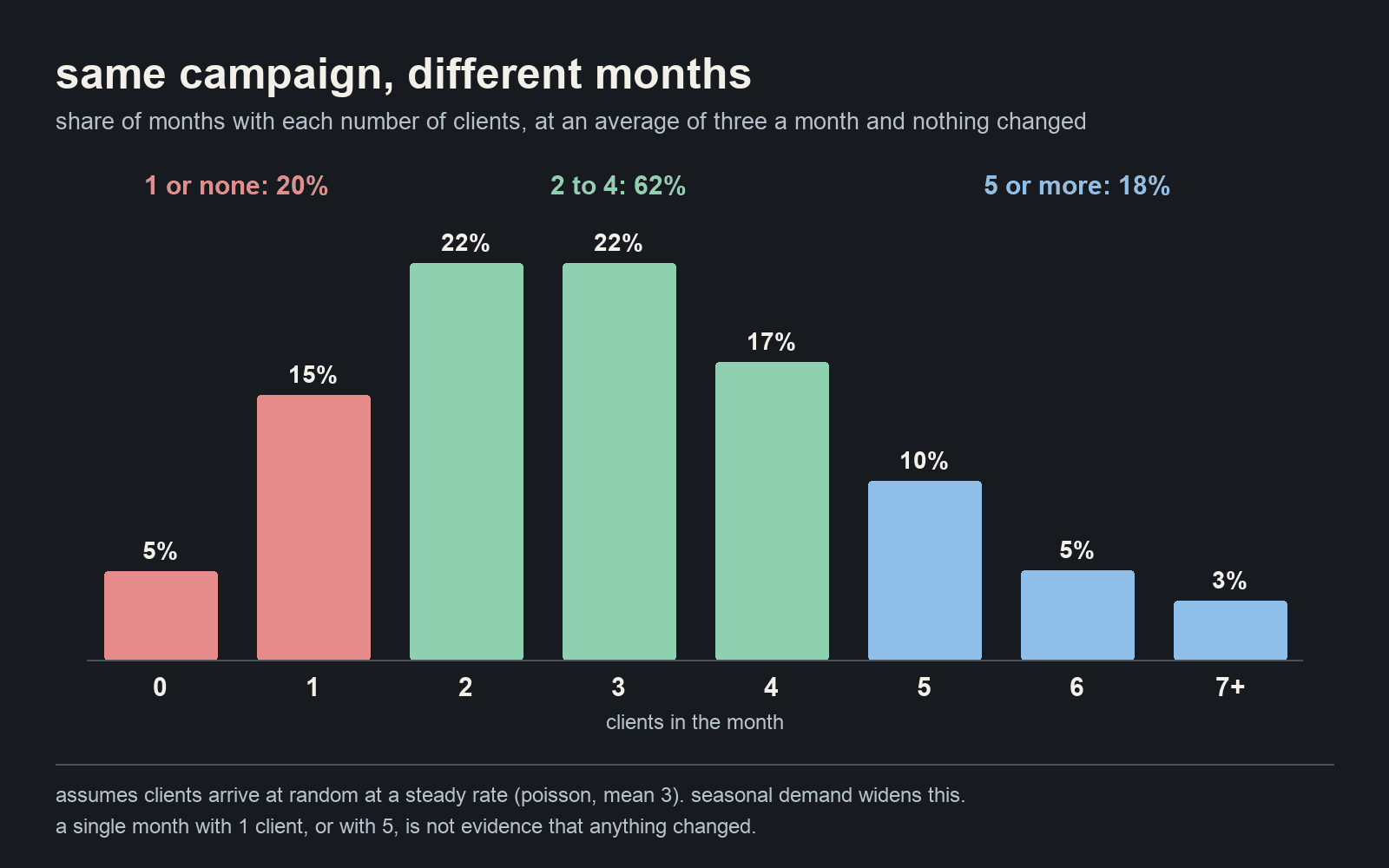
Assumes clients arrive at a steady random rate. Real demand for most services also moves with the season, which only widens the spread.
the fix is to read the stage that has the most events in it. clients are the scarcest number in the chain, so they are the slowest to tell you anything. leads are the most plentiful — at fourteen a month, the count will read between ten and eighteen about three months in four, so a month at eight means more than a month with one client does. booked calls sit in between. use them in that order:
- a test of new creative, a new audience or a new form: judge it on booked calls, over at least four weeks.
- a change to how you sell: judge your close rate only once you have about ten signed clients to judge it on. at three a month, that is a quarter. i worked out where the ten comes from in the piece on what a test has to cost.
- whether the whole thing is working: your cost per client over the last three months, against your ceiling.
and say the target as a range. two to five clients a month at about $200 each is a predictable system. four clients a month, flat, is a wish, and the first month that misses it will get read as a failure.
this also answers the question one person asked before launching: "what is a reasonable expectation for how many booked calls this approach and budget should be able to get?" the honest answer is the budget divided by cost per lead, times the share that book — and the first month is for measuring those two numbers, not for being judged on them. anyone who quotes you a booked-call number before you have run a month is quoting somebody else's rates.
Put new ads on a calendar
the third problem is the one a funnel diagram leaves out entirely.
a service business advertising locally is advertising to the same few hundred thousand people every week. the painter's three ads went to an audience of 170,000 to 200,000. at a steady budget, meta shows the ads first to the people most likely to respond, they respond, and after that the campaign is spending on the same three ads shown to the people who already said no. that is when cost per lead creeps up, and before it creeps up, the people still filling in the form are the less interested ones. the fatigue question at the top put the two together for a reason: tired creative and weaker leads arrive together.
so the predictable part of a predictable system is a calendar entry, not a funnel. a new creative goes in on a fixed day, whether or not the current ones look tired yet — every two weeks is a sensible starting point for a small local campaign, and i went through how to set that frequency properly in the piece on how often to add creatives. add it next to the others as a test; do not replace the one that is working, and do not move the budget to make room for it.
what the new creative is matters more than how often. for a service business, a new ad is a new reason to call, not the same ad in a different colour:
- a finished job. before and after of the kitchen you just did, as a static or a short video, with the area named.
- the owner, talking. a thirty-second video on what happens when they come round to quote.
- the price, said plainly. a starting price in the first line filters better than any form question.
- the objection. the thing people worry about before they book — the mess, the timeline, the deposit — answered in one line.
a business that does the work every week already has the raw material for one of these every week. the photos of last month's jobs are this month's ads.
a new ad every fortnight is only realistic if it doesn't mean a shoot. this is one photo turned into a new ad, step by step: https://clear-cortex.com/playbooks/how-to-make-an-ad?src=x-predictable-clients-mid
One account, worked end to end
back to the painter, and the month from the opening line. the setup, from their post: one campaign, one ad set, three ads, instant forms, a ten-mile radius with 170,000 to 200,000 people in it. they started on a $10 daily budget with another $10 of budget held back to add once something was working; over the month it averaged about $19 a day. their numbers for thirty days:
- $557.58 spent, 14 leads — $39.83 a lead.
- 5 estimates booked — $111.52 an estimate. five of fourteen is about 36% of leads booking.
- 3 jobs closed, at $7,000, $3,000 and $5,000 — $186 a job. three of five is 60% of estimates signing.
- $15,000 of work. an average job of $5,000.
the four numbers. the post does not say what a job is worth after costs, so here is the constructed part, flagged: say the painter is happy to spend a tenth of an average job to win it. that is a ceiling of $500 a job. their two rates multiply to three jobs per fourteen leads, about one lead in five. so the most they could pay for a lead and still sit under the ceiling is $500 × 3/14 — about $107. they are paying $39.83. there is room for the cost per lead to rise to about 2.7 times what it is now before a job costs more than they will pay.
which tells you where not to look. chasing a cheaper lead here is optimising the one number with the most headroom in it. the numbers that would actually move this account are the 36% and the 60%. a 60% close rate on estimates is the business's real asset, and it lives entirely off the ad account — in how fast they ring back and how they quote.
what scaling the funnel would do. say they double the budget on the same ten-mile audience. the extra spend reaches further into it, so say the cost per lead rises to $60 and only one lead in four books instead of one in three, with the close rate holding at 60%. a job then costs $60 ÷ (0.25 × 0.6) = $400. still under the $500 ceiling, so on these made-up rates the scale is worth doing — and the ceiling is exactly what lets you say so. the same sum also tells you where to stop: at a one-in-four booking rate and 60% close, the lead ceiling falls to $75. past $75 a lead, the extra jobs cost more than the painter will pay. that is a line to draw before raising the budget, not after the extra budget has been spent.
is it predictable? not yet, and the post itself shows why. three jobs is one month. at an average of three, next month could bring one with nothing changed, and that would not be the ads failing. fourteen leads and five estimates are the numbers to watch week to week, and the post already tracks cost per booked estimate, which is the right dial.
one thing i would do differently: they made ten adjustments over the month — swapping creative, tightening targeting, moving budget between ads. on fourteen leads, none of those ten can be read on its own. that is not an argument for ignoring the account; their own view is that attention moved the needle, and the attention that clearly did — ringing leads back the moment they arrive — is not an adjustment at all. it is an argument for fewer changes, each one run as a test and given a fortnight of booked estimates to show what it did.
the calendar. three ads into 170,000 people at about $19 a day of budget will tire. the raw material is already in the post: three finished kitchens this month, $7,000, $3,000 and $5,000 of them. that is three before-and-afters — three new creatives, statics or short videos — and a new one every fortnight for a month and a half without anybody picking up a camera for an ad.
so: one good month, the right numbers being tracked, and three things missing — a ceiling written down, a range instead of a target, and a calendar for new ads. with those, about three months from now there will be roughly ten jobs to read the close rate on, and a cost per client that means something. that is when it becomes a system. the month on its own was a month.
The part i cannot prove
the painter's figures are somebody else's account, read from what they wrote about it. i do not run a service campaign at this spend. the cost per estimate and cost per job are their spend divided by their counts; the 36% and 60% are their counts divided by each other. the $500 ceiling, the doubled-budget scenario, and the $40/$90 comparison are made up to show the arithmetic, and say so where they appear.
the month-to-month spread assumes clients arrive at random at a steady rate. real demand for home services moves with the season and with the weather, and an agency's clients arrive in lumps. both make the spread wider than the sums above, not narrower.
the platform features — optimising a lead campaign for a later stage, a form with a review step — are from meta's own documentation and from advertisers describing them. none of it is my measurement.
and there is one thing i genuinely do not know. how much friction is too much? every filter in the section above removes some good leads along with the bad ones. somewhere there is a point where the cost per booked call starts rising again, and i have not seen anyone measure where it sits for a service business. if you have added a qualifying question to a lead form and kept your cost per booked call before and after, i would rather have your numbers than be right.
if any of this is wrong, say so. a correction is worth more to me than agreement.
a calendar of new ads only works if a new ad doesn't cost a shoot. that's the part clear cortex does — the next ad from a photo you already have, for pence: https://clear-cortex.com/?src=x-predictable-clients-end