 Clear Cortex
How to use the pixel without paying it to find the wrong people
10k installs a day. a week later, back to zero.
that was an app company, and they wrote up what happened. the cost per install fell below target, the click rate looked great, meta started spending fast, installs doubled in days. then costs climbed, the people who had installed stopped using it, and within a week the account had drifted back to where it started. they blamed meta, then creative fatigue, and then found the real cause, which was that they had told meta to find installs. it found installs. for a subscription app, as they put it afterwards, "the install means almost nothing."
i went looking for how people think about this and counted 13 separate threads asking some version of the same question: how much does the pixel matter, and what should it be pointed at. in three of them the campaign was already delivering — messages, form leads — and the trouble was who they were coming from. the question at the top of the pile is the plainest version:
"how important is the pixel/tracking data in this process?"
and the same person, in the next breath, guessing at the answer:
"is meta basically just using conversion data to find more people similar to the buyers?"
here is how the rest of them put it:
"we are using reach as objective and "register your interest" form-is pixel worth setting up?"
"with no pixel/CAPI on the destination, what objective and optimization event do you actually run?"
"is it because i chose the wrong campaign objective?"
"what are you guys doing on the meta side (creative, offer, form strategy, targeting, copy, etc.) to improve lead quality and booking rates without killing volume too much?"
the usual answer to the first one is that the pixel is everything. install it, add the conversions api, test it until it is clean, then let the pixel find better audiences and it will find your buyers. i think that answer is wrong where it matters, and it is costing people money. the pixel does not learn your buyers. meta learns whoever does the one thing you told it to count, and on most small accounts that thing is not a sale. it is a click, a chat, a form, an add to cart, an install. a perfectly installed pixel pointed at the wrong event does not fix that. it finds the wrong people faster, and it reports the result as a cheaper cost per result.
one boundary before the method, because i have written the neighbouring pieces and this is not them. whether the pixel is firing at all, whether the platform's purchase count matches your orders, whether the conversions column is counting junk alongside sales, how platform roas compares with what the bank says — those are separate. this one is about the event your ad set optimises for: what it does to who sees your ads, and how to check every week that it is still pointed at money.
so here is the whole thing. the two jobs the pixel does and the one that spends your money, what "find more people similar to the buyers" actually means, where your pixel goes blind, the one ratio that shows when a cheap result has stopped being a sale, and how to move the event closer to the money in the order to try it. then the whole method run on the account from the question above, a $250 first week selling supplements through whatsapp. about twenty minutes with numbers you already have. nothing is held back and there is no gate on any of it.
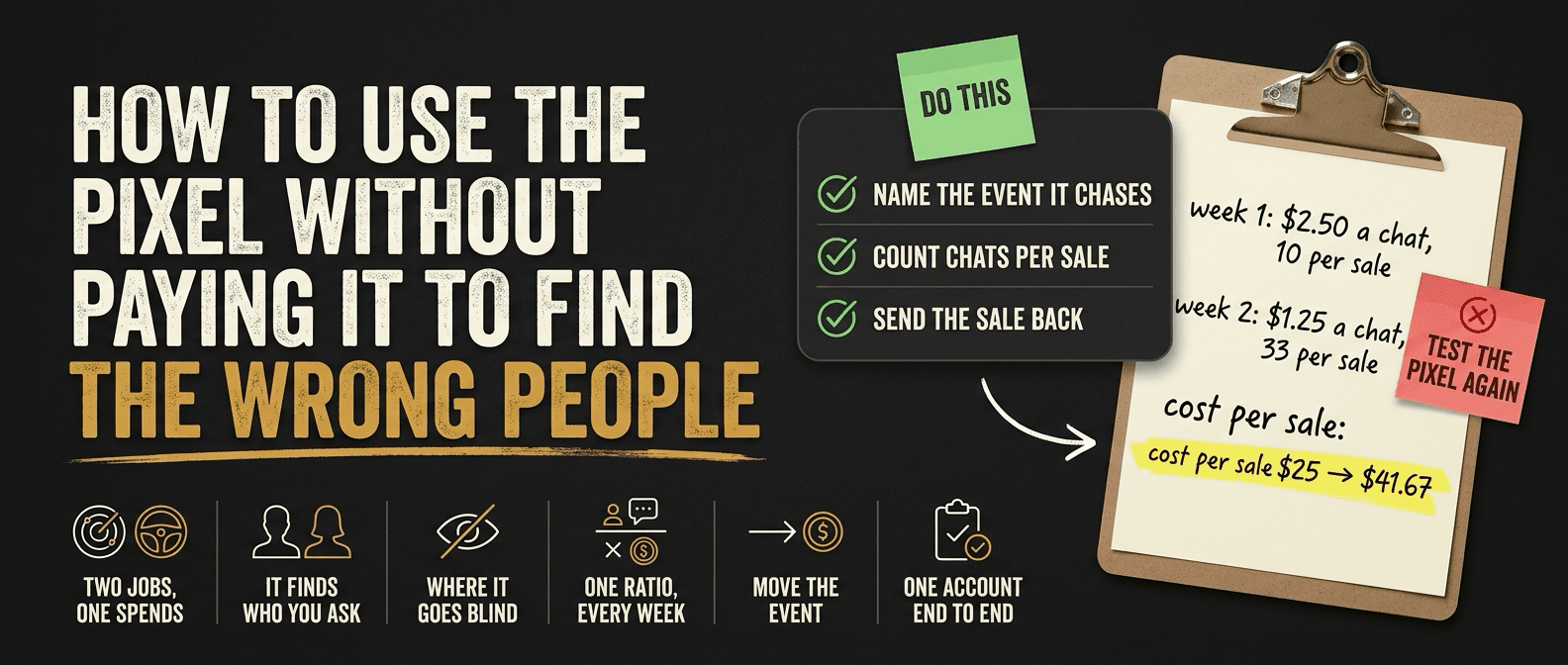
the cover on this piece was made in clear cortex for about 8p, on the cheapest model that could spell the headline. that's the studio i'm building, and it's the only ask in this piece: https://clear-cortex.com/?src=x-pixel-signal-top
The pixel has two jobs, and only one of them spends your money
start by separating them, because almost every confused answer to the pixel question mixes them up.
job one is reporting. the pixel, and the conversions api if you send events from your server, tells meta that something happened after the ad: a page loaded, a cart filled, a form went in, a purchase completed. ads manager turns those into the results column. this job is about what you can see.
job two is steering. when the campaign's goal is a conversion, meta uses those same events to decide who gets shown the ad next. every auction, it estimates how likely this person is to do the thing you asked for, and it bids for the people most likely to do it. this job is about who you pay to reach. it decides where every dollar of the budget goes, and it is the one that spends your money.
which job the pixel is doing depends on the campaign goal, not on the pixel. that answers one of the questions above directly: with reach as the objective and a "register your interest" form, the pixel does only job one. reach is an instruction to show the ad to as many people as the budget allows, and it does not care who fills in the form. setting the pixel up there is still worth doing — it is the only way to know which ad sent the signups — but it will not make a single signup cheaper, because nothing is steering towards signups. if you want the form to steer, the campaign has to be told to optimise for it.
the reporting job is the one people spend their effort on. one team selling supplements and test kits, six months in and about $30,000 spent on cold traffic, had the pixel and the conversions api in place, deduplicated, managed through a tag manager, tested clean. their own words: "we've tested our pixel over and over in any and every scenario and seems to be fine." it was fine. a clean pixel told them very accurately that they were not selling. the reporting was perfect, and the reporting was never what was wrong.
the steering job is the one almost nobody checks, and it is the one where the money goes.
It finds people like the people who did the event, not like your buyers
so, to the guess in the question: is meta basically just using conversion data to find more people similar to the buyers?
yes — if, and only if, the buyers are what you told it to count. meta has no idea who your buyers are. it knows who did the event the ad set is optimising for. if that event is a purchase, then people like the people who did the event means people like your buyers, and the answer to the question is yes. if the event is anything else, meta is finding people like the people who did that, and calling them results. it is not building an audience of your buyers. it is building an audience of whoever fired the event.
that is where the app company's week went. they optimised for installs, meta got very good at finding people who install apps, and the people who install apps were not the people who pay for subscriptions. their fix was to stop treating every app the same and give each kind its own signal — for the subscription apps, "what matters: trial starts, trial-to-paid conversion, retention." and the line that is really the whole of this section: "a user watching rewarded ads isn't worth the same as one buying an annual subscription." the event has to be the thing that is worth something to you, or as close to it as you can get.
you can see the same thing at the smallest end. somebody running their first campaign for a new instagram page, selling handmade cushion covers and gift hampers starting at ₹2,299, set it up to get whatsapp messages, on an engagement goal. it delivered. the messages came in. and most of them were from people offering to build a website, list the products on amazon, sell marketing services. very few asked about the hampers. their question was "is it because i chose the wrong campaign objective?"
mostly, yes. an engagement goal tells meta to find people who start conversations, and in their case the people quickest to message a brand-new business page were people selling things to brand-new business pages. meta did exactly what it was asked. the ad said the price; the goal did not care.
the instant form question above is the same problem one step later. the forms come in, the volume is fine, and the people who fill them in do not answer the phone. a form goal finds people who fill in forms, and the easiest form in the world to fill in is one that is already pre-filled from their profile. the same post asked whether meta's higher intent form or its conversion leads goal would actually move the needle. of everything on their list, the conversion leads goal is the only one that changes the event, so it is the one most likely to — the rest of the list, the creative and the qualifying questions, change who fires the event, which is the other half of the fix and comes later.
this is what the common advice misses. a popular checklist says to avoid traffic and engagement goals and "focus exclusively on purchases for e commerce or leads for service businesses". right about the first half. but for a service business a lead is a form, and a form is exactly the kind of cheap event meta can find a lot of people to do. the advice moves the event one step closer to the money and stops, and the step it stops on is the one the tire-kicker complaints come from.
Where your pixel goes blind
here is the first check, and it takes five minutes.
open the ad set and write down the one event it is optimising for. not the campaign's objective, the performance goal and the conversion event under it: purchase, add to cart, lead, conversations, landing page views, link clicks. that event is the instruction. everything else in the account is downstream of it.
then write out the chain from that event to money, one step per line. for a shop it might be: landing page view, add to cart, checkout, purchase. for a service business: form submitted, phone answered, appointment booked, job sold. for a business selling through whatsapp: chat started, product asked about, price agreed, paid.
now mark two things on the chain. where the optimisation event sits, and where the pixel stops being able to see. those are the two facts that decide how much the pixel matters on your account.
- if the event sits at the money step and the pixel can see it, you are in the case the advice assumes. meta is finding people like your buyers. what matters now is volume, and whether the count is honest, which is a different piece.
- if the event sits before the money step, meta is steering on a proxy. every step between the event and the money is a place where the people it finds can stop being buyers without the dashboard noticing.
- if the money step happens where the pixel cannot see, you are steering blind, and no amount of pixel work fixes it. a sale in a whatsapp chat, a job agreed on the phone, a purchase on someone else's checkout — the pixel never fires on any of them. one affiliate marketer sending traffic to a retailer's page had exactly this: no conversions coming back at all, so meta had nothing to optimise towards except clicks and page views. their question is the right one for anyone in that spot: "how are you structuring creative testing without a clean conversion signal?"
most small accounts sit in the second or third case. the source question is in the third: the company wants to sell through whatsapp, which means the pixel will never see a sale unless somebody sends it one.
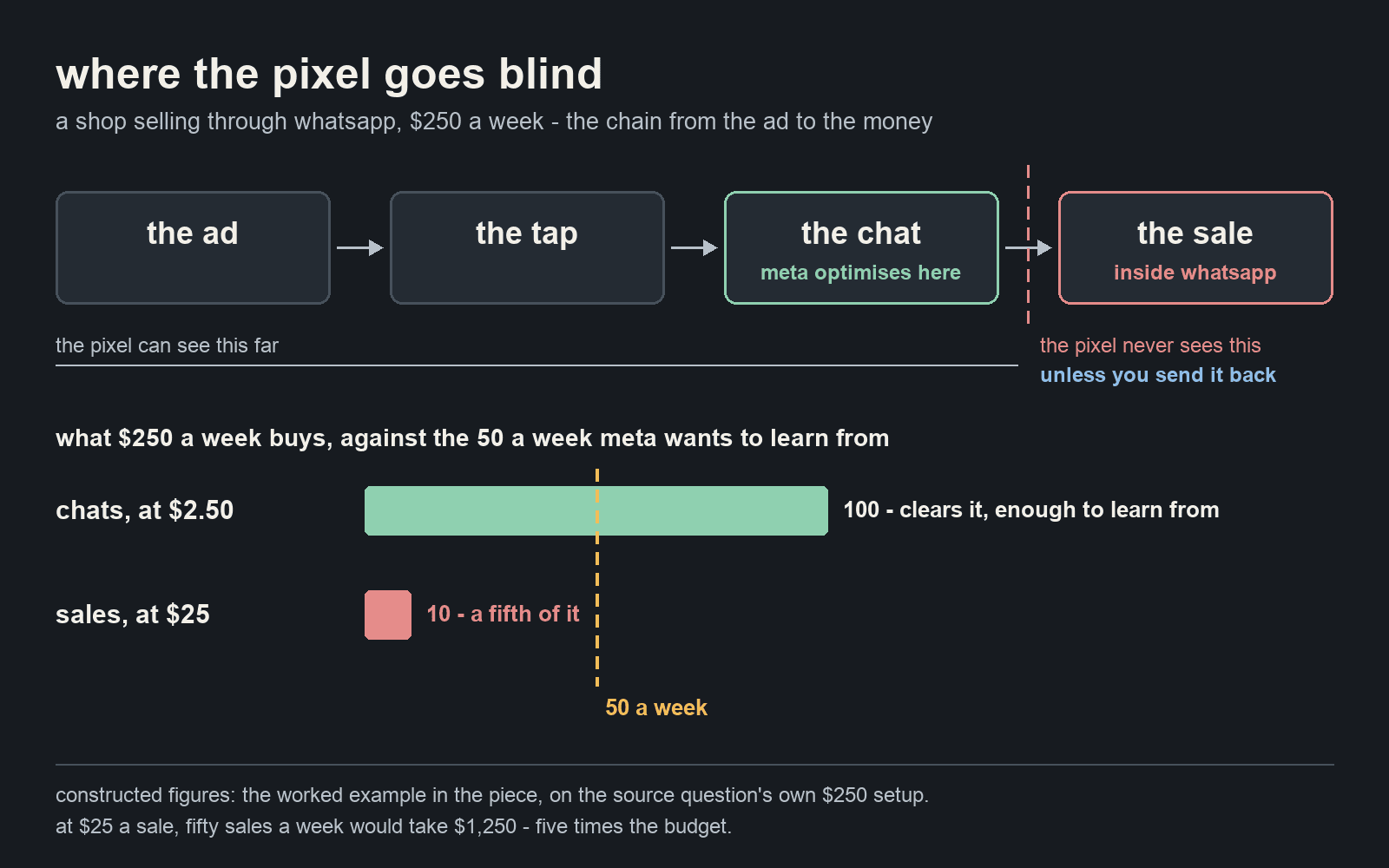
Constructed figures from the worked example at the end of the piece, not an account's. The fifty a week is meta's own guidance for leaving the learning phase.
The one ratio that shows a cheap result has stopped being a sale
this is the check that only this piece has, and it is the one to put in your week.
when the event is not the sale, the cost per result in ads manager is the cost of the event. the number you actually pay is the cost of the sale, and the two are joined by one ratio:
cost per sale = cost per event × events per sale
events per sale is how many of your optimisation events it takes to produce one real sale: chats per order, forms per booked job, add to carts per purchase. you work it out from two counts you already have — the results column in ads manager, and your own count of sales from wherever sales actually land: the shop, the crm, the whatsapp log, the invoice book. one lead-gen advertiser wrote their numbers up exactly this way, with the instrument named: "real CPL (phone number + consent in my crm, not pixel counts) was ~$200." the bracket is the method.
write both numbers down every week, and divide. then read the two halves of the sum against each other.
- cost per event falling, events per sale steady: the cheaper result is real. meta found more people like the ones who were already buying. this is the case where letting it learn works.
- cost per event falling, events per sale rising: this is the one that costs money. meta has found a cheaper kind of person who does the event, and they buy less. the dashboard shows a better cost per result. the sum shows a worse cost per sale. it is often both at once, which is why the dashboard alone cannot catch it.
- cost per event steady, events per sale rising: something after the event broke — the offer, the page, the person answering the chats. that is not a pixel question, and it is not this piece.
it also decides which creative wins your tests. a creative test is scored on the same results column, so when the event is a chat or a form, the winning video is the one that gets the most chats or forms for the money — which is not always the one that sells. a founder video that says the price can lose a test on cost per chat and win it on cost per sale. score every creative test on the ratio as well as the result, or you will scale the creative that is best at attracting people who do not buy, and the more budget you put behind it, the faster meta finds more of them.
the dangerous week is the one where the results column looks best. the app company's dashboard was at its best — cost per install under target, spend climbing — in the days before the account fell over. a cost per result that drops sharply while nothing in the account changed is not a gift. it is meta telling you it has found a new kind of person who does the event. the ratio tells you whether they buy.
if your ad set already optimises for the purchase, events per sale is one by definition, and this check turns into comparing the purchases meta reports with the orders you took — which is the count i covered in the piece on advantage+. the ratio is for everyone optimising on anything shorter of the money than that, which on a small budget is most people.
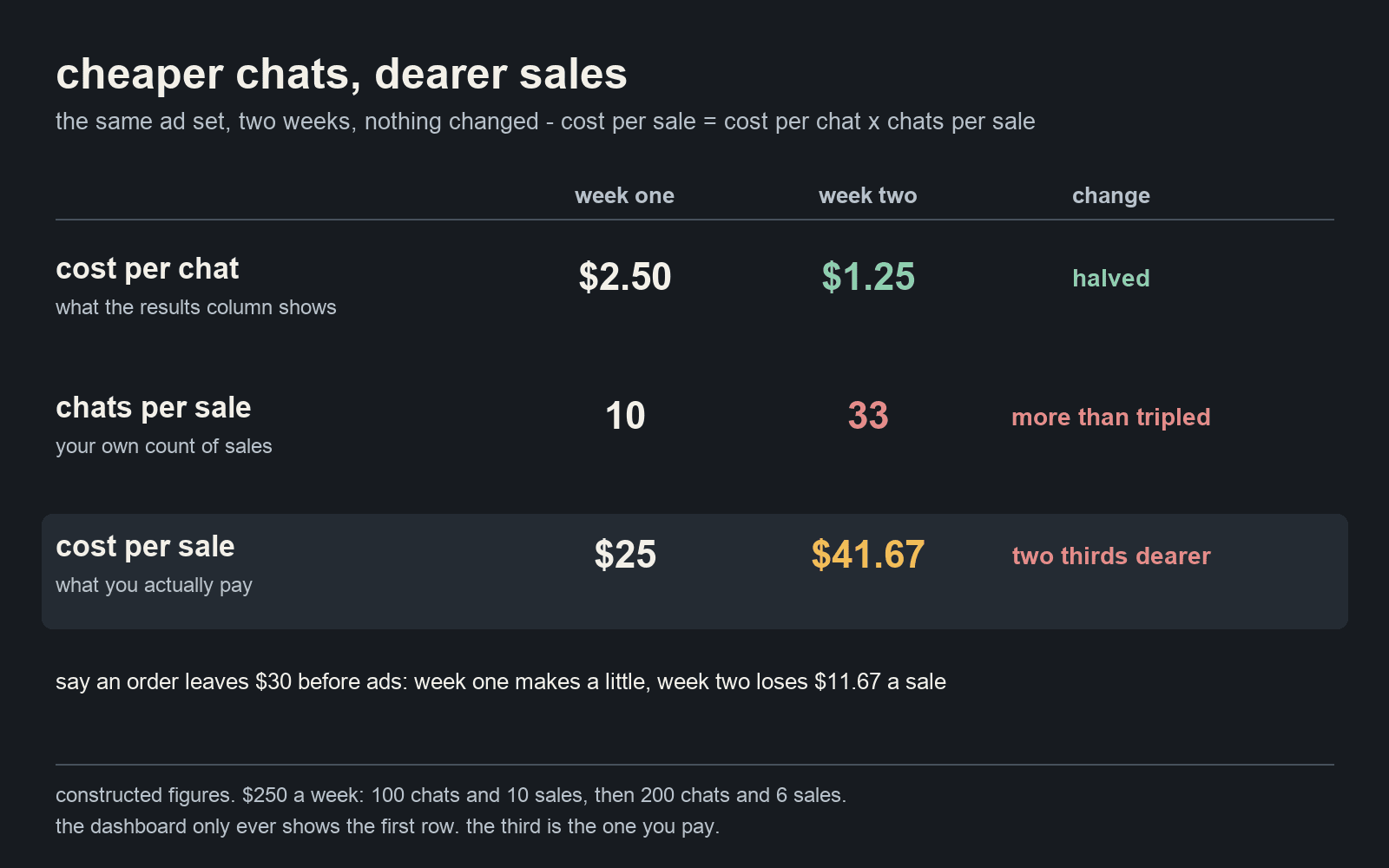
Constructed figures. Cost per sale is cost per chat × chats per sale; the dashboard only ever shows the first half.
Move the event closer to the money, in this order
once the chain is written out and the ratio is running, the fix is to shrink the distance between the event meta steers on and the money. there are four ways, and the order matters, because the first one is the best and the last one is the only option some accounts have.
one: optimise for the money step, if you can see it and afford enough of it. meta's own guidance is about fifty optimisation events a week per ad set to leave the learning phase. one advertiser said it the way most people meet it: "we know our budget is on the lower side and we haven't reached the recommended 50 optimization events yet, so we're wondering whether the rising cpa is simply part of the learning process." if your budget buys fifty purchases a week, optimise for the purchase and most of this piece stops applying to you. if it buys nine, it does not, and pretending it does leaves the ad set learning indefinitely. i worked through the ladder — the deepest step you can afford fifty of — in the piece on new accounts in learning limited. the one thing to add here is that any rung below the purchase needs the events-per-sale ratio running from day one, because the drift lives exactly there.
two: if the money happens where the pixel cannot see, send it back. this is the step the source question needs and the one people skip, because it is admin rather than ads. every sale that happens in a chat, on the phone or in a crm can be sent to meta afterwards — through the conversions api or an offline upload of your own records, matched on the phone number or email the customer gave you. for instant forms, meta's conversion leads goal does the same thing for lead stages: you send back which leads became bookings and it optimises towards those. the affiliate marketer above asked whether it was worth it: "has anyone made offline/manual conversion uploads from impact data work to feed meta?" even when there are too few to optimise on yet, it is worth it, because it turns the sale into something meta can report, and it builds the history you will optimise on, and eventually scale on, once the volume is there. log every sale with the contact it came from, from the first sale. it costs nothing to start and it is the only way the "similar to the buyers" answer ever becomes yes.
three: make the cheap event cost a little more, so it means more. when you cannot move the event, move who does it. the creative is the first filter: a video or an image that says the price, says who it is for, and shows the product doing the thing it does. people who would never buy at that price scroll past instead of messaging, the cost per chat goes up, and the chats per sale go down by more. the same goes for the form — one real qualifying question costs you volume and buys you people who answer the phone. judge the change on cost per sale, never on cost per result. the cost per result will get worse. that is the filter working.
an ad that says the price and who it is for is a new ad, and it shouldn't need a new shoot. this is one product photo turned into a new ad, step by step: https://clear-cortex.com/playbooks/how-to-make-an-ad?src=x-pixel-signal-mid
four: if nothing can come back, treat the event as a steer and score by hand. some setups really cannot return a sale — traffic sent to someone else's checkout with no data shared back. there, if any page of your own sits between the ad and the checkout, optimise for the deepest event that page can fire — a landing page view beats a link click, because it at least proves the page loaded. if none does, the click is what is left. either way, judge every creative on the revenue you can tie to it yourself — sub-ids, tagged links, codes. meta is steering on a proxy and you know it is. your job is to make sure the proxy is not the thing you are scoring on.
what not to do is the thing the common advice leads to: keep perfecting the pixel. a fifth test of the purchase event does not change which event the ad set steers on. a new pixel does not either — it only throws away the history the old one had. the work that changes who sees your ads is all in the four steps above, and none of them is a tracking project.
The account from the question, worked end to end
this is the account the source question came from. the setup is theirs, from their own post. the numbers after it are constructed — they had not launched when they asked — to show what each check finds. put your own in.
the setup. a friend's company selling protein, creatine and other supplements, on an island, so cheaper reach than the us. "we're starting with a small budget of $250 for the first week." the plan: sell through whatsapp, with either a sales campaign or a lead campaign that drives people into whatsapp conversations. their questions, in their order, were what to do if nothing sells, how to scale, and how important the pixel is.
the chain. ad, tap, whatsapp chat, product asked about, price agreed, paid. the event the campaign can optimise on is the chat starting. the sale happens inside whatsapp. the pixel never sees it. this is the third case from the chain check — steering blind — before a single dollar is spent.
can it optimise for the sale? say a sale costs about $25 of ad spend. a $250 budget buys ten sales in the week. meta wants about fifty to learn from. ten is a fifth of that, and getting to fifty at $25 a sale would take a budget of about $1,250, five times what they have. so the honest answer to "is meta basically just using conversion data to find more people similar to the buyers?" is: not on this budget, not yet. with perfect tracking and every sale sent back, ten buyers a week is not enough for it to find people like them. what it can learn from is the chat.
so optimise for the chat, and run the ratio. say a chat costs $2.50 in week one. the budget buys 100 chats, which clears the fifty comfortably, so the ad set can actually learn. say ten of those chats become sales. chats per sale: 10. cost per sale: $2.50 × 10 = $25. say the margin on an order leaves $30 before ads. week one makes a little money.
week two is the trap. nothing is changed. meta has learnt who starts chats, and it finds cheaper ones: the cost per chat halves to $1.25, and the same spend buys 200 chats. the results column has never looked better. but only six of the 200 buy. chats per sale: about 33. cost per sale: $1.25 × 33.3 is about $41.67 — two thirds dearer than week one, and $11.67 a sale over the $30 margin. the advice in the air at this point is to scale the winner — raise the budget on the creative with the cheapest chats. scaling it would spend more of the budget on more of the people who chat and do not buy, and a creative test scored on cost per chat would crown exactly the wrong video.
what the ratio says to do. the cost per chat fell and the chats per sale more than tripled, which is the second line of the read: meta has found a cheaper kind of chatter. the fix is not a new pixel and not a new campaign.
- send every sale back. from the first week, log each whatsapp sale with the customer's number, and send them to meta through the conversions api or an offline upload. at ten it is not enough to optimise on. it is the history that will be, and it makes the sale visible in ads manager next to the chat.
- filter in the creative, then test it on the ratio. put the price and who it is for in the video and in the whatsapp greeting, so the people who were never going to pay for a tub of protein at that price do not start the chat. a chat at $3 that turns into a sale one time in eight costs $24 a sale — cheaper than a $1.25 chat at one in 33, even though the results column says it is more than twice as bad.
- move the event when the sales let you. when the sales sent back reach about fifty a week, the ad set can optimise for the sale itself, and only then does "find more people similar to the buyers" describe what is happening.
so how important is the pixel here? for reporting, important — without the sales sent back, this account cannot even see its own cost per sale in one place. for steering, on a $250 budget, the event matters far more than the pixel, and the event they choose on day one decides who they spend the budget reaching for the whole month — and which creative they end up scaling.
The part i cannot prove
how delivery steers on the optimisation event, the fifty-a-week guidance, the conversions api, offline uploads and the conversion leads goal are all platform behaviour from meta's own documentation, and the names of goals in ads manager change often enough that you should check the current one in your own account. none of it is my measurement. i do not run an account selling through whatsapp, and the worked example is constructed on the source question's setup, not taken from their results. the app company, the hamper seller and the form advertiser are other people's accounts, read from what they wrote.
events per sale is a ratio, not a test. it moves for reasons that have nothing to do with delivery — a slow week, a stock-out, a new person answering the chats — and two weeks is a short run to read a drift from. read it over several weeks, and look for the shape in the second line of the read, the cost per event falling while the ratio climbs, before you act on it.
and there is one thing i genuinely do not know. how many sales a week does meta need sent back before steering on them beats steering on a cheaper event that drifts? the guidance says about fifty. people running small accounts say they get good results on fewer, and the app company found that even plenty of a cheap event was worse than fewer of the right one. i have not seen anyone measure the crossover. if you have moved an ad set from a cheap event to the real one and kept both sets of numbers, i would rather have your numbers than be right.
if any of this is wrong, say so. a correction is worth more to me than agreement.
the cheapest filter in this whole piece is the ad itself — one that says the price and who it is for before anyone taps. that's the part clear cortex does: the next ad from the product photo you already have, for pence: https://clear-cortex.com/?src=x-pixel-signal-end