 Clear Cortex
Why AI UGC converts worse, and the two accounts where it doesn't
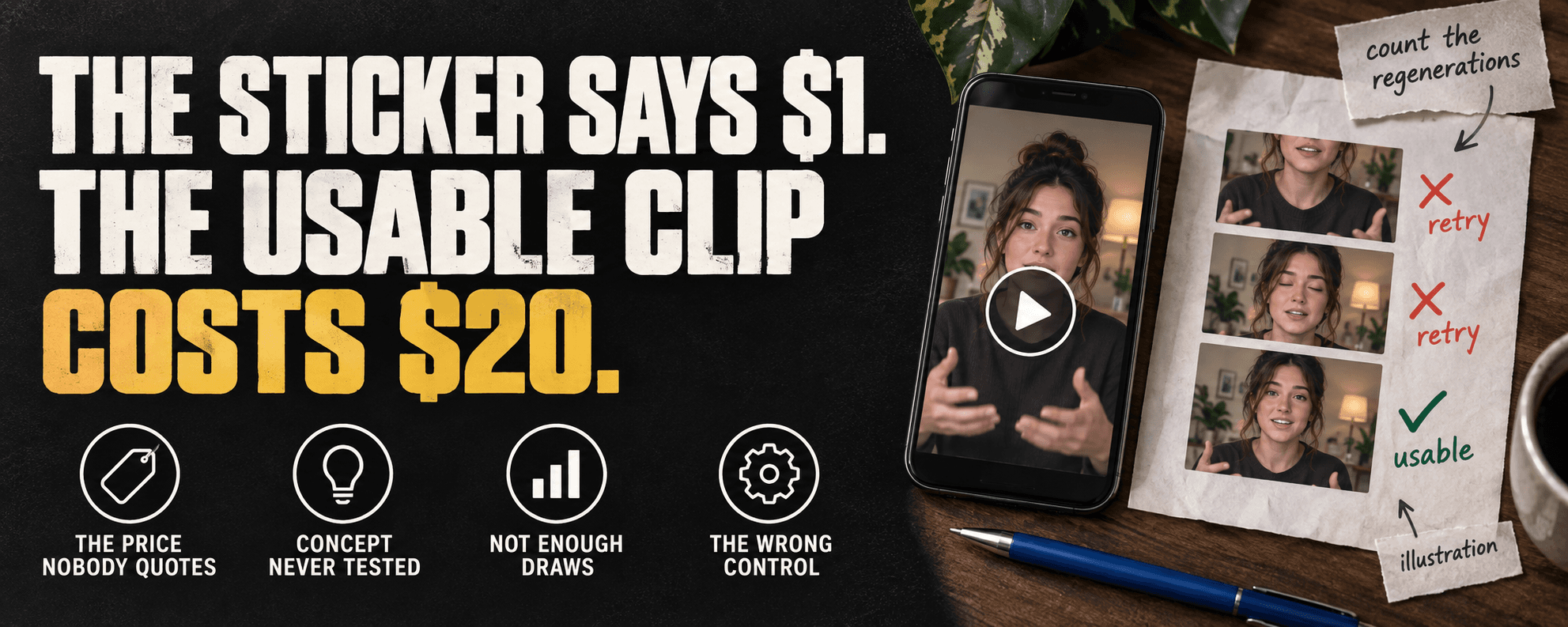
$20 a clip once you count the regenerations.
i went looking for whether AI UGC actually converts worse and read 53 lines from people running it, across 34 threads. the corpus contains both answers, stated flatly, by people with live accounts:
"the AI clip is $20+ once you count regenerations, gets buried by the platform, and converts worse."
"6.2 roas stable on meta. automated scene generation, every language supported, 1 prompt."
neither of them is lying, and the difference between them is not the tool. they are running different things in different places, and once you can name the difference the question stops being "does AI UGC convert worse" and becomes answerable.
so here is the whole thing: the three real reasons it converts worse when it does, the two account shapes where it beats the alternative, the price nobody quotes, and the test that tells you which one you are in for about £200. about fifteen minutes, nothing held back, no gate on any of it.
the price nobody quotes
start here, because most of the argument is downstream of an arithmetic error.
the number everyone repeats is the sticker price. a clip is a dollar, or five dollars, or free on a plan you already pay for. the number that matters is what a usable clip costs, and the corpus has it:
"the AI clip is $20+ once you count regenerations"
that is the same number arrived at from the other end by someone who tracked it:
"it took me like 10 minutes and cost less than $1 to create"
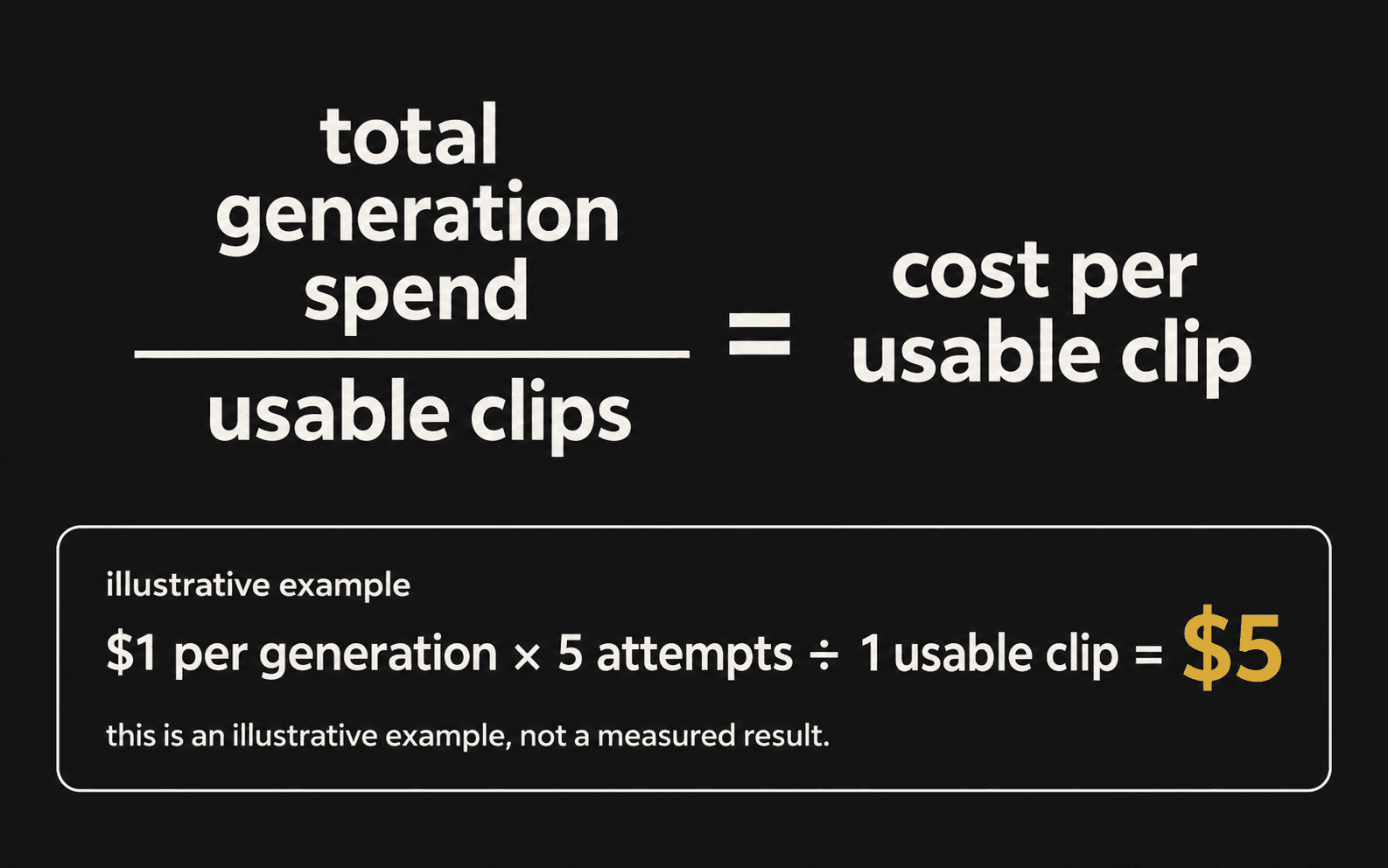
both are true and they are measuring different things. the second is one generation. the first is the number of generations it took to get one you would actually run. if four in five come back with a hand that has six fingers, a product that morphs, or a delivery that is flat, your real cost is five times the sticker.
this is the single most common way the maths goes wrong, and it goes wrong in the optimistic direction, which is why people are surprised later. it is also why "AI is cheaper" and "AI is not that cheap" are both defensible positions — one is quoting the price and one is quoting the bill.
work in cost-per-usable-clip from the start. it is the only figure that compares to what a creator charges.
the three real reasons it converts worse
when it does convert worse, it is almost always one of these, and none of them is "AI is bad".
1. the concept never got tested, because rendering felt like working
a human creator costs enough that you think before you brief. at a dollar a clip you skip that step, generate forty, and discover that forty variations of a weak idea all perform like a weak idea.
there is a line in the corpus that quietly makes this point:
"created 15 ai ugc ads, which took me around 5 hours start to finish"
fifteen ads in five hours is genuinely fast. it is also fifteen chances for the same underlying claim to fail, if the claim was picked in the first ten minutes and never questioned. volume multiplies whatever you had. if what you had was untested, you now have forty untested things.
2. the account cannot afford the volume the method needs
the accounts winning with AI UGC are buying their answer statistically — running enough variations that the winner surfaces on its own. that works when you have the conversions to read it.
if you are running four creatives on £400, you do not have the draws. you get a hundred impressions each, no conversions, and you conclude they were bad. they might have been. you cannot tell. you never bought an answer, and the AI had nothing to do with it — the same thing would have happened with four human-shot videos.
so "AI UGC converts worse" is frequently a sample-size result wearing a technology costume. it is the most common misattribution in this whole topic.
3. it is being judged against the wrong control
"CPA sitting in the high $20s, separating it from all that AI junk."
that is a real result and it is also an unfair comparison unless the two ran against the same audience, at the same time, at the same budget. a creator's best video from a shoot you commissioned is a selected asset — you already threw away the takes that did not work. an AI batch is usually run unselected. comparing a curated human clip to an uncurated AI batch and concluding the technology is worse is comparing the shortlist to the applications.
the two accounts where it wins
now the other side, honestly, because the corpus has those too.
the first is volume-constrained accounts. you have spend, you have conversions, and your bottleneck is that you cannot produce creative fast enough to feed the account. this is the shape where AI UGC is not slightly better but categorically better — the constraint it removes is the exact one you have. the 6.2 ROAS line above comes from an account running automated scene generation across every language, which is a volume problem no human production schedule solves at any price.
the second is the untested-angle problem. you have twenty ideas about why someone buys and the budget to shoot two. everything about which angle wins is a guess, and the expensive part of finding out is production. here AI is a research tool rather than a production one: render all twenty cheaply, find the two that stop people, and then — this is the part people skip — spend real money making those two properly.
that second pattern is the one the arguing crowd keeps missing, because it does not require AI to be as good as a human creator. it only requires it to be good enough to rank ideas, which is a much lower bar and a genuinely different job.
the test that settles it for your account
about £200 and a week. run this instead of reading another argument about it.
- pick one product and one claim you already believe in. not a new angle. you are testing the production method, so everything else has to be held still.
- make it twice. one AI-generated, one however you make creative now. same claim, same length, same call to action.
- own ad set each, own fixed budget. if they share an ad set the delivery system will pick a winner in the first hours and starve the other, and you will learn nothing.
- write the pass gate before launch. minimum spend per creative and the CPA that counts. decided in advance, or every result reads as encouraging.
- let it spend past the point of comfort. the failure mode is stopping at £40 each and calling it.
then compute cost-per-usable-clip for the AI side including everything you threw away. that is the number that goes against the creator's invoice.
and the honest caveat: n=1 tells you about that claim and that product, not about the technology. it is still worth more than the entire timeline argument, because it is your account.
what usually goes wrong
people run the test inside one ad set and read the incumbent's dominance as a verdict.
people count the sticker price on one side and the full invoice on the other — a creator's fee includes their retakes; your generation cost should include yours.
people fix the render and not the idea. getting the skin right on a claim nobody cares about produces a beautiful ad that does not work.
people generalise from one product. AI UGC on a supplement and AI UGC on a £2,000 B2B product are not the same experiment.
the honest answer
why does AI UGC convert so much worse?
usually because the concept was never tested, the account cannot afford the volume the method needs, or it is being compared against a curated control. all three are real, all three are fixable, and none is a property of the technology.
and where it does win, it wins for a narrower reason than its advocates claim: not that it makes better videos than a person, but that it makes ranking ideas cheap, which is a different job that used to be impossible.
if your bottleneck is production volume, it is the biggest unlock available. if your bottleneck is knowing what to say, it will make you wrong faster.
i'm building the version of this where the claim, the render and the test sit on one canvas, so cost-per-usable-clip is a number you can see rather than one you reconstruct afterwards. if you want to see it when it lands: https://clear-cortex.com/early-access?src=x-03-converts-worse