 Clear Cortex
Why the ads everyone calls slop are the ones that scale
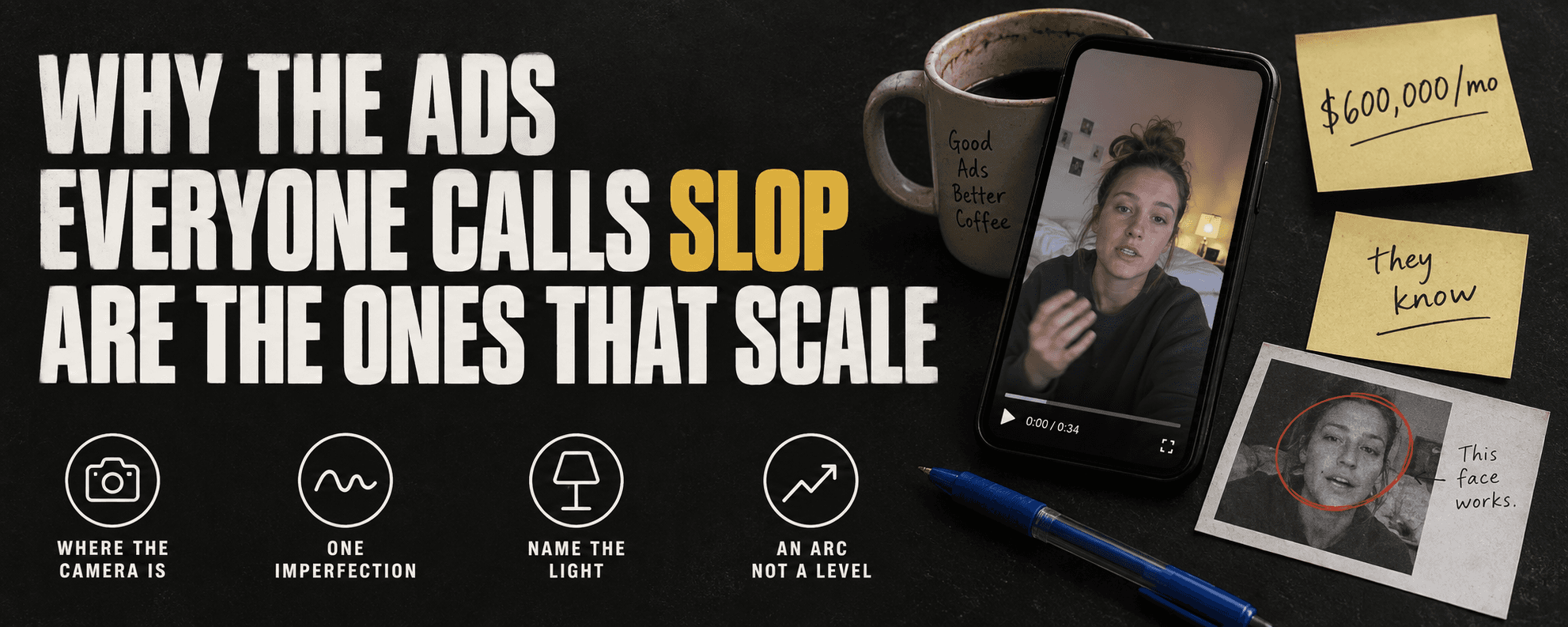
$600,000 a month, on ads the whole feed calls slop.
i went looking for people complaining about how AI ads look and found 65 of them saying it in their own words across ten threads. the loudest line has 19,615 engagements on it and it is a question, not a complaint: "do companies not realize AI ads look genuinely fugly or do they just not care?"
the answer is in the same corpus as the question, four lines down, and nobody puts the two together. they know. it converts anyway. one app is doing $600k a month on AI dancing videos, another $500k a month on what the person posting about it called "literal AI slop". the people running these creatives are not unaware that the videos look cheap. they have a spreadsheet that says it does not matter.
so here is the whole thing: why the feed does not punish an ugly ad, the one case where it does and it costs you everything, and the four prompt lines that fix the specific "plastic" look people are objecting to in these videos. about fifteen minutes to read, nothing held back, no gate on any of it.
the objection, in their words, because it is a real one
these are all real lines, and they are not from people who hate AI:
"the other thing i've realised is that people are sick of ai slop, and ai ads."
"By far the most annoying thing in the majority of ad accounts right now is that there's only genuine AI slop or super lofi UGC converting."
"He got tired of watching AI videos that look decent in a feed thumbnail but fall apart the second someone taps fullscreen and sees plastic skin and dead eyes staring through them."
"so sick of checo's ugly ai ads"
that last one is a customer. the one above it is somebody who builds with this stuff. the objection is not coming from outside the industry — it is coming from inside it, from people running the ads, which is what makes it worth taking seriously rather than arguing with.
why the feed does not punish it
the mistake in the objection is a category error, and it is easy to make because it feels like taste.
a creative is not competing for approval. it is competing for a stop. a video gets served, and that is the whole of it. the platform serves it, a thumb either keeps moving or it does not, and every downstream number follows from that one event. nothing in the auction asks whether the viewer respected the ad. a person can find an ad cheap, ugly and beneath them, stop anyway, and buy — and every metric the account is optimised against records that as a win.
this is not a defence of ugly ads. it is a description of what the machine measures. and once you see it, the $600k app stops being surprising: they are running thousands of near-identical video variations of one product, and being disliked costs them nothing that the system counts.
there is a line in the corpus that states this better than i can:
"People are sick of AI slop in their feed and the genuine-feeling stuff is what converts, so they're using the exact thing everyone's tired of to recreate the one thing everyone wants."
that is the whole mechanic in one sentence, written by someone watching it happen.
the case where it does cost you, and it is not the one you expect
so far this reads as a licence to ship anything. it is not, and the exception is specific.
the creative is fine. the brand is what pays. a video runs for days or weeks; a brand is a thing people carry an impression of for years. the cost of a cheap-looking creative is not paid in that campaign's CPA — it is paid later, in a place your ads manager will never show you, and by the time it shows up in anything you can measure, six months of video have gone out under the same look.
which gives you the actual rule, and it is not "AI ads good" or "AI ads bad":
if the ad is the only thing the customer will ever see of you, cheap is free. if the ad is the first thing they will see of you, cheap is borrowed.
a cooking app with a one-tap install and no repeat relationship is in the first case. that is why the $600k app can run slop indefinitely and nothing bad happens. a brand selling a £200 product that needs someone to come back is in the second, and running the same creatives is spending something that does not appear on the invoice.
most people arguing about this on the timeline are arguing past each other because one of them is in each case and neither has said which.
the thing they are actually objecting to is fixable
here is the part that gets lost in the argument about taste. when people say an AI ad looks fake, they are usually not describing the concept, the script or the actor. they are describing four specific artefacts in the video, and the corpus names all four.
"that flat, plastic, AI slop look"
"plastic skin and dead eyes staring through them"
"you get flat neutral delivery the whole clip"
"if you skip those two fields, you get that flat, obviously AI read"
flat. it comes up four times in four unrelated lines. that is not an aesthetic complaint, it is a technical one, and it points at exactly three things: the lighting is even, the camera does not move, and the performance has no arc.
somebody in the corpus published their fix and said it took one line:
"one line fixed like 90% of my bad AI UGC gens — universal magic prompt to avoid shitty ai videos with plastic skin and floaty camera. just paste it before your prompt: Locked-off camera, real…"
and another gave the opposite half of it — the handheld version:
"subtle handheld motion mimicking a propped-up phone, slight micro-shake from breathing, no static locked-off framing"
read those two together and you get the actual principle, which neither of them states: you are not choosing between locked-off and handheld. you are removing the default. the model's default is a smooth, floating, motionless camera that exists nowhere in real footage, and it reads as fake because no human has ever seen a shot like it. either fix works because either one is a decision. the default is what looks like AI.
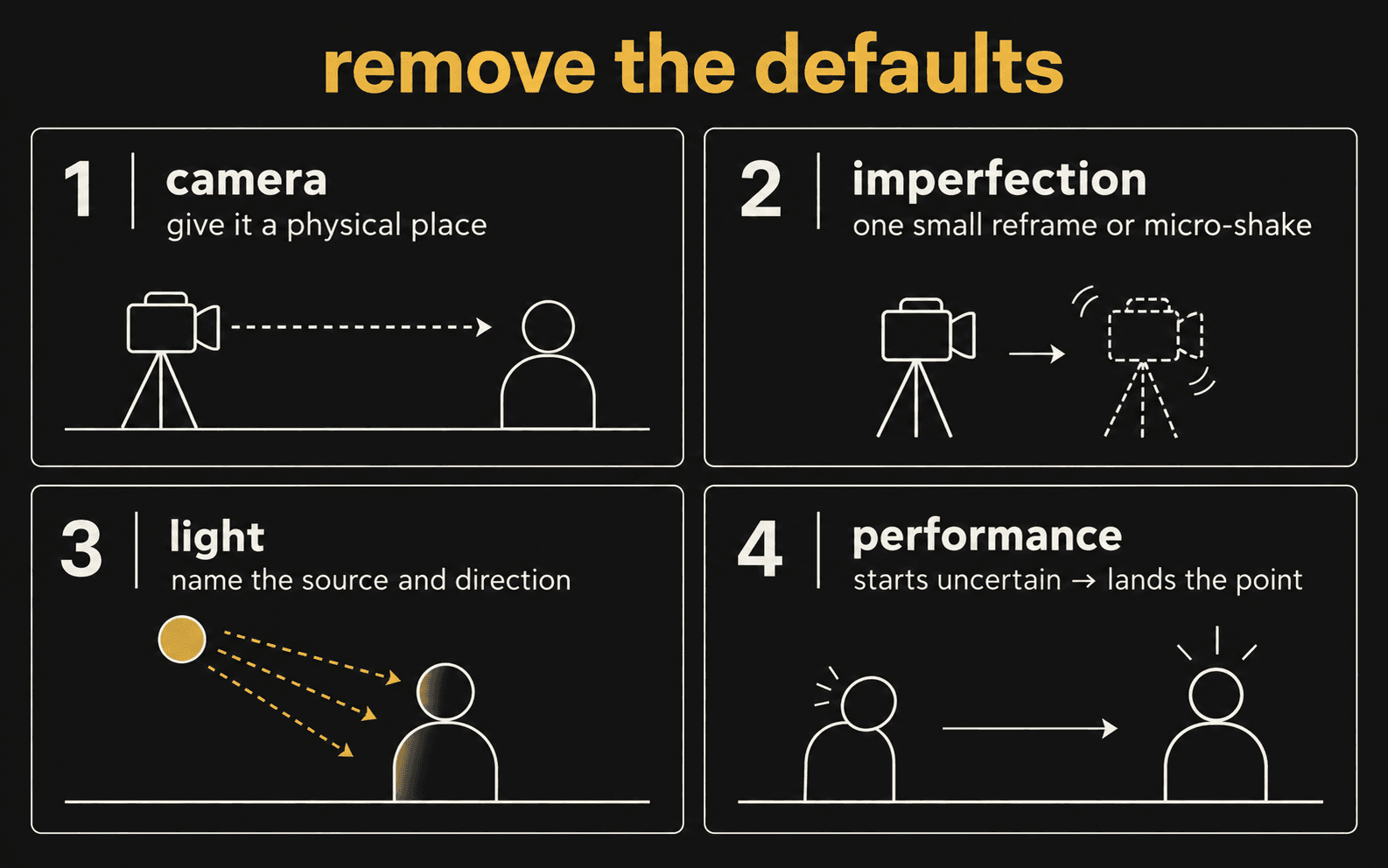
so, concretely, the four things to specify every time:
- the camera's physical situation. propped against something, held in a hand, on a tripod on a kitchen counter. not "cinematic".
- one imperfection. micro-shake from breathing, a slight reframe halfway, focus that hunts once. real footage always has one.
- the light source, named and placed. a window on the left, an overhead kitchen light, a phone torch. even light is the single biggest tell.
- an emotional arc across the clip, not a level. starts uncertain and lands on a point. "flat neutral delivery the whole clip" is what you get when you specify a tone instead of a change.
none of that costs money. it costs a longer prompt.
what usually goes wrong
three failures, in the order people hit them.
the first is fixing the render and not the idea. you can spend a week getting the skin right on a video whose argument nobody cares about, and it will still not work. the render is a floor, not a ceiling — below a certain quality people bounce, above it the concept decides everything. one line in the corpus puts the money on exactly this: "a generic engagement costs you $2k/client in revision rounds." the revisions were not about the skin.
the second is assuming volume substitutes for judgement. the $600k app runs thousands of variations because it can afford to buy the answer statistically. if you are running four creatives on £400 for one product, you cannot — you have to be right more often, and the only thing that makes you right more often is picking better ideas before you render anything.
the third is the one nobody admits: you are the wrong judge of your own ad. you have seen that video eighty times in a preview window at full attention. the person you are selling the product to will see it once, at a quarter of that, at speed, muted, in a feed. "it looks fake to me" is a statement about you at 80 views, not about them at one.
the honest version of the answer
do companies not realise AI ads look fugly, or do they just not care?
they know, and for most of them not caring is a correct read of their own numbers. the feed does not price taste. a creative that gets stopped on and bought from is a good creative by every measure the account is judged by, and no amount of anyone's distaste changes the auction.
but the objection is not wrong, it is misfiled. the thing people are calling ugly is mostly a set of four default settings nobody turned off, and it takes a longer prompt rather than a bigger budget to fix. and the cost of leaving it — where there is one — lands on the brand rather than the campaign, which is why the people running the ads genuinely cannot see it in their dashboard, and why the people objecting genuinely are seeing something real.
both sides of that argument are right about different things. that is why it never resolves.
i'm building the version of this where the brief, the render and the test all sit on one canvas, so the four things above are part of the prompt every time instead of something you remember on a good day. if you want to see it when it lands: https://clear-cortex.com/early-access?src=x-01-ai-ads-look-fugly