 Clear Cortex
How to add creatives without killing your campaign
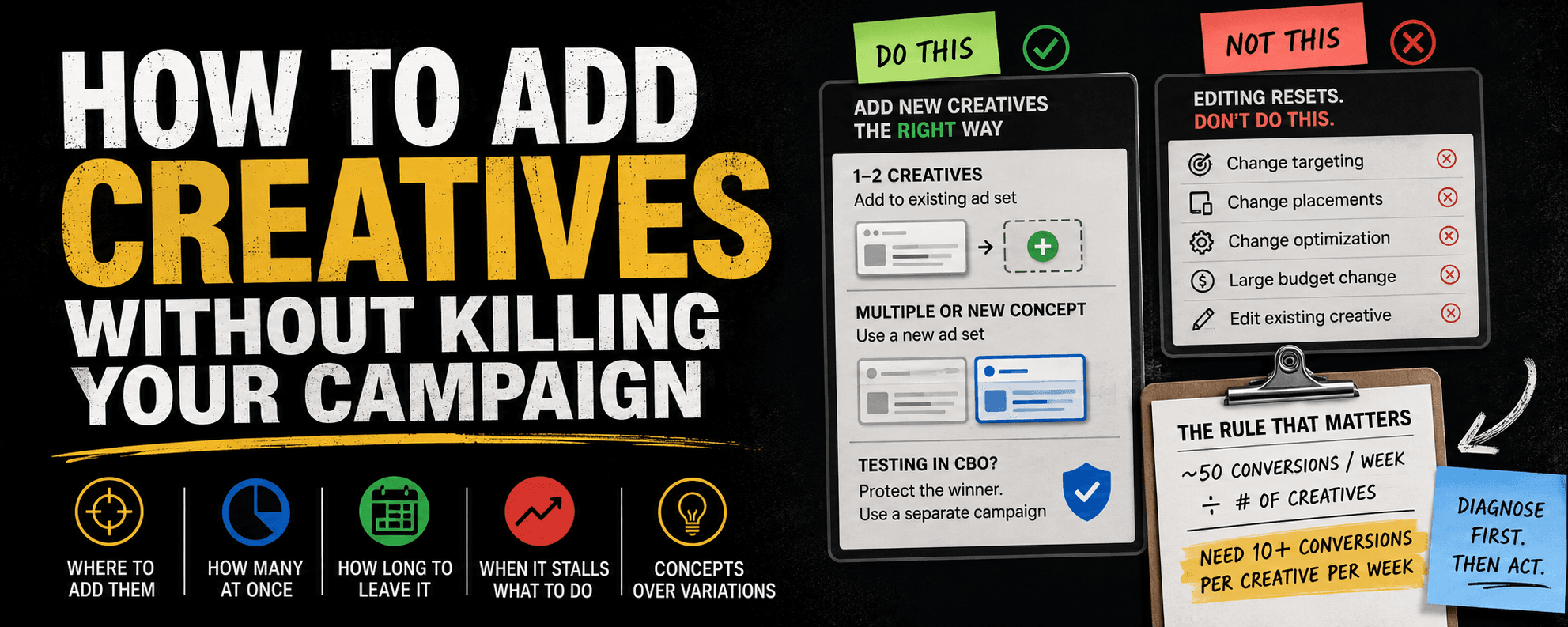
i went looking for a straight answer to this and counted 62 versions of the same question asked in three months. exactly one of them had a method in the replies. everything else was an opinion, a "depends", or somebody offering to audit the account for a fee.
it gets asked six different ways but it is one question. how do you add new creatives without killing the campaign. do they go into the existing ad set or a new one. if it's a new ad set, does that sit inside the same cbo or does it need a fresh campaign. do you just dump everything in and let the algorithm sort it out. how do you give every creative a fair start without needing a separate test budget for each variant. and when the thing stalls, what do you actually do about it.
i'll give you the whole method. there is no link at the end of this.
Everyone has this backwards
start here, because this one misunderstanding causes most of the damage.
adding a new creative to an ad set that is already running does not restart anything. the ad set keeps every bit of history it has built up. you can put a new ad in tomorrow morning and the ad set carries on exactly as it was, with the new creative competing alongside the existing ones for the same spend.
what does restart it is editing the things that were already there. change the targeting, change the placements, change the optimisation event, move the budget in a big step, and the ad set goes back to square one. and — this is the part that catches people — editing the creative on an ad that already exists counts too. not adding a new ad. editing an old one.
so think about who that actually punishes. the person who is being careful, who does not want to disturb a campaign that is working, so instead of adding a new creative they tweak the copy on the one that is already live. that person has just reset their own campaign. the person who piled three new creatives on top and walked away is completely fine.
that is the single most useful thing in this post and it is the opposite of what most people assume.
Where the new creatives actually go
if the ad set is already running properly and you are adding one or two creatives, put them in the existing ad set. they inherit everything it has learned, meta starts reallocating spend between them and the incumbents within a day or so, and you find out quickly whether the new ones are better.
if you are adding a batch — five, ten, whatever a production sprint gave you — put them in a new ad set. same if you are testing a concept that is genuinely different rather than another variation on the thing that already works.
the reason has nothing to do with learning. it is about spend. an ad set has a fixed budget and it splits that budget across the ads inside it, weighted by how they are performing. drop eight new creatives with no history into an ad set that had two proven ones, and the money gets spread across ten ads instead of two. the winner you already had goes from getting most of the budget to getting a tenth of it.
your results drop. nothing broke. you diluted it. and because the drop happens right after you added creatives, the obvious conclusion is that the new creatives are bad, so people pull them and never work out what actually happened.
the cbo version of the question has a specific answer too. someone asked whether a new ad set should sit inside the big cbo campaign or a fresh one, and the answer depends entirely on what you are trying to do. a new ad set inside the same cbo is competing with your existing ad set for the same pot of money — meta will give the budget to whichever looks better, which means your new untested creatives can starve, or worse, they can win early on noise and take budget away from something that was reliably profitable. if the point of the exercise was to protect the winner while you test, a separate campaign with its own budget is the honest way to do it.
How many at once
the number people ask about most is how many creatives to test before deciding on a winner, and the answer is bounded by arithmetic rather than preference.
an ad set needs roughly fifty conversions a week to optimise properly. every creative you add is another thing that budget has to be split across. if the ad set is getting sixty conversions a week and you put ten creatives in it, each creative is getting six conversions a week, which tells you nothing at all. you will look at that data and see noise, and you will make a decision on it anyway.
so work backwards. take your weekly conversions, divide by the number of creatives, and if the answer is under about ten per creative per week you are not running a test, you are generating random numbers. either cut the number of creatives or raise the budget.
this is also the answer to whether you should consolidate. somebody asked whether to go from ten active ads down to four or six proven ones. if the budget is not big enough to give ten creatives a fair read, then yes, consolidate — not because fewer ads is better in principle, but because you are currently paying for data you cannot use.
How long to leave it
give it a week before you look properly, and give it a week from the last significant change rather than a week from launch. if you edited the targeting on wednesday, your week starts wednesday.
inside that week the numbers will swing hard, and the swings are not information. an ad set that has not settled will show you a two hundred percent day and a zero day and neither one means anything. people kill creatives on day two constantly and the creative was fine — it just had not been served enough times to have a real number attached to it yet.
the exception is spend. if a creative has burned through a meaningful chunk of budget with nothing at all coming back, you do not need statistical confidence to turn it off.
When it stalls, work out which problem you have
"stuck" almost always means the campaign cannot get enough conversions to optimise on. that is a budget problem wearing a creative problem's clothes, and it is the most expensive misdiagnosis in the whole thing.
more creatives will not fix it. this is the pattern i see over and over: the ad set is starving, so somebody adds four more creatives hoping one of them breaks through, and now the same too-small budget is being split six ways instead of two. every creative gets less data than before, everything looks worse, and the conclusion drawn is that the creatives are the problem.
three things actually move it. raise the budget until fifty conversions a week is reachable at whatever your cost per result currently is. or consolidate ad sets so that conversions pool into one instead of being scattered across three. or broaden the audience, which gets you to the same place from the other direction. if none of those are available to you, that ad set is not viable at that budget and no creative is going to rescue it.
the other thing worth separating out is creative fatigue, which is a genuinely different failure. fatigue is when a creative worked, ran for a while, and stopped working because the audience has seen it too many times. the tell is frequency climbing while your cost per result climbs alongside it. that one is fixed by new creative, and it is the only one of these that is. a starving ad set and a fatigued creative look similar on the graph and want opposite treatments, which is why the first thing to do when something stalls is work out which of the two you are looking at.
Concepts or variations
there is a decent question in the pile about whether to test completely different concepts first, or small variations of the same one.
different concepts first, every time. a concept is a claim about why someone should buy — the angle, the promise, the problem you are naming. a variation is a different way of saying the same claim. if the claim is wrong, no amount of variation saves it, and you can burn a month producing fifteen versions of an argument nobody cares about.
so test three or four genuinely different claims against each other, cheaply, and only once one of them is clearly working do you start producing variations of that one. it is also cheaper: concepts are a scripting job, variations are a production job.
The mistake that costs the most
somebody sees a campaign stalling, opens it up, and edits it to fix it. new targeting, new budget, tweak the copy. the campaign restarts its clock, and now it is starving and back at zero at the same time.
if the ad set was not getting enough conversions before you edited it, changing the creative resets everything and leaves it starving anyway. you have paid for another week and changed nothing except the date.
when something stalls, the first move is diagnosis, not action. work out whether you are short of conversions or short of fresh creative, because the fix for one makes the other worse.
that is the whole method, and there is nothing held back. if you run meta ads and do any of this differently, say so — i would much rather be corrected than repeat something that stopped being true two platform updates ago. happy to answer anything in the replies.