 Clear Cortex
Are AI talking-head ads worth anything? The $1.40 face and the $400 invoice
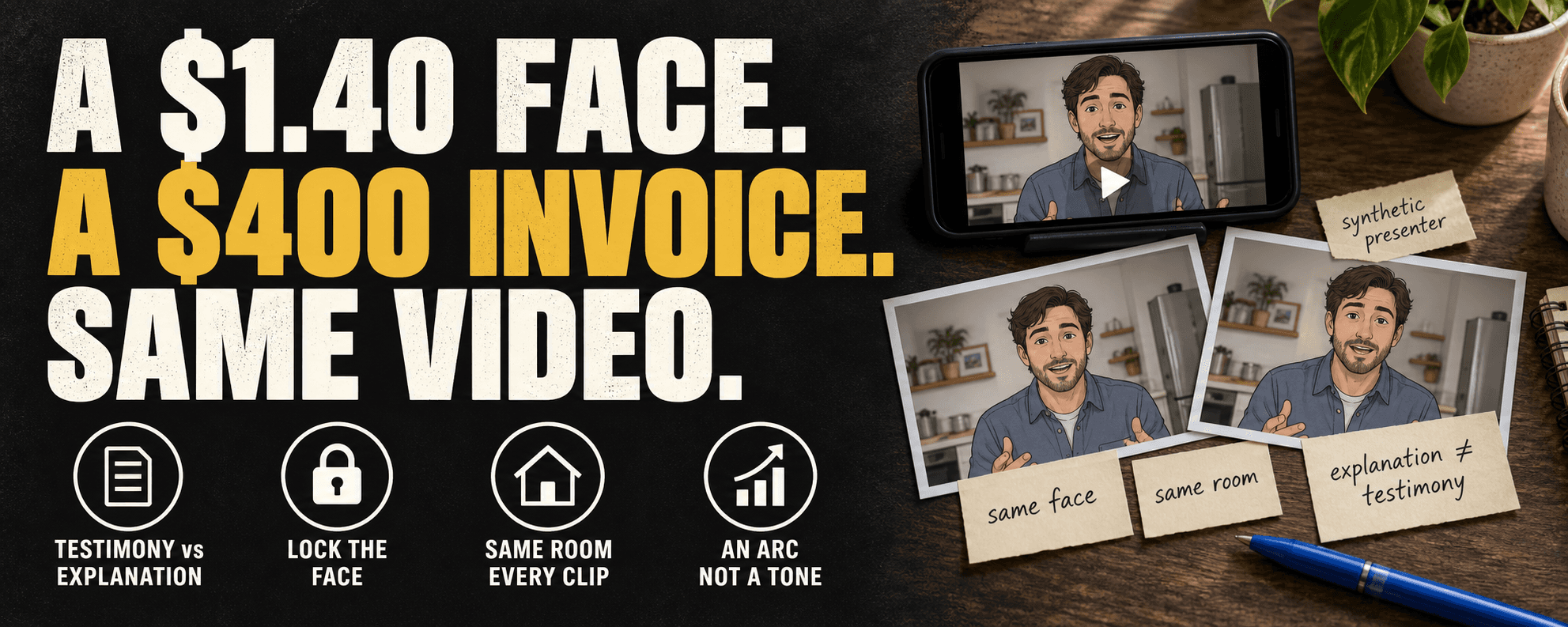
the face is a $1.40 generation. the creator charged $400.
i went looking for whether AI talking-head ads — the ones people call yapper ads — are worth running, and read 133 lines from people making them, across 22 threads. two lines sit at opposite ends of the same job and nobody puts them together:
"Now the face is a $1.40 generation."
"not just a talking head — a UGC creator charges $200 to $600 for this exact video."
that is a 150x to 430x price gap on an identical deliverable, and the argument about whether these ads are "worth anything" is really an argument about what that gap buys and what it costs. one person in the cut says "talking head AI UGC videos like this are a big part of how i do $200k/day". another spent "about 3k + credits before i gave up". both are running the same format.
so here is the whole thing: the one job a talking head does that nothing else does, the failure that eats the entire saving, the four consistency constraints people are actually fighting, and when to spend the $400 instead. about fifteen minutes, nothing held back, no gate on any of it.
what a talking head is actually for
a talking head is the only ad format that makes a claim with a person attached to it.
that is not a small thing. a product shot shows you the thing. a demo shows it working. a talking head says someone believed this enough to say it out loud with their face on it, and the whole persuasive weight of the format rests on that single implication. there is a line in the cut that states the mechanic exactly, in the context of paying a real creator:
"Their face, their credibility, your ad budget behind it."
three nouns, and the middle one is what you are buying. which sets up the honest question about the AI version: when the face is a $1.40 generation, what happens to the credibility?
the answer is more interesting than either camp claims, and it depends entirely on what the face is asserting.
the split that decides it
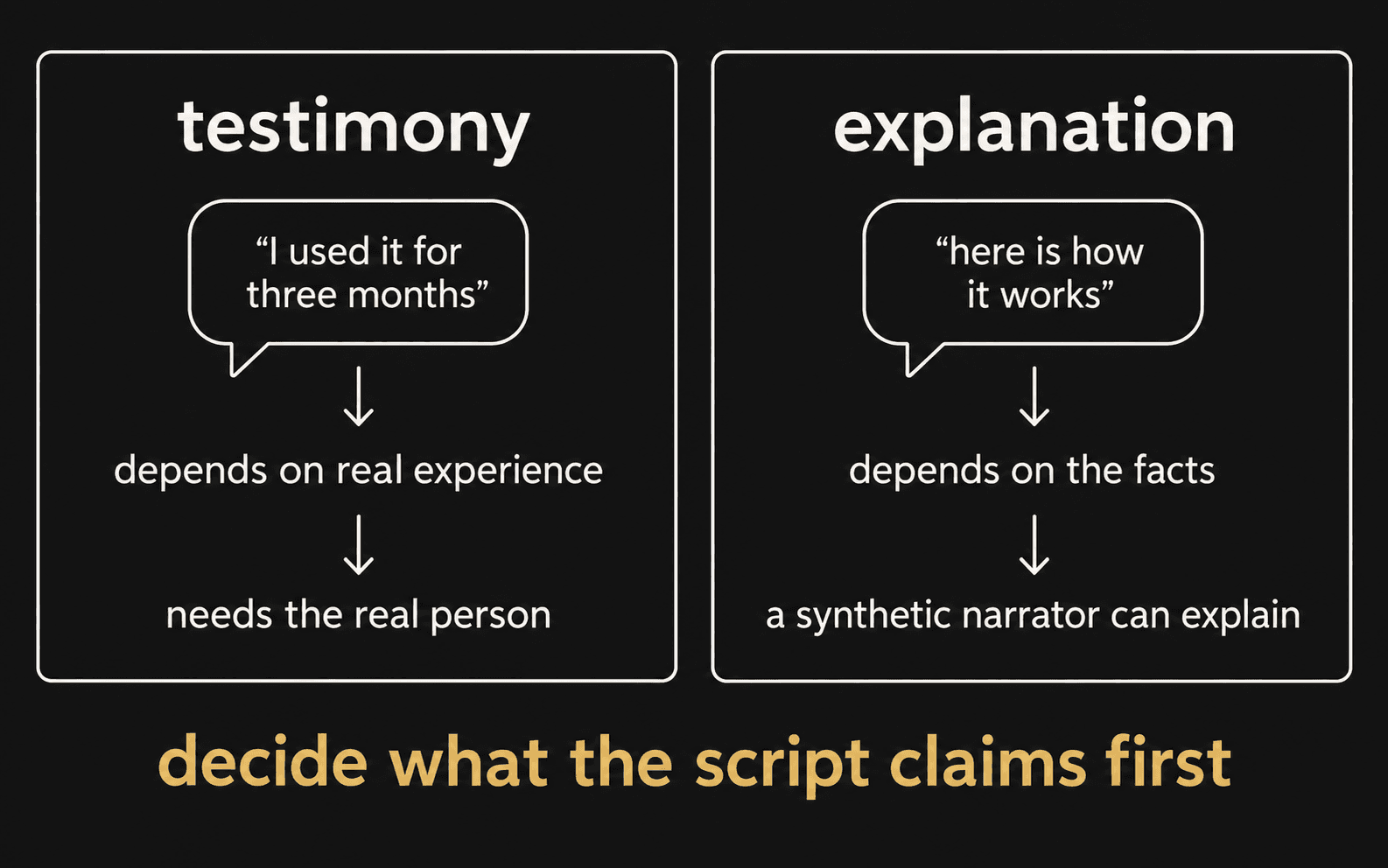
a talking head making a testimonial claim needs a real person. a talking head making an explanatory claim does not.
that is the line, and almost every argument about this format ignores it.
"I've used this for three months and my skin cleared up" is a testimony. Its entire value is that a specific person is vouching. Generate that face and you have not made a cheap testimonial — you have made a fabricated one, and the risk is not aesthetic, it is that the claim is false in a way that matters to a regulator and to a customer who finds out.
"here's the mistake most people make with retinol" is an explanation. it is true or false on its own terms, and nothing about it depends on who is saying it. a synthetic presenter delivering it is doing the job of a narrator, which is a role that has been performed by hired actors reading scripts for a century without anyone calling it deception.
most of the heat in this topic comes from people arguing about the first case using examples from the second, or the reverse. decide which one your script is before you decide whether the format is acceptable, and the question mostly answers itself.
the failure that eats the saving
now the practical half, because $1.40 is not the real number and the cut says why.
"Tired of random AI clips that lose the face, outfit, or room halfway through?"
"No face changes, age changes, hairstyle changes, clothing changes, duplicate people, warped hands, extra fingers, distorted food, floating objects, impossible shadows, inconsistent…"
that second line is somebody's negative prompt, and it is a list of everything that had already gone wrong. the cost of a talking head is not the generation. it is the number of generations you discard before one holds together for thirty seconds.
and that is why the person above burned three thousand credits. a five-second clip is easy. a thirty-second continuous piece to camera, with the same face, the same top and the same room throughout, is a completely different engineering problem — and it is the one the format actually requires, because a talking head that cuts every four seconds does not read as a person talking, it reads as an edit.
two lines in the cut treat solving this as the headline feature, which tells you how hard it is:
"Consistent face, natural handheld camera, full 30-second story — no more broken clips."
"Consistent face, continuous 30-second storytelling, real vlog feel — no more prompt roulette."
"prompt roulette" is the honest name for the default state.
the four constraints, and the order to lock them
so if you are running this format, these are the four things to fix before you generate anything, and locking them in this order costs the fewest retries:
- the face, as a reusable reference. not a description. an actual image you pass every time. describing a face in words produces a different person on every generation — this is the single biggest source of the drift people complain about.
- the wardrobe and the room, named in full, every clip. "the same cream jumper" and "the same kitchen with the window on the left" in every prompt of a set. the model has no memory between generations; every clip is a fresh stranger unless you re-specify.
- the camera's physical situation. propped against something, held in a hand. this is also the fix for the "flat AI look" people complain about separately — the default floating camera exists in no real footage.
- the delivery arc, not a tone. "starts uncertain, lands on the point" rather than "enthusiastic". one line in the cut names the failure: "or you get flat neutral delivery the whole clip".
lock all four before you scale a set, or you will regenerate the same clip forty times and call it a tooling problem.
when to spend the $400
honestly, because the answer is not never.
spend it when the claim is a testimony. covered above, and it is the one that carries real risk.
spend it when the person is the product. a founder-led brand, a practitioner selling their own expertise. there the face is not a delivery mechanism, it is the offer.
spend it when you have already found the winner. this is the pattern most people miss and it is the strongest use of both. render twenty synthetic versions to find out which claim stops people — $28 at $1.40 each — then spend the $400 making the one that won properly, with a real person. you have bought the answer cheaply and paid for quality only where it is going to run.
that is a better use of both budgets than either camp's position, and it needs AI to be nothing more than good enough to rank ideas, which it plainly is.
what usually goes wrong
people generate a face per clip and wonder why the set feels wrong. covered above; it is the same failure as filming with a different actor each day.
people count the sticker price and not the retries. $1.40 × the number you threw away is the real figure, and it is the only one comparable to an invoice.
people put a synthetic face on a testimonial and treat it as a style choice. it is not; it is a claim about a person who does not exist.
people judge the format on their own reaction after eighty previews. you are not the audience, and you have watched it far too many times.
the honest answer
are AI UGC yapping videos valuable?
yes, for explanatory claims, and the value is not mainly the price — it is that finding out which claim works stops being expensive. the $1.40 face is not competing with the $400 creator on quality. it is competing on how many ideas you can test before you commit.
no, for testimonial claims, where the entire persuasive mechanism is that a real person is vouching, and generating the voucher removes the thing being bought.
and the saving is real but smaller than quoted, because the format's actual cost is thirty seconds of consistency, not one generation of a face.
i'm building the version of this where the face, the wardrobe, the room and the script are held on one canvas across a whole set, so the four constraints above are structural instead of something retyped into every prompt. if you want to see it when it lands: https://clear-cortex.com/early-access?src=x-04-yapping-videos