 Clear Cortex
How to know when to scale an ad without scaling a lucky week
$30 a day became $60 on day 7. the cost per lead doubled.
that is somebody's own account of their first scale-up, and they asked the room whether they had gone too early. i went looking for a straight answer on when to scale, and counted 12 versions of the question across 10 separate threads. the thing i did not expect is what they ask about. eight of the twelve are about speed — gradually or aggressively, every day, 20% every few days, whether doubling on day 7 was too fast. exactly one question puts a number of purchases in it at all, and it leaves the number blank.
here is how they put it:
"and what's a realistic timeline and trigger for scaling (increase by 20% every X days after Y purchases, or wait until you exit the learning phase)?"
"how do you know when a campaign is working and when to scale it?"
"how do you usually scale a meta ads campaign—gradually or aggressively?"
"do you guys scale daily?"
"when i doubled budget at day 7, did i scale too fast?"
the good news is that the blank has an answer, and it is not a guess. the Y in that first question — how many purchases before you scale — can be worked out from two numbers you already have: what a purchase costs you — the cost per result in meta ads manager, if you optimise for purchases — and what you can afford to pay for one. the X — how many days between budget increases — falls out of your daily budget and what a purchase costs. and once both are written down, the learning phase stops being the thing you wait for, because it was never measuring the thing you need to know.
the boundary, because there are neighbouring questions. how to raise a budget — the size of the step, the checks before it, going sideways into a new audience — i went through in the piece on raising a winner's budget. when to switch an ad off is a separate piece too. this one is only the clock: how much evidence earns the first budget increase, and how long to leave between the increases after that.
so here is the whole thing, in the order to use it on your next test. why the winner of a test fades, the one line that tells you when a creative has earned more budget, what the learning phase does and does not tell you, how to turn the line into a date for your budget, how long to leave between steps, and one account run end to end. about ten minutes of arithmetic before launch, then one check each time the count moves. nothing is held back and there is no gate on any of it.
the cover on this piece was made in clear cortex for about 8p, on the cheapest model that could spell the headline. that's the studio i'm building, and it's the only ask in this piece: https://clear-cortex.com/?src=x-when-to-scale-top
Why the winning creative fades the week you scale it
start with the opening line, because it is the most common way this goes wrong and it is not the one people think.
the account that doubled on day 7 put it in a sentence: "doubling budget got me barely more leads at 2x the CPL." and the week after the raise, in their own numbers: "week 2 (at $60/day): 20 quiz submissions, $18 CPL, 2.75% click-to-lead conversion." so week one ran at $30 a day and something like $9 a lead. that $9 is what made day 7 feel like the moment to put more spend behind the winning video.
the usual reading is that the budget increase broke it. sometimes it does — a doubling is a big step, and the piece on raising a budget explains why a big step costs you. but there is a second thing going on underneath, and it would have happened at any step size, including none.
the creative you pick as the winner of a test is, almost by definition, the one that got lucky.
sales do not arrive evenly. a video that genuinely costs $25 a purchase will show $18 one week and $33 the next with nothing changed, because a few sales more or less in a small count moves the average a long way. now run a test with four creatives side by side, all of them genuinely $25 a purchase, $200 of spend each. more often than not, the best of the four shows 11 sales or more — about $18 each. it looks like a clear winner, more than a quarter cheaper than it really is. it is not. it is the same creative as the other three, on a good week.
you scale it. the next week it goes back to being a $25 video, which is what it always was. that is a 37% rise in cost per purchase, it lands in exactly the week you touched the budget, and the budget gets the blame.
somebody described the whole pattern without the arithmetic: "a campaign might start out with a few encouraging purchases, but the moment you scale the budget or let it run past a week, the acquisition costs skyrocket and it turns into an expensive cash burner." "a few encouraging purchases" is the phrase to stop on. a few purchases cannot tell a $15 video from a $30 one. and "or let it run past a week" is the giveaway that it is not only the budget — the cost goes up even when nobody touches it, because the first week was the lucky one.
the same order of events turns up in another account. "for the first 10 or so days, the cost per whtsap conversation was really good." then: "after around 18 days, i increased the budget of the winning creative by about 20%." by the time they wrote in, "cost per conversation is around 115% higher than it was in the beginning." i cannot tell from outside how much of that was the budget increase, how much was the creative tiring and how much was a lucky first ten days. neither could they, and that is the point. without a trigger written down in advance, every one of those explanations fits.
this is the fixable part. you cannot stop luck from picking the winner of a test. you can make the winner prove itself past the point where luck is a likely explanation, before any more spend goes behind it. that is all a trigger is.
The trigger is a margin, not a count
the folk answer to the Y is a single number. one of the clearest versions: "once an ad had social proof and around 5–10 purchases, i'd move it into a scaling campaign with a higher budget." other people say 30, or 50.
any single number is right for some ads and wrong for others, because how many purchases you need depends on how far under break-even the creative is. a creative that looks like half your break-even cost needs far less proof than one that looks like 90% of it. one is clearly making money even if you have misread it a bit. the other might be losing money and look fine.
so first, break-even. take the price, minus what the product costs you to make and ship, minus payment fees and what you lose to returns. what is left is the most you can pay for a purchase without losing money on it. write it down before launch.
then the line. a count of sales wobbles by about its own square root — 25 sales could easily have been 20 or 30 with the same creative. allow two of those wobbles and you have a margin wide enough that a lucky run rarely clears it. turned into a rule:
a creative has earned more budget when its cost per purchase is below break-even × (1 − 2 ÷ √purchases).
that looks worse than it is. here it is as plain numbers — how far under break-even the creative has to be, at each count:
- 10 purchases: 63% under break-even
- 20 purchases: 45% under
- 30 purchases: 37% under
- 50 purchases: 28% under
- 100 purchases: 20% under
read the 5–10 purchase rule against that. at 10 purchases, a creative has to be costing you about a third of break-even before the count means anything. some videos are that good, and they clear the line on 10. most winners are not, and on 10 sales they look exactly like the creative that got lucky.
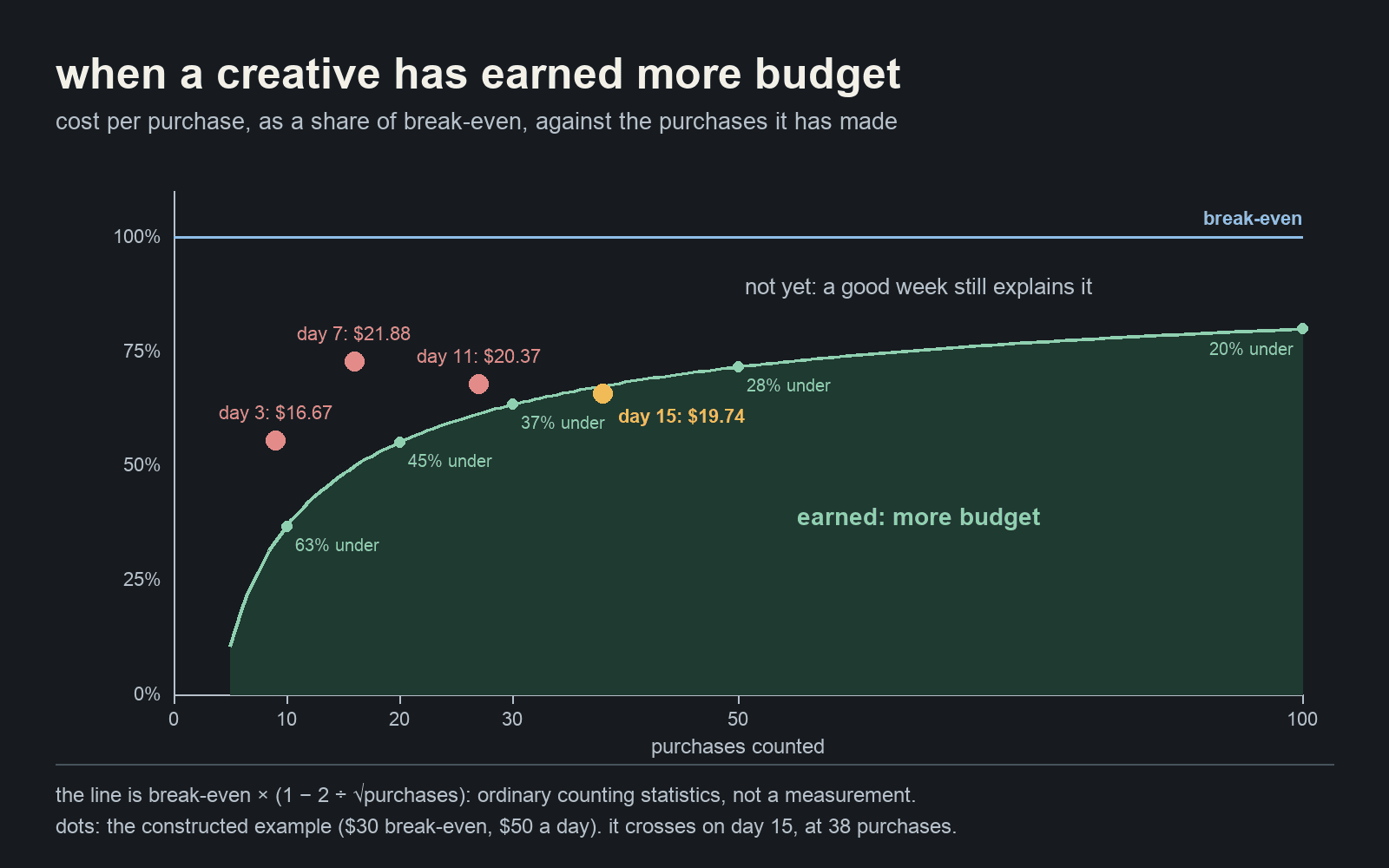
Ordinary counting statistics, not a measurement: the line is break-even × (1 − 2 ÷ √purchases). The dots are the constructed example later in this piece.
turn it round and it tells you Y for any creative. the purchases a creative needs is 4 ÷ (1 − its cost ÷ break-even)². that gives three numbers worth remembering:
- a creative at half of break-even needs about 16 purchases.
- a creative at two thirds of break-even needs about 36.
- a creative at three quarters of break-even needs about 64.
this is the answer to the question at the top, and it is good news in a specific way: the better the creative, the sooner it earns its budget. the video that is genuinely good gets there first. a genuinely great video proves itself in a couple of dozen sales. a marginal one takes a hundred or more, and that is right — an ad at 90% of break-even barely makes money, and scaling it is the most likely way to push it over the line. the rule waits longest exactly where waiting costs least.
it also answers the more general version: "how do you know when a campaign is working and when to scale it?" it is working when it is under break-even. it is ready to scale when it is far enough under break-even, on enough purchases, that a good week is no longer the likeliest explanation. those are different moments, often weeks apart, and most of the damage happens in between.
the person who asked whether to "start with $50 AUD and less ads until the campaign starts converting and then decide to scale the budget" had the order right. the line just tells you what "starts converting" has to mean before the decision is made.
The learning phase is a different clock
the other half of the question was "or wait until you exit the learning phase", and it deserves a straight answer: the learning phase is not a trigger for scaling, in either direction.
what learning measures is whether meta's delivery has settled. an ad set enters it when it launches or after a significant edit, and leaves it after roughly fifty results — fifty of whatever it is optimising for — in about a week. somebody worked it out for a small account: "meta requires roughly 50 conversions per ad set per week to optimize, and with ~1 purchase/day you are giving it only about 7."
that tells you two things, and neither is the thing you need.
exiting learning does not mean the campaign makes money. fifty results at 95% of break-even will take an ad set out of meta's learning phase, and that ad is one bad week from losing money. on the line above, 50 purchases needs the cost to be 28% under break-even. exiting learning is a statement about stability, not about profit.
and not exiting learning does not mean you cannot scale. to reach fifty purchases a week, the daily budget has to be about seven times the cost of a purchase. at a $20 cost per purchase, that is $140 a day. a $50-a-day account at that cost buys about 17 purchases a week and will never exit learning on purchases at all — and it can still have a creative that has clearly earned more budget. waiting for the label in that account means waiting forever. (getting a small account out of learning is a separate job, and i went through it in the piece on learning limited.)
so here is what each clock is for. the trigger line decides whether more budget is earned. the learning status tells you how clean the next read will be — an ad set that is still settling gives noisier numbers after a change, so it gets the full gap between steps, never a shortcut. two clocks, two jobs, and the mistake is reading one as the other.
Turn the trigger into a date for your budget
the timeline half of the question is now just arithmetic. you know how many purchases the creative needs, so you know how much spend it needs. your budget tells you how fast that spend goes out.
days to the trigger = purchases needed × cost per purchase ÷ daily budget.
take a break-even of $30 and two budgets:
- a creative at $15 a purchase — half of break-even — needs about 16 purchases, $240 of spend. at $50 a day, about 5 days. at $150 a day, under 2.
- a creative at $20 — two thirds — needs about 36, $720 of spend. at $50 a day, about 14 days. at $150, about 5.
- a creative at $22.50 — three quarters — needs about 64, $1,440 of spend. at $50 a day, about 29 days. at $150, about 10.
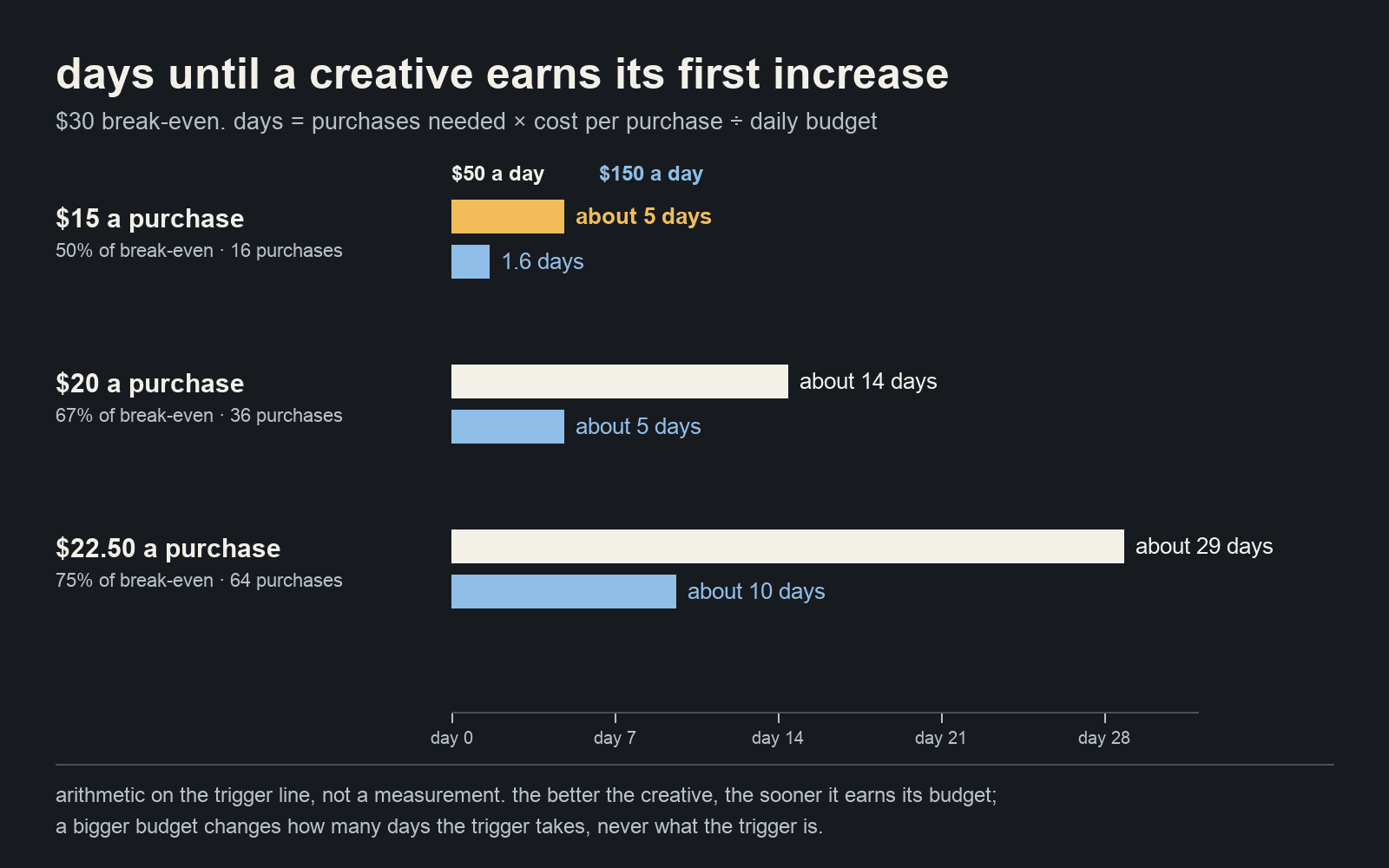
Days = purchases needed × cost per purchase ÷ daily budget. Arithmetic on the trigger line, not a measurement.
so for most small accounts, the realistic timeline from launch to the first raise is one to four weeks, and a genuinely great ad gets there inside one. that is not slow for its own sake. it is how long that budget takes to buy enough sales to tell a real winner from a lucky test.
it also explains why the advice people give each other sounds contradictory. one reply to the beauty brand that asked the question at the top was blunt about the budget: "at beauty CPMs and a realistic 2-3% cvr you're paying $30-50 per purchase early, so $50/day means 1-2 purchases a day and painfully slow learning." and then: "budget: start at $100-150/day, not $50." that is the same arithmetic. a bigger budget does not change what the trigger is. it changes how many days the trigger takes. if you are going to spend the money anyway, a budget that reaches the trigger in a week rather than a month means you find out which creative is real three weeks sooner.
and it puts a number on the advice people give each other most often: "start small, like with $10/day budget and only scale when there is clear signal." right instinct. at $10 a day, a $20 cost per purchase and the same $30 break-even, though, "clear signal" for a good ad is about 36 purchases, and that is around ten weeks. worth knowing on day one rather than finding out on day thirty.
How long between budget increases after that
once the first increase is earned, the X in the question — how many days between increases — is next. the folk answers are all over the place, and they turn out to be the same rule at different budgets:
"winners → move to your main campaign to scale, or raise budget 20–30% every 3–4 days (gradual, so you don't reset learning)."
"if you want to increase the budget then increase it by 15%-20% not more than that once week or when campaign is stable giving you consistent ROAS."
every three or four days, or once a week. both are right somewhere. the gap between increases has one job: to let the spend at each new budget level buy enough purchases to show whether the step held. so:
wait for whichever comes later — three full days, or ten purchases at the new budget.
the three days are there because the first day or two after a change is not a fair read. delivery takes time to settle at a new budget, and in meta's reporting a purchase is credited to the day of the click or view that led to it, so the most recent days keep filling in for a while afterwards. read a step on day one and it looks worse than it is.
the ten purchases are there because three days is meaningless if the budget only buys four purchases in them. at $100 a day and $20 a purchase, ten purchases take two days, so three days is the binding rule and you are on the every-three-or-four-days schedule. at $50 a day, ten purchases take four days. at $30 a day, nearly a week, and that is the once-a-week schedule. same rule, different budget.
which is also the answer to "do you guys scale daily?" at almost any budget a small account runs, a daily increase means judging each step on one or two days of purchases, half of which have not been reported yet. you would be reading the luck from the first section, every day.
the step held if the cost per result since the increase is under break-even. not under the trigger line — the creative already proved itself there, and ten purchases is too few to re-prove anything. this check is a smoke alarm, not a second trial: it catches a step that clearly broke something. if it held, take the next step. if it did not, go back to the last budget that held and stay there, which is a finding rather than a failure.
then one more check, so the smoke alarm is not the only thing watching. once the purchases since the first raise reach about 30, run the trigger line again on them. that is the number that tells you whether the creative you are scaling is still the creative you proved, or whether it has been sliding a step at a time. if it clears, keep climbing. if it does not, stop increasing and hold where you are — the creative is still making money, it just has not shown it can carry more.
and anything you change restarts its own count. swap the creative inside the ad set, change the audience or the optimisation, and the purchases before the change stop describing what is running now. a new video or a new static belongs in its own test, on its own clock, where it can earn its own trigger instead of borrowing the old one's.
that next creative is the part to have ready before the scaled one starts sliding, and it does not need a shoot. this is the whole process from one product photo: https://clear-cortex.com/playbooks/how-to-make-an-ad?src=x-when-to-scale-mid
the size of each step — why 20% and not 50, and what to do when the audience runs out — is the other piece. this one only needed the clock.
One account, worked end to end
here is the whole thing on one ad set. the numbers are constructed to keep the arithmetic clean — they are not from an account i run — and the point is to watch the line make the calls.
a shop sells one product at a price of $45. after the product, shipping, fees and returns come off that price, it can pay $30 for a purchase and break even. it runs one ad set at $50 a day. the video in it is, though nobody knows this yet, genuinely about a $20-a-purchase creative.
day 3. $150 spent, 9 sales, about $16.70 each. that is under half of break-even and it is the day most people put more budget behind it. the line at 9 purchases sits at $10. not yet.
day 7. $350 spent, 16 sales, about $21.90 each. the cost has gone up by nearly a third and nothing about the video or the budget was changed. this is the lucky first three days washing out, and it is the week the budget would have taken the blame if it had been raised on day 3. the line at 16 is $15. not yet.
day 11. $550 spent, 27 sales, about $20.40. the line at 27 is about $18.50. close. not yet.
day 15. $750 spent, 38 sales, about $19.70. the line at 38 is about $20.30. under it. more budget is earned. the ad set is still in learning — at $50 a day and $20 a purchase it buys about 17 purchases a week and never could have left — and it does not matter. the money line says yes.
day 15, first increase: $50 to $60. ten purchases at $60 a day and $20 each takes a little over three days, so the next read is day 19. on day 19: $240 at the new level, 11 sales, about $21.80. under $30. held.
day 19, $60 to $72. ten purchases take just under three days, so three days is the rule. day 22: $216 spent, 10 sales, $21.60. held.
day 22, $72 to $86. day 25: $258 spent, 10 sales, $25.80. under $30, so the step held — but it is creeping up, and the piece on raising a budget explains why higher budgets cost more per purchase.
day 25, the re-check. the purchases since the first raise have just passed 30: 31 of them, on $714, about $23 each. the line at 31 is about $19.20. it does not clear. every step held on its own, and the ad is still making money, but it has not shown it can carry more. so the climb stops here. the ad set stays at $86 a day, and it keeps being watched with the same smoke alarm.
the step it did not take. say they had gone to $100 on day 25 anyway. by day 29: $400 spent, 12 sales, about $33.30 each — over break-even, on ten or more. the step-check would have sent it back to $86 on day 29. the re-check got there four days sooner, before $400 went into a step that lost money on every sale.
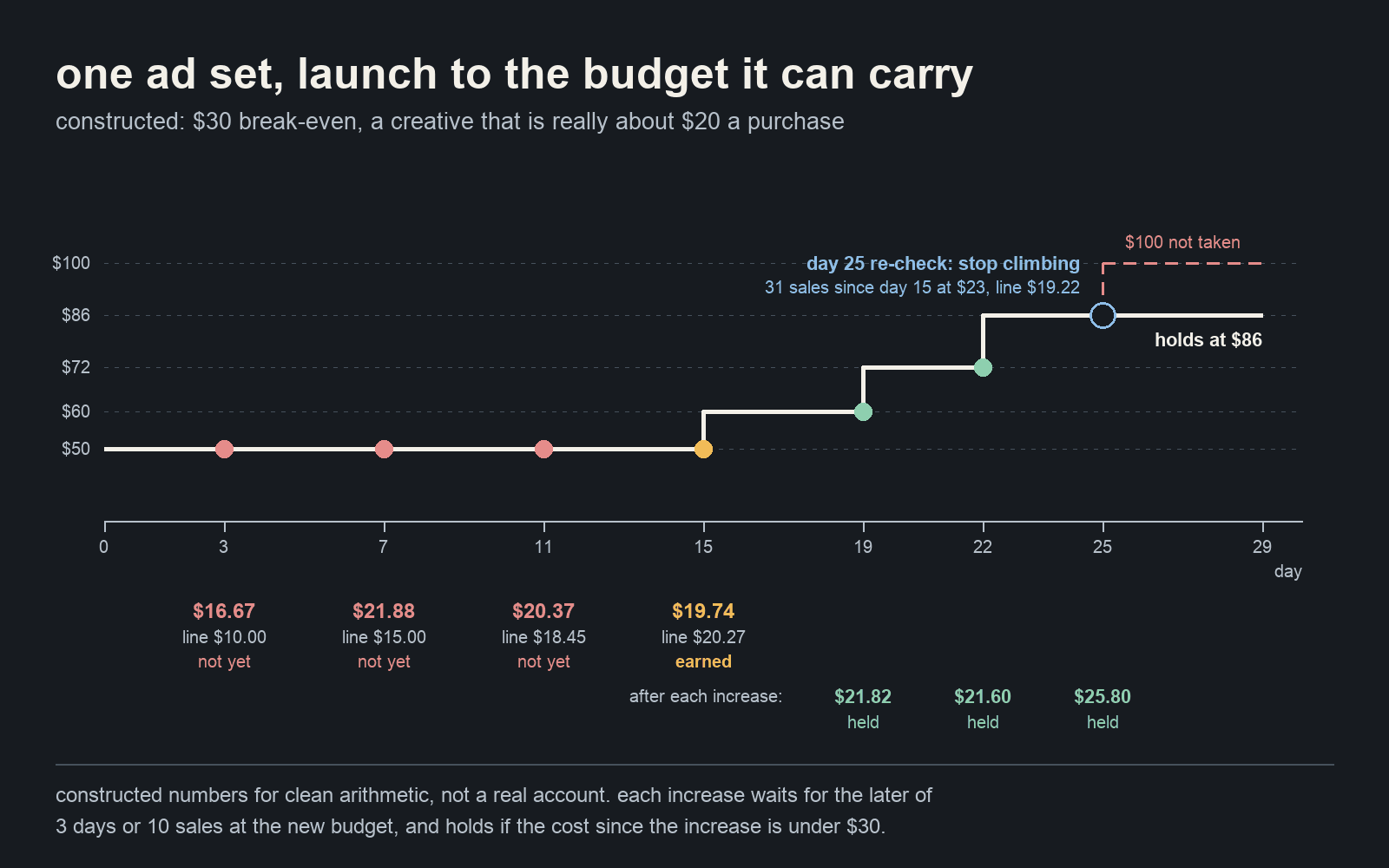
Constructed numbers for clean arithmetic, not a real account. A before-and-after on one ad set is not a controlled test.
what the clock did. 25 days from launch to the highest budget the ad could carry, $86 a day, and not one decision in it was a feeling. it refused the day-3 increase that would have scaled a lucky run, and the day-7 numbers show why. it put more budget behind a profitable creative that was still in learning, which "wait until you exit the learning phase" would never have done. and it stopped the climb before a step broke, rather than after.
and the counter-case. say the same video had been genuinely $25 a purchase rather than $20. at five sixths of break-even, it needs about 144 purchases — around ten weeks at $50 a day. that is the rule saying this ad is barely worth scaling, which is true: $5 of margin a purchase does not survive the higher cost of a bigger budget. the answer for that account is not a faster clock. it is the next video in the test.
The part i cannot prove
the trigger line is ordinary counting statistics — purchases treated as arriving at random at a steady rate, with a margin of two standard deviations. that is the simplest honest model, and it is not something i measured. real accounts are lumpier: weekdays differ, delivery shifts, an ad's cost moves as it runs. the true margin you need is probably somewhat wider than the clean one above, not narrower.
the three days and the ten purchases between steps are judgement, not a finding. three days comes from how delivery settles and how purchases get reported, which is meta's documented behaviour. ten purchases is the smallest count that tells you anything at all, and it only catches a step that clearly broke — a step that made things 15% worse will usually pass it, which is why the 30-purchase re-check is there. none of it is my measurement and i do not run an account at these numbers. the worked example is built for clean sums. the real figures — the doubling on day 7, the 115% after a 20% increase, the $50 a day and 1–2 purchases — are other people's, from what they wrote about their own campaigns.
and there is one thing i genuinely do not know. the trigger trades speed for certainty, and i have only counted one side of that trade. the cost of scaling a lucky week is easy to see. the cost of waiting — a great ad sitting at $50 a day for an extra week when it could have been at $100 — is invisible, and i cannot tell you how big it is in a real account. if you have scaled early and been right more often than this rule would allow, i would rather have your numbers than be right.
if any of this is wrong, say so. a correction is worth more to me than agreement.
the trigger only ever fires on an ad worth scaling, and finding one means testing more of them. clear cortex makes the next test ad from a product photo, for pence: https://clear-cortex.com/?src=x-when-to-scale-end