 Clear Cortex
How to set up a new ad account without wasting your launch budget
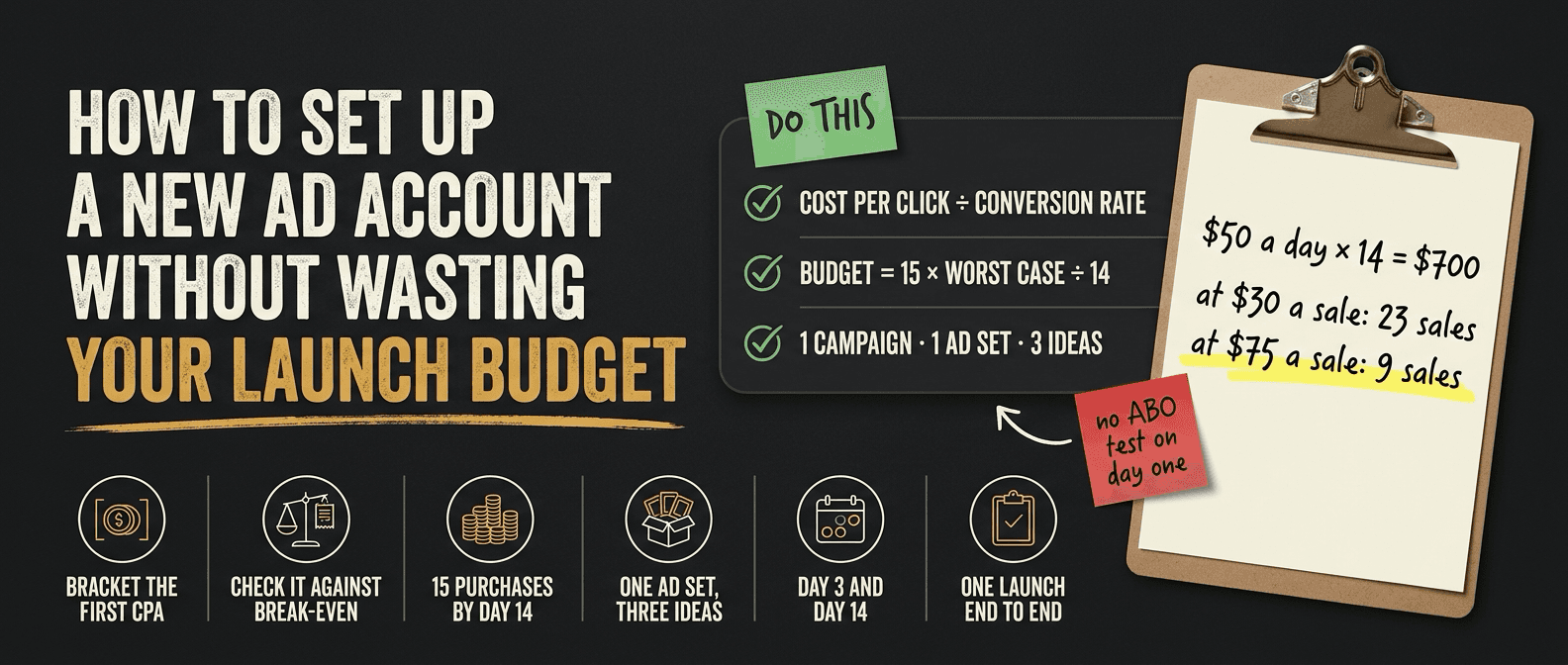
$50 a day can buy 23 sales in two weeks, or 9.
which one you get depends on a number you can work out before you spend anything, and it is the number almost nobody starting a new account works out. $50 a day for fourteen days is $700. if a sale costs you $30, that is 23 sales. if it costs $75, it is 9. same budget, same account, same fortnight, and one of those gives you a real answer about your ads and the other gives you a handful of sales and a feeling.
i went looking for how people decide what to start a new account on and found 6 people asking, across 11 threads — most of them asked twice, in two different rooms. the budgets they gave ran from $46 a day to 3,000 rupees a day, and one of them had $100k to spend over the next six to twelve months and still did not know whether to start at $50. the replies that named a number named $80 to $100, $100, and $100 to $150 a day. the replies that actually helped did not name a number at all. they started from the price of the thing being sold.
here is how it gets asked:
"how would you structure the account from the start?"
"how many ad sets/creatives per ad set in the abo testing phase, and what daily budget would you start at, $50/day?"
"also what is the right budget to start ?"
"should i start with $50 aud and less ads until the campaign starts converting and then decide to scale the budget and add more creatives ?"
"is the starting budget of 3000/day is low or high?"
"what cpm range should a brand new ad account expect on purchase campaigns?"
the good news is that every one of these has an answer, and you can have it before launch. the starting budget is not a guess and it is not a matter of nerve. it is one sum on your own price. the structure that spends it is simpler than any of the setups people describe. and the first fortnight has exactly one job, which is not testing creatives and not scaling: it is buying you your first real cost per purchase — your first real cpa — because every other decision in the account needs one and a new account does not have it.
one boundary first, because i have written the neighbouring pieces and this is not them. getting a new account out of Learning Limited, whether the budget sits at campaign or ad set level, how many tests a budget can fund, when to split testing from scaling, when to raise a winner's budget — those are separate, and they all start from a cost per purchase you already know. this one is day one: the account has no cost per purchase yet, and you have to set a budget anyway.
so here is the whole thing, in the order to do it. a bracket for what a sale will cost you, built before you spend a penny. a check of that bracket against what an order leaves you. the starting budget that bracket sets. the structure that spends it. two dates to write down before you press publish. and one launch worked through end to end. about twenty minutes with a calculator and your own prices. nothing is held back and there is no gate on any of it.
the cover on this piece was made in clear cortex for about 8p, on the cheapest model that could spell the headline. that's the studio i'm building, and it's the only ask in this piece: https://clear-cortex.com/?src=x-launch-budget-top
Day one has no cost per purchase, so bracket one
every useful rule about running meta ads is written in terms of your cost per result, and for a store the result is a purchase. how many tests you can fund, when a creative has earned more budget, when to switch an ad off, whether the campaign can leave learning. on day one you have none of it. so people pick a round number — $50 a day is the most common — and find out afterwards whether it was enough.
you can do better than a round number, because a sale's cost is made of two things, and you can put a range on both.
cost per purchase = cost per click ÷ the share of clicks that buy
the cost of a click is what meta charges you to get one person to your store — ads manager reports it as cost per link click. it comes from what a thousand impressions cost and how many of those people click. the honest answer to "what cpm range should a brand new ad account expect on purchase campaigns?" is that nobody can tell you yours — it depends on the country, the category, the time of year and the ads — but you do not need it, for a reason the next sections lean on. for a bracket, take a range wide enough to be safe. for a consumer product in the US, say 90 cents to $1.50 a click.
the share of clicks that buy is your store's conversion rate on cold traffic: strangers who have never heard of you, arriving from an ad. if you have run the store before — organic, email, a previous launch — you have a number already. if not, one reply in the threads put a realistic first range for a beauty brand at 2 to 3%, and that is a sensible range for a first bracket on most single-product stores.
now divide. the best case is the cheap click and the high conversion: 90 cents ÷ 3% = $30 a sale. the worst case is the expensive click and the low conversion: $1.50 ÷ 2% = $75 a sale. that is your bracket. $30 to $75.
it is wide, and that is correct. it is wide because you do not know yet. the point of the first fortnight is to narrow it, and the point of writing it down is that you now know the range your account will land in, before anyone has spent anything.
it holds up against a real account, too. one person running an $80 silver ring wrote out their funnel in full — clicks at 80 cents to a dollar, a click-through rate of 5% and up, a cost per thousand impressions of $35 and up — and their cost per purchase held at $46. divide one by the other and their store was converting about 2% of clicks. that lands inside the bracket above. (the same thread had the right warning about what those click numbers do not tell you: "a 5% ctr with sub-$1 clicks says the ads create interest; it doesn’t prove purchase intent." that is exactly why the conversion rate sits in the sum as its own number.)
Hold the bracket against what an order leaves you
before the bracket sets a budget, it gets one check. is a sale at the bracket's prices worth having at all?
that is a question about the order, not the ads. what is left of an order after the product, the shipping, the payment fees and the returns is the most you can pay for a purchase and break even. (if you think in roas, it is the same line turned over: order value ÷ break-even cost is your break-even roas.) i went through how to work that number out properly in the piece on fixing a stuck account, so here it is only the comparison: put your break-even next to your bracket.
the ring account is the clean version. one reply to it put the whole thing in one line: "which makes the real question whether $46 is a cpa you can live with and on an $80 ring i don't think it is." their budget was not the problem. their order was.
there are three ways the comparison can come out, and each one tells you something different to do on day one.
the whole bracket is under break-even. even the worst case, $75, leaves you money. launch. the first fortnight is about finding out how far under you are.
break-even sits inside the bracket. some of the outcomes make money and some lose it. launch, and the fortnight decides which side you are on. this is the most common result and it is fine.
the whole bracket is over break-even. even the best case loses money on the first order. this is the one worth catching before launch, because no budget and no structure changes it. the advice given to a brand launching a $15.99 hero product was exactly this: "a $15.99 hero against beauty cpms means first-purchase cac will likely exceed aov even with great creative." if your bracket is over, the day-one job is the order — bundles, a bigger pack, a threshold that lifts the basket — or a deliberate decision to buy first customers at a loss because you know they come back. both are legitimate. what is not legitimate is finding it out in month three.
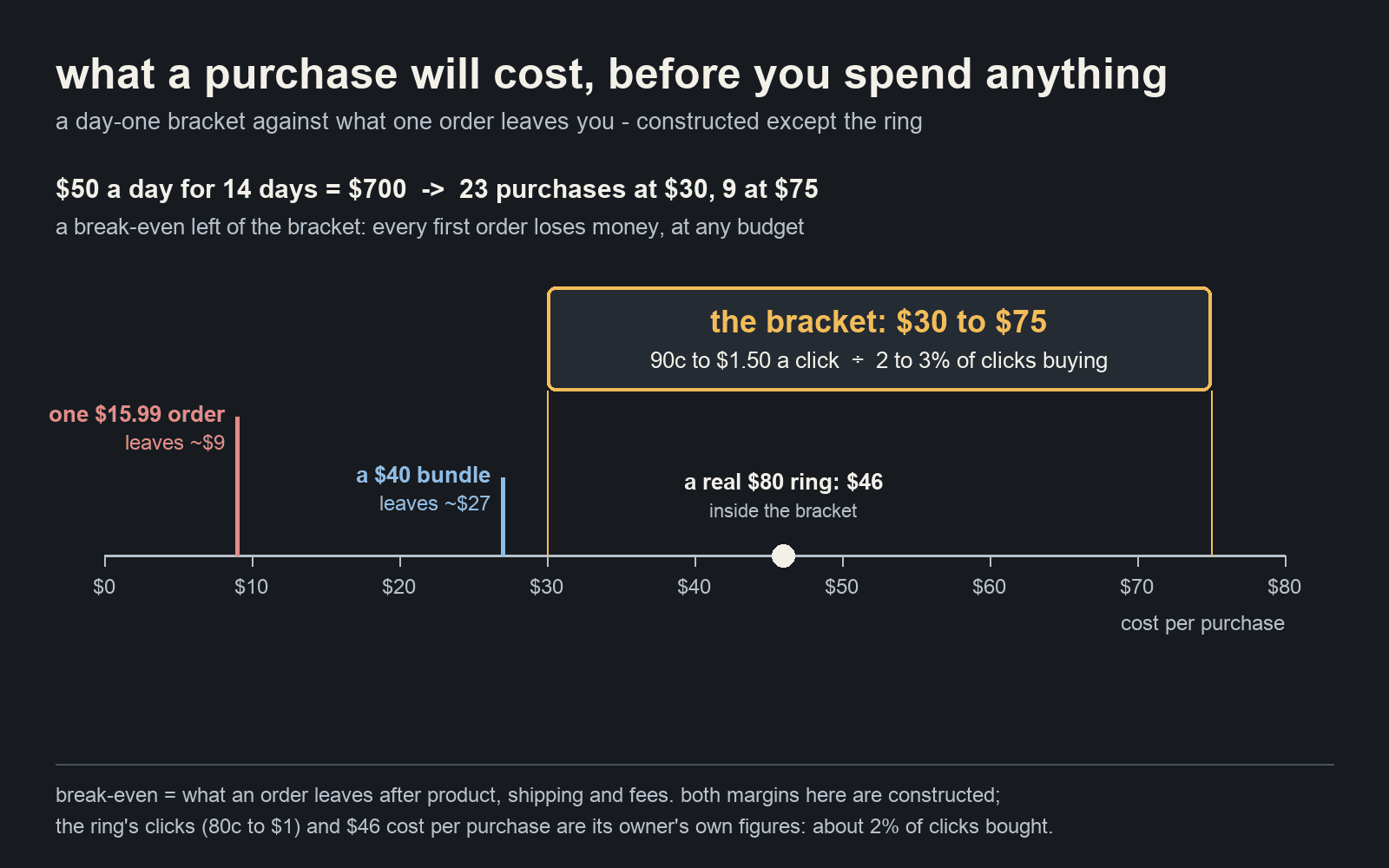
The bracket and both margins are constructed; swap in your own click cost, conversion rate and order. The $46 is a real account's, from its owner's post.
The starting budget is the price of fifteen sales
now the budget, and it falls out of the bracket in one line.
the first fortnight's job is a cost per purchase you can plan on. a cpa measured on a handful of purchases is mostly luck: purchases arrive a bit at random, so even if your true cost is steady, the number you measure wobbles around it. on 5 purchases it is typically out by about 45%. on 10, about 32%. on 15, about a quarter. on 25, about a fifth. past fifteen, each extra purchase buys less and less certainty, and you are paying full price for it.
so the target is about fifteen sales by day 14, at the worst end of your bracket. the budget that buys that is:
starting daily budget = 15 × the top of your bracket ÷ 14
and because fifteen over fourteen is close to one, it comes out at roughly one worst-case sale a day. with a $30 to $75 bracket, that is about $80 a day. fourteen days of it is $1,120. if your sales land at the cheap end, you will have about 37 of them by day 14 and an even better read. if they land at the expensive end, you will have about fifteen, which is the minimum you planned for. either way, on day 14 you know.
which answers the $50 question directly: $50 a day is the right starting budget if the worst case of your bracket is about $50 or under. for a store whose clicks are cheap and whose page converts, it is plenty. for a $75 worst case, it buys about 9 sales in a fortnight — a number that can be out by a third either way — and you will spend two weeks to learn roughly what you knew on day one. that is not a failure of the budget. it is the budget being sized for a different product.
the ring account shows the sum working from the other side. one reply did the arithmetic for them: "you're spending $46 a day at a $46 cpa, so one purchase a day is arithmetically the only possible outcome." that sounds like a complaint, and as a starting budget it is exactly right — one sale a day, at the cost they actually got, is what this method aims for. it bought them a read. the read said $46. the problem it found was the ring's margin, which is what a first fortnight is supposed to find.
the silver jeweller asking whether 3,000 a day was "low or high?" can answer it the same way. fifteen sales in fourteen days on 3,000 a day needs a sale to cost no more than 2,800 — a little over half of their 5,000 average order. their post reports three conversions in ten days across their two campaigns — at least 10,000 a conversion on any reading of it, twice the order. so for that account, 3,000 a day is low, but not because of some rule about rupees. it is low because a sale costs far more than 2,800, and the bigger finding is that a sale costs more than an order brings in.
and a bigger launch fund buys speed, not a different answer. the beauty founder with $100k asked whether to start at $50, $100 or $200 a day. on a $30 to $75 bracket, $80 a day reaches fifteen sales by day 14; $160 a day reaches it by about day 7. the read is the same read. the difference is how soon you have it. $1,120 is about 1% of their fund, and that is the whole point: the first number is cheap. the money that matters is everything that gets spent after it, and the first number is what tells you where to spend it.
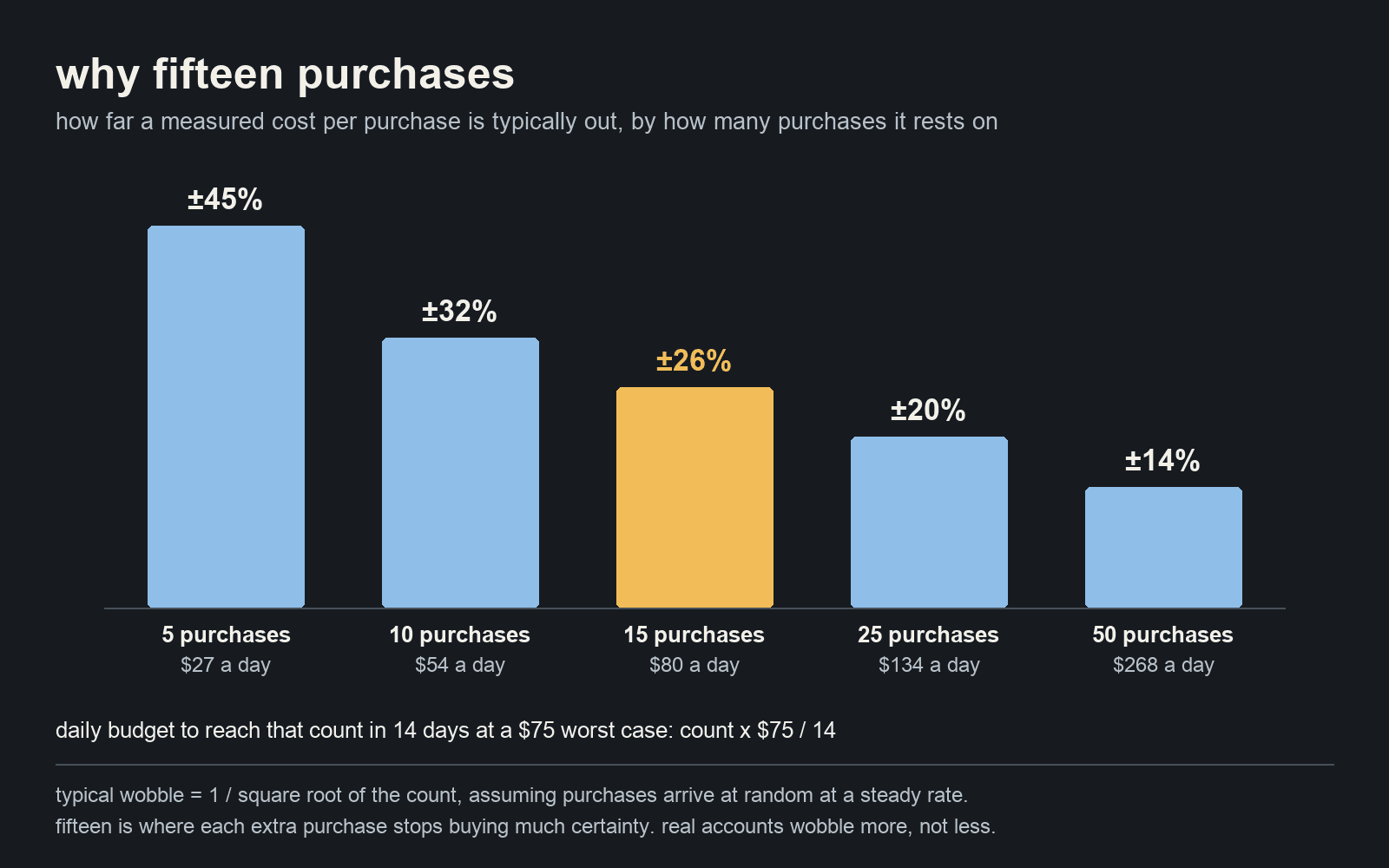
Typical wobble (one over the square root of the count), assuming sales arrive at random at a steady rate. Real accounts wobble more, not less.
The structure that spends it: one campaign, one ad set, three ideas
the question at the top asked how many ad sets and how many creatives per ad set in the abo testing phase. on day one there is no testing phase yet, and building one is the most common way a launch budget goes nowhere.
here is why. a test of four ad sets at $20 a day each divides your fifteen purchases into four piles of about four. every pile is too small to read. you get four numbers, they are all different, and none of them means anything. i worked out what a test actually has to cost in an earlier piece, and the piece on cbo or abo has the division that says how many ad sets a budget can carry. on a new account, with no cost per purchase to put into that division, the safe answer is one.
so the structure from the start is:
- one campaign, optimising for the sale if your budget can bear it — the piece on Learning Limited has the ladder for when it cannot. either way, the fifteen you are counting are purchases in your store, not whatever results the campaign reports.
- one ad set, broad audience: the country, an age band if the product really needs one, and very little else. a new pixel knows nothing about who buys, and a fence of interests only gives it less room to find out. with one ad set, the cbo-or-abo setting does not matter — a campaign budget and an ad set budget are the same number.
- three creatives, each a genuinely different idea. a different reason to buy, a different person it is for — a demo video against a testimonial video against a before-and-after static. not three cuts of one video, and not the same video with three different hooks. one reply to the ring account said it about as well as it can be said: "one campaign testing 3-4 ads max, with the budget concentrated rather than spread thin."
the three creatives are the one place day one asks you to make something, and they do not need a shoot or a creator video each. this is one product turned into six genuinely different ads: https://clear-cortex.com/playbooks/one-product-six-ways?src=x-launch-budget-mid
meta will put most of the money behind one of the three creatives within a few days. that is fine, and it is not a verdict on the other two — the piece on running one ad set goes through how to read that properly. for now it is the one sign the first fortnight gives you about which idea is worth a test later.
the testing phase starts on day 15, when you have a real cost per purchase to put into the division. that is also the answer to the supplement seller asking whether to "start with $50 aud and less ads until the campaign starts converting and then decide to scale the budget and add more creatives": yes, fewer ads at the start, and yes, more creative later. the trigger for "later" is not "starts converting", which is vague. it is fifteen sales in the store.
Two dates to write down before you launch
the plan only works if the decisions are made before the numbers arrive, while you can still be cold about them. write two dates in the calendar.
day 3: your real click cost. clicks arrive dozens of times faster than sales. by day 3 at $80 a day you have spent $240, and at around a dollar a click that is a couple of hundred clicks — enough to know your real cost per click to within about a tenth. the click half of the bracket is no longer a guess. replace it, and recalculate the bracket with only the conversion rate left as a range.
this is also the answer to the cpm question. you never needed to know your cpm in advance. day 3 hands you your real cost per click, and that already has your cpm and your click-through rate inside it.
the day-3 rule: if the best case of the new bracket is already well over your break-even — say twice it — stop and fix the page or the order before spending the other eleven days. eleven more days will only confirm it. if it is not, change nothing. no new ads, no edits, no budget moves: the learning piece has the list of changes that reset an ad set, and day 3 is when people are most tempted to make them.
day 14: your real cost per purchase. total spend in the account divided by purchases in your store — your store, not meta's dashboard. with about fifteen of them it is typically within a quarter of the truth. now put it next to your break-even, and there are three answers, each with its next step written in advance:
- under three quarters of break-even. even if the true number is a quarter worse, you are making money. the testing phase starts: run the division from the cbo-or-abo piece on your real number to see how many ad sets you can fund, and use the trigger in the when-to-scale piece before any budget goes up.
- within a quarter of break-even, either side. the account is alive and too close to call. keep the budget where it is. the next money goes on better creatives, a better page or a bigger order, not more spend.
- over a quarter above break-even. the account is losing money on every purchase, and more budget makes that bigger, not smaller. one reply put it as plainly as possible: "more budget at the same cpa gets you more purchases and no more profit." fix the order or the page, then run another fortnight.
the supplement seller is what happens without the dates. they ran $50 to $100 aud a day from the start of may to early june and got 6 purchases — somewhere between about $280 and $570 each, depending on the days at each budget. a day-14 read would have shown the same thing three weeks and most of the spend earlier, with a decision already written down for it.
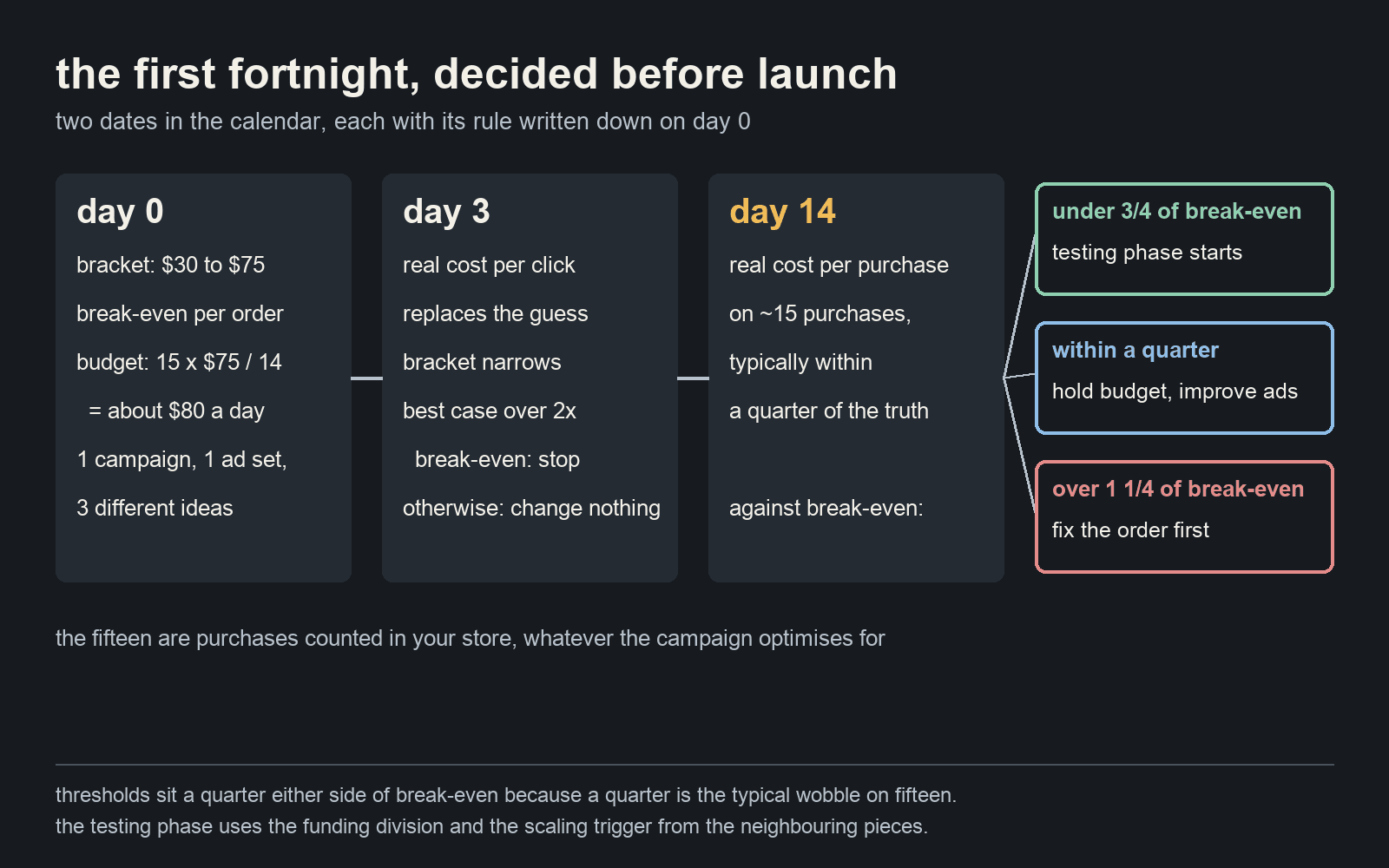
The calendar from this piece. The thresholds are about a quarter either side of break-even because that is the typical wobble on fifteen sales.
One launch, worked end to end
the founder with $100k is the best case to run it on, because they wrote down almost everything. a new beauty brand starting from zero — no followers, no email list, no reviews yet. a $15.99 hero product with bundle tiers to lift the order. a store built and tested before, about 6,000 units on order, and a little over $100k to spend over six to twelve months across meta, tiktok shop affiliates and organic. the plan for meta was an abo creative test first, then scaling winners into advantage+. their question: "how would you structure the account from the start?"
the costs below are constructed to keep the sums clean, and they are marked where they are. the method is the part to copy.
day 0, the bracket. clicks at 90 cents to $1.50, a cold conversion rate of 2 to 3%. $30 to $75 a sale.
day 0, break-even. say a single $15.99 order leaves about $9 after the product, shipping and fees, and a $40 three-pack bundle leaves about $27. against the bracket: the single order is far under even the best case, so selling one unit at a time loses money on every first order. the bundle's $27 sits just under the best case. so this launch is the third case — the whole bracket is over break-even — and it is caught on day 0, which is the point. two things follow before any budget is set. the store leads with the bundle — top of the page, the default choice, the thing the ads show — which costs nothing and is the most valuable thing the whole day-one process produces. and the founder decides, with a fund this size and a consumable product, to launch anyway, knowing first orders lose money and using the fortnight to find out by how much. that is a legitimate decision because it is made on day 0, not discovered in month three.
day 0, the budget. fifteen purchases at the $75 worst case over fourteen days: $80 a day, $1,120 for the fortnight. about 1% of the fund. no testing phase yet, and no $50 either — $50 a day on this bracket buys about 9 sales, too few to plan the next $99k on.
day 0, the structure. one campaign, one broad ad set in the US, three creatives that are three different ideas — say a texture demo video, a creator's before-and-after video and a bundle-value static. the ugc videos and organic content already being made are where those ideas come from.
day 3, the click cost. $240 spent, and say the clicks came in at $1.20. the bracket narrows to $1.20 ÷ 3% to $1.20 ÷ 2%: $40 to $60 a sale. the best case, $40, is about one and a half times the bundle's $27 break-even — over it, but not the twice-over that triggers a stop. change nothing.
day 14, the read. say $1,120 bought 19 sales in the store. $59 a sale, typically within about $45 to $72 of the truth on 19 sales. against $27, even the optimistic end is well over a quarter above break-even. that is the third answer: fix the order before the budget. for $1,120 the founder knows, two weeks in, that the next stretch of the $100k goes into the order size and the page — more of every basket going to bundles, a bigger pack, a post-purchase offer — and not into ad spend. and the division from the cbo-or-abo piece agrees: $80 a day is $560 a week, and ten purchases at $59 is $590. not even one test fits, so the abo testing phase they planned would have been four starved ad sets.
what it would have taken to get the first answer instead. at $27 break-even, three quarters is about $20 a sale. with clicks at $1.20, a $20 sale needs 6% of clicks to buy. that is not a creative problem or a budget problem — it is the order and the page. if the bundle work lifts what an order leaves to, say, $50, the same $59 sale sits close to break-even and the account moves to the second answer: alive, keep the budget, work on the ads. at that point a test is worth funding, and the $100k is going into an account that can use it.
what did not happen. no abo test on day one. no $50 a day because it sounded safe, no $200 a day because the fund was large. no new ads in meta on day 3 because the numbers looked bad. no budget raise on day 14 because the sales were coming in. the whole fortnight cost about 1% of the fund and returned the one number every later decision in the account depends on.
The part i cannot prove
how meta allocates inside an ad set, the learning threshold and the list of edits that reset it are platform behaviour from the platform's own documentation, and from what advertisers describe. none of it is my measurement. i do not run a new account at these numbers, and the worked launch is someone else's, with the costs constructed — the $100k, the $15.99, the bundle tiers, the 6,000 units and the abo-then-advantage+ plan are theirs; the click costs, conversion rates, margins and the 19 sales are mine, chosen to keep the arithmetic clean. the $46 ring, the 3,000-a-day jeweller and the supplement seller's 6 purchases are other people's real figures, from what they wrote about their own accounts.
the wobble figures assume purchases arrive at random at a steady rate, which a new account does not quite do — the first days are usually the most expensive while meta works out who buys, so the real first number can be noisier than the sum says. the 15 and the quarter-either-side thresholds are arithmetic choices, not results; somebody with a tighter margin may want twenty-five purchases before acting, and somebody with a wide one can act on ten.
and there is one thing i genuinely do not know. how good is a bracket built on day one? the method only needs it to be roughly right, because day 3 and day 14 replace it. but if most people's real cost per purchase lands outside the bracket they wrote down — above the top, usually — then the starting budget it sets is too small, and the first read takes longer than fourteen days. i have one account where the sum lands inside on the first try. if you have launched a new account and remember what you expected a sale to cost against what it actually cost, i would rather have your two numbers than be right.
if any of this is wrong, say so. a correction is worth more to me than agreement.
the first fortnight needs three genuinely different ads on day one, and they should not cost more than the fortnight's budget. that's the part clear cortex does — three ideas from the product photo you already have, for pence: https://clear-cortex.com/?src=x-launch-budget-end