 Clear Cortex
How to read ROAS without paying twice for the same sale
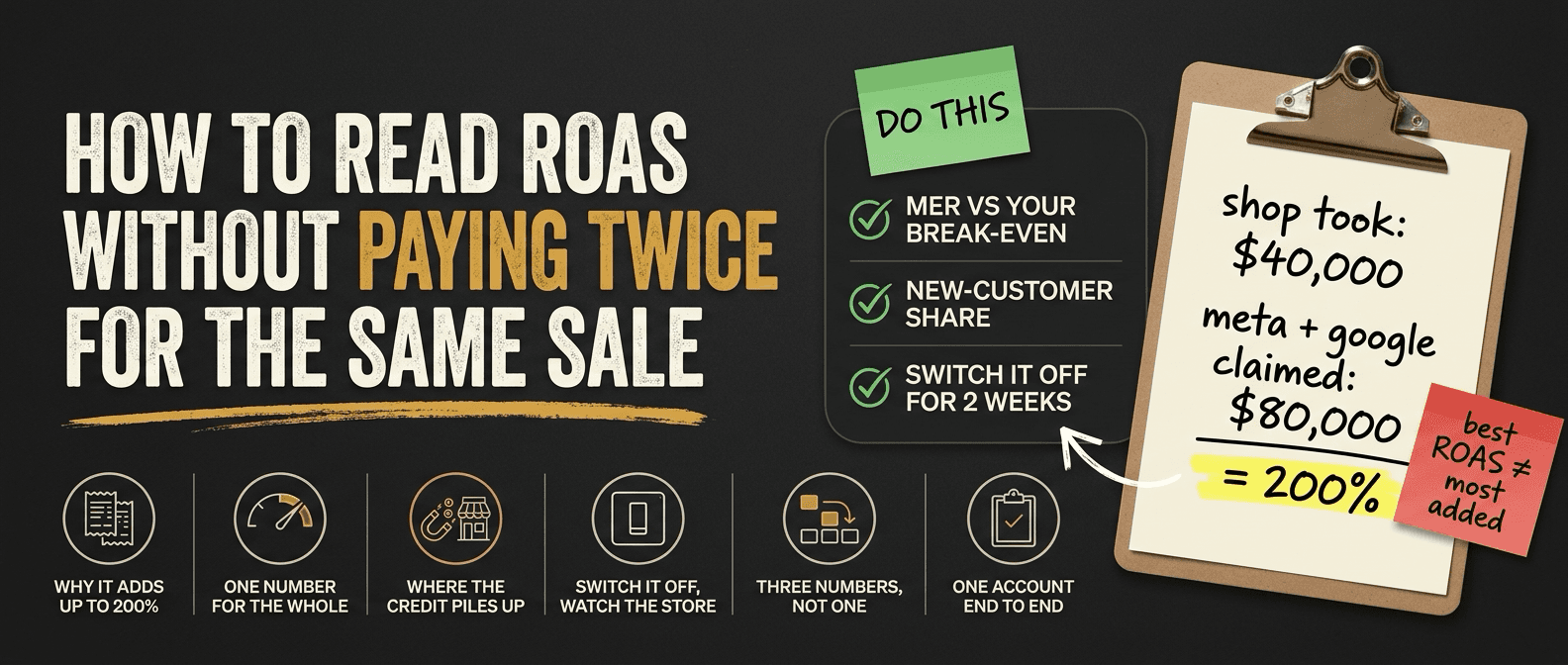
Meta and Google claimed 200% of the store's revenue.
that was an agency describing its own clients. every account running both platforms had the same pattern: meta claimed credit for an order, google claimed credit for the same order, and when they added the two reports together they came to twice what the shop had actually taken. neither platform was lying by its own rules. and every budget decision in those accounts had been made on one or other of those two numbers.
i went looking for how people handle this and found 6 separate threads circling it — the platform's number against the store's, and what the ad spend was really buying. in 4 of them the argument came down to retargeting. only one put a figure on how far apart the platforms and the store were, and it was that one: 200%.
here is how the rest of them put it:
"are you still primarily using platform ROAS or have you moved to something blended?"
"did MER improve or only platform ROAS?"
"did backend revenue match platform reporting?"
"did it bring new customers or cheap retargeting conversions?"
"what's the best way to structure it so metas not just solely focusing on retargeting?"
"is it wise to spend on retargetting like this?"
the default answer to the first one is still the platform's ROAS. it is in every report, it updates every hour, and it is broken out by campaign, which is exactly what you need to move a budget. i think steering the budget by it is wrong, and it is costing people money in a predictable place. each platform's ROAS is that platform's claim on sales that other channels also claim, and the campaigns that claim the most are the ones spending on people who were already on their way to buy. move money towards the best ROAS and you move it towards retargeting, existing customers and your own brand name, and away from the campaigns finding new customers, which are the only ones that grow the business. scale an account that way and you are scaling the part of it that was never the reason sales came in.
and moving to "something blended" fixes half of it. a blended number is honest about the whole account. it cannot tell you which campaign to cut, because it does not know there are campaigns.
one boundary before the method, because i have written the neighbouring pieces and this is not them. which number should pick a winning creative inside one campaign, the weekly read of what an order costs against what it leaves you, what the conversion column is actually counting — those are separate. this one is about the budget across channels and campaigns: how much of each platform's ROAS is real, and where to move the money.
so here is the whole thing. why the platforms add up to more than the store, the one number that sees the whole account and the line it has to clear, where the extra credit comes from, a switch-off test that puts a price on what one campaign actually adds, and how to move the budget on three numbers instead of one. then one account, worked end to end. about an hour to set up, then ten minutes a week, with numbers already sitting in your ad accounts and your shop. nothing is held back and there is no gate on any of it.
the cover on this piece was made in clear cortex for about 8p, on the cheapest model that could spell the headline. that's the studio i'm building, and it's the only ask in this piece: https://clear-cortex.com/?src=x-blended-roas-top
Why the platforms add up to more than the store
start with how a platform decides a sale is its sale, because nearly all of the confusion follows from it.
a platform does not see your sales. it sees its own ads, and it sees the purchase event your site sends back to it. when a purchase comes in from somebody who clicked one of its ads in the last few days, or on meta's default settings saw one in the last day, it counts that purchase and the order value as revenue its ads produced. that is what ROAS divides by the spend.
google does exactly the same thing with its own ads and its own window. so does tiktok, so does every other platform you run. none of them knows what the others counted. a customer who saw a meta video on monday, searched your brand name on google on wednesday and bought, is a meta sale in the meta account and a google sale in the google account. one order, two claims, and both are correct by the rules each platform set for itself.
somebody who has spent years explaining this to nervous advertisers puts it plainly: "we often can't attribute any particular conversion to one marketing channel 100% because they overlap and they interact". the customer journey is several touches. each platform reports the touch it owns as if it were the whole journey.
so the sum of the platform reports is not your revenue. in the accounts at the top it was twice your revenue. the more channels you run, and the more they reach the same people, the bigger that gap gets.
and the gap does not only run one way. one agency, showing the first eight days of a month on a large account, said: "we've spent over a million to drive over $1.7 million in revenue and over $3.5 million in actual shopify revenue." there the platform claimed about half of what the store took. orders from email, from word of mouth, from somebody who saw an ad on a friend's phone — the platform never sees those, and some of them would not have happened without the ads.
that is why you cannot fix platform ROAS by knocking a fixed percentage off it. one platform over-claims, another under-claims, the same platform does both in different months. the platform's number is not a slightly wrong version of the truth. it is an answer to a different question — how many of the sales it could see did its ads touch — and nobody running the business asked that question.
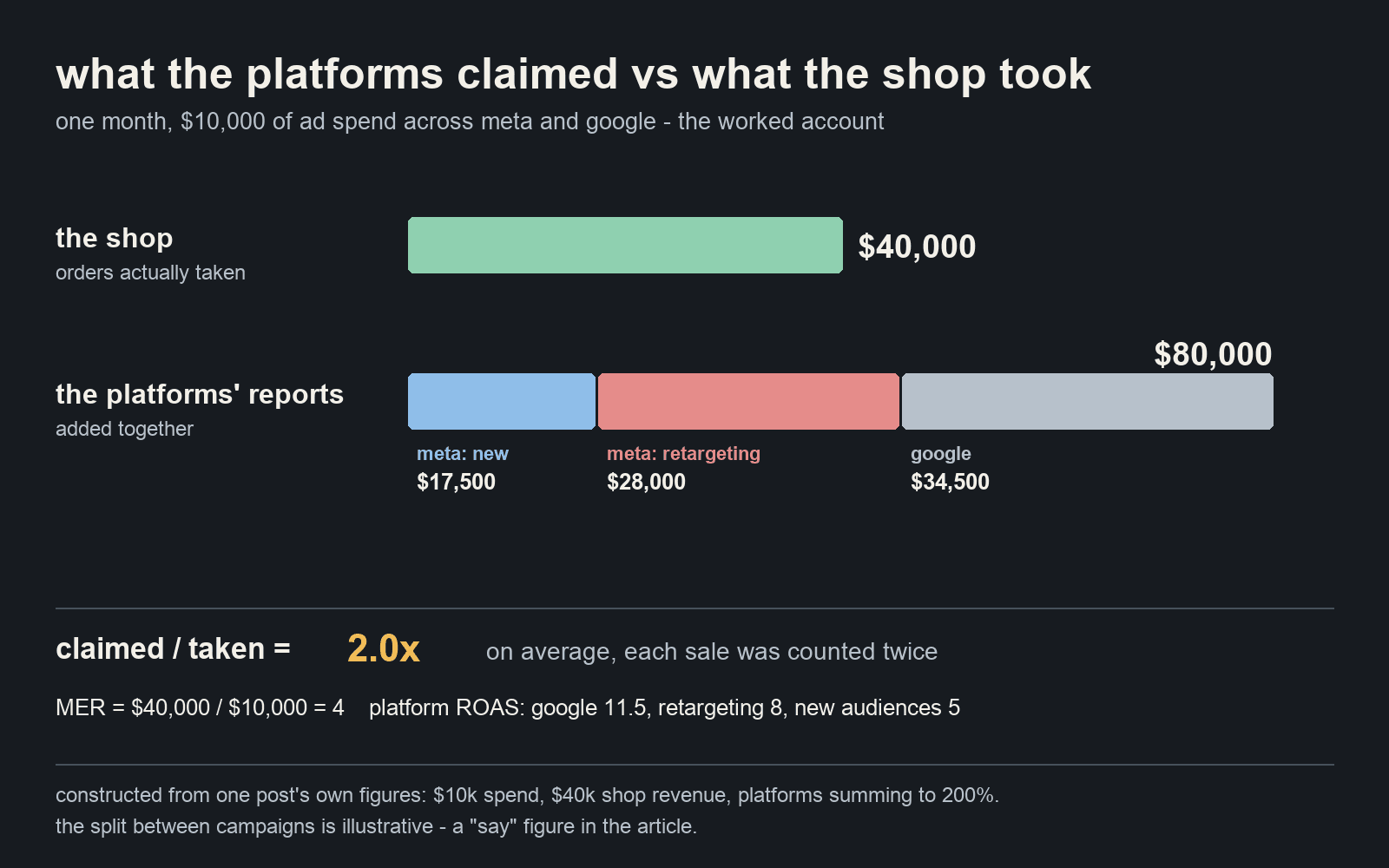
Constructed from one post's own figures ($10k spend, $40k shop revenue, platforms summing to 200%); the split between campaigns is a "say" figure.
The one number that sees the whole account
so you need one number that every channel cannot argue with, and it is the one the post at the top switched to. "if you spent $10k on ads and drove $40k in shopify revenue, your MER is 4x."
MER is total store revenue divided by total ad spend, across every channel, for the same period. no windows, no claims, no double counting. it does not care which campaign drove the sale. it only asks whether the whole of the ad budget is paying for itself.
a MER is only useful against a line, and the line comes from your margin, not from a benchmark. take what an average order leaves you after the product, packaging, shipping and payment fees — call that your margin. if it is 50%, every $1 of revenue leaves 50 cents to pay for ads and everything else, so the ad spend breaks even at a MER of 2: $2 of revenue per $1 of ads. the break-even MER is 1 divided by your margin. a 40% margin breaks even at 2.5. a 25% margin at 4.
if you sell on leads rather than through a shop, the same sum works with your own records in place of the store: signed clients or paid customers from the CRM, divided into total spend across every campaign — never the lead count the platforms report, which is their claim again.
that line is the first thing to write down, before you look at any platform report. above it, the whole budget is paying for itself and the question is where to scale. below it, the whole budget is losing money and no amount of shuffling between campaigns will fix that on its own.
i went through the weekly version of this read — what an order costs from the store's numbers against what it leaves you — in the piece on getting unstuck, so i will not redo it. the only part that matters here is what MER cannot do.
MER cannot tell you which campaign to cut. it is one number for the whole account. a MER of 4 with a 50% margin says the budget is working. it does not say whether all of it is working, or whether half of it is doing everything and the other half is collecting credit for sales that would have happened anyway. that is why the post at the top kept a second number: they still read platform ROAS inside a single channel, for campaign decisions, and used the blended figure to judge whether the marketing was working at all.
that split is right as far as it goes. the trouble is that reading platform ROAS for campaign decisions puts you straight back where you started for the decision that costs the most money, which is how much of the budget goes to the warm end of the account.
Where the extra credit comes from
the over-claim is not spread evenly. it piles up in the campaigns that spend on people who already know you.
retargeting — usually its own campaign or ad set — shows ads to people who visited the site, added to cart, or watched a video. existing-customer spend shows ads to people who have already bought. branded search shows an ad to somebody who typed your name into google. all three reach people who are, on average, much closer to buying than a stranger. so all three catch a lot of purchases — and a share of those purchases were going to happen with or without the ad. the platform cannot tell which share. it counts them all.
the post at the top found exactly this when it stopped reading platform ROAS: "it was consuming 30-40% of budget at some accounts and claiming outsized ROAS." that was retargeting. once they judged it on blended MER instead, it looked like it was mostly harvesting people who would have bought anyway, so they cut its budget, and MER held or improved.
platform ROAS ranks the warmest spend highest, every time. one agency showed the per-audience split of an account it was proud of: "the return on ad spend in this account is a 10.37 last month, eight on new customers, 12 on engaged, and 14.69 on existing customers." read as a league table, that says existing customers are the best place for the money and new customers the worst. it says nothing of the kind. existing customers buy most easily, so ads shown to them sit next to the most purchases, so their ROAS is highest. the number ranks how warm the audience was, not how much the ads added.
and the algorithm already leans that way without your help. on a small budget, as one long-time meta trainer put it, "meta is going to spend the majority or all of that budget on retargeting depending on the size of your of your warm audiences." that is the question in the thread about structuring a new store's account — how to stop meta "solely focusing on retargeting" — and it is not paranoia. the warm audience converts cheapest, so the system finds it.
the same agency showed what an account looks like when nobody checks: "our engaged audience has spent $161,000 out of the $317,000 in ad spend." and "new audience spent $120,000, which i'm happy about, but that's around 40% of the total spend." about 51% to people who had already engaged, about 38% to people who had never heard of the brand, and $34,000 to existing customers. in that same video, the engaged audience had seen the ads about nine and a half times each in thirty days, and existing customers 36 times.
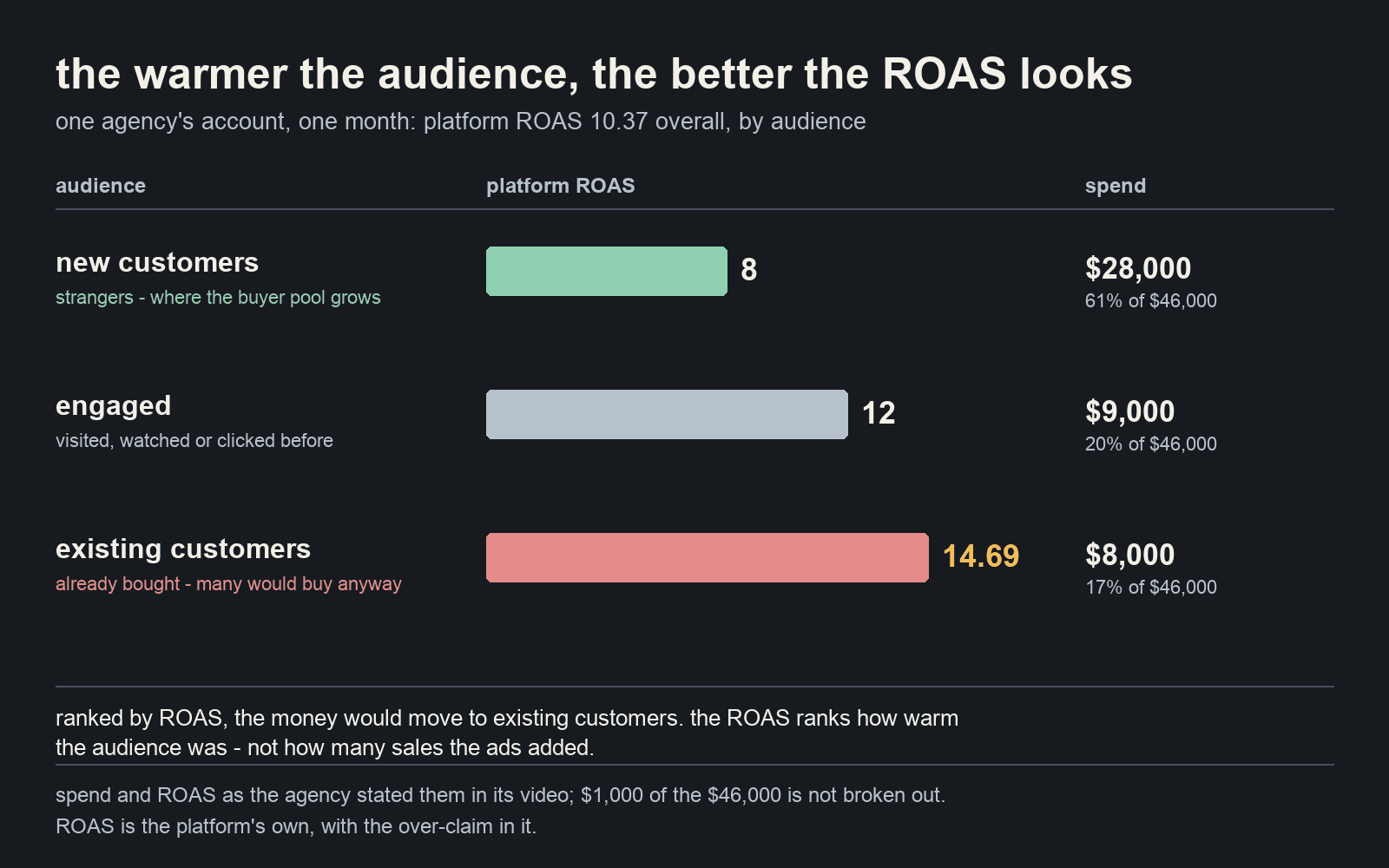
One agency's own account, as shown in its video. Spend per audience as stated; ROAS is the platform's.
so the first move is to see the split, before you change anything. on meta, the audience segment reporting splits spend and results into new audience, engaged audience and existing customers. on google, split branded search from everything else. then write down one share: what fraction of the whole budget is going to people who have never bought or visited. somebody else put the same instruction in one line: "in order to scale your paid funnel, you NEED to look at your NC (new customer) ROAS." the new-customer number is the one that tells you whether the budget is growing the business or only collecting from it.
none of this says retargeting and branded search are worthless. some of those sales would not have happened without the reminder, and branded search can be defending your name from a competitor bidding on it. it says the platform's ROAS cannot tell you how many. for that you need a test.
Switch it off and see what the store loses
the question to put to every warm campaign was asked in one line by somebody who built software for a lot of online stores: "if we turn this off entirely, would sales actually drop and how much?" the same checklist asked the other half: "does your inplatform ROAS match your marketing efficiency ratio?" and "are you running an incrementality test to verify?"
that is the test. it costs nothing but nerve, and it is the only number in this piece that measures what a campaign adds rather than what it claims.
step one: work out the line before you switch anything off. the campaign costs a known amount over the test — say two weeks of its budget. if it was paying for itself, switching it off should cost the store at least enough revenue to have paid for it, which is the spend divided by your margin. a retargeting campaign spending $1,750 a fortnight, at a 50% margin, has to be bringing in $3,500 of store revenue that would not otherwise have happened. that is the line. write it down next to what the platform claims that campaign made over the same fortnight. the gap between those two numbers is what the platform's ROAS has been telling you.
step two: check the line is big enough to see. store revenue moves every fortnight anyway — an email, a price change, payday, the weather. take your last eight fortnights of store revenue and look at how far they swing. if the line is smaller than the normal swing, a two-week switch-off cannot tell you anything, and you either run it longer or test a smaller slice of the business: one country, one region, one product range, switched off while everything else keeps running. meta and google both offer formal lift tests that do the same thing with a held-out group of people. the switch-off is the version anyone can run.
step three: switch it off, change nothing else, and wait the full two weeks. no new creative, no budget changes elsewhere, no sale. one thing moves.
step four: read the store, not the ad account. compare store revenue for the fortnight against the fortnights before it and the same fortnight last year if you have it. three outcomes:
- the store lost more than the line. the campaign was earning its keep, whatever its ROAS was. switch it back on. now you know what it is worth, and it is probably less than the platform said.
- the store lost something, but less than the line. the campaign was adding results, just not enough to pay for itself. bring it back at a smaller budget and test again, or keep it off.
- the store lost nothing you can see. the campaign was collecting credit for sales that were coming anyway. leave it off. that budget is now free.
the sum that comes out of it is the one platform ROAS was pretending to be: store revenue lost, divided by spend saved. call it the campaign's real return. if it is above your break-even MER, the campaign pays. if it is below, it does not, and the gap between it and the platform's ROAS is the size of the over-claim on that one campaign.
run it on the warmest campaign first, and on one campaign at a time. retargeting, then existing customers, then branded search. switch off the whole campaign or ad set, not the ads inside it, so meta cannot quietly move the same budget to the same people somewhere else. two switched off together and you cannot tell which one the store missed.
one honest caution from the other side. the trainer quoted earlier also said: "money spent on people that may have converted anyway and conversions that aren't strictly incremental, i don't believe is a waste of money." he has a point — a reminder can speed a sale up, keep a customer from drifting, or stop a competitor showing up in your place. one agency's case for branded search was exactly that: "if amazon was showing up every single time instead of us and possibly putting our competitors in front of our own branded search terms, we could have lost over $300,000 in revenue just from amazon alone and not having a branded search campaign." the switch-off test is how you find out whether that is your account. it settles the argument with your own store's numbers instead of anybody's opinion, mine included.
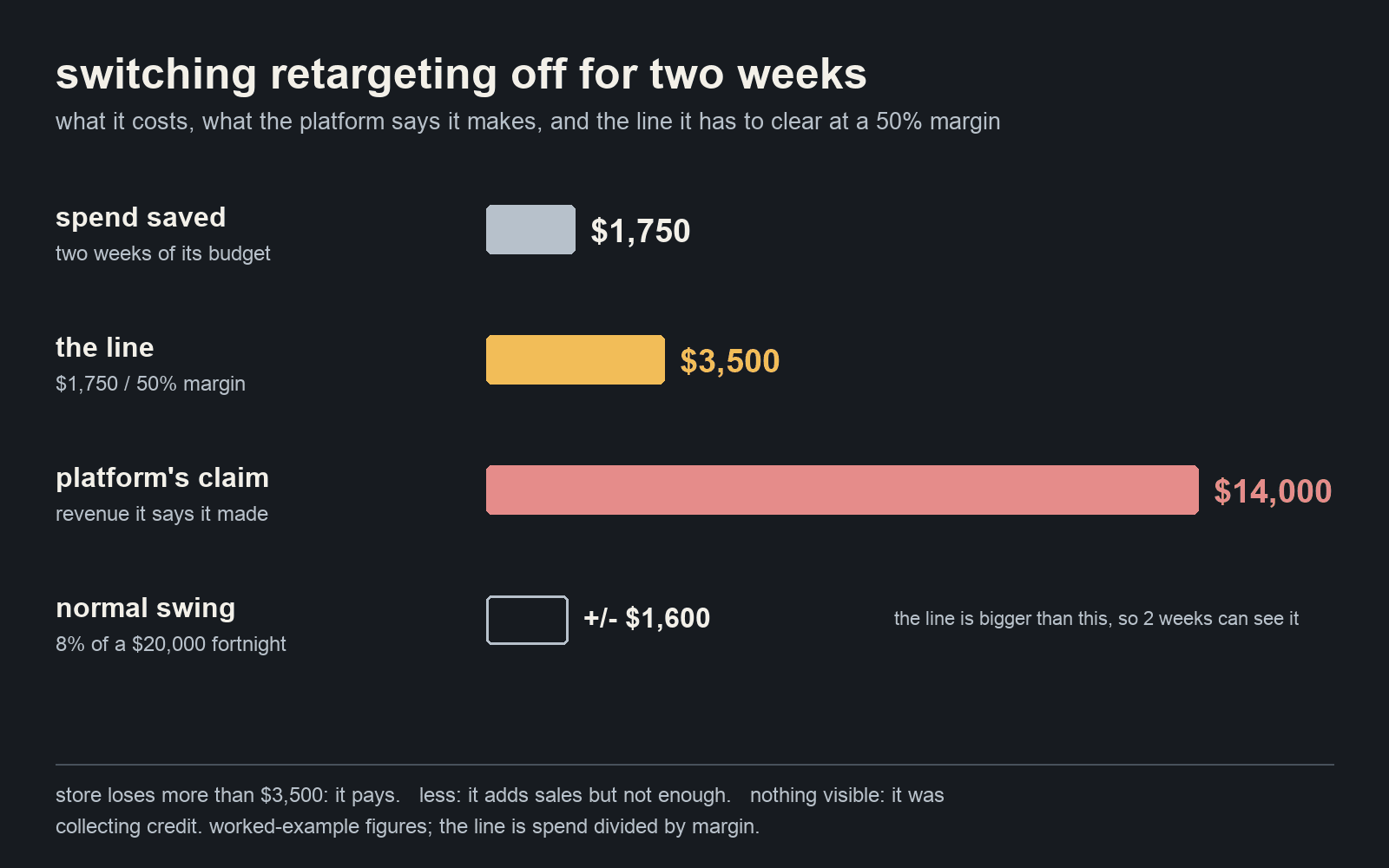
Worked-example figures, constructed from the post's own $10k / $40k / 200% illustration. The line is spend divided by margin.
Move the budget on three numbers, not one
so the answer to "are you still primarily using platform ROAS or have you moved to something blended?" is: neither on its own. three numbers, each doing the one job it can do.
MER judges the whole budget. once a week, store revenue over total ad spend, against your break-even line. it decides whether the account as a whole gets more budget or less. it never decides which campaign.
the new-customer share decides where the budget goes. once a week, the fraction of spend reaching people who have never bought or visited, and the ROAS on those people alone. when MER says there is room to scale, the extra budget goes to new-customer campaigns, because they are the only ones that make the pool of future buyers bigger. scaling the warm end only buys the same customers more often. warm campaigns get what their switch-off test says they earn, and no more.
the switch-off test settles each warm campaign, once a quarter, or whenever its share of the budget starts to grow. it replaces the platform's ROAS for that campaign with a real return, and that real return is what you budget it on.
platform ROAS keeps one job: ranking inside one campaign. which ad, which product, which audience beats which, within a single channel where the over-claim is roughly the same for everything being compared. that is how the post at the top still uses it, and it is the right use. i went through how to pick a winning creative with it, and the ways it misleads even there, in the piece on which number picks the winner.
what this does to the budget, in almost every account that runs it, is move money from the warm end to the cold end. the retargeting budget gets smaller, the new-customer budget gets bigger, and MER either holds or improves, which is what the post at the top reported. the platform ROAS on the account gets worse, because cold audiences convert less easily and the platforms see less of what they bring. that drop is not a loss. it is the over-claim leaving the report. expect it, and warn anyone who reads the dashboard before you start.
and the money that moves to new customers needs new creative to spend on. a stranger needs a different ad from somebody who has already been to the shop: a video that says what the product is, why it is for them, why now — not a 15%-off reminder and a review carousel. a retargeting creative can run for months because its audience is small and already sold. the cold end of an account runs through creatives much faster, so to scale it you need a steady supply of new videos and statics to test. the bill for moving the budget is mostly a bill for more creative made for strangers.
that doesn't have to mean a shoot for every one of them. this is one product photo turned into a new ad, step by step: https://clear-cortex.com/playbooks/how-to-make-an-ad?src=x-blended-roas-mid
One account, worked end to end
no account in the threads published every number this needs, so this one is built from the post at the top — its $10,000 of spend, its $40,000 of store revenue, its 200%, and retargeting in the middle of its 30–40% — with the rest filled in to make the arithmetic visible. every figure below that is not from that post says "say".
the account. say $10,000 a month of ad spend: $3,500 on meta campaigns to new audiences, $3,500 on meta retargeting, and $3,000 on google, most of it branded search. the shop took $40,000 that month.
what the platforms claim. say meta reports $17,500 from the new-audience campaigns and $28,000 from retargeting, and google reports $34,500. that is $80,000 of claimed revenue against $40,000 in the shop — 200%. platform ROAS: google 11.5, retargeting 8, new audiences 5.
the decision platform ROAS makes. rank by it and the budget moves to google and retargeting and away from new audiences. the campaign finding new customers is bottom of the table, and the next $1,000 of budget goes to the two that mostly reach people who already know the shop.
the line. say the margin after product, shipping and fees is 50%. break-even MER is 2. actual MER is $40,000 ÷ $10,000 = 4. the whole budget is paying for itself, with about $10,000 left after ads ($40,000 × 50% − $10,000). so the question is not whether to spend — it is where.
the split. new-audience spend is $3,500 of $10,000: 35% of the budget is reaching people who have never been to the shop, and 65% is going to retargeting and to google, most of which is people searching the shop's own name.
the switch-off. retargeting first. two weeks of its budget is $1,750. at a 50% margin, the line is $1,750 ÷ 0.5 = $3,500 of store revenue over the fortnight. the platform claims it made $14,000 in that time. the fortnight's store revenue is about $20,000, so the line is 17.5% of it. say the last eight fortnights swung by about 8% either way — about $1,600. a $3,500 drop would show clearly, so two weeks is long enough.
the read. the post at the top reports what happened when they cut retargeting: MER held or improved. in this account, that means the shop lost less than $3,500 — retargeting was adding less than it cost, while the platform credited it with four times the line. it stays off, or comes back at a fraction of the budget.
the move. the $3,500 a month goes to new-audience campaigns, with new creative to carry it — say three new videos a month to test, because the cold ad sets will tire them faster than retargeting ever did. the new-customer share goes from 35% to 70%. platform ROAS on the meta account will fall, because the account is now mostly paying to reach strangers. the number to watch is MER, against the line of 2, and the new-customer ROAS, week by week. if MER holds above the line, that is the signal to scale the new-audience budget further.
then google. branded search gets the same test next quarter, one country at a time, with the amazon caution in mind: if a competitor starts showing up on your name the moment you leave, the test will show it as lost revenue, and the campaign earns its place back.
the whole read took the store's revenue, the ad accounts' spend and claims, and one number about margin. no tool, no attribution software, no new tracking.
The part i cannot prove
how each platform counts a sale — the click and view windows, the audience segment reporting, the lift tests — is platform behaviour, from the platforms' own documentation and from what advertisers describe. none of it is my measurement. i do not run an account at this spend. the worked account is built from one post's own figures, with everything else marked "say", and the per-audience figures are one agency's account as it showed it.
the switch-off test is a before-and-after on a business that never holds still. two weeks of store revenue is noisy, a sale or an email can swamp the line, and some of what a warm campaign does — speeding a purchase up, keeping a customer from drifting — may show up after the test has ended. a test that finds nothing is evidence, not proof. the held-out-country version and the platforms' own lift tests are cleaner, and slower.
and there is one thing i genuinely do not know. how much of a typical retargeting budget is collecting credit, and how much is really adding sales? the post at the top cut it and MER held or improved. a trainer with a much bigger audience than mine thinks the non-incremental part is not wasted. both can be true in different accounts, and i have not found anyone who published the switch-off numbers side by side. if you have switched a warm campaign off for two weeks and written down what the store did, i would rather have your numbers than be right.
if any of this is wrong, say so. a correction is worth more to me than agreement.
the money this moves goes to strangers, and strangers need ads made for them. that's the part clear cortex does — the next ad from the product photo you already have, for pence: https://clear-cortex.com/?src=x-blended-roas-end