 Clear Cortex
How to let the platform run the campaign without losing the account
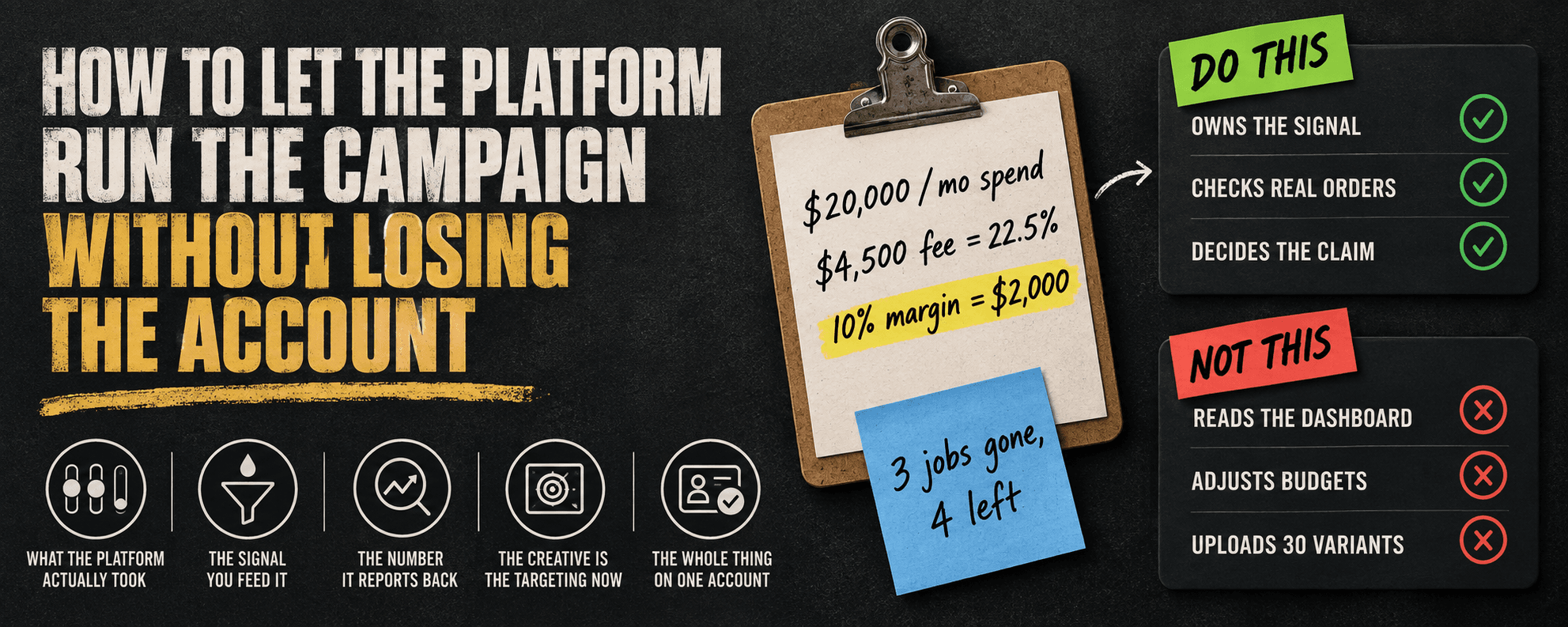
$20k a month on meta. the media buyer costs $4,500.
i went looking for what is actually left for a person to do once the platform does the bidding, the targeting and the creative, and counted 20 people asking some version of that question across 19 separate threads. the two loudest sit four points apart in the same room, and neither of them got an answer you could act on. they got reassurance, they got "it depends on your spend", and they got somebody explaining that expertise still matters without once saying what the expertise does on a tuesday.
it arrives in a few shapes and they are all the same shape:
"just got asked: 'if pmax and ai max do the bidding, targeting and creative for me, why would i still pay a specialist?'"
"is this actually a positive move or are we losing another campaign type to automation?"
"has advantage+ changed enough that i should be setting campaigns up differently?"
"if you've built your whole targeting edge around audience segmentation, does that skill set start losing relevance on advantage+ campaigns specifically, or just get abstracted away?"
"do you just dump everything into one ad set and trust the algorithm?"
"so did the barrier to entry drop, so anyone can spend now?"
the honest answer to the last one is yes. it genuinely is easier to spend money now than it was three years ago, and anybody telling you otherwise is protecting a retainer. the barrier to spending dropped. the barrier to spending well did not move, and in a couple of specific places it went up, because the parts that decide whether the budget works are now further away from the buttons.
so here is the whole thing. the four jobs the platform did not take, what each one costs you when nobody does it, and the question to ask on each one this week. nothing is held back and there is no gate on any of it.
if you want to see the thing i'm building while you're here, it's the only ask in this piece: https://clear-cortex.com/early-access?src=x-why-pay-specialist-top
What the platform actually took
start by conceding the point properly, because a piece that opens by defending the human loses the argument in the first paragraph.
three jobs are gone or going. bidding went first and nobody misses it — manual bid caps were a worse version of what the auction does by itself, and the people who were good at them were mostly good at knowing when to leave them alone. targeting went next, and it went further than most people noticed: on meta's newest campaign types the audience is not something you tune, it is something the delivery system infers. and the creative is going now, in the sense that meta will generate variants, crop them, restate the headline and serve whichever one it likes.
that is real. somebody who charged a client for those three things is in trouble and should be.
but notice what all three have in common. they are all execution inside the ad account. bidding, audience selection and variant production are the three things that live entirely between the campaign brief and the delivery system, and they were always the most mechanical part of the job. a platform tidying up its own interior is not the same as a platform doing the work.
the work that is left is the work that crosses the boundary of the ad account, and there are four pieces of it. none of them are visible in ads manager, which is exactly why the question keeps getting asked — if you judge the job by what is on the screen, the screen now looks like it does everything.
The signal you feed it
the first job, and the one nearly everybody skips.
every campaign optimises towards an event you defined. it does not know what that event is worth. it knows you said "purchase" and it goes and finds purchases, in the cheapest order it can, and it reports back how many it found. if the event is wrong, badly measured, or worth wildly different amounts on different products, meta will optimise beautifully towards the wrong thing and the dashboard will be delighted about it.
this is the part that got harder rather than easier. when you were picking audiences by hand, a bad conversion event was survivable, because your own judgement about who to target was doing half the work. hand the targeting over and the conversion signal becomes the only instruction the system has. it is now the entire brief.
so the questions are:
is the event you optimise for the event you actually want? optimising for add-to-cart because purchases are thin is a legitimate move, and it is also an instruction to go and find people who add to cart and do not buy. the system will follow that instruction perfectly. one person running traffic to a third-party page described the position exactly — "with no pixel/capi on the destination, what objective and optimization event do you actually run?" — and the honest answer is that until that is fixed, nothing downstream of it is a test.
the lead gen version is worse, because it hides for longer. optimise for form fills and you will get form fills. a form fill is not a lead, and if the sales team is quietly binning half of them, you have spent the budget teaching meta to find you more of the half that get binned. the fix is to feed the qualified ones back as the conversion, and nothing in the campaign will ever suggest it to you.
does every conversion count the same to the business? if you sell a £15 product and a £90 product through the same ad account and both fire the same event, you have told the system the two are identical. it will go and buy you whichever is cheaper, which is the £15 one, and your cost per purchase will look excellent while revenue flattens.
is there enough volume to learn from at all? a store doing a handful of conversions a week is not feeding the model enough, and a broad campaign fails hardest here rather than softest, because a thin signal spread wide is thinner still. this is also the honest reason a small advertiser cannot simply copy what a big one does: the same setup on a tenth of the budget is not a smaller version of the test, it is no test. one reply put the arithmetic on somebody's account without softening it — "at $46/day for one $80 sku with 25 lifetime purchases, you don't have enough volume to feed two campaigns' worth of learning, you'd just double the noise …"
none of that is a button. all of it changes what the campaign produces, and there is nobody else in the building who is going to do it.
The number it reports back
the second job is reading the result, and it is where the money quietly leaks.
meta is very good at finding conversions it can claim. that is not the same as finding conversions that would not have happened anyway. the two are indistinguishable on the dashboard, they are worth completely different amounts to the business, and the gap between them is the single most expensive thing in this article.
the shape of the failure is always the same. spend goes up, the reported roas holds or improves, and the business's actual revenue does not move in proportion. everybody looks at the campaign, the campaign is reporting a good number, and the conclusion is that the campaign is fine. it is fine. it is buying people who were already coming.
so the check is not inside ads manager at all, which is precisely why the platform cannot run it for you:
compare reported conversions against what the business actually did. total orders, total revenue, new customers as against returning ones — whatever your back end can tell you, over the same window. if reported conversions rose 40% and the business did not, you are not scaling, you are re-buying.
watch what the campaign is eating. a campaign given free rein finds the cheapest conversions available, and the cheapest conversions available are people who already know you. on the search side that means your own brand terms. on the social side it means recent visitors and existing customers. in both cases the reported result is excellent and the incremental result may be nothing.
know what you are allowed to pay. one person in the middle of exactly this decision gave the number that makes it real: "we do about 20-30k in monthly ad spend with about 10% margins." at ten percent the difference between a real conversion and a re-bought one is not a reporting quibble, it is the whole business. nobody inside the campaign knows that figure. it lives in the business, and meta has never been shown it.
this is the job that "just run it yourself" quietly assumes somebody is doing. usually nobody is, and it does not surface as a problem for two or three months, by which point the spend has compounded.
The creative is the targeting now
the third job, and the one that changed shape most.
if the delivery system infers the audience from the ad itself, the creative is no longer just the creative. it is the instruction that decides who sees it. the room worked this out before anyone wrote it down — the question was whether a targeting edge built on audience segmentation "start[s] losing relevance on advantage+ campaigns specifically, or just get[s] abstracted away", and the answer is that it got abstracted into the creative brief. it did not disappear, it moved.
which makes the creative decisions the load-bearing ones, and there are four the platform will not make for you.
what you are actually claiming. a tool will produce twenty variants on request and the variants will be competent. the clearest statement of the limit came from somebody who had run them: "the tool can write twenty hooks, but it doesn't automatically know which frustration your customer genuinely feels." the claim is the targeting now. pick the wrong one and you have handed the delivery system a precise instruction to go and find people who do not care.
how many things you are testing at once. this is where automatic budget allocation punishes you for being generous. one person described putting "30+ image variations of the same product line, all in one ad set, with a daily budget of about 500 euros total for all 31 of them", and another described the consequence without connecting it to the cause: "once one ad gets a tiny early lead, it grabs almost all the budget and the rest barely gets shown, so you never really know if the others would have worked too." the allocation is done for you. deciding how many creatives the ad set is allowed to allocate between is not, and it is the cheapest lever left on the table. two genuinely different ideas can resolve on a small budget. thirty variations of one idea produce a winner that means nothing, and they do it while spending the same money.
whether you are testing ideas or testing edits. meta will happily crown a winner inside a batch that was one idea wearing five outfits, and it will report that winner with the same confidence either way. the campaign cannot tell you that the whole test was too narrow to be worth running, because from where it sits there was a winner. that judgement has to come from outside.
whether the output is good enough to spend behind. somebody answering the original question listed five things a specialist still does, and the fifth has teeth: "being able to assess when the machine is generating garbage, which is quite often when it comes to ai generated creatives." volume is free now. deciding which of the free things deserves budget is not, and it gets harder as the volume goes up, not easier.
worth saying plainly, because it cuts against the identity panic in the original question: this is more creative work than before, not less. the part that shrank was audience building. the part that grew was deciding what the ad says and how many versions of it the budget can actually read.
The whole thing on one account
so, the account from the top of this piece. $20k a month on meta, a media buyer at $4,500 a month, and an owner asking whether to keep paying.
the two replies that thread got are the two ends of the argument. one said "yes mainly because $4500 is too much in mgmt for $20k as spend" — that is 22.5% of spend going on management, which is high by any standard. the other said "i am sorry but you do not need media buyer below $300k a month spend", the maximalist version of the same view. neither is a bad answer. both are pricing answers to a question about what happens to the account.
run the four jobs over it instead.
the signal. one product line, one conversion event, purchases in the tens per week. is every purchase worth the same? if a £90 bundle and a £15 entry product fire the same event, that is the first fix, it takes an afternoon, and it changes what every campaign in the account chases from that day on. nobody needs a retainer to do it. somebody needs to notice it.
the number. the $20k figure is ad spend, not revenue, so ten percent of it does not tell us the business’s gross margin. we need revenue and a clear definition of the quoted margin before deciding what is available to cover advertising, the fee and other costs. so the check is a monthly comparison of reported orders against actual orders — twenty minutes in the back end, and the highest-value twenty minutes in the account.
the creative. at $20k a month the binding constraint is how many ideas the budget can read at once, and automatic allocation tightens that constraint rather than loosening it, because it backs an early leader before the rest have been seen. so the work is picking two or three genuinely different claims per testing cycle and killing the impulse to upload thirty variations because the tool made thirty variations cheap.
the two the dashboard never shows. whether the offer is right, and whether the page converts the traffic arriving on it. these sit entirely outside the ad account and meta has no opinion on either. one person on another thread put the trap in one sentence: "a 5%+ ctr and decent cpc can still produce expensive customers if the product page, offer, price, trust or checkout is leaking …" a campaign pointed at a leaking page will optimise itself towards the cheapest possible version of a bad outcome, and it will look busy doing it.
then there is the decision that sits on top of all four, and it is the one people are most surprised to find is still theirs: when to stop testing and start scaling. the delivery system will keep testing forever if you let it, because testing is what it does. it has no view on whether you can afford another month of buying information, whether this is your season, or whether the cash needs to come back before january. so somebody has to decide that the test is over, that this creative is the one carrying the budget, and how fast that budget is allowed to rise.
scaling is a business decision wearing a campaign's clothes. the ad set that is ready to scale and the ad set you can afford to scale are two different questions, and only the first one is answerable from inside meta. i have written the mechanics of both — when a winner can take more budget, and what a test has to cost before it can tell you anything — elsewhere, and i am not going to re-run them here. the point for this piece is narrower: neither decision is available to the platform, because both depend on facts it has never been shown.
so the answer for this account is not "fire them" or "keep them". it is that $4,500 a month for somebody who logs in, reads the dashboard and adjusts budgets is now a bad trade, because meta does that better and for free. the same $4,500 for somebody who owns the conversion signal, runs the monthly comparison against real orders, decides what the ads claim, and tells you when the page is the problem is a completely different purchase, whether it earns its fee depends on the additional contribution it produces after costs.
whether that somebody is an in-house hire, a freelancer or an agency is a separate argument, and it is the one the thread spent all its time on. the four jobs do not change shape depending on who holds them.
that is the real answer to the original question, and it is not "expertise still matters". the buttons are gone. the four jobs above are not, they were always the part that decided whether the budget worked, and they are now the whole job rather than a quarter of it. anybody who cannot say which of the four they do is correctly being replaced by a checkbox.
one more thing, which settles more of these arguments than it should. somebody in a thread about whether a test was worth running asked the question that applies to all four: "before the test starts, i think the useful question is: what decision will we make if this wins or loses?" the platform cannot answer that. it does not know what you would do differently, because it does not know what else you sell, what you can afford to lose, or what you are trying to become. that is not a romantic argument about human creativity. it is a structural one about which facts live inside the ad account and which never have.
The part i cannot prove
the behaviour i am describing — automatic bidding, inferred audiences, generated variants, budget flowing to an early leader — is platform behaviour as documented and as described by the people running these accounts. it is not my measurement. i do not run an account at $20k a month, and if i implied otherwise the first person to ask which one would end it.
the figures here are other people's, taken from what they wrote about their own accounts: the $20k spend and the $4,500 fee, the ten percent margins, the thirty variations on €500 a day, the $46 a day against 25 lifetime purchases. they are real, and they are a handful of accounts — enough to work an example, nowhere near enough to call a benchmark.
the weakest part is the middle. i am confident that reported conversions and incremental ones diverge. i cannot tell you by how much on your account, because the only honest way to find out is a holdout test and almost nobody at this spend is going to run one. one reply in the original thread drew the line at budget — "for small budgets (less than $500/month) … it might not matter much one way or the other", and "once the budget is high enough, an expert can make sure the budget is performing well" — but nobody said where high enough starts. i do not know either. if you have found the point on your own account where paying somebody started clearly paying for itself, i would rather have your number than be right.
and if any of the above is wrong, say so — that is more use to me than agreement.
i'm building the version of this where the brief, the creative and the numbers that came back all sit on one canvas, so the decision behind an ad is still attached to it three months later: https://clear-cortex.com/early-access?src=x-why-pay-specialist-end
the campaign side of it is here: https://clear-cortex.com/use-cases/ai-ad-creative