 Clear Cortex
How to decide when to kill an ad without killing the one about to work
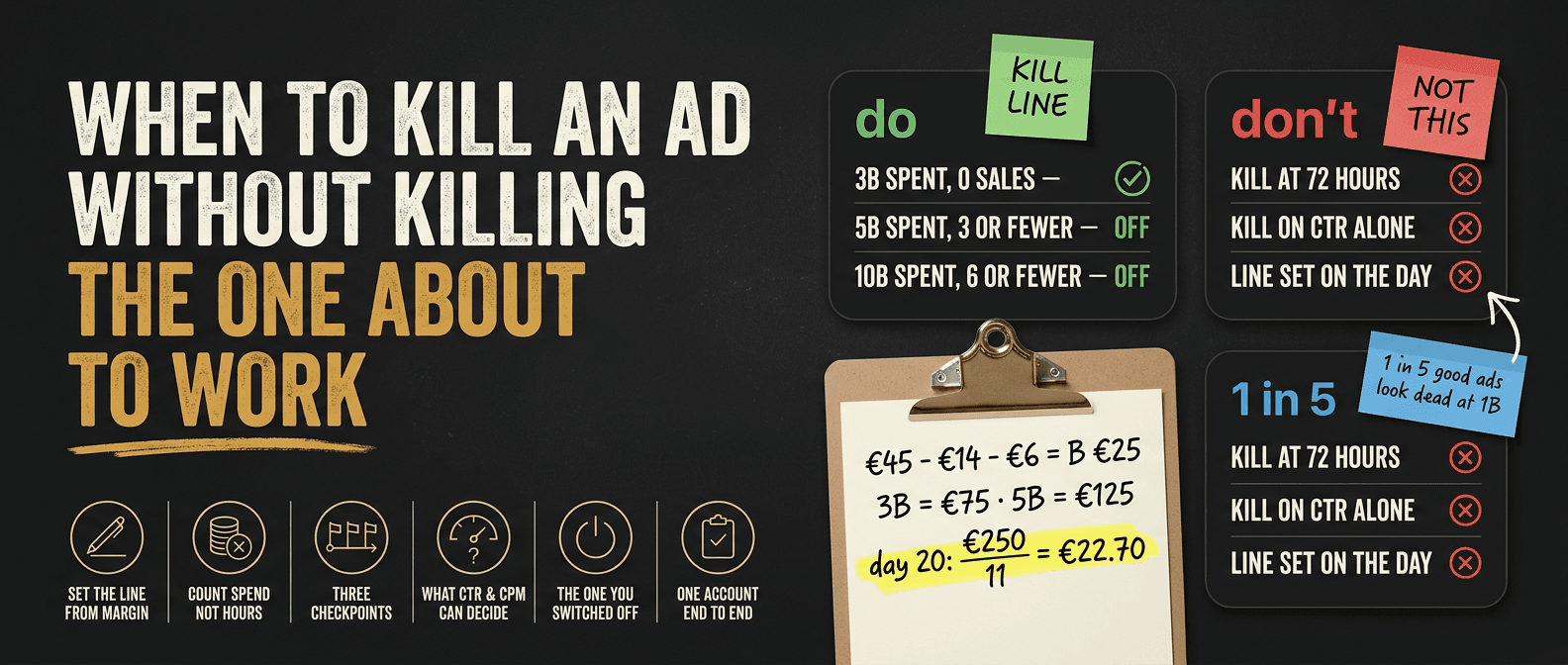
72 hours, €100 CPMs, no conversions yet.
that is somebody's actual position, and they asked the room what to do with it. i went looking for a rule that settles it and counted 11 people asking some version of the same question, 14 times between them. the thing i did not expect is how they ask it. nine of the fourteen put it as a question about time — 72 hours, another day, another 24–48 hours, how long. exactly one asks how much spend it takes. and spend is the only thing that decides it.
here is the question in their words:
"would you kill the two ugc ads with consistently €100+ cpms after 72h on soft metrics alone, or wait for conversion data even if meta is barely delivering them?"
"with only €10/day per ad set, how long should i let each creative run before making a decision?"
"how long do you let a creative run before judging it?"
"are the rough rules of turn off ads that reach 1.5-2x cpa and things like that still the same with a brand new account and pixel that haven’t got and data to go off or would you run the initial tests for longer for it to get some more data?"
"is it realistic to optimize this to at least break even (1.0+ roas), or should i turn it back on and let it ride?"
the good news is that this is decidable. not it-depends, and not give-it-a-week-and-see. there is a rule you can write down before an ad goes live, it fits on one line, and it tells you at any point in a test whether an ad is off, on, or not yet judged. it is built so the ad it kills by mistake is almost never one that would have made you money.
so here is the whole rule, in the order to set it up. one number from your margin, three checkpoints, about ten minutes before launch and thirty seconds each morning after it. nothing is held back and there is no gate on any of it.
the cover on this piece was made in clear cortex for about 8p, on the cheapest model that could spell the headline. that's the studio i'm building, and it's the only ask in this piece: https://clear-cortex.com/?src=x-kill-or-ride-top
Write the line before launch, and take it from your margin
every kill decision is a comparison against a number. the reason most of them go wrong is that the number is chosen after the test is live, while you are looking at it, and it drifts towards whatever you are feeling that afternoon. somebody gave the plainest advice in the whole pile on this: "decide exactly how much volatility you can tolerate before killing something, otherwise you're going to end up babysitting ads manager all day."
so the first job is to decide the number while nothing is running.
the number is your break-even cost per purchase, not your target. take what a customer pays, subtract what the product costs you to make and ship, subtract payment fees and whatever you lose to returns. what is left is the most you can pay for a purchase without losing money on it. call it B. everything in the rest of this piece is a multiple of B.
people who work this properly start there. one reply, working out somebody else's account: "i'd start with break-even cpa for the $80 ring after product cost, shipping, fees + returns." the same person put the roas version of it just as bluntly: at a 60 to 70 per cent gross margin, "break even is somewhere around 1.4 to 1.7x before you account for shipping and payment processing." if you think in roas, the arithmetic is the same thing upside down.
why break-even and not the cpa you would like. because a kill line set at your target kills ads that make money. an ad that comes in a little above your target but under break-even is profitable. it is not the ad you hoped for, but switching it off is switching off profit, and an ad that is merely fine in its first week has room to improve that a losing one does not. the whole purpose of the line is to separate ads that lose money from ads that do not, and break-even is the only number that does that job.
this is also the answer for a brand new account. the question about whether "the rough rules of turn off ads that reach 1.5-2x cpa" still apply without a pixel history has a hidden problem inside it: 1.5 to 2 times what? a new account has no cost history to multiply. but it does have a price and a margin, and B comes from those, not from history. so a new account can use exactly the same rule as an old one from its first test. what a new account changes is how long the rule takes to reach a verdict, not what the verdict is.
write B down before the test starts. the rest of the rule is three multiples of it.
Count the spend, not the hours
here is why "how long" has no answer, and why every answer to it that names a number of days is right for one budget and wrong for all the others.
an ad does not learn anything from the clock. what it accumulates is budget spent, and purchases arrive in proportion to it, a bit at random. so the real question is never whether an ad has had long enough. it is whether the ad has spent enough that no purchases means something, and that is a question about money, measured in B.
work out what zero sales actually tells you at each level of spend. take an ad that is genuinely break-even — every B of budget buys one purchase on average. because sales arrive a bit at random, it will sometimes show nothing for a while. how often:
- spent 1B, the chance it shows zero conversions: about 37 per cent
- spent 2B: about 14 per cent
- spent 3B: about 5 per cent
- spent 4B: about 2 per cent
now take an ad that is properly profitable — it costs two thirds of B per purchase, which is the ad you are actually hoping to find. at 1B spent it still shows zero sales about 22 per cent of the time.
that line is the title of this piece. one in five of your good ads look dead after one break-even's worth of budget. anybody killing ads at that point is switching off a fifth of their winners, and they will never find out, because a switched-off ad does not report what it would have done.
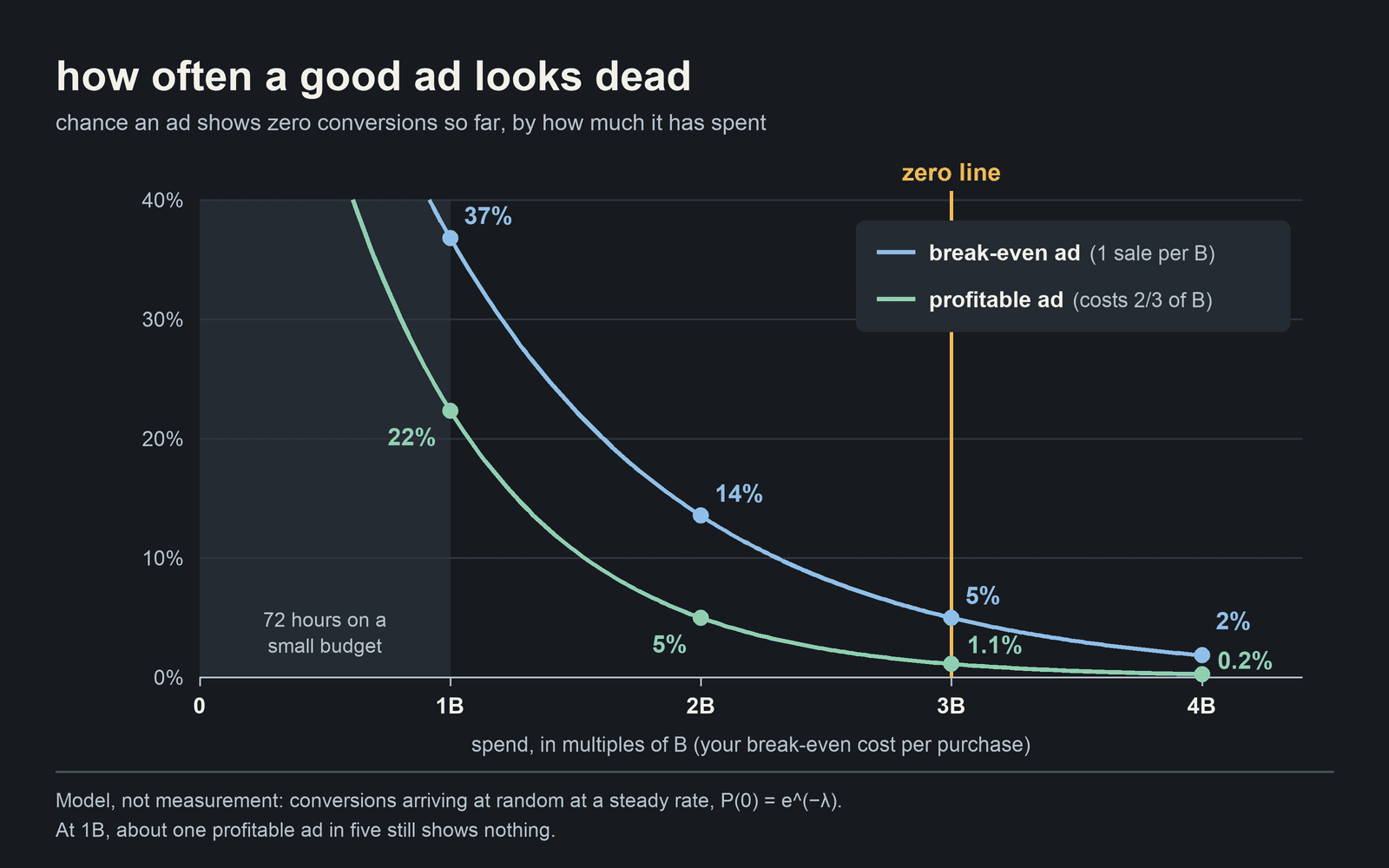
Model, not measurement: conversions arriving at random at a steady rate. Real accounts are lumpier, so treat these as the best case.
and 1B is where most of these questions are being asked. at €10 a day and a break-even of, say, €30, three days is one B. seventy-two hours is one B. the instinct to judge at three days is not impatience, exactly — it is a threshold set in the wrong unit, and on a small budget the wrong unit lands you right in the zone where the data says nothing.
one person described, in their own words, what it is like when you judge in hours: "i would make a decision after only a few hours, then change the budget, audience, or campaign structure just as the system began collecting data."
so convert the rule into days for your own budget, once, and stop asking the calendar. days to a checkpoint = the checkpoint in B ÷ that ad's daily budget. that is the entire answer to "with only €10/day per ad set, how long should i let each creative run before making a decision?" — at €10 a day and a €30 break-even, the first checkpoint arrives on day nine, not day three. a small test budget does not change the rule. it changes how long the rule takes, and that is a price worth knowing before launch rather than discovering on day four.
the same arithmetic answers the question asked in the same post: "if only one ad has generated a sale, should i cut the others already or wait for more data?" look at what each of the others has spent. any of them past 3B with nothing is off. any of them under 3B has not been judged yet, and one purchase somewhere else in the ad set says nothing about it.
Three checkpoints, and what each one costs you
the rule is three lines, all in multiples of B, all counted per ad on that ad's own spend.
checkpoint one, the zero line: 3B spent, no conversions — off. a break-even ad shows nothing at 3B about one time in twenty. a profitable one, about one time in a hundred. below 3B, zero conversions is not evidence of anything, and an ad with none and under 3B behind it is not a loser, it is unjudged.
checkpoint two: 5B spent, three conversions or fewer — off. three conversions on 5B is a cost per purchase of at least 1.67 times break-even. this is the folk rule — "turn off ads that reach 1.5-2x cpa" — made exact, with the one thing the folk rule leaves out, which is how much budget has to be behind the number before you are allowed to read it. an ad on one purchase at 2B spent also has a cpa of twice break-even, and it means almost nothing.
checkpoint three: 10B spent, six conversions or fewer — off. same cost line, twice the evidence. anything still running past 10B has spent enough that its cost per purchase is real, and it is a keep, with ordinary judgement from there on. from that point it is a scaling question, and scaling is its own piece.
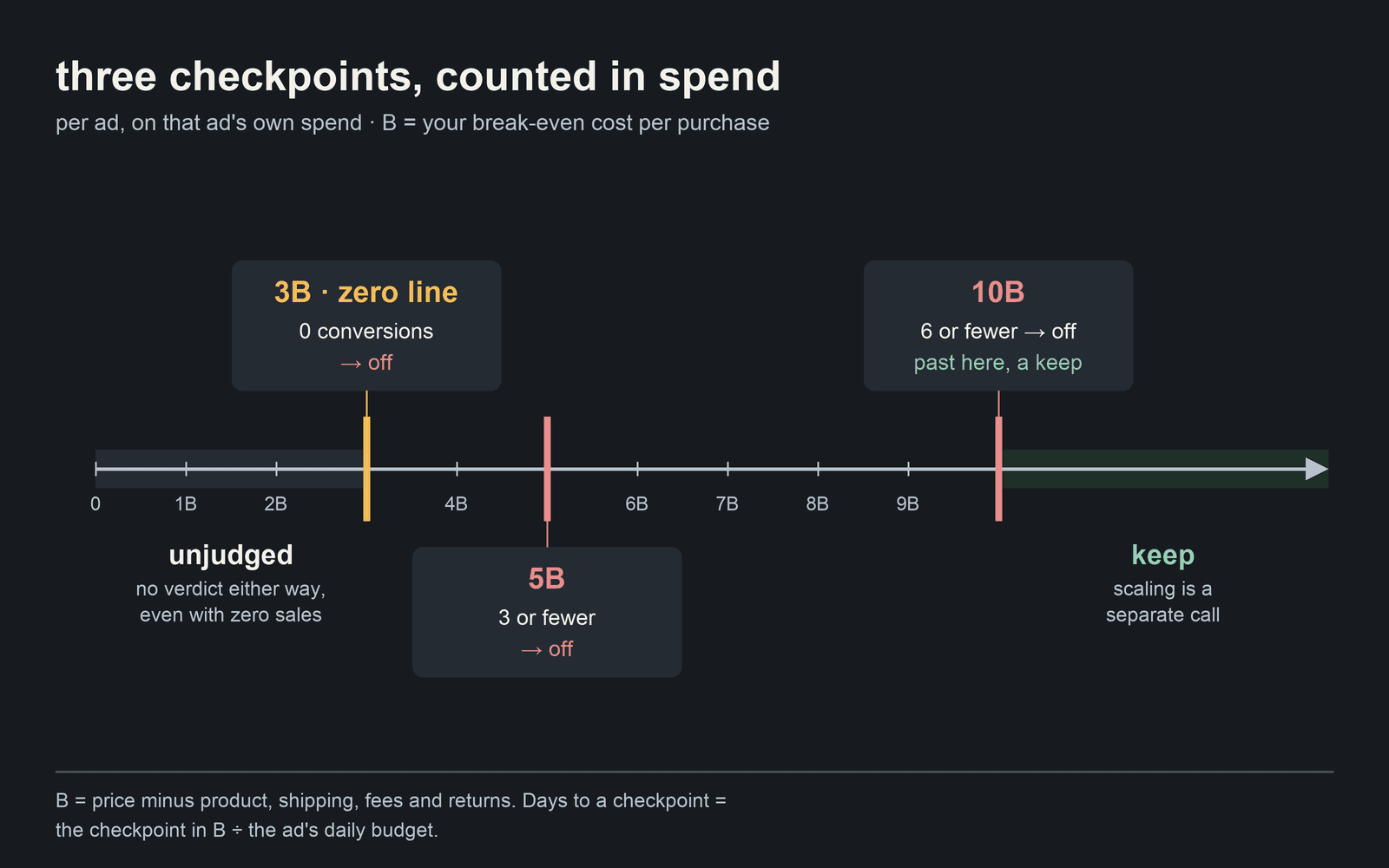
B is your break-even cost per purchase: price minus product, shipping, fees and returns.
run a whole population of test ads through those three lines — i simulated it with conversions arriving at random at a constant rate, which is the simplest honest model — and this is what each kind of ad does by 10B:
- an ad costing half of break-even — the great one — is switched off by mistake about 1 time in 80.
- an ad at two thirds of break-even — solidly profitable — about 1 in 15.
- an ad at exactly break-even — about 3 in 10. that is not a mistake worth worrying about. a break-even ad earns you nothing; killing it costs you nothing either.
- an ad at one and a half times break-even — losing money — about 2 in 3 get switched off.
- an ad at twice break-even — about 85 per cent. at three times, 97 per cent.
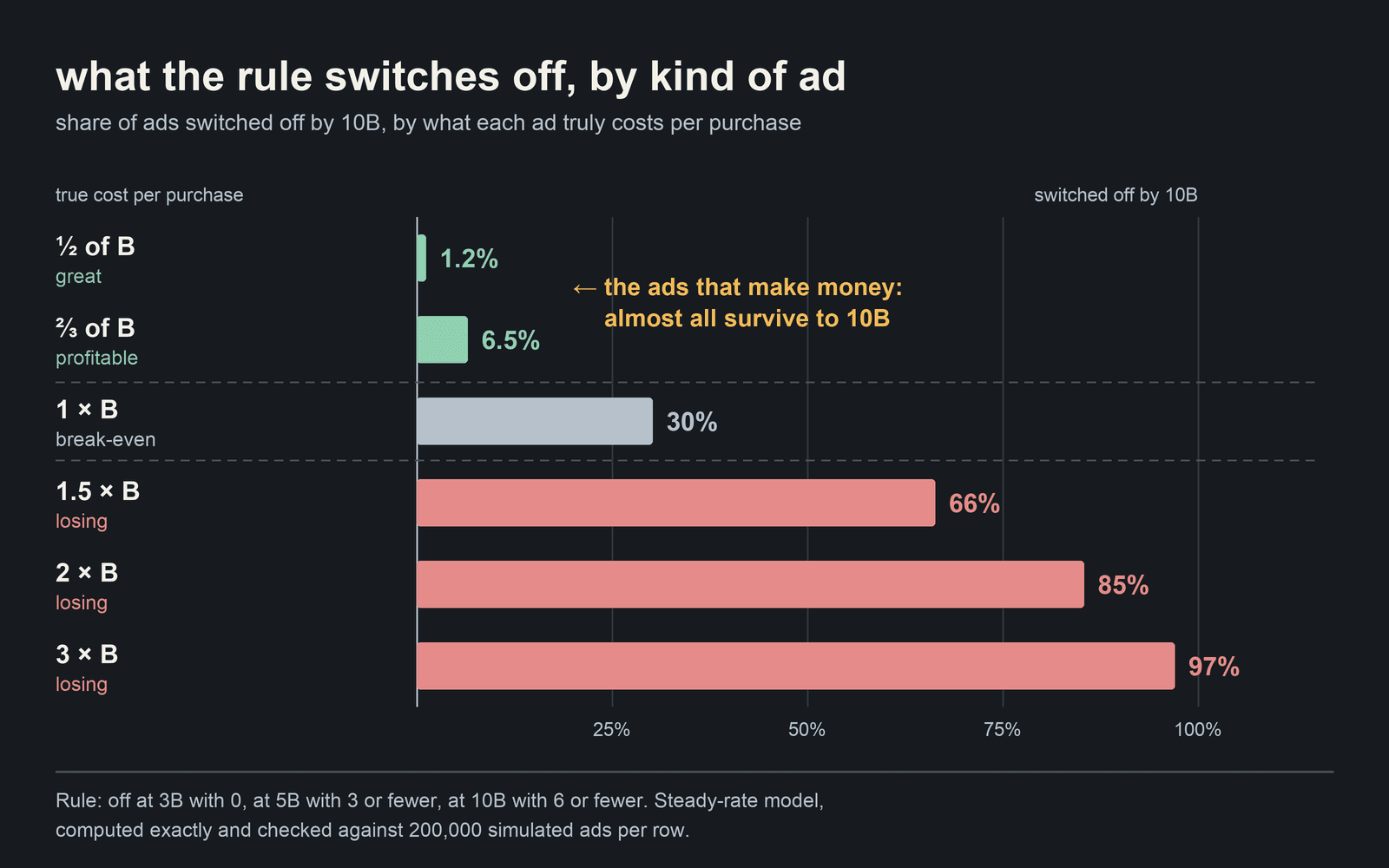
Simulated under a steady-rate model. The errors fall almost entirely on ads that were never going to make money.
one thing the lines deliberately do not do is promote anything. an ad sitting above break-even but short of a kill line is a keep, not a scale. surviving the rule means it has not lost yet, and scaling asks for more than that.
that is what a rule looks like when it is built around the title. the errors it makes are nearly all on ads that were never going to make money, and the ads that would have made money almost all survive to 10B.
compare the habit it replaces. kill anything without a purchase at 1B, and you lose about 22 per cent of the profitable ads — against about 1 per cent with the zero line at 3B. that is the whole difference between the two approaches, and it costs 2B of extra budget per losing ad to buy it.
and yes, the rule costs money. every ad that genuinely does not work will use up to 3B of budget before you are allowed to turn it off, and the ones that sell a little, just too expensively, will spend 5B and sometimes 10B. that is the tuition. the alternative is not free, it is invisible: the cost of the fast kill is the winner you never find out about.
it is worth noticing that practitioners who run a lot of tests have landed on something close to this without writing down why. one person's testing workflow: "pause a losing ad set (toggle off, never delete) after ~$75–100 spent on it, not after a few hours." in the same post they benchmark against a "known $20 cpa". $75 to $100 on a $20 cpa is 3.75 to 5 times. that is checkpoint one and checkpoint two, found by experience.
one more thing makes it work: add the replacement when you kill. same workflow: "add the replacement immediately when you pause a loser, so total daily spend stays at $100." a kill without a replacement quietly moves the loser's budget onto the survivors, and now their clocks run at a different speed and your checkpoints arrive at the wrong time.
What CTR, CPM and hook rate are allowed to decide
the most-engaged question in the whole cluster was this one: "what metrics do you pay the most attention to before deciding whether to kill an ad or keep pushing it?"
the positive answer is that you already have it. the money line contains every soft metric. a bad click rate means fewer people reach the page per pound, which means fewer purchases per B. an expensive cpm means fewer people see it per pound, which means fewer conversions per B. a weak hook means fewer people watch the video long enough to click. every one of those problems arrives at the checkpoints as fewer sales for the money, and gets killed there. counting them again separately is counting the same problem twice, on less evidence.
the same practitioner said it in one line: "judge on cost per application (your money metric), not ctr or cpm alone."
soft metrics have a real job, just a different one: they tell you why an ad was killed, and so what to make next. a dead ad with a good click rate and a bad landing page conversion is a page problem. a dead ad nobody clicked is a claim problem, and it tells you what to test next. that is the most useful thing the ad will ever tell you and it is worth writing down on the day you switch it off.
now the question at the top. two ugc ads, €100+ cpms, 72 hours, meta barely delivering them.
run it through the rule. a €100 cpm is expensive, but the rule does not care what an impression costs, only what a conversion costs. if meta is barely delivering them, they have barely spent — which means they are nowhere near 3B, which means they are unjudged. the rule's answer is: not yet.
and here is the part that makes "not yet" easy to say. an ad that is barely delivering is barely costing you anything. waiting is almost free. the expensive version of this is the opposite — an ad spending its whole budget at €100 cpms and converting nothing — and that one hits 3B quickly and the rule switches it off on schedule. either way, nobody had to decide on soft metrics.
there is one honest exception, and it should be written down before launch with everything else: broken things are not tests. a checkout that errors, a pixel that is not firing, a link to the wrong product — those get fixed immediately, and the ad's count restarts once they are fixed, because none of the budget before the fix was measuring the ad.
The ad that was profitable, and the one you already switched off
two versions of the same decision keep arriving from the other direction. somebody has an ad that used to make money and wants to know when to give up on it. or somebody has already switched something off and suspects they did it too early.
for an ad that was profitable and has gone off, run the same three checkpoints on the recent window only. pick the point it started looking worse, count only what it has cost and sold since then, and apply the lines. a former winner that has spent 5B since it turned and made three sales or fewer in that stretch is off, exactly like a new ad would be. its history bought it a fair hearing, not a pardon — and that goes double for a winner you were in the middle of scaling, because the extra budget brings it to the checkpoints faster.
this also settles the fear one person put very precisely: "if i make a small profit and don't pause my campaigns, i'll probably end up losing those gains once the remaining budget gets spent on 2 or 3 conversations that never lead to a sale." with the rule, the most a failing ad can cost you before the line catches it is fixed in advance — 3B if it sells nothing, 5B if it sells almost nothing, 10B at the very outside. letting it ride is not an open-ended bet, it is a bet with a stop, and you know the size of the stop on day one.
whether an ad that went off is tired, or the audience is used up, or the numbers were never real, is a different question and i went through it separately in the piece on fatigue. this rule does not need the diagnosis to make the call. it only needs the money.
now the one that was already switched off. here is the whole of what one person described:
"i ran 3 creatives with a $30/day budget using cbo (campaign budget optimization)."
"day 1: $0 · day 2: 1 sale · day 3: 3 sales · day 4: $0"
"overall, this translated to a negative roas of roughly 0.6 at a $29.99 price point."
and then the question: turn it back on and let it ride?
take their own numbers. at roughly 0.6 roas on a $29.99 product, each sale cost about $50. four sales at about $50 is about $200 of spend — across three creatives. B for a sample pack, which costs almost nothing to deliver, sits a little under the $29.99 price once fees come off. so the whole campaign had spent somewhere around 7B, and each of the three creatives, on an even split, a little over 2B. (their $30 a day for four days would make it $120 rather than $200, which is under 5B in total and under 2B each. either way, the next paragraph comes out the same.)
no creative in that campaign had reached the first checkpoint. not one had been judged. the campaign was switched off below the first checkpoint, in the zone where a profitable ad looks dead one time in twenty and a break-even ad looks dead one time in seven — and with four sales in total, one sale either way moves that 0.6 by 0.15 in either direction.
so the rule's answer is yes: turn it back on, and let it ride to the checkpoints, not to a feeling. each creative gets to 3B, then to 5B, and the lines do the deciding. on their budget that is about a week and a couple of hundred dollars to reach the second checkpoint on all three, and three weeks to reach the third — and it is a known couple of hundred dollars. at the end they will know which of the three, if any, makes money — which is the thing they turned it off without knowing.
one practical note. switching an ad back on does not always pick up exactly where it left off, and the first stretch after may look a little different. count the spend from the restart and do not hold the first day against it.
The whole thing on one account
here is the rule running end to end on one account, because it is easier to trust once you have watched it make a call you would not have.
the figures are constructed to keep the arithmetic clean. the shape is the one the questions describe: a new store, a small budget, three creatives, and the temptation to decide on day three.
before launch. the product sells for €45. making and shipping it costs €14, and payment fees plus a realistic allowance for returns come to about €6. so B is €25. the owner's hoped-for cost per purchase is €20. the lines, written down before anything is live: zero line at €75, second checkpoint at €125, third at €250, all per creative. one ad set, €20 a day, a three-creative test — two videos and a static. call them one, two and three.
day three. €60 spent. creative one has spent €31 and has one sale. creative two has spent €22 and has none. creative three has spent €7 and has none.
this is the moment every question above is asked from. by the folk rule on the owner's own €20 target, creative one is at 1.55 times cpa and goes off. two and three have no sales and go off with it. the whole test is over in 72 hours, having learned nothing, and the owner writes a post asking whether the creative was the problem.
by the rule: nothing is past €75. nothing is judged. nothing changes.
day ten. €200 spent. creative two reaches €76 with no sales. zero line — off, and a new creative goes into its slot the same day so the budget stays where it was. creative one has spent €100 on three purchases, about €33 each. above break-even, uncomfortably, and not at any checkpoint yet, so it keeps running. creative three has barely been delivered — €24 so far — and is costing almost nothing, so it waits.
replacing it the same day is only realistic if the replacement costs pence, not a reshoot. here's one product turned into six different ads: https://clear-cortex.com/playbooks/one-product-six-ways?src=x-kill-or-ride-mid
day twelve. the replacement from day ten is on its own clock, counted from its own first euro, and nowhere near a checkpoint yet. creative one reaches €125 with four sales. checkpoint two says off only at three or fewer, so it survives, at about €31 a sale. this is the day it would be easiest to overrule the rule. do not.
day twenty. creative one reaches €250 with eleven sales — about €22.70 each. under break-even. profitable. it is a keep, and the scaling question starts. creative three reaches €74 without a sale and goes off at the zero line the next day.
look at what the rule did. it spent about €150 across the two creatives that never worked — that is the tuition, and it was fixed before launch. and it kept creative one alive through most of three weeks in which it looked like a loser at every glance. creative one is the ad that was about to work. by the 72-hour habit it was dead on day three. by the rule it is the one thing in the account now worth putting more money behind.
the counter-case is just as clean. if creative one had reached €125 with two sales, the rule would have switched it off on day twelve, and it would have been right to: two sales on €125 is €62 each, two and a half times break-even, and a genuinely profitable ad shows two conversions or fewer on 5B about one time in fifty.
The part i cannot prove
the probabilities in this piece come from treating conversions as arriving at random at a steady rate for a given ad. that is the simplest honest model and it is ordinary statistics, not something i measured. real accounts are messier — delivery shifts, days of the week differ, an ad's cost moves as it runs — and the real odds will be somewhat worse than the clean ones above. the rule survives that because it has room in it; the exact percentages do not. none of this is my measurement, and i do not run an account at this spend. if i pretended otherwise the first person to ask which account would end it.
the figures from real accounts — the €100 cpms, the €10 a day, the $30 a day and four sales, the $75–100 on a $20 cpa, the 1.4 to 1.7x break-even — are other people's, taken from what they wrote about their own campaigns. the store in the last section is constructed so the arithmetic comes out clean. put your own numbers in.
and there is one thing i genuinely do not know. 3B, 5B and 10B are the checkpoints i would use, and i can show you what they do under the model. i cannot show you they are the right ones on a real account where the pixel is new, the budget is small and delivery is lumpy — which is exactly the account most of these questions come from. there is presumably a budget below which the rule takes so long to reach a verdict that the market moves underneath it first. i do not know where that is. if you have run something like this and found the point where it stops holding, i would rather have your number than be right.
if any of this is wrong, say so. a correction is worth more to me than agreement.
the rule only works if a killed ad can be replaced the same morning. that's the part clear cortex does — the next creative from the same product shot, for pence: https://clear-cortex.com/?src=x-kill-or-ride-end