 Clear Cortex
How to run creative tests at volume without losing track of what won
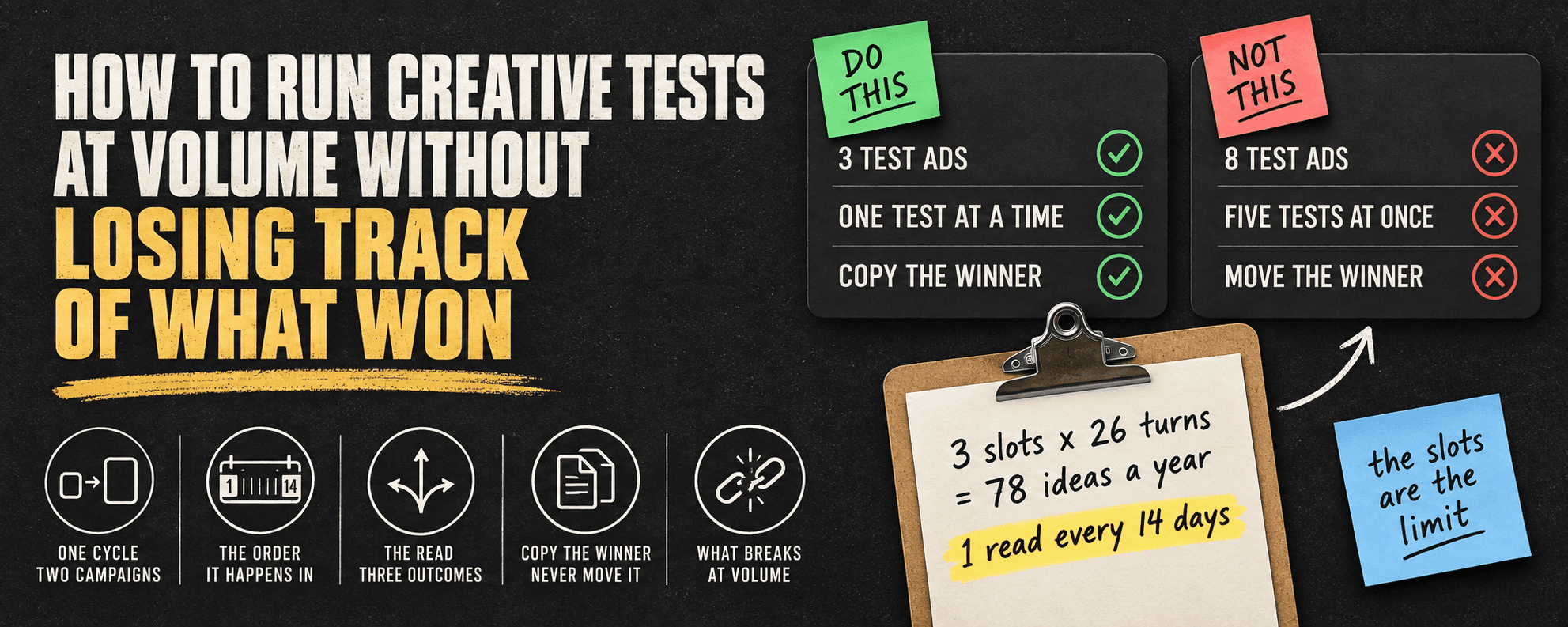
3 test ads at £25 a day. the winner runs at £110.
i went looking for what a full testing operation actually looks like once it is running — not one test, the repeating cycle — and counted 34 people asking for the process itself across 27 separate threads. the answers they got were fragments. a budget number from one person, a campaign structure from another, and nothing joining them up into something you could run on a monday.
it is one question and it arrives in the same two halves every time:
"is the usual strategy to test a lot of creatives with a small budget, find winners, and then put more money behind them?"
"do you usually create one campaign just to test creatives, then move the winning creatives into another campaign with a bigger budget?"
the frustrating part is that the fragments are good. somebody posts their real setup and it is genuinely useful:
"1 CBO testing - 1 Adset - 3 test ads - £25 daily budget. 1 CBO scaling - 1 Adset - 6 ads (3 static, 3 vids) - £110 daily budget."
and somebody else posts the other half:
"Once I have those winners, my scaling approach is to duplicate the entire campaign containing only the winning creatives, increase the budget to around 2x the testing budget, and then allow it to stabilise."
between them that is most of a system. but nobody writes down the bit in the middle — what happens on which day, how you decide, and what falls over when you try to do it twelve times a year instead of once. one person asked for exactly that and got nothing back: "i'm especially interested in the actual process and numbers people use, not just 'test more creatives.' what does a good creative testing system look like for you?"
so here is the whole cycle, end to end, in the order it happens. five stages, a fortnight per turn, and one output per turn. i have also written down what breaks first when you run it repeatedly, because that is the part that is never in anybody's answer and it is the part that actually costs people money. nothing is held back and there is no gate on any of it.
if you want to see the thing i'm building while you're here, it's the only ask in this piece: https://clear-cortex.com/early-access?src=x-testing-process-top
What one cycle actually contains
the shape almost everyone converges on, once they have done it a few times, is two campaigns with completely different jobs.
a testing campaign that never stops. it has a small fixed budget, a small fixed number of slots, and it runs continuously. it is not switched on when you have new creative and off when you do not. it is a permanent line item, and the thing that changes is what is in the slots.
a scaling campaign that only ever receives. nothing is tested in it. things arrive in it having already been proven somewhere else. it carries most of the money.
the £25 and £110 above is one real setup doing exactly this. the ratio is the interesting part: £25 against £110 is about a fifth of the money, and that fifth's entire job is to produce the thing the other four fifths get spent on. the shape does not change when the numbers get bigger — somebody else titled their post "$5k a day creative testing structure", which is the same two boxes with two more zeroes on them. somebody else described the same two-campaign split in a different structure — "abo - one ad per ad set - find winners. once i find them then i put them into a cbo" — and a third person asked the question that shows they have understood it: "and how much of your total budget do you typically allocate to the testing campaign versus your scaling/bau campaign?"
the number of slots is the decision that sets everything else. three test ads, not eight. and the reason is arithmetic i wrote up separately, so i will state it once here rather than doing it again: an ad set needs roughly fifty conversions a week to optimise on, every creative in it splits that pool, and under about ten conversions per creative per week the differences you are reading are noise rather than a result. one person put the consequence in one line — "five to ten creatives in one ad set at $50 a day is $5 to $7 each" — and another finished the thought: "at a $20 cpa that's roughly one conversion every three days per creative." if you want the full calculation for your own cost per result it is in the piece about what a test costs.
what matters for the cycle is the conclusion: your slot count is fixed by your budget, not by how much creative you can make. that is the single most common place a testing operation goes wrong, and it goes wrong in the direction of ambition. you make more, so you run more, so you read none of it.
the same applies to how many tests you have in flight at once. the person i found who had done the most of this — "i've been running facebook ads since 2015 and i've run countless split tests across a few hundred ad accounts, everything from $50/day up to a few thousand" — reduced it to one sentence: "there are only so many tests you can have running at once before the budget is spread too thin to read any of them."
one testing campaign, then. not one per product, not one per angle. one.
The order things happen in
a cycle is a fortnight. here is what occupies it.
day one: the slots get filled. three creatives go in, and they are three genuinely different ideas rather than three versions of one. everything that goes in goes in on the same day. this sounds fussy and it is the difference between a readable test and an unreadable one — a creative added on day five has had nine days where the others have had fourteen, and you will compare them anyway because they are sitting in the same column.
days two to thirteen: observe without unplanned changes. this is the stage nobody writes down and it is the one that gets broken. set loss limits and tracking-failure exceptions before launch; those still apply during the observation window. you do not pause the losing ad on day three. you do not add a fourth creative because it finished rendering. you do not raise the budget because one of them looks good. every one of those is a change that makes the fortnight unreadable, and the temptation to make them is strongest exactly when something looks like it is working.
the honest cost of this stage is time, not money. the same practitioner: "the bigger cost of small testing is time." a fortnight per turn is twenty-six reads a year, and that is the real ceiling on how fast you can learn. it is also why the slot count matters so much — three slots at twenty-six turns is seventy-eight ideas a year, and most brands do not have seventy-eight ideas.
day fourteen: the read. one sitting, all three at once, against the number you wrote down before launch.
day fourteen, an hour later: the moves. the winner gets promoted, the losing ads get turned off, and the slots get refilled the same day. leaving them empty for a week is a week of a permanent budget line producing nothing.
that is the whole loop. the discipline in it is almost entirely about the empty middle — everything difficult about running this at volume is the urge to touch a live test.
The read, and the three things it can say
people ask which metric decides it, and the question usually arrives as a list: "what metrics do you use to decide winners: hook rate, hold rate, ctr, cpa, trials/purchases, roas?"
the list is the problem. six metrics do not decide anything — they let you pick the one that agrees with the creative you liked. you decide on one number, chosen before launch, and it is the one closest to money that your account produces at a readable volume. the rest of the list is for explaining a result after you have it, which is a genuinely useful job and a completely different one. i wrote the gate itself up in a separate piece and will not repeat it here; what belongs in this one is what the read can return, because there are three outcomes and almost everybody only plans for two.
one: a winner. something cleared the gate. it gets promoted, and the cycle has done its job.
two: everything failed. all three are worse than what you already run. this feels like a wasted fortnight and it is not — you have removed three ideas from the list, and the slots refill tomorrow. the failure mode here is emotional rather than technical: a run of these is when people abandon the process and go back to changing things at random.
three: nothing resolved. the numbers are close, nothing cleared the gate, and nothing is clearly dead. this is the most common outcome and the one that has no plan attached to it. it is also where the account quietly starts bleeding, because the instinctive response is to leave them running "a bit longer to be sure", which turns one readable fortnight into a month of half-attention. one person described the bill for exactly that: "a lot of money was wasted on unprofitable testing and letting ads run longer than they should."
the rule that makes outcome three survivable: an unresolved cycle ends on schedule anyway. you turn all three off, and you write down that the three ideas were indistinguishable at your budget — which is real information, and it is the answer to whether they were worth making. extending a test to rescue it is how "$8.7k deeper in tests than we should be and the answer keeps being a shrug" happens.
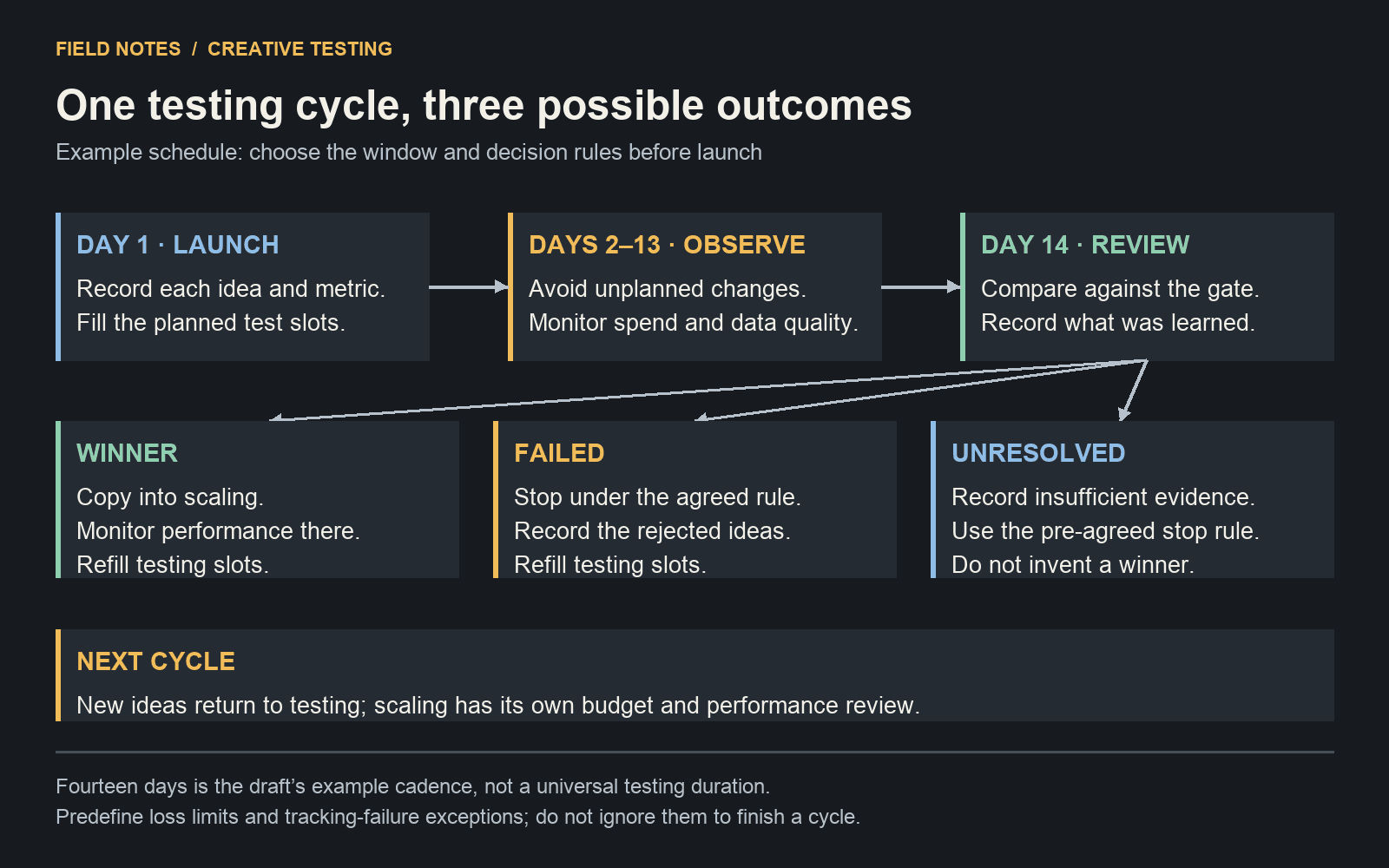
Example cadence only. Set the review window, evidence requirements, loss limits and stopping rules for the account before launch.
What actually happens to the winner
promotion is the stage with the most folklore attached to it, and one detail decides whether the whole cycle compounds or just churns.
you copy the winner into the scaling campaign. you do not move it. the version people describe most often is the duplicate — "duplicate the entire campaign containing only the winning creatives, increase the budget to around 2x the testing budget, and then allow it to stabilise" — and the reason it is a duplicate rather than a transfer is that the testing campaign has to keep running. it is a permanent line item with a job. dragging its contents out leaves it empty, and an empty testing campaign is how you end up with one winner and no successor to it three months later.
so after promotion the testing campaign is back to three fresh slots, and the scaling campaign has one more proven thing in it.
two things that are worth saying because they get asked directly:
do not assume the winner gets cheaper when it lands. somebody asked whether to expect it — "should i assume that a winning creative will likely achieve a noticeably lower cpm once it's moved into a more stable scaling campaign?" — and the test result does not establish that. auction conditions, allocation and the audience reached can change after promotion. monitor CPM and cost per result in the destination campaign; neither a lower CPM nor a better CPA is guaranteed.
what you then do to the budget is its own subject and i am not going to compress it into a paragraph here. it has a piece of its own — the checks before raising it, and why the same increase kills one ad set and not another. for the purposes of the cycle, promotion ends at "it is in the scaling campaign and stable". the ramp starts after that.
What breaks first when you run this at volume
this is the part that is missing from every answer i read, and it is the reason people who have a good process still end up stuck. none of these are failures of the method. they are what the method does to you at the twelfth turn rather than the first.
one: production outruns the reading, and production is not the constraint. you can make far more creative than you can read. the whole industry is pointed at making more of it — "the brands keeping cac in check since ios are shipping more ad creative per week than their competitors" — and that is true and it is also the trap, because shipping more per week only helps if the reads keep up. three slots a fortnight is your throughput. a library of forty finished videos does not raise it. the question "do you batch a month of variants up front, swap one variable at a time, keep a swipe file, something smarter?" has an uncomfortable answer: batch whatever you like, but the queue moves at three a fortnight regardless.
two: cycles start overlapping and attribution dies. the second cycle is where the discipline goes. you promote a winner on day fourteen and launch the next three the same day, and now a change in account performance could be either of them. it stays readable only if the two campaigns stay separate — the promotion lands in the scaling campaign, the new slots are in the testing campaign, and you never judge one by looking at the other's numbers. the moment you start reading blended account roas to decide whether a test worked, the process is over and you just do not know it yet.
three: the scaling campaign becomes a graveyard. winners accumulate. nothing ever gets retired, because turning off an ad that once worked feels like throwing money away. six months in, the scaling campaign has fourteen ads in it and the same dilution problem the testing campaign was designed to avoid — somebody asked precisely this: "could too many active ads be causing meta to rotate delivery before winners receive enough data?" the fix is the one people reach for far too late: "killed everything, moved to one campaign, one broad ad set, ~2x the daily budget, winning creative only." a promotion should have a retirement attached to it. things come in, things go out.
four: you stop being able to say which idea won. this is the expensive one and it is invisible for a long time. at twelve turns you have tested thirty-six creatives, and if the only record is the ads manager then what you have is thirty-six ads, thirty-six filenames and some numbers. somebody diagnosing another person's account landed on it exactly: "your details point to a testing system problem, not 'meta used up the easy pocket' — you're spending $30-$50/day across 5-10 ads and you've tested 100+ creatives." a hundred creatives tested and no answer. the missing thing is not data, it is the claim each creative was making. "how many creatives per persona before you admit you're just making variants?" is a question you can only answer if you wrote down what each one was arguing before you launched it.
five: the cycle slips, and slipping is silent. day fourteen becomes day nineteen because you were busy. the losers stay on. the slots sit half-full. nothing announces this and nothing looks broken — the ads keep running and the money keeps going out. a testing operation that has quietly become "we look at it when we get a chance" costs the same as one that runs, and returns a fraction of it. the calendar is load-bearing.
there is a version of this that works at real money. one person described arriving at it: "now having implemented this, i've found more winning creatives, consistently launch and create more converting content, and now i currently spend $40,000 a week on meta alone for just one of my brands." the process at that spend is not more sophisticated than the one above. it is the same loop with more slots, because the conversion volume supports more slots, and with somebody whose job it is to make sure day fourteen happens on day fourteen.
The part i cannot prove
the two-campaign structure, the slot count and the promotion step are what practitioners describe doing and what the platform's delivery mechanics make sensible. they are not my measurements. i do not run an account at this spend, and if i dressed this up as my own operating history the first person to ask which account would end it.
the numbers in here belong to other people, taken from what they wrote about their own accounts — the £25 and £110 setup, the $46 and $20 costs per result, the $40,000 a week. they are real, and they are a handful of accounts, which is enough to show the shape and not enough to call it a benchmark.
the fortnight is the softest thing in the piece. it is long enough for most accounts to accumulate a readable number of conversions and short enough to turn twenty-six times a year, and that is the whole justification. if your conversion volume is high the right cycle is shorter, and there is no rule here that finds the crossover for you.
and the thing i genuinely do not know, which is the same thing i could not answer last time: at what point does running a formal cycle stop being worth it and start being theatre? there is a spend below which three slots, a fourteen-day wait and a written gate cost more in delay than they return in certainty, and you would do better backing one idea hard. i can tell you that point exists because the arithmetic demands it. i cannot tell you where it is. if you have found it on your own account, i would much rather have your number than be right.
if any of the above is wrong, say so — that is more use to me than agreement.
i'm building the version of this where the whole cycle sits on one canvas — the idea each creative was arguing, the gate it was measured against, and what came back, all attached to each other instead of scattered across a folder and an ads manager: https://clear-cortex.com/early-access?src=x-testing-process-end
the campaign side of it is here: https://clear-cortex.com/use-cases/ai-ad-creative