 Clear Cortex
How to tell if it's the ad or the landing page without remaking both
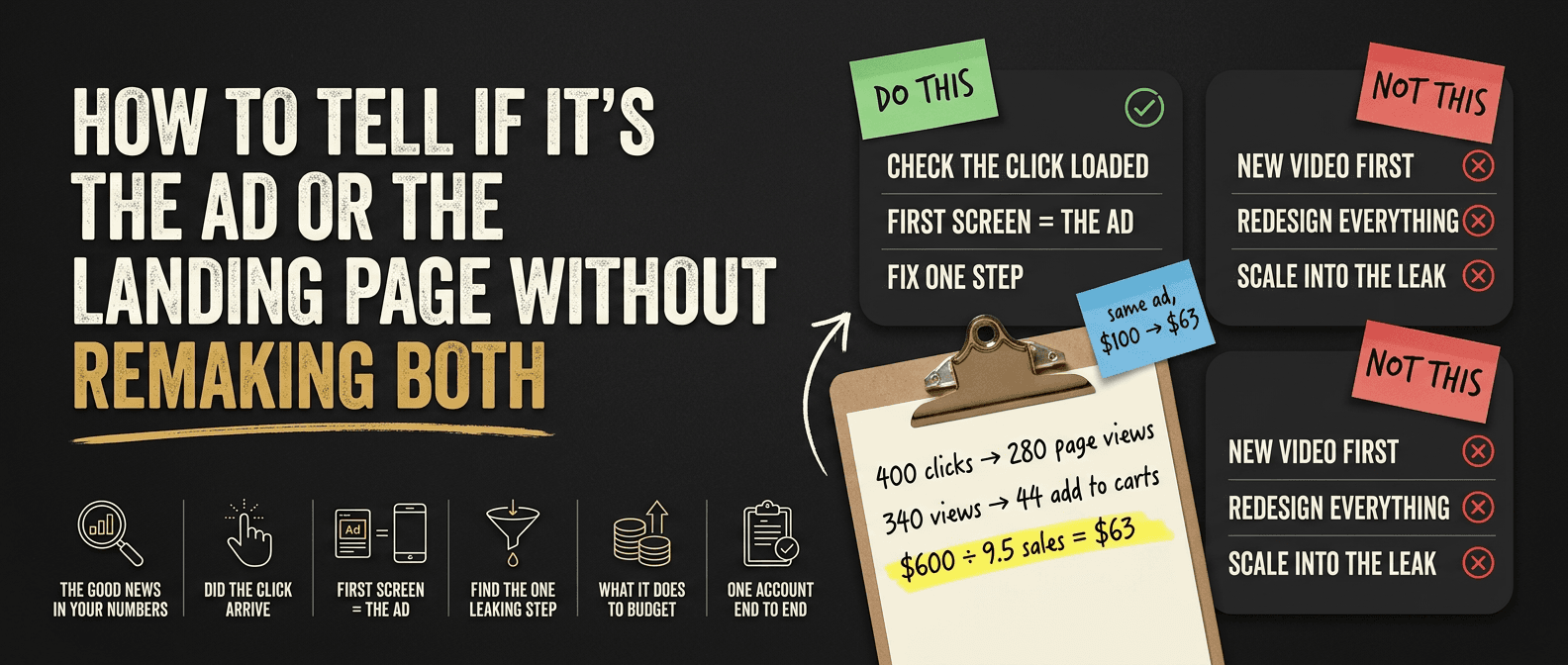
90% of the clicks never reach the quiz.
i went looking for how people tell a broken ad from a broken page, and counted 14 versions of the question across 10 separate threads. the good news was in how they asked it. half of them say, inside the question itself, that the ad is doing its job — the impressions are normal, the clicks are there, the click-through rate looks healthy. the money is being lost after the click, and the usual response is to pay for new creative.
here is how they put it:
"anyone running campaigns that were profitable for months and suddenly seeing: normal impressions → normal clicks → terrible conversion rate?"
"my meta ads are performing normal. my quiz completion (once started) is very good. but there's a 90+% dropoff from landing page to quiz…"
"even if the landing page was terrible, you'd still expect the majority of actual clicks to result in some kind of page load."
"for people who have tested it: where have you seen the bigger impact - paid-social CTR or product-page conversion?"
"is a ~3.5% ATC rate genuinely bad for a $99 impulse-adjacent physical product, or is my bar wrong?"
every one of those is a better problem than it feels like. an ad that gets people to click has done the expensive part — it found the people and it made them curious enough to leave the feed. what is broken is downstream of that, and downstream is the cheap end of the campaign to fix. it is a page. you can change a page this afternoon without a shoot, a creator, a render or a new round of creative testing.
one boundary before the method, because it matters which problem you have. if people are not clicking — the ad gets served and they scroll past — that is an ad problem, and i wrote the piece on finding out whether it is the hook separately. this one starts where that one ends: the click happened, and the loss is after it.
so here is the whole thing, in the order to run it. four checks, what fixing them does to your budget, one worked example, and at the end of it you will know whether you need new video at all. most of the time you won't. nothing is held back and there is no gate on any of it.
the cover on this piece was made in clear cortex for about 8p, on the cheapest model that could spell the headline. that's the studio i'm building, and it's the only ask in this piece: https://clear-cortex.com/?src=x-page-not-ad-top
The good news is in the numbers you already have
start with why a working ad and a bad conversion rate is the better of the two problems, because it changes where you spend the budget fixing it.
what you pay for a sale is what you pay for a click, divided by the share of clicks that buy. somebody wrote their own account out exactly that way: "$2 CPC, ~2% CVR = ~$100 CPA." and then the part that makes it feel hopeless: "i can't picture the version where CPC drops to $0.40 or CVR jumps to 10% on cold traffic."
you don't need either. look at what the smaller moves do. take the conversion rate from 2% to 3% — one extra buyer in every hundred clicks — and that $100 becomes about $67. same ad, same daily budget, same clicks. to get the same drop from the ad side you would need the cost per click to fall from $2 to about $1.33, which means a meaningfully better creative, which means a new video and a test you have to fund and wait for.
that is also the honest answer to the question above about which has the bigger impact, click-through or product-page conversion. on the arithmetic, a 50% lift in either one does exactly the same thing to your cost per sale. the click rate and the conversion rate multiply, so neither is worth more than the other per point. the difference is entirely in what each lift costs you to get:
- a lift in click-through usually needs a new creative. that is spend on production, a turnaround, and a new video that has to prove itself in a test from zero while the budget splits across it.
- a lift in conversion usually needs a page edit. it applies to every ad, every campaign and every click you are already paying for, including the ones you bought yesterday.
and there is a trap in the first one. a better click-through rate can bring in worse clicks. one reply put it more plainly than i can: "a 5% ctr with sub-$1 clicks says the ads create interest; it doesn't prove purchase intent." push the ad harder and you can buy more curiosity and the same number of buyers. push the page and every click you already have is worth more.
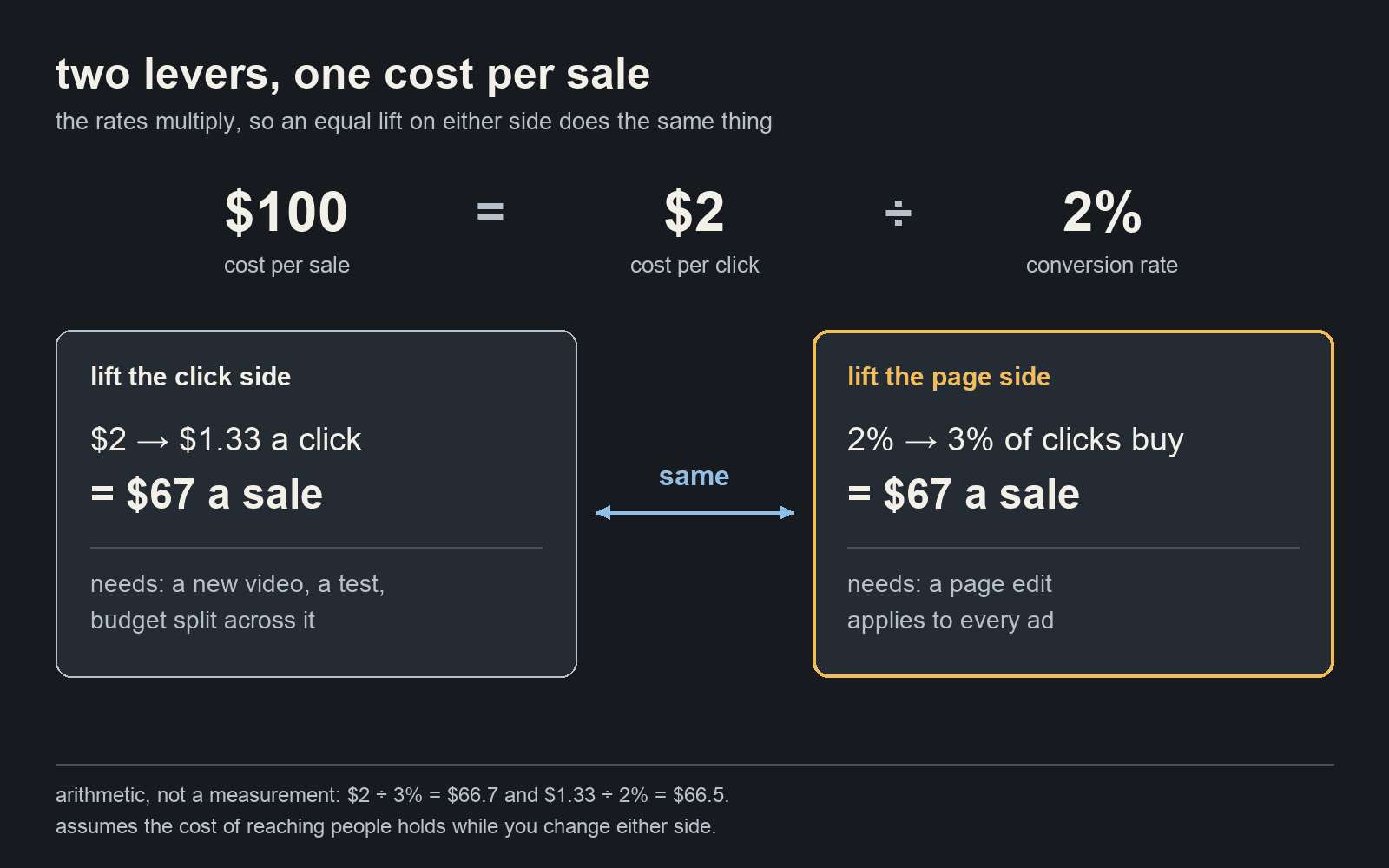
Arithmetic, not a measurement. Assumes the cost of reaching people holds while you change either side.
the people who have fixed this describe it the same way. one account running a quiz funnel wrote the whole thing up — "the real killer was mobile quiz open rate: 3–6% of paid visitors ever started the quiz." they had already consolidated the ads into one campaign and one broad ad set, and it barely moved: "CPL didn't improve much (~$239) because the landing page was still the bottleneck". then they changed the page so the form came first, and by their own account that is what moved it — the title of the post is the result: "form-first funnel took my CPL from $200 to $70, then leads went to zero for 3 days with nothing changed."
i'm keeping the second half of that sentence in on purpose. it did not fix everything and it did not stay fixed without attention. but the page change moved the cost per lead by roughly two thirds, and the ad-side change before it had not.
First, check the click actually arrived
before you judge the page, check the page was ever seen. this is the cheapest check in the piece and it catches the most expensive mistake — redesigning a page that most of your clicks never loaded.
the platform counts a click when somebody taps the ad. it counts a landing page view when the page actually loads and the pixel fires. those are different numbers and the gap between them is the first thing to look at. one person, staring at a campaign with "~77k impressions, ~180 clicks, 0 sign-ups, ~$700 spent", got this reply, and it is the right instinct:
"even if the landing page was terrible, you'd still expect the majority of actual clicks to result in some kind of page load."
a terrible page still loads. if most of your clicks are not turning into page views, the page design is not the problem yet. something between the tap and the page is — a slow load on mobile, a redirect, an in-app browser that chokes on your site, a pixel that is not firing so the views are happening and not being counted. every one of those is a fix measured in hours, and none of them involve the creative.
so pull two numbers for the same campaign and the same dates: link clicks and landing page views. if views are well under clicks, stop here and fix the arrival — every click that never loads is budget spent on nothing, and no page redesign gets it back. if they are close, the click is landing and the page is the next suspect.
and if it was working and then stopped, look for what changed downstream before you touch the ad. the question at the top — profitable for months, then "normal impressions → normal clicks → terrible conversion rate" — has a shape. the ad did not change. the people clicking did not suddenly change. so something after the click did, and the list of things that can change on their own is short. a post written about exactly this misdiagnosis had it in one line:
"whatever broke is downstream: landing page, offer, price, out of stock, or tracking (pixel/CAPI/iOS/attribution window)."
run down that list against the date the numbers turned. a price change, a discount that ended, a best-selling size that went out of stock, a theme update, a checkout app that got updated, a tracking change that means sales are happening and not being reported back to the campaign. any of those makes a healthy ad look like a dead one, and a new video fixes none of them. that is the good news again: every item on that list costs less than a shoot, and none of it touches the budget.
Make the first screen say what the ad said
once the click arrives, the first thing it meets is the top of the page, before any scrolling. this is the most common place for budget to leak in the whole chain and it is the easiest to see, because you can check it with your own phone in two minutes.
the rule is simple enough that someone wrote it in capitals: "DON'T LET THE OFFER VANISH AT THE CLICK." and then: "whatever the ad showed (a product, a bundle, a price, a gift) must be above the fold."
the ad made a promise. it showed a specific product, or a price, or a bundle, or a claim about what the thing does. the person tapped because of that promise. if the first screen they land on shows something else — the brand's homepage hero, a different product, a general headline about quality — they have to go looking for the thing they tapped for, and most people will not. the answer someone gave to the campaign with 180 clicks and zero sign-ups was exactly this:
"the thing i'd check first: does the landing page's first screen deliver exactly what the ad promised?"
it is not only the words. the best line i found on this was about a ring, in a thread where the ads looked healthy and the purchases did not: "if the winning video is a warm macro and the PDP is a flat lay on white, the ring reads as a cheaper object the moment they land." same product, same price, same headline, and the page still breaks the promise, because the ad sold a feeling and the page shows a catalogue photo. put a frame from the winning video at the top of the page and you have changed nothing about the ad and fixed the mismatch.
the other version of this shows up when a campaign runs several angles. somebody asked it directly: "do you build a landing page per angle or send them all to one?" — their ads each argued something different, cost savings, speed, reporting, integrations. the first-screen rule answers it. if four ads make four different promises and they all land on one page, at most one of them lands on the promise it made. you do not need four whole pages. you need four first screens: the same page with the headline and the top image swapped to match the ad that sent them. it is a much smaller job than four new videos, and it means the creative you already have stops leaking at the click.
there is one limit worth saying. one founder had checked this already — "ruled out so far: checkout mechanics (clean, free shipping, standard express checkout options), message match (ad promise matches page headline), price complaints (none)." if you have genuinely ruled it out, move on to the next check. the point is to rule it out on purpose, on a phone, rather than assume it.
Find the one step where they leave
if the click arrives and the first screen keeps the promise, the loss is somewhere further down, and the job now is to find the one step where most of it happens. not the overall conversion rate. the step.
every funnel breaks into a handful of steps. for a shop it is landing page view, add to cart, checkout started, purchase. for a lead campaign it is landing page view, form or quiz started, form finished. the platform and your store will give you each of those as a count. divide each step by the one before it and you get the share of people who make it through that step.
one of those numbers will be much worse than the others, and that is where the budget is leaking.
this is where the 90% at the top of this piece comes from. that account had ads performing normally and a quiz that people finished once they started it. the loss was in one step: from landing on the page to starting the quiz, and more than nine in ten people were leaving there. once you can see that, the fix is obvious and specific — the quiz has to start sooner, on the first screen, with less between the click and the first question. it is the same fix the other quiz account made when it moved the form to the top and saw quiz starts go from about 6% to about 22%. you would never get to that fix by looking at the overall conversion rate, and you would never get to it by changing the ad.
break the worst step down by device before you change anything. one reply to a jeweller with good clicks and poor sales said to "inspect checkout → purchase by device and creative." both halves matter. a step that is fine on desktop and terrible on mobile is a mobile page problem, usually speed or layout. a step that is fine for three ads and terrible for the fourth is the one place where the ad really is involved — that ad is sending people who were promised something the page does not show.
then ask whether your bar is right, and set it from your own numbers. the add-to-cart question at the top, the one asking whether the bar is wrong, is the one everybody asks in some version. another person put it as "what conversion rate and cost per purchase should I realistically aim for in the beginning?" there is no universal figure, and the published benchmarks mix industries, prices and traffic sources until they mean nothing for yours. the bar that matters is your break-even. take what you pay for a click, divide it by the most you can pay for a sale and still make money on it, and that is the conversion rate the campaign has to reach. at $1.50 a click and a $70 break-even, that is a little over 2%. above it the campaign makes money; below it is a page problem to work on before you scale.
that last part is the rule people learn the expensive way. one reply said it as a rule: "only raise budget once the existing conversion path produces acceptable contribution consistently." scaling a campaign into a leaking page buys more of the leak.
and it tells you how long a fix takes to read. with a realistic conversion rate, sales arrive slowly — "at beauty CPMs and a realistic 2-3% cvr you're paying $30-50 per purchase early, so $50/day means 1-2 purchases a day and painfully slow learning." at one or two sales a day you can wait a long time for an answer. the good news is that you do not have to read a page fix on sales. you read it on the step you changed. if you moved the quiz up the page, count quiz starts. there are several times as many of those as there are sales, so the answer shows up in days rather than weeks.
What a fixed page does to your budget
this is the part that makes the whole thing good news rather than just a cheaper chore. the page is not only where the budget leaks. it is also what decides how far you can scale.
the people asking say it more bluntly than any guide. the jeweller from earlier, spending $46 a day at a $46 cost per sale, asked how to structure a scaling campaign and got this back: "more budget at the same CPA gets you more purchases and no more profit." that is true, and it is the reason a fixed page matters more than it looks. a better creative buys you cheaper clicks on the same spend. a better page changes what every dollar of spend returns, so the same budget clears break-even, and then more budget is actually worth spending.
the page can also change what a sale is worth, which moves the break-even itself. the advice given to a new beauty brand with a $15.99 hero product was not about the ads at all: "the lever isn't the channel split, it's making the average order bigger before scaling spend: put the 2x/3x bundle tiers front and center, add a threshold gift ('free X over $35'), and test a post-purchase offer." and then: "get blended AOV to $35-45 during testing, THEN the Meta math starts working." every one of those is a page change. bundles at the top, a gift threshold, an offer after checkout. none of them needs a new video, and a bigger average order means you can afford to pay more for each click than you could last week.
treat every page change as a test, and keep it clean. while you are testing the page, leave the creative and the budget alone. if you swap the video and move the first screen in the same week, and it gets better, you will not know which one did it, and you will not know which one to repeat on the next campaign. one change to the page, the same creative, the same spend, and read the step you changed. that is the whole discipline, and it is much easier than testing creative, because you are not waiting for the platform to learn a new ad.
and only then scale. once the page holds the promise and the worst step is fixed, the creative you already have is running into a page that converts, and scaling it is spending into something that pays back. that is the order: fix the page, then raise the budget, then — if you still need more — make new video.
and if you do get to that third step, a new video no longer means a production cycle. this is the whole process from one product photo: https://clear-cortex.com/playbooks/how-to-make-an-ad?src=x-page-not-ad-mid
One account, worked end to end
here is the whole thing on one campaign. the numbers are constructed to keep the arithmetic clean — they are not from an account i run — and you should put your own in.
a shop sells one product. break-even is $70 a sale. the campaign spends $600 a week at $1.50 a click, so it buys 400 clicks. it made 6 sales last week. that is $100 a sale, and the instinct is that the creative has stopped working and needs replacing with new video.
step one, did the clicks arrive. 400 link clicks, 280 landing page views. 30% of the clicks never loaded the page. that is the single biggest leak in the whole budget, and it has nothing to do with the creative or the page design. the product page is heavy on mobile and loads slowly inside the in-app browser. they compress the images and remove an app they installed and never used. the next week, 340 of 400 clicks load the page.
step two, the first screen. the ad shows the product in a bundle of two at a bundle price. the page opens on the single product at the single price, and the bundle is further down. they move the bundle and its price to the top of the page and use a still from the ad as the first image.
step three, find the step. with the page loading, and before the first-screen change goes live, they count each step: 340 page views, 34 add to carts, 17 checkouts, 7 sales. add to cart is 10%, checkout started is 50% of those, and about 43% of checkouts complete. the next week, with the first-screen change in, add to cart rises to 13% — 44 add to carts, 22 checkouts, 9 or 10 sales.
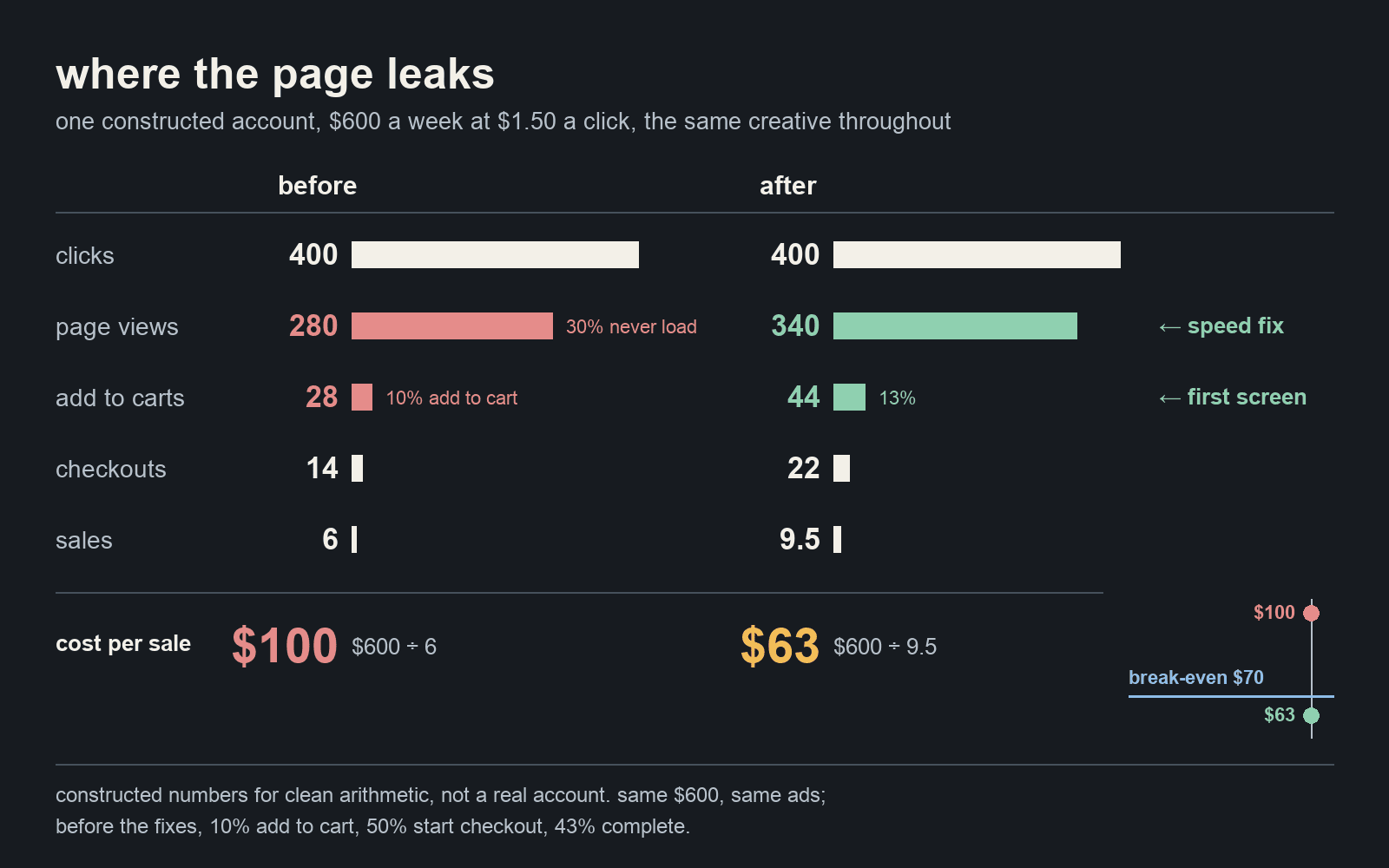
Constructed numbers for clean arithmetic, not a real account. A before-and-after on one campaign is not a controlled test.
the result, on the same creative and the same budget. $600 a week, about 9.5 sales, about $63 a sale — under the $70 break-even, from $100, without a new video. and now the campaign is worth scaling, which it was not a fortnight earlier. getting the same result from the ad side would have meant cutting the cost per click from $1.50 to under $1. that is a much better creative than the one they had, and no amount of testing can promise you one.
and the counter-case, because sometimes it really is the ad. say they had broken the funnel down by ad and found three ads sending people who add to cart at 12% and one sending people who add to cart at 3%. the fourth ad is getting cheap clicks from the wrong people, or it is promising something the page does not have. that is the case where you do touch the ad — you turn that one off, or you make its first screen match what it says. you still do not need four new videos. you found out which one by looking at the page's numbers, which is the point of the whole method.
one claim you will hear against all this is that the ad is still the cause, just further back: "many AI ads receive impressions and traffic but struggle to generate strong conversion rates because they lack authenticity." it can be true. the per-ad breakdown above is how you would know. if one ad's clicks convert badly on a page that converts everyone else's clicks fine, the ad is sending the wrong people, whatever the reason. if every ad's clicks convert badly, it is the page, and a more authentic video will just send more people to the same leak.
The part i cannot prove
the arithmetic is arithmetic: cost per sale is cost per click divided by conversion rate, and a lift in one does the same as a lift in the other. the checks — arrival, first screen, step by step, by device, by ad — are ordinary funnel analysis, not something i discovered, and none of it is my measurement. i do not run a store at this spend and the worked example is built for clean sums, not taken from an account.
the real figures in this piece are other people's, from what they wrote about their own campaigns: the 90% that never reached the quiz, the 3–6% of mobile visitors who started one, the cost per lead that went from $200 to $70 and then went to zero for three days. that account changed other things around the same time, including what the campaign optimised for, and i am taking their word for which change did the work. that is the honest caveat on the whole thing. a before and after on the same campaign is not a controlled test. the week you fix the page is also a different week in the auction, and some of what you see will be that.
and there is one thing i genuinely do not know. i have argued that a page fix is cheaper than new creative, and in hours and spend it usually is. what i cannot tell you is how often the fix is out of reach — a price that cannot move, a product that genuinely does not convert at this price to cold traffic, a checkout you do not control. one reply to the jeweller said it might "just be a demand ceiling, not an ads problem." i do not know where that line sits for you. if you have run these checks and found every step was fine and it still did not convert, i would rather have your numbers than be right.
if any of this is wrong, say so. a correction is worth more to me than agreement.
if the check says it really is the ad, clear cortex makes the new one without a shoot — from the product photo on the page you just fixed: https://clear-cortex.com/?src=x-page-not-ad-end