 Clear Cortex
Which model, and what actually changes when you switch
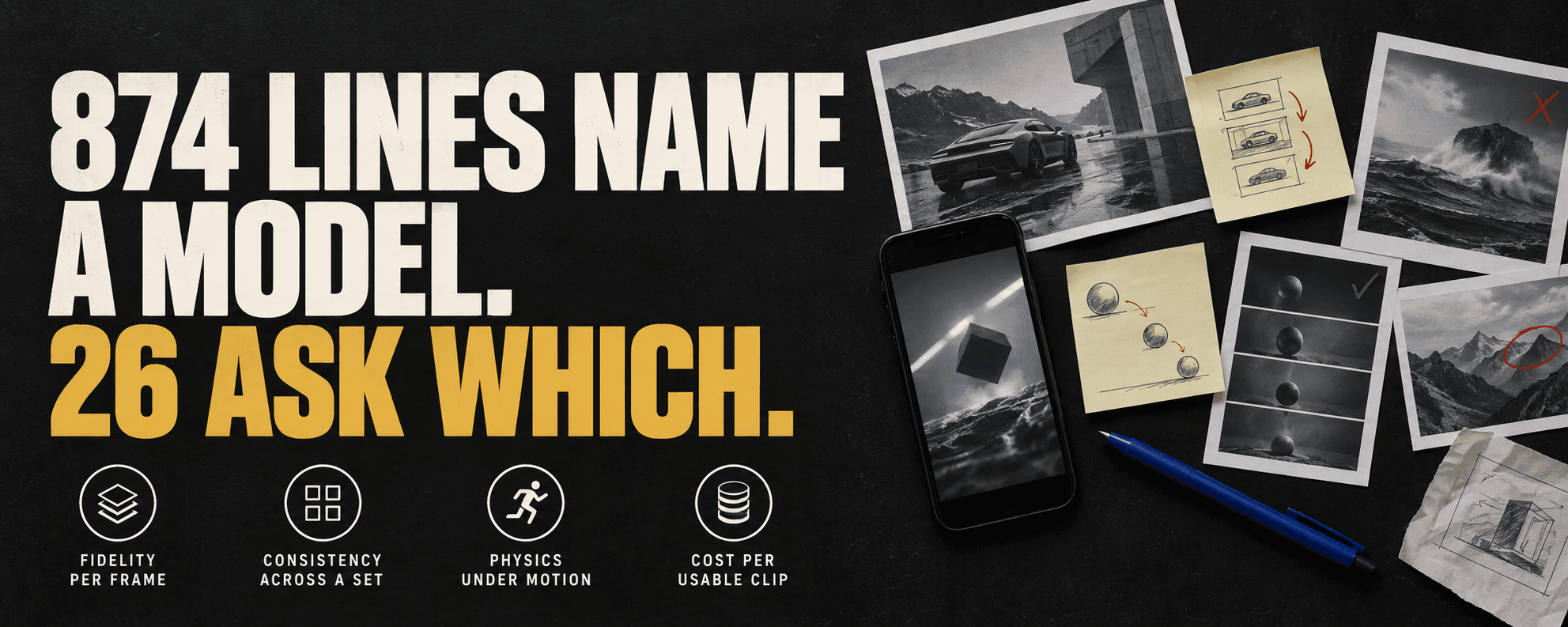
874 lines naming a model. 26 people asking which one to use.
i went looking for how people choose an AI video model and read 874 lines naming one, across 114 threads. the ratio is the finding: thirty-three lines announcing a model for every one line asking which to pick. almost everything written about models is release news, and almost none of it is decision help.
and the questions that do get asked go unanswered:
"Which is the best AI video generation model?"
"Seedance 2.5 vs Seedance 2.0 for AI UGC — who got it better?"
"Do you think we'll eventually see another AI video model capable of challenging Seedance?"
so here is the whole thing: why the question as asked has no answer, the four axes that actually differ between models, the switching cost nobody mentions until it bites, and a way to choose that survives the next release. about fifteen minutes, nothing held back, no gate on any of it.
why "which is best" has no answer
not because it is subjective. because the field moves faster than any answer's shelf life.
look at what the corpus is actually made of. "Seedance 2.0 in native 4K is now on Higgsfield", "Seedance 2.0 in native 4K is finally cinema-ready", "Seedance 2.0 nails skin realism in native 4K", "Seedance 2.5 vs Seedance 2.0", "i built an AI agent... using Seedance 2.5" — one model line, several versions deep, inside a single capture window. anything i tell you about which model is best is wrong by the time you read it, and anyone telling you otherwise is either selling one or has not checked recently.
so the useful question is not which model. it is which axis you are actually constrained on, because that does not change every six weeks, and it tells you what to re-test when something new lands.
the four axes that actually differ
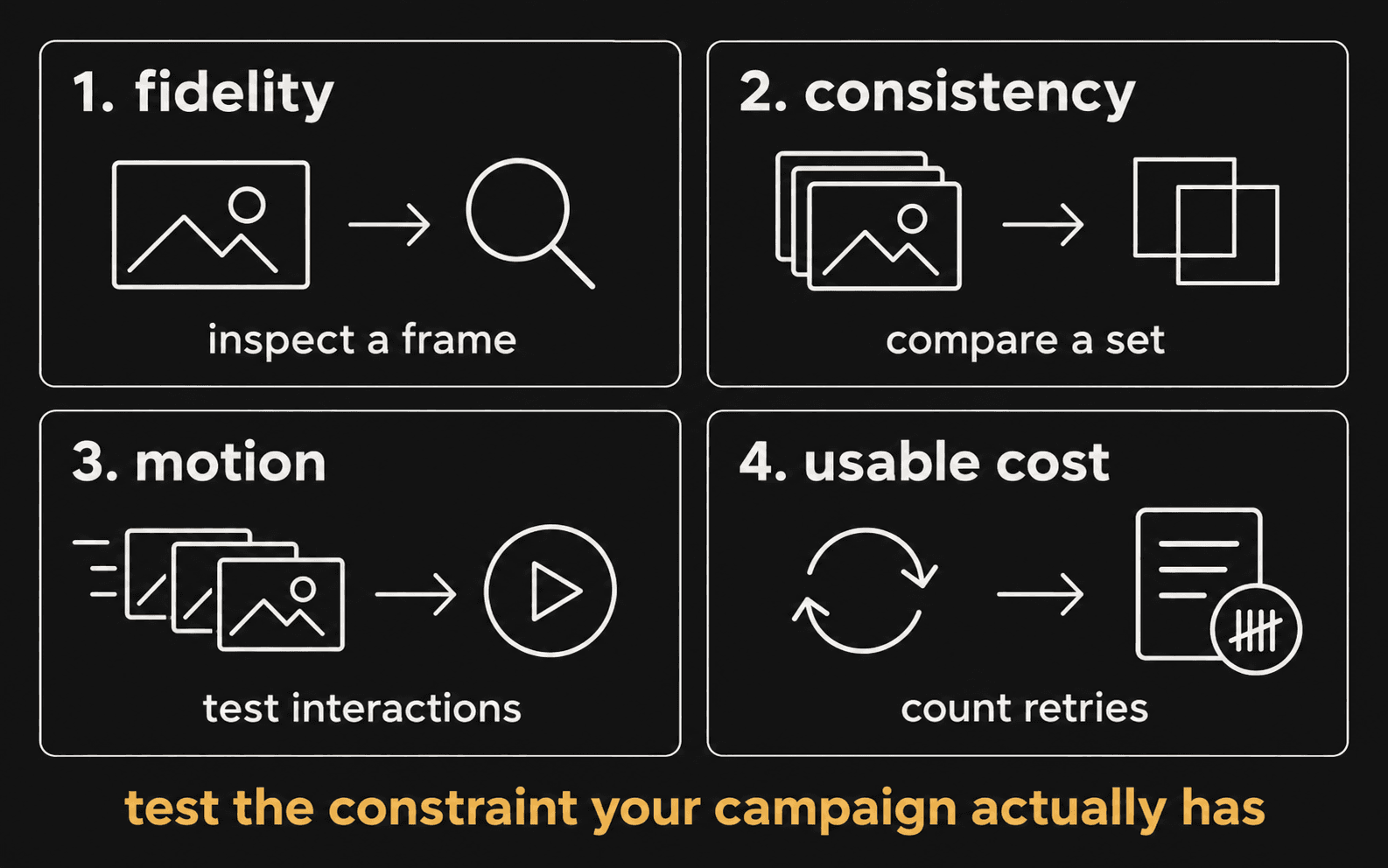
these are the real dimensions, and most people only ever evaluate the first.
1. fidelity per frame. how good a still from the middle of the clip looks. this is what every launch post shows you, it is the easiest thing to demo, and it is the axis that matters least for advertising — because almost every current model clears the bar where a viewer stops caring. the cut is saturated with it: "nails skin realism", "keeps every detail intact", "cinema-ready".
2. consistency across a set. the same face, the same product, the same room, across forty clips. this is the axis that decides whether you can actually run a campaign, and it is barely demoed because it cannot be shown in a single clip. the cut names it as a headline feature when a model gets it right — "this model is the best for ultra-realistic videos, clean voices and character consistency" — which tells you it is not the default.
3. physical plausibility under motion. what happens when things move fast or interact. somebody actually stress-tested this:
"I just tested an AI tool to recreate FIFA's live broadcast. Most AI video models didn't handle: fast motion, intense tackles. But Seedance 2.0 in 4K doesn't look like AI anymore."
that is worth more than any launch reel, because it is a named failure mode with a test attached. for most ad work this axis barely matters — a person talking in a kitchen is not a physics problem. for product demos with movement it is the whole thing.
4. cost per usable output. not cost per generation. the two are different by whatever your discard rate is, and a model with slightly worse fidelity and half the failure rate is cheaper in every way that matters.
pick on 2 and 4 for ad work. 1 is table stakes and 3 is situational. this is the opposite of how the launch posts are ordered.
the switching cost nobody mentions
here is the part that only shows up later, and it is the reason to think about this at all rather than just using whatever is newest.
if your creative depends on a consistent face, the model is not a tool. it is a dependency. switch it and the face changes. the persona you have run in two hundred ads, that your audience has started to recognise, is gone — and the recognition, which is the only part of this that compounds, resets.
so there are two genuinely different postures and you should pick deliberately:
stay current. always on the newest model, accept that the look drifts, and never build anything that depends on continuity. correct for volume-testing accounts where each ad stands alone and nothing accumulates.
pin and hold. lock one model for the life of a persona, take the fidelity hit as newer things ship, and keep the asset. correct for anyone building a face people are meant to recognise.
most people are in the second position and behaving as though they are in the first, upgrading on release day and quietly destroying the thing they spent months building.
where the model sits in what you are buying
worth naming, because the cut conflates them constantly.
"With Higgsfield inside, you get every AI video model and every image model that is available."
"This opens up the video workflow and now you can choose which AI video model you want to use."
a platform that carries every model has moved the decision, not made it. that is genuinely useful — it means a model going bad is a swap rather than a rebuild, which is the thing you actually want to buy. but it does not tell you which to use, and the choice is still yours.
and one line in the cut is worth flagging for a different reason: "we've perfected this internally & this is not a system any other platform has access to or will be able to replicate even closely at my price + realism". treat claims of an unreplicable edge in this category with more suspicion than usual — the underlying models are available to everyone, and the differentiation is almost always workflow rather than capability.
how to choose, in a way that survives the next release
- write down which axis binds you. consistency across a set, or physics, or cost per usable clip. one sentence. this is the durable part.
- build a fixed test. three prompts you re-run on every candidate: one talking to camera, one product interaction, one that needs the same face as a previous clip. same prompts every time, kept in a file.
- score on discard rate, not on the best output. generate ten of each, count how many you would actually run. this is the number that maps to money and it is never in a launch post.
- decide your posture before you test — current or pinned — because it changes which result matters.
- re-run the fixed test when something ships. do not switch on the announcement.
that whole loop costs an afternoon and it is re-runnable forever, which is the point. it replaces the question with a procedure.
what usually goes wrong
people choose on the launch reel, which is a curated best-of on the axis that matters least.
people switch mid-persona and lose the only compounding asset they had.
people compare the best output of one against the average of another — generate ten of each or you are comparing selection to production.
people evaluate fidelity and ship on consistency, then blame the model for a problem they never tested for.
the honest answer
which is the best AI video generation model?
unanswerable as asked, and it will still be unanswerable next month — 874 lines in this corpus name a model and thirty-three of them are announcements for every one that is a question.
what is answerable: for ad work, pick on consistency across a set and cost per usable output, not on per-frame fidelity. decide whether you are staying current or pinning to protect a persona, because that decision costs more than the model choice does. and keep a three-prompt test in a file so the next release is an afternoon rather than an argument.
i'm building the version of this where the model is one swappable node and the face, the wardrobe and the brief sit outside it on the canvas — so switching generator is a change of one thing rather than a lost persona. if you want to see it when it lands: https://clear-cortex.com/early-access?src=x-09-which-model