 Clear Cortex
How to tell which fatigue you have without wasting the new creative
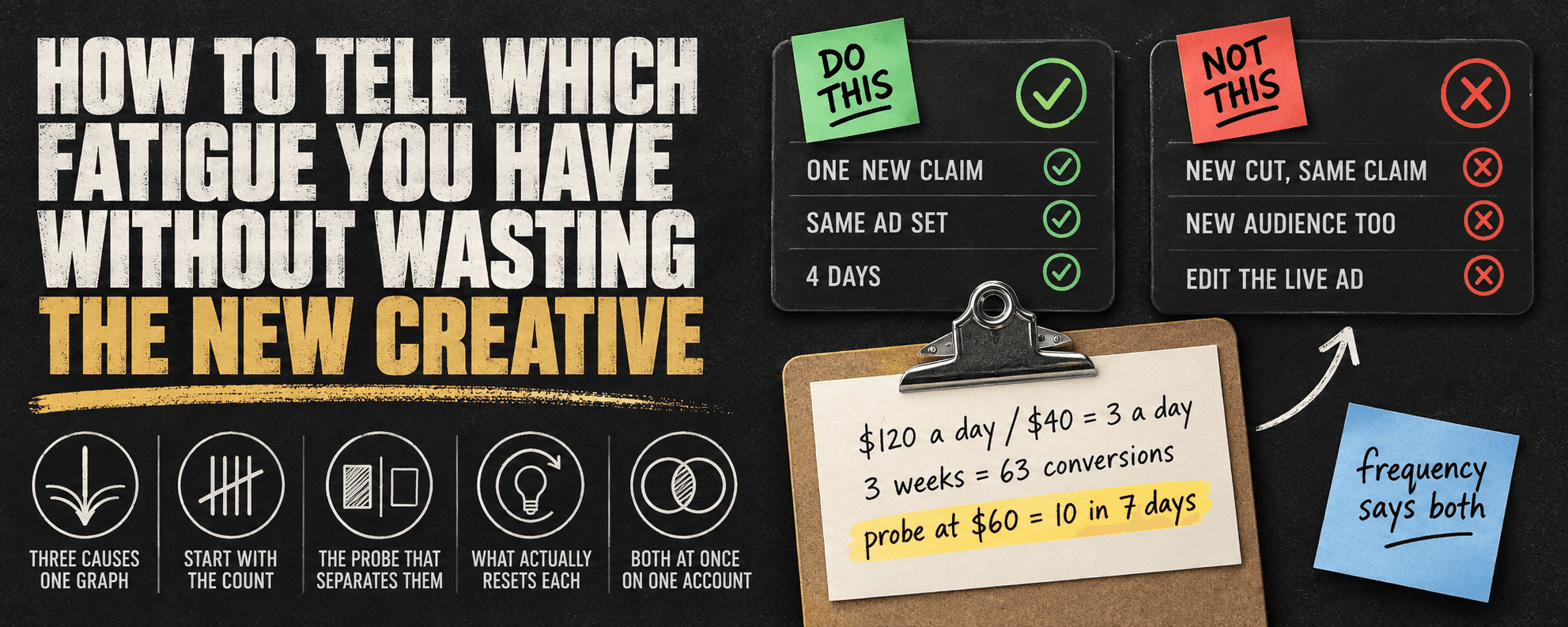
one account burned $4.6k in 8 days for 0 purchases.
i went looking for a test that tells the two apart and counted 31 people asking which one they had, across 29 separate threads. the thing i did not expect is that only one of the two has a name. "creative fatigue" turns up about ten times as often as "audience fatigue" does in the same body of writing — so one half of the diagnosis is a phrase everybody already reaches for, and the other half barely has a word. the loudest answers in the pile are vendors selling fatigue detection, which is a product for the half that has a name.
it gets asked in five or six shapes and it is one question:
"is it audience fatigue or ad fatigue?"
"does this sound like normal learning-phase volatility, audience fatigue, creative fatigue, or something else?"
"i'm confused — is this regular creative fatigue, or is there something wrong with my meta ad account?"
"if it actually has exited the learning phase, what to do when it reaches creative fatigue?"
"what kind of variation actually resets fatigue vs just looks different?"
the reason nobody answers it properly is that all three causes produce the same graph. cost per result goes up, return on ad spend goes down, and the ad that was working stops working. you cannot read them apart from the shape of the line, and almost everything written about this tries to.
so here is the whole differential, in the order to run it. three causes, one probe that costs a single creative and four days, and a rule for what actually resets each. two of the three causes get worse when you add creative, which is why guessing is expensive. nothing is held back and there is no gate on any of it.
if you want to see the thing i'm building while you're here, it's the only ask in this piece: https://clear-cortex.com/early-access?src=x-which-fatigue-top
The three it can be, and the fix for one makes the others worse
there are exactly three things behind an ad that was fine and is now expensive, and it is worth being precise about them because the word "fatigue" is doing the work of two of them at once.
one: the creative is worn out. the people you are reaching have seen this video enough times that it has stopped landing. they still buy — they are just done with this particular ad. the audience is intact. the ad is the thing that is tired.
two: the audience is used up. you have reached the people who were ever going to buy at this price, and what is left in the pool is more expensive to convert. the ad is fine. a brand new ad, made today, by someone better than you, would now do roughly what the old one is doing. somebody put this in the plainest terms i have seen: "the ai version just burned through the audience faster." the creative was not the variable there. the speed at which it consumed the pool was.
three: nothing is tired and the numbers were never real. the ad had a small number of results, the small number landed on the good side, and what you are watching now is the average arriving. one person describing their own account: "meta ads suddenly burning budget." another, at $700 a day: "burned $4.6k in 8 days for 0 purchases."
notice what the third one does to the vocabulary. an ad set that burned $4.6k for zero purchases does not have fatigue, because fatigue means something worked and then stopped. nothing worked. calling that creative fatigue is how a budget problem gets a creative-shaped fix, and the fix does not touch it.
and here is why the guess is expensive rather than merely wrong. new creative is the correct response to cause one. against cause two it makes things actively worse — you are putting more ads in front of the same exhausted people and paying for video to do it. against cause three it destroys the evidence, because the new ad starts its own count from zero and you have thrown away the only thing that would have told you the first number was noise.
one fix, three causes, and it helps in one case out of three. that is the whole reason this is worth twenty minutes.
and there is one thing that changes the clock on all three of them: your daily budget. two accounts running the same video can be in completely different places after a week, and the difference is the budget rather than the creative.
a campaign at $40 a day works through an audience slowly. the same campaign at $700 a day gets through the same people in a fraction of the time, so the video that "lasted six weeks" on the small budget looks like it fatigued in eight days on the large one. same video, same audience, different clock. one person's figures have exactly that shape — a winner set at $700 a day that burned $4.6k in 8 days.
this is also why scaling manufactures something that looks like fatigue. you find a video that works, you raise the budget to scale it, and within a fortnight the cost per conversion has gone up. the obvious conclusion is that the creative wore out under the extra volume. sometimes it did. more often the larger budget reached the cheap part of the audience faster and is now paying for the expensive part, which is a pool problem arriving on a schedule you set yourself. when and how to raise a budget on a winner is its own piece and i have written that one separately; the only part that belongs here is that scaling moves the clock on the diagnosis.
so "how long should a video last" has no answer that is not a budget figure. an ad lasting four days at a few hundred a day and an ad lasting two months at $30 a day can be the same creative burning through the same audience at the same rate per person reached. before concluding anything about a creative's lifespan, work out how many conversions the budget has actually bought and roughly what share of the reachable audience that represents.
and it is worse at the small end rather than better, which surprises people. at a low daily budget the campaign accumulates conversions so slowly that the audience moves underneath the test while it runs, and one of the more useful observations in the threads is that "low budget campaigns are now more likely to receive lower quality traffic, creative fatigue happens much faster". a small budget does not buy you a longer runway. it buys you a worse read on a shorter one.
one word on the number everyone reaches for first. the standard answer to this is to look at how many times the average person has seen the ad. somebody in the middle of it asked the question i would have asked: "makes me wonder, is frequency even still a reliable signal for creative fatigue anymore?"
it is not, and the reason is structural rather than a platform change. that number climbs when an ad wears out and it climbs when the audience runs out, because both mean the same people are seeing the same thing more often. it is a symptom of two causes, so it cannot separate two causes. it tells you something is happening. it is silent on which.
the practitioner version of it is a threshold — "i check frequency first, since under 3 means the audience still has room" — and that is a reasonable smell test for whether you are anywhere near saturation at all. it is not a diagnosis, and this article does not build on it.
Start with the count, because the cheapest answer is that nothing is tired
before either kind of fatigue is on the table, the ad has to have been genuinely good. that is a counting job and it takes two minutes.
an ad set needs roughly fifty conversions a week for delivery to optimise properly, and every creative inside it splits that same budget. so the working floor per creative is about ten conversions a week — below that, the gaps between your ads are smaller than the week-to-week wobble of one ad against itself. i laid that arithmetic out in full in the piece about adding creatives, so i will not re-run it here; take it as given.
go and count how many conversions the ad actually had over the window where it looked good. not impressions, not clicks. conversions.
if it is under about ten, stop. you have not got a tired ad, you have got a small number that bounced. a campaign at $120 a day with a $40 cost per result is buying three results a day — so the ad you are about to diagnose has about twelve behind a four-day run, and one lucky conversion inside twelve moves the average by eight per cent. there is nothing there to have fatigue.
this is the case the threads are full of without naming it. "my ads always get super pricey after 3-4 days" is not a fatigue pattern. three or four days at most people's daily spend is not enough results to have established the cheap number was real in the first place, and what looks like an ad dying on day four is usually an ad that was never at that price.
if the count is comfortably into double figures and the cost per result has genuinely gone up and stayed up for a week, then something is tired and it is worth finding out which thing.
The probe that separates creative from audience
this is a practical diagnostic probe. it can suggest where to investigate next; it is not a controlled experiment that isolates the cause.
put one genuinely new creative into the same ad set, change nothing else, and watch where it starts.
that is it. the intention is to keep the setup stable while changing the creative. delivery can still send the two ads to different people, so the same ad set does not hold the actual audience fixed or establish causation. if you change the targeting at the same time you have moved both variables and the result means nothing.
the rules that make it a test rather than a gesture:
- it goes in the ad set that is already running, next to the old ad, not into a new campaign and not into a new audience. the point is to reach the same people.
- it is a new claim, not a new cut. a different reason to buy. not the same video with a different opening three seconds — more on why below, because this is where most attempts at this fail.
- you do not edit the existing ad. editing a live creative sends delivery back to working out who to show it to, which contaminates the read. add, never edit.
- you do not move the daily budget while the probe is running. a big budget change does the same thing an edit does.
- you look on day four and you decide at ten conversions. if the new creative receives $60 a day and converts at $40, ten conversions takes roughly a week. at $88 it takes roughly fifteen days. neither allocation nor CPA is guaranteed. four days tells you the direction; ten conversions is when you are allowed to act on it.
then read it against where the old ad started, not against where it is now:
- it comes in near what the old ad cost at its best — the creative was tired. the audience still buys, they were just done with that particular ad. make more of that claim.
- it comes in near what the old ad costs now — the audience is used up. the creative was never the variable, and more ads will not help.
- it lands somewhere between the two — both at once. the section below is for you. fix the free one first.
the second of those is the expensive one to miss, and it is the one people assume away. if a brand new ad, made specifically to be different, immediately performs like the worn-out one it was meant to replace, the ad was not the problem — the pool was. the clearest description of that mechanism i found was somebody explaining what actually happens underneath: "meta burns through the easy pocket in whichever cheap countries it finds first, and once that's exhausted there's nothing in your data telling it who else is worth chasing, so it just stalls." nothing in that sentence is about creative.
there is a free half-check worth running alongside it. hold the daily spend flat and look at how many new people the campaign is reaching week on week. if the money is the same and the number of people it can find is falling, the pool is thinning, and that is corroboration for row two before the probe has even finished. on its own it is a hunch — plenty of things move reach — but a thinning pool and a new ad that starts badly is a diagnosis.
the probe is not free. it costs one creative and about a week of one ad set. against commissioning a batch of video to fix something you have not identified, it is the cheapest instrument available, and it is the only one that answers the actual question.
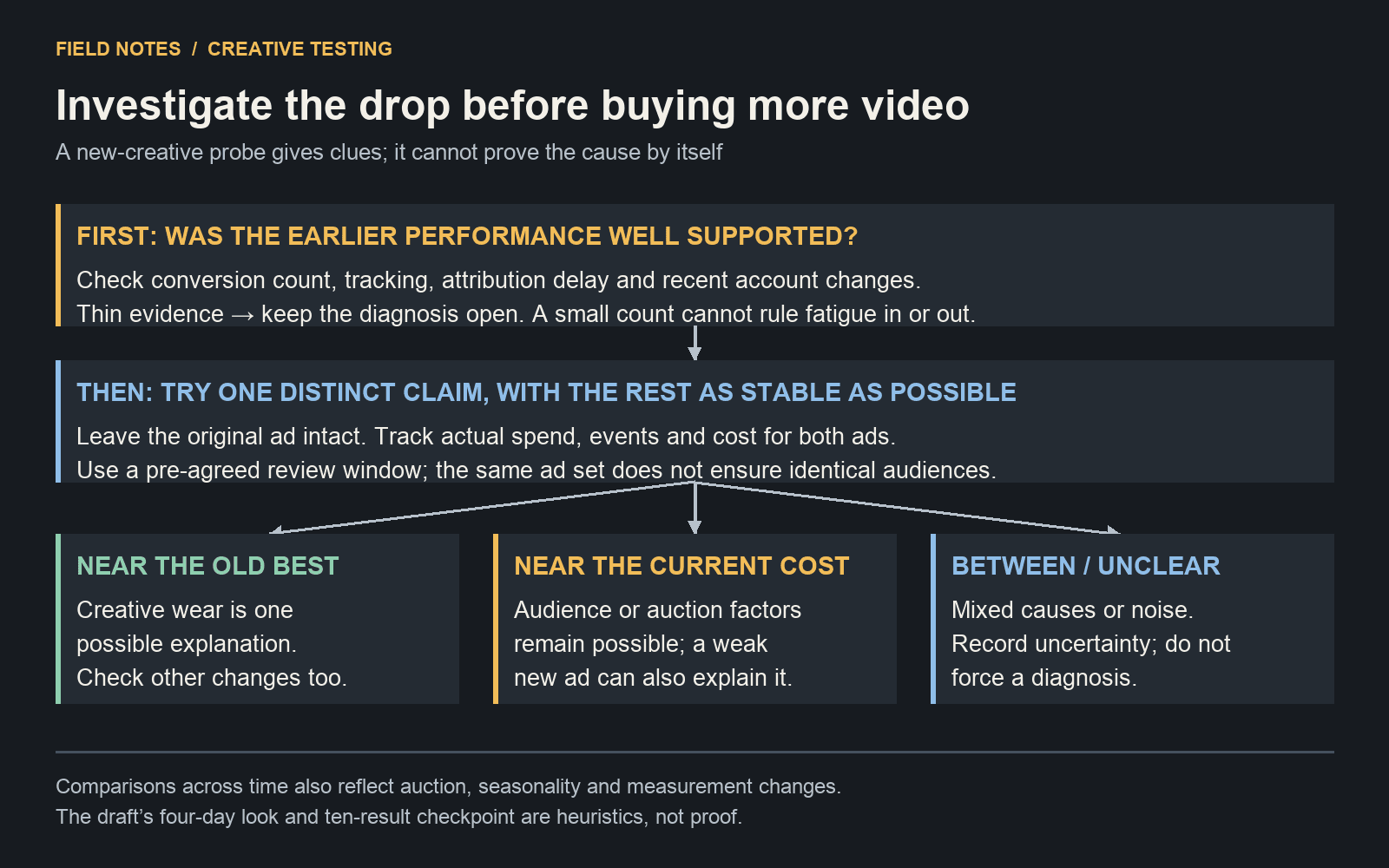
Diagnostic aid, not a causal test: delivery and audiences can differ between ads, and comparisons with historical costs carry other explanations.
What actually resets each, and what only looks different
this is the second half of the question people ask and it almost never gets answered separately from the first: "what kind of variation actually resets fatigue vs just looks different?"
creative fatigue resets on a new claim. it does not reset on a new cut.
the thing that wore out was not the pixels, it was the argument. if the person scrolling has already decided they are not interested in "the fastest way to do X", then a new thumbnail, a new opening line, a new voiceover and a new set of captions over the same argument are the same video to them. you have changed everything a production process measures and nothing the viewer is actually evaluating.
this is why so much creative volume buys so little. somebody said it better than i can: "i'm getting tired of hearing 'just test more creatives' because at some point there has to be more to it than simply producing video #16, #17 and #18." sixteen, seventeen and eighteen are usually sixteen, seventeen and eighteen versions of one claim. the room has started to notice — the same question keeps arriving as "more distinct ideas instead of small tweaks?", which is exactly the right instinct.
so: a reset needs a different reason to buy. a different problem named, a different person addressed, a different objection answered. variations of a winning claim are a scaling job and they are worth doing — they are just not a treatment for fatigue, because they carry the thing that got tired.
audience fatigue does not reset on creative at all. it resets on people.
there is no ad that fixes a used-up pool, which is the uncomfortable half of this and the reason the diagnosis matters more than the cure. what does move it is anything that changes who is reachable: broaden the targeting, drop the exclusions that are no longer earning their keep, add a country or a placement, or change what the campaign is optimising for so the system is hunting for a cheaper signal. that last one comes up in the threads in its own words — "is the play to stop optimizing for purchase entirely and buy a cheaper signal until there's volume?" — and it is a real move, with a real cost, because you are buying a weaker event.
and the third cause resets on nothing, because nothing broke. it needs time and a floor: decide in advance how many results an ad has to have before you are allowed to have an opinion about it, and then keep to it when the numbers are exciting.
- the creative is worn out — it resets on a different claim. what only looks like a reset: a new cut, hook or thumbnail over the same claim.
- the audience is used up — it resets on new people, which means targeting, geography, placement, or a cheaper event. what only looks like a reset: any amount of new video into the same pool.
- the numbers were never real — it resets on time, and on a conversions floor you set before you look. what only looks like a reset: restarting the ad, which resets the count as well.
the trap in the second half of each of those is that the wrong fix is always the one that feels productive. making video is work you can schedule, brief and see finished. widening an audience takes four minutes and feels like giving up, and it is the one that works when the pool is the problem.
When both are burning at once, worked end to end
they overlap constantly, and it is not bad luck. they run on the same clock — the longer an ad runs, the more the people you reach have seen it and the more of the reachable pool you have used. by the time anybody notices a problem, both have had the same number of weeks to develop.
the signature of both is a partial recovery. the probe comes in better than the old ad is doing now, and clearly worse than the old ad did at its best. that is not a failed test. it is the test returning "some of each", and it tells you the order to work in: take the free fix first. widen the pool, wait, and then judge the creative against the wider pool. if you buy a batch of video first you will spend the money and still be sitting in a used-up audience, and you will never learn which half you fixed.
here is the whole thing on one account.
an ad set has been running three weeks at $120 a day. cost per result sat around $40 for the first fortnight. it is now $95 and has been for eight days. the instinct is that the creative has burned out and needs replacing.
step one, the count. $120 a day at $40 a result is three results a day, twenty-one a week, so about forty-two results behind the good fortnight. that gives us more evidence to investigate than a handful of purchases, but the count alone does not prove that the earlier cost was stable. carry on, checking the comparison window and measurement.
step two, the probe. one new video, a genuinely different claim, into the same ad set. targeting untouched, budget untouched, the old ad left alone and still running. for this illustration, assume the new creative receives $60 a day. actual allocation can be uneven, so check what it really spends.
step three, the read, on day four and then at ten conversions. the new creative comes in at $88. the old ad's best was $40 and its current number is $95.
$88 is not a recovery. it is the new ad landing almost exactly where the old one now sits, which is the second reading above: the audience is used up and the creative was never the variable. a batch of video commissioned here would have cost real money, produced ads that all settled around $88 for the same reason, and taught nobody anything.
what happens instead. widen first, because it is free: the exclusions come off, the age band opens up, a second country goes in. two weeks later the same ad set is at $61 with the original creative still running — which is not back to $40, but it is most of the way, bought with four minutes of work.
and now the creative question is finally answerable. against a wider pool, the old ad at $61 and the probe creative at $58 are close enough that the original was not badly worn after all. this constructed example points us toward investigating the audience, but it does not measure a percentage contribution from either cause, and every diagnosis that started from the word "fatigue" would have got that backwards.
the counter-case is worth stating because it is the happy one. if the probe had come in at $44 — near the old ad's best — the read is the opposite: the audience is fine, that claim is spent, and the right place for the budget is more video built around whatever the probe was arguing. same test, same four days, opposite instruction, and you would not have known which without running it.
The part i cannot prove
the fifty-conversions figure is platform mechanics and the ten-per-creative floor is arithmetic on top of it. the probe is a controlled comparison — hold one variable, change the other — which is ordinary practice rather than anything i discovered. none of it is my measurement. i do not run an account at this spend and if i pretended otherwise the first person to ask which one would end it.
the costs per result in the worked example are constructed to be arithmetically clean. the figures i have quoted from real accounts — the $4.6k over eight days for nothing, the $700 a day, the ad that burned through an audience faster — are other people's, taken from what they wrote about their own campaigns. put your own numbers in. the calculation is subtraction and one comparison.
and there is one thing i genuinely do not know. four days to look and ten results to decide is the interval i would use, and i cannot show you it is right. at a low daily budget the probe does not reach ten results for over a week, and by then the pool has moved underneath the test, so the thing you are measuring has changed while you measured it. there is presumably a spend below which this probe stops being readable at all — the same floor problem that shows up everywhere else in creative testing. i do not know where it is. if you have run this on your own account and found the point where it stops working, i would rather have your number than be right.
if any of this is wrong, say so. a correction is worth more to me than agreement.
i'm building the version of this where the ad, the claim it was making and what came back all sit on one canvas, so the creative you are diagnosing still has its reasoning attached three weeks later: https://clear-cortex.com/early-access?src=x-which-fatigue-end
the campaign side of it is here: https://clear-cortex.com/use-cases/ai-ad-creative