 Clear Cortex
Where AI UGC actually beats the alternative, and where it cannot
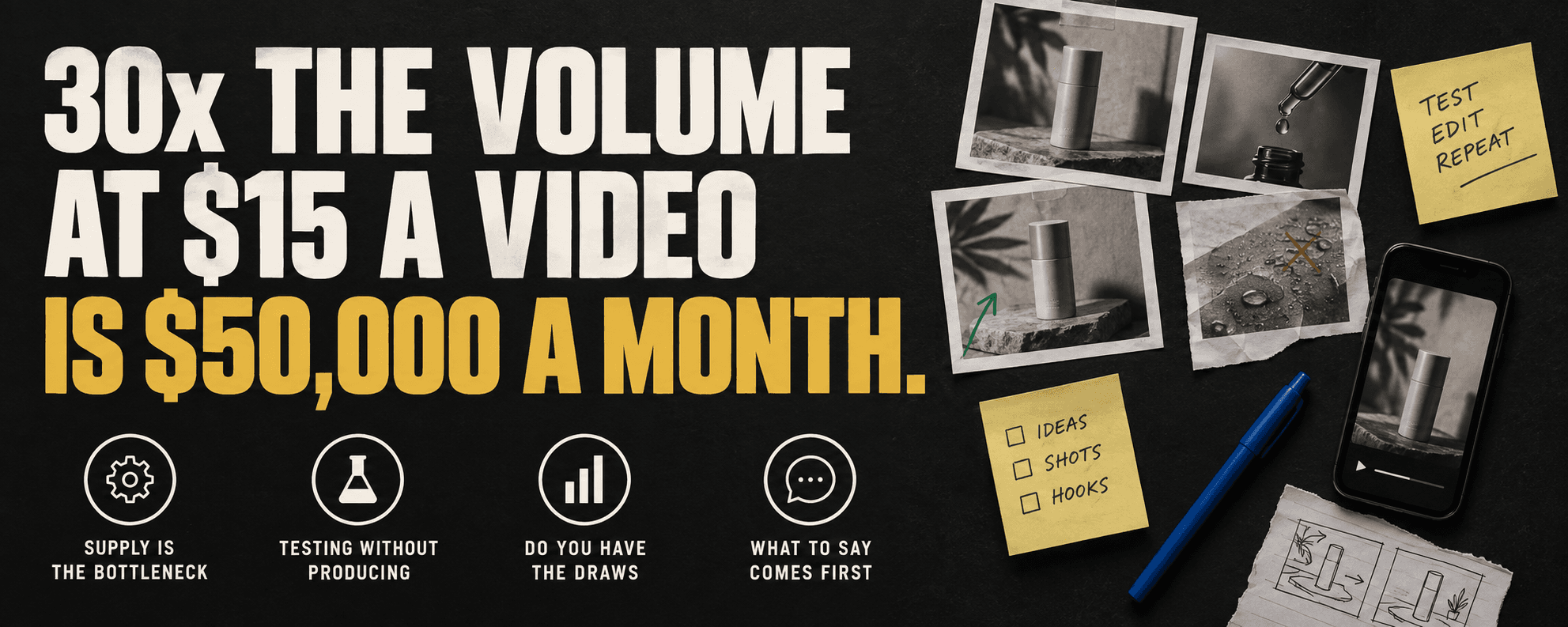
30x the volume at $15 a video is $50k a month.
i went looking for where AI creative genuinely wins rather than where it is cheaper, and read 141 lines about scaling and volume across 90 threads. one of them does the arithmetic that makes the case, and it is not a line about quality:
"so you need 20-50x the volume too. at $10-20 a video from UGC folks, 30x'ing that is $50k+/mo."
that is the honest argument for this whole category, and it has nothing to do with whether a generated clip looks as good as a filmed one. it is that the volume the platforms now demand has a price attached, and above a certain account size that price is not payable by anyone.
so here is the whole thing: the one constraint AI creative actually removes, the account shape where that constraint is binding, the three shapes where it is not and doing this will make things worse, and how to tell which one you are in before you commit. about fifteen minutes, nothing held back, no gate on any of it.
the constraint it removes
there is exactly one, and being precise about it is the difference between this working and not.
it removes the coupling between number-of-creatives and cost-and-time.
that is all. it does not make better ads. it does not know what your customers want. it makes the fortieth variation cost the same as the first, which under the old economics was impossible, and everything genuinely good about this follows from that one property.
the cut describes the pressure this relieves:
"They're pushed into a content treadmill. To beat ad fatigue on social platforms, companies demand endless variations of ad creative, at a scale that's almost impossible to perform."
"almost impossible to perform" is the accurate phrase. the platforms did not ask whether the volume they reward is producible at a sane cost. they just reward it, and accounts have been quietly failing that test for years.
the account where this wins outright
you have spend, you have conversions, and creative supply is your bottleneck.
concretely: you are running enough budget that ads fatigue in days rather than months, you have enough conversions that a test reads in under a week, and the thing that stops you scaling is that you cannot get new creative made fast enough to feed it.
in that account, AI creative is not a cheaper option, it is the only option — because the alternative at that volume costs $50k a month, and the cut has people operating in exactly this shape:
"used it this to scale my ecom brand to $200k days — this format is beating every studio shot creative i've tested this year."
"$130k+/month brands are quietly scaling with AI UGC pages."
note what is doing the work there. it is not that AI creative is better. it is that at $200k days you need creative faster than any production schedule delivers, and once you are there the comparison to a studio shot is beside the point.
the second win, and it is available to everyone
the first case needs a big account. this one does not, and it is the more useful of the two for most people.
testing a claim stops requiring production.
"TEST YOUR AD CREATIVE FOR $0 BEFORE YOU SPEND A DOLLAR ON IT."
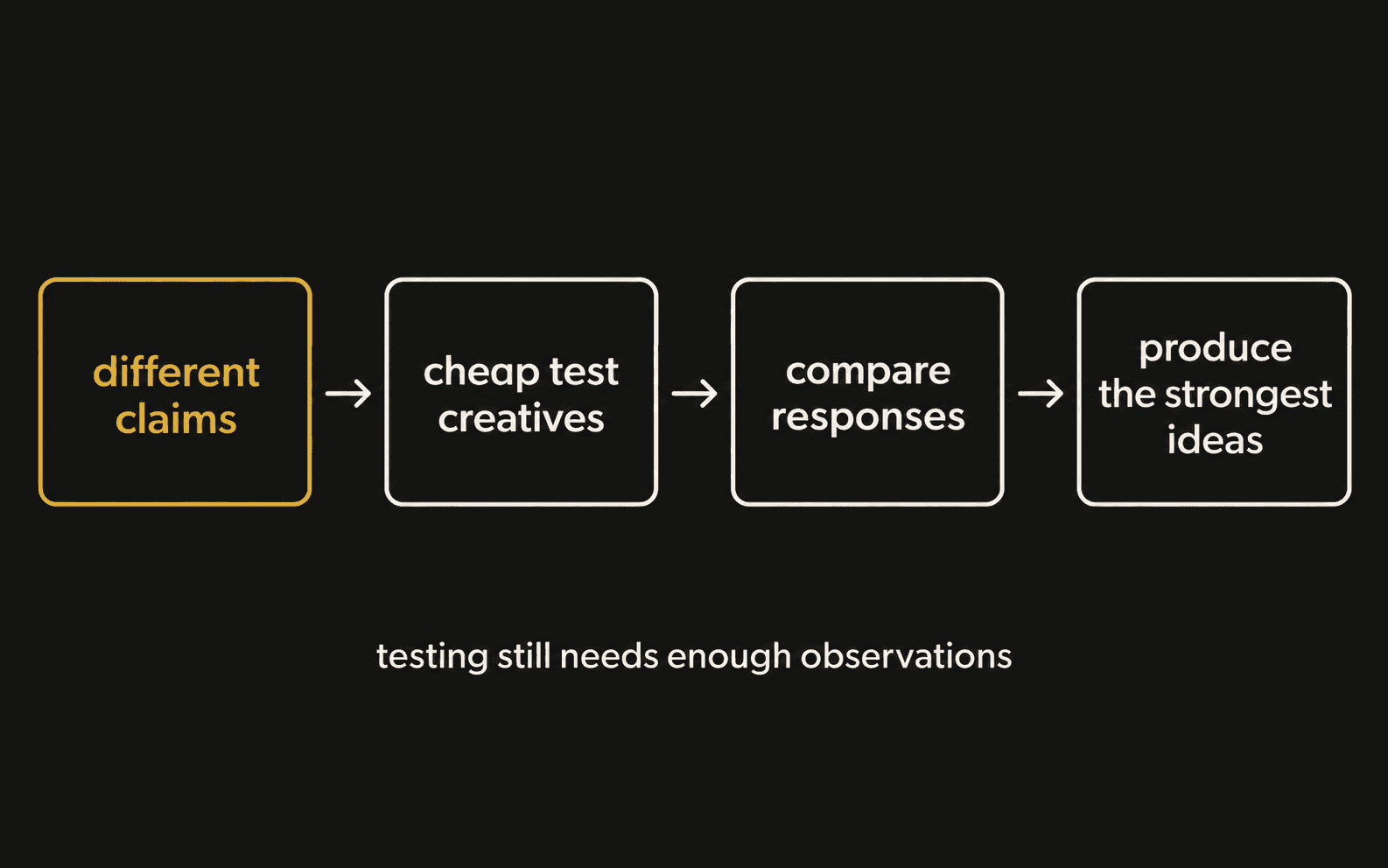
that is a vendor line, but the underlying move is real and it inverts the old order of operations. you used to have to make an ad to find out whether its argument worked, which made every test expensive and meant most angles were never tested at all. now you can rank twenty claims cheaply, find the two that stop people, and spend real money making those two properly.
this only needs the generated version to be good enough to compare, not good enough to run. that is a much lower bar than the arguments about realism assume, and it is why the realism debate is mostly beside the point for this use.
the three shapes where it makes things worse
honestly, because the case above is real and these are where people get hurt.
1. you do not have the draws. if you are running four creatives on £400, more variations do not help — you cannot read them. a hundred impressions each and no conversions tells you nothing, and generating forty instead of four just spreads the same budget thinner across more unreadable arms. at small spend, volume is the wrong lever entirely; being right more often is the only one available, and that is a judgement problem.
2. your bottleneck is knowing what to say. if you do not have a stack of untested angles waiting, the constraint that just got removed was not the one you had. you will produce forty versions of the claim you were already making and conclude the technology does not work.
3. the persuasion depends on a real person. testimonials, founder-led brands, practitioners selling expertise. the volume gain is real and irrelevant, because the thing being scaled is the thing that cannot be generated.
how to tell which you are in, in ten minutes
four questions, answered honestly with numbers you already have.
- how many creatives did you ship last month, and how many did you want to? if those are the same number, creative supply is not your bottleneck.
- how long does an ad stay profitable? days means you are on the treadmill. months means you are not, and the volume case does not apply to you.
- how many conversions a week does the account produce? divide by the number of arms you want to test. if a single arm cannot reach a readable number in a fortnight, you cannot buy answers statistically and must buy them by judgement.
- how many untested angles are written down? if the answer is none, that is the actual project, and no amount of render capacity substitutes.
three and four are the ones people skip, and they are the two that decide whether any of this helps.
what usually goes wrong
people adopt the volume method at a spend that cannot read it. the most common failure by a distance, and it looks exactly like the technology not working.
people scale before they have a winner. the cut has the warning: "Meta will spend your entire budget testing creative that doesn't convert." volume applied to an untested claim buys forty confirmations of nothing.
people count production cost and forget the reading cost. every extra arm needs conversions to read. creative got cheap; statistical power did not.
people treat "instant" as a feature rather than a hazard. "Production time: 10 minutes. Scale: instant." the constraint that used to force thinking was cost, and removing it removes the thinking too unless you deliberately put it back.
the honest answer
human UGC farm or AI — which are you picking to scale?
if creative supply is genuinely your bottleneck and you have the conversions to read a test, AI, and it is not close — the alternative costs $50k a month and does not arrive fast enough anyway.
if it is not your bottleneck, neither, and the money belongs in finding out what to say rather than in producing more of what you are already saying.
the constraint this removes is real and it is exactly one constraint. everything good here follows from it, and everything that goes wrong follows from applying it to an account whose constraint was something else.
i'm building the version of this where the angles, the renders and the test results sit on one canvas, so "how many untested claims do we have" is a thing you can see rather than a question nobody can answer. if you want to see it when it lands: https://clear-cortex.com/early-access?src=x-08-where-it-wins