 Clear Cortex
When "it looks AI" stops mattering, and when it never will
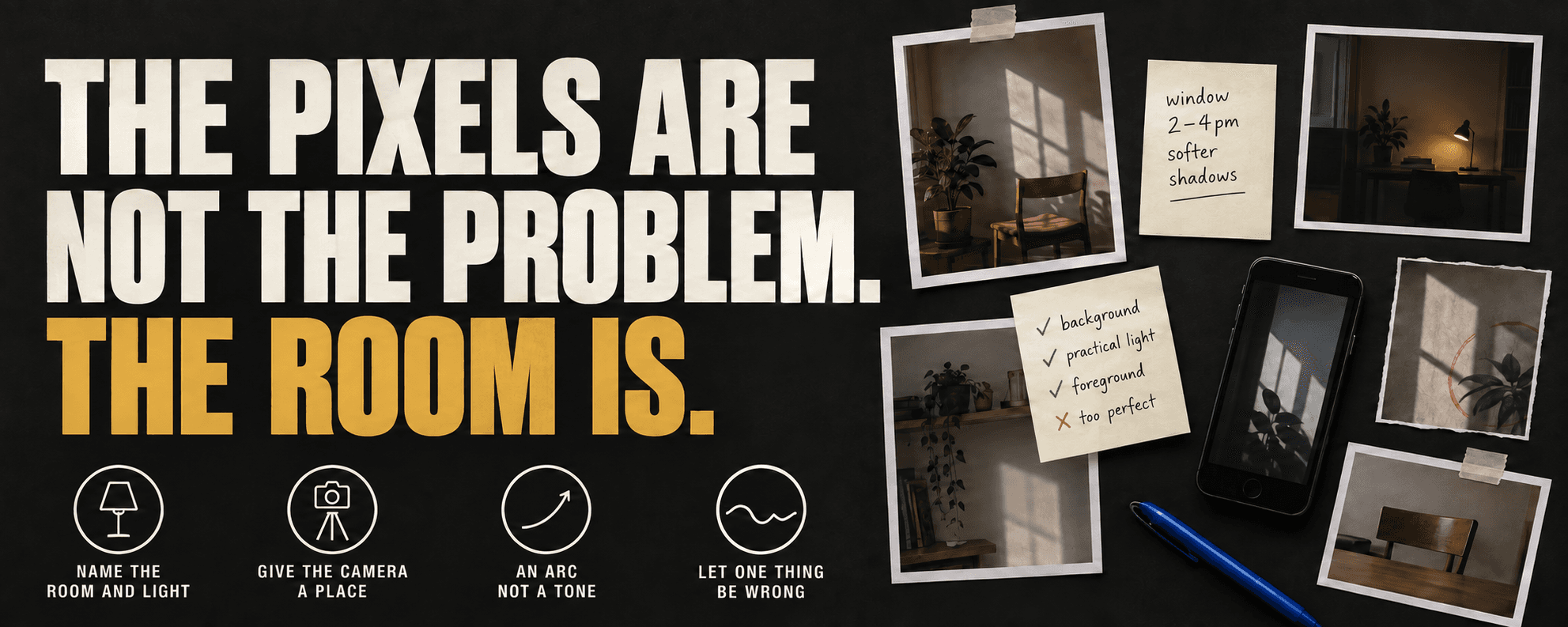
368 lines about realism. 39 real questions.
i went looking for whether AI creative is realistic enough yet, and read 368 lines on it across 246 threads — the biggest cluster in the whole topic. and the way people talk about it splits cleanly in two, which is the finding:
"Seedance 2.0 nails skin realism in native 4K."
"It feels authentic, grabs attention and lets people instantly understand the value of the product, which often leads to higher conversion rates."
the first is about the pixels. the second is about the ad. they are different problems, they are solved by different things, and almost every argument about realism collapses them — which is why the argument never gets anywhere.
so here is the whole thing: the two kinds of realism and why only one of them is about the render, the point at which additional fidelity stops buying anything, the case where it never stops mattering, and what to do instead of chasing it. about fifteen minutes, nothing held back, no gate on any of it.
the two realisms
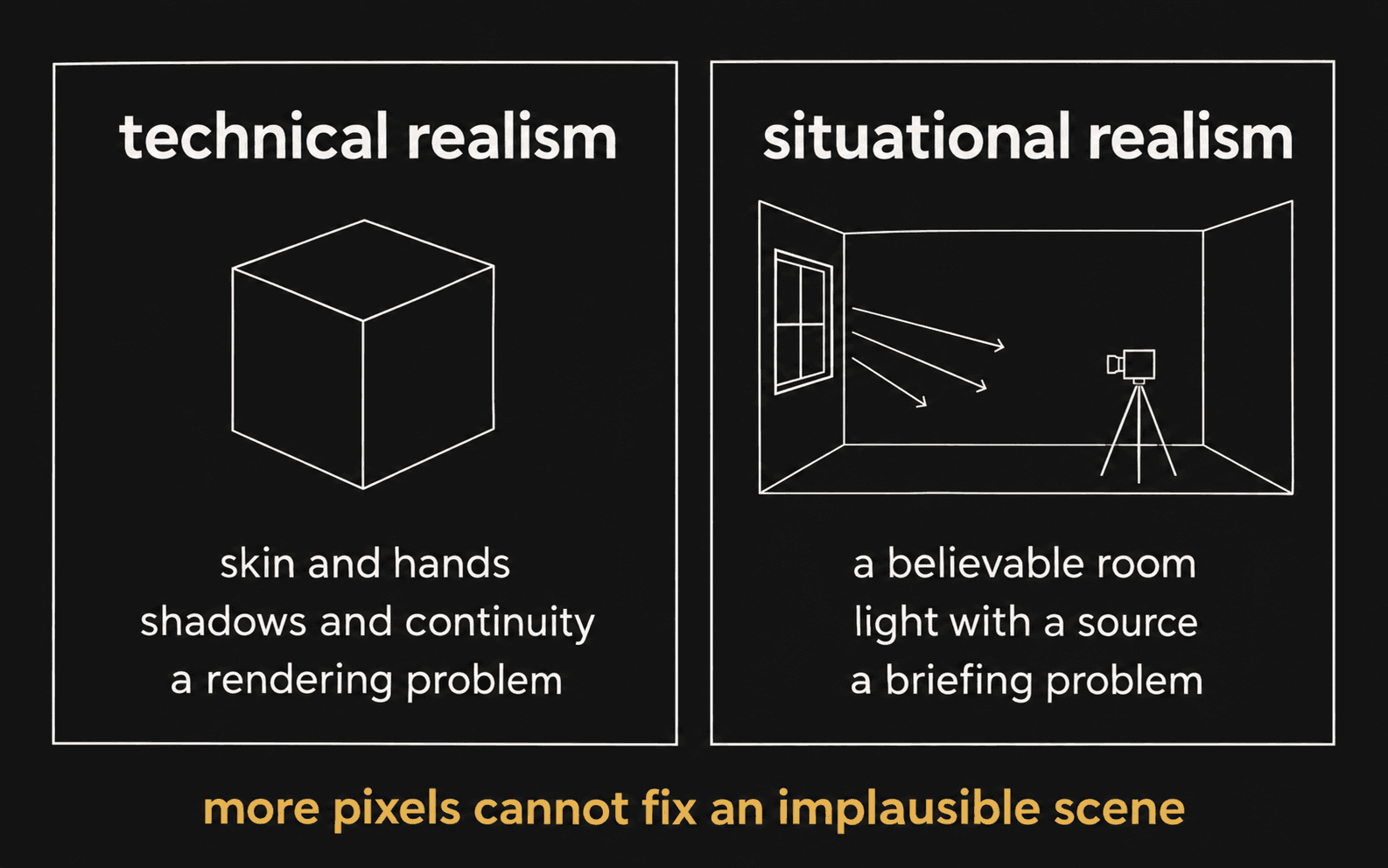
technical realism is whether a frame withstands inspection. skin, hands, shadows, continuity. it is a rendering problem, it improves with every model release, and it is what every launch post is about. the corpus is thick with it: "ultra-realistic, 4K HDR, natural lighting, smooth handheld camera, realistic human motion", "nails skin realism", "keeps every detail intact".
situational realism is whether the clip resembles something that would exist. the right room, the right lighting for that room, a person behaving as a person behaves when nobody is directing them. it is a briefing problem, not a rendering one, and no model release improves it because it was never the model's job.
almost everything people call fake is the second one. a technically flawless clip of a person in an impossible room, lit from nowhere, delivering a line at an intensity no human uses in a kitchen, reads as fake at 4K exactly as hard as at 720p. more fidelity makes it a sharper implausible thing.
that is why the fidelity race has not settled the question and will not.
where technical realism stops paying
there is a threshold and it is lower than the discourse assumes.
the bar is: does it survive the viewing conditions. an ad is watched once, at speed, in a feed, usually muted, on a phone, by someone not looking for artefacts. under those conditions technical realism has to clear "nothing snags the eye" — and current models clear that comfortably for the standard shot of a person talking in a room.
the cut has someone describing the failure at the boundary:
"He got tired of watching AI videos that look decent in a feed thumbnail but fall apart the second someone taps fullscreen and sees plastic skin and dead eyes staring through them."
read the conditions in that sentence. it survives the feed and fails on a tap-through. so the honest bar depends on the format: for an in-feed ad, the current bar is met. for anything the viewer will study — a product page, a landing hero, anything paused — it is not.
above the threshold, extra fidelity buys nothing measurable and the money is better spent on the claim. below it, nothing else you do matters. it is a floor, not a scale, and treating it as a scale is how people spend a week on skin texture for an ad nobody was going to stop for anyway.
where it never stops mattering
three cases, and they are not about the render either.
where the claim is about a person's experience. "i've used this for three months" said by a generated face is not a realism problem you can fix with a better model — it is false. the cut has the version of this that should worry people: "$12K IN GARAGE BRAND DEALS BOOKED FOR A FACE THAT'S NEVER SEEN A WRENCH."
where the product's appearance is the purchase. food, clothing, furniture, jewellery. here the viewer is inspecting the object, so they are looking for artefacts, and the threshold above does not apply. this is also the one place the cut's prompt language is correct rather than decorative: "Soft natural studio lighting, clean beige background, premium fashion aesthetic, shallow depth of field" is describing a product shot, and a product shot gets studied.
where being caught costs more than being ignored. regulated categories, high-consideration purchases, anything where a customer discovering the person was generated changes how they feel about the company. that is a brand cost, it never shows up in the campaign's CPA, and it lands months later.
what to do instead of chasing fidelity
the four things that actually produce situational realism, none of which is a model upgrade.
1. name the room and the light together. "a kitchen with a window on the left, mid-morning" rather than "natural lighting". even, sourceless light is the single biggest tell and it is the model's default.
2. give the camera a physical situation. propped against a mug, held in a hand. the default is a smooth floating camera that exists in no real footage — which is why "subtle handheld motion mimicking a propped-up phone, slight micro-shake from breathing" is in the corpus as somebody's fix.
3. specify an arc, not a tone. "starts uncertain, lands on the point" rather than "enthusiastic". a level performance across fifteen seconds is the thing people are describing when they say dead eyes.
4. let one thing be wrong. a slightly cluttered counter, a reframe halfway, focus that hunts once. real footage always contains something nobody would have chosen. perfection is the tell.
and then stop. past that, you are polishing a floor.
what usually goes wrong
people upgrade the model to fix a briefing problem. the most expensive mistake in this piece, and the most common — the new model produces a sharper version of the same implausible scene.
people judge realism at full attention on a large screen. you are not the viewing conditions. watch it once, muted, on a phone, in a scroll, and judge it there.
people apply the in-feed threshold to a product shot. different job, different bar.
people treat realism as the whole question. a perfectly realistic ad making a claim nobody cares about is a perfectly realistic ad that does not work. the cut has a version of this: "it's literally impossible to tell the difference between AI-generated videos and real footage and these ads convert" — the second clause is doing the work, and it is not a fact about realism.
the honest answer
is AI UGC better than content created by real people?
for an in-feed ad making a claim about a product, the technical question is already settled and has been for a while — current models clear the bar those viewing conditions set, and further fidelity is not where the return is.
for anything a viewer will study, or any claim that depends on a person having actually done the thing, it is not a fidelity question at all and never becomes one. the first needs a real product shot; the second needs a real person, because the alternative is not a cheaper version of the claim, it is a false one.
and the thing people are calling fake is mostly four briefing decisions nobody made. that is worth more than the next model release, and it is available today.
i'm building the version of this where the room, the light, the camera and the arc are part of the brief every time rather than things you remember on a good day — so situational realism is structural instead of a lucky generation. if you want to see it when it lands: https://clear-cortex.com/early-access?src=x-10-when-ai-look-ok