 Clear Cortex
How to test video ads on a small budget without wasting it on production
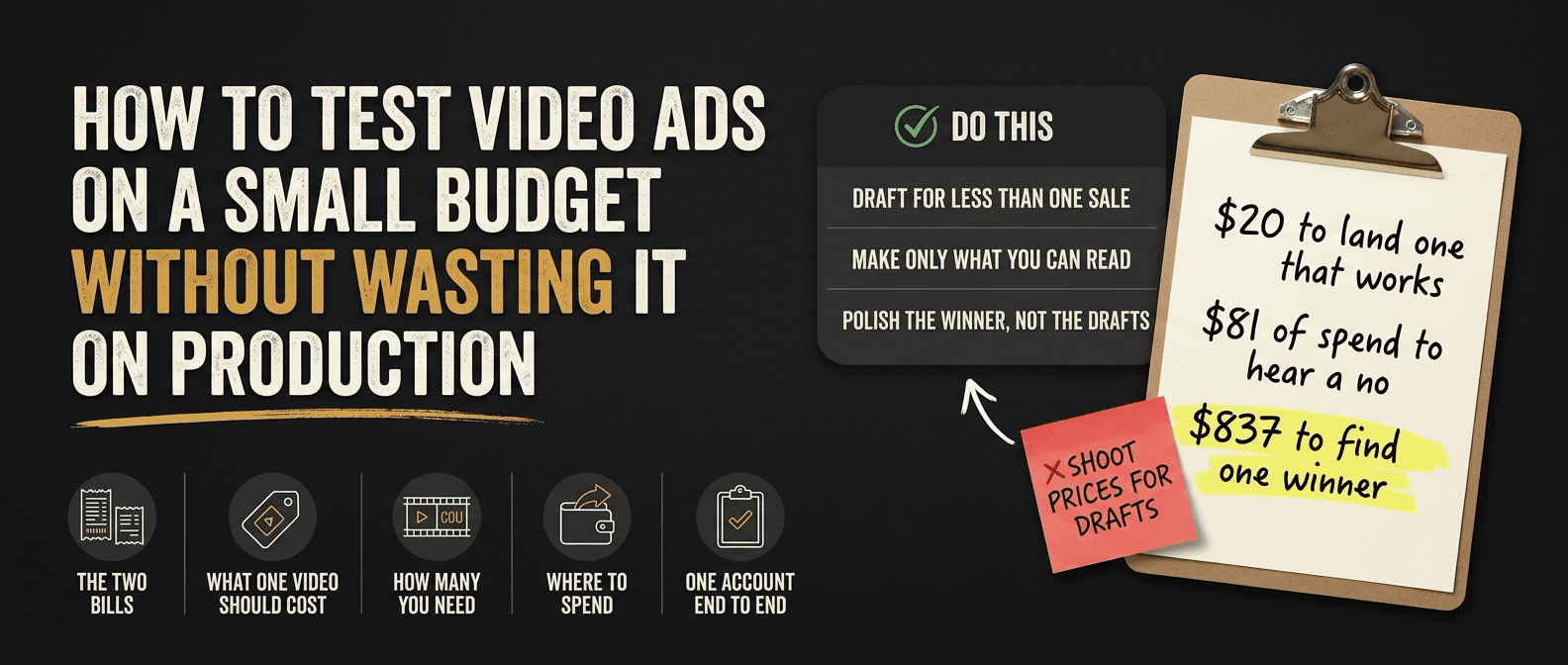
$20 to land one video ad that works is cheap.
that is a skincare founder's number. image ads on meta losing steam, no money for a shoot, so they make simple video drafts from their own product page, polish the ones that show any traction, and only then put real spend behind them. their cost, in their words: "costing me around $20 in tools/credits to land one ad that actually works." then the question underneath it, which is the one this whole piece answers:
"is that a normal cost of testing for other bootstrapped founders, or is there a more efficient way people are handling video creative without a real budget?"
i went looking for what other people pay for one ad video and found a price in 10 separate threads. they run from about $6 a video to $800. only two of the ten priced it per video that worked or was usable, with the throwaways counted in. everyone else quoted the sticker for one video, whether it turned out to be any good or not.
the same question comes in a few shapes:
"everything i read says video performs better, but i can't afford a proper shoot or studio."
"is AI the right call here, or is real UGC worth it even at this budget?"
"how do you make an effective ad video for a mobile game on a tight budget?"
"is the usual strategy to test a lot of creatives with a small budget, find winners, and then put more money behind them?"
the short answer is good news. $20 to land a winner is at the cheap end of everything people reported, and the method behind it — rough drafts first, polish only what shows traction — is the right one. there is a more efficient way, but it is not a cheaper way to make the video. the making is the small bill. the big bill in any video test is the ad spend meta needs before it can tell you whether each creative works, and that one does not care how the creative was made. once you plan around that, the rest of the decisions get easy: what a test video should cost you, how many creatives to make each month, and where the money that is not going on a film crew should go instead.
one boundary, because i have written the pieces next to this one. what a test has to spend before it can crown a winner, what happens when one ad in an ad set takes the whole budget, and whether an AI face can carry a testimonial are separate pieces. this one is the making side of a small test budget: what each video should cost, how many you need, and when it is worth paying for a real one.
so here is the whole thing. the two bills in every video test and which one is big, a rule for what an untested video should cost on your own numbers, how many creatives it takes to find a winner and how many your budget can read each week and each month, where the money should and should not go, and one small skincare account worked end to end. about fifteen minutes with your cost per sale and your daily budget. nothing is held back and there is no gate on any of it.
the cover on this piece was made in clear cortex for about 8p, on the cheapest model that could spell the headline. that's the studio i'm building, and it's the only ask in this piece: https://clear-cortex.com/?src=x-video-test-budget-top
The two bills in every video test
every video in a test costs you twice. once to make it, and once to find out whether it works.
the making bill is the one everybody talks about: a UGC creator's fee, an agency's invoice, credits in a tool, or your own evening. the finding-out bill is the ad spend you have to put behind the video before its numbers mean anything. most people never write the second one down, because it does not arrive as an invoice. it arrives as a week of campaign spend on a creative that turns out not to work.
put both bills in the same unit, and the unit is sales. divide each one by what a sale costs you on meta. a $90 video in an account where a purchase costs $30 is three sales' worth of making. it sounds fussy, and it is the step that makes everything after it obvious, because it lets you compare a creator's fee with a week of ad spend directly.
the finding-out bill has a floor you cannot negotiate with. conversions arrive a bit at random, so a video exactly as good as your current winner can easily go its first sale's worth of spend with nothing to show. after three sales' worth with zero sales, though, an ad that good would show nothing only about 5% of the time. so three sales' worth of spend is roughly what it costs to hear a no. a yes costs more, about ten sales' worth, because to say one creative beats another you need enough conversions on it to see the gap — i worked both of those out in earlier pieces and they are only borrowed here.
now the part that matters. those numbers are the same however the video was made. a $400 creator video and a $7 draft both need about three sales' worth of spend to fail. meta does not give an expensive video a cheaper read. at a $27 cost per sale, a no costs about $81 and a yes about $270, whichever way the video came to exist.
so the finding-out bill is fixed by your cost per sale, and the making bill is the only one you actually choose. that is why the question is the right one to ask, and it is also why the answer is mostly about the bill you are not choosing.
What one test video should cost
here is the rule i would use, and it is simple enough to check against any quote you get:
until a video has been read, it should cost less to make than one sale.
the reasoning is the bill above. if a no costs three sales' worth of spend and the video cost under one sale to make, then the making is under a quarter of the total cost of the question. the money goes mostly on finding out, which is the part that tells you something. once making a video costs more than reading it, you are paying more to ask the question than to get the answer.
run the prices people posted through it, at a $27 cost per sale:
- an agency, for one founder who took the calls: "$600 to $766 per ad." that is 22 to 28 sales' worth each, before a single one has been read.
- UGC creators, from an advertiser spending $30k to $50k a month who has bought a lot of them: "i've been paying creators anywhere from $150 to $400 per video depending on the niche." 5.6 to 14.8 sales' worth.
- a marketplace creator, from a store owner who posted a year of their own numbers: "a year ago: ugc creator on fiverr, $60-120 per video, 5-7 day turnaround, one revision." 2.2 to 4.4.
- the same store owner now, on a subscription tool: it "works out around $6-8 per usable video once you account for the ones i throw away (i throw away a lot, maybe 60%)." about a quarter of a sale.
- the founder at the top: $20 per ad that actually works, which is under one sale's worth for the winner, with every draft that did not make it already paid for inside it.
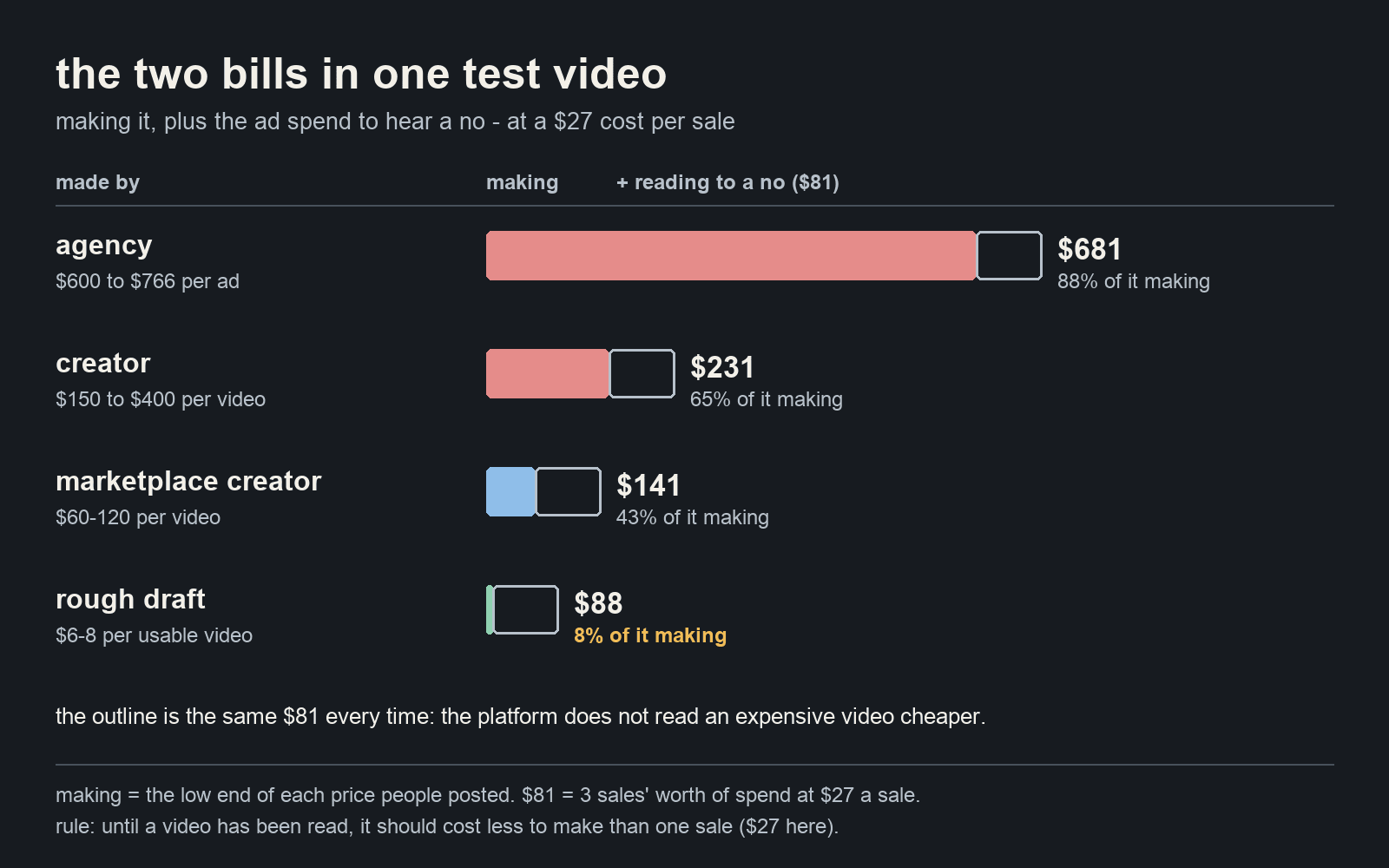
Making prices are the low end of each range people posted; the $81 is three sales' worth of spend at $27 a sale, the cost of hearing a no. Arithmetic, not a measurement.
so: is $20 normal? it is the cheap end, and it is under the line. the founder is already doing the efficient thing for a brand their size, and nothing in the list above would make their testing meaningfully cheaper, because their making bill is already small next to the reading bill. even if every one of their drafts had cost the whole $20, a $7 draft instead would save thirteen dollars on a question that costs eighty-one to ask.
two things this rule does not say. it does not say creators are overpriced: a creator's fee includes a person, a performance and their retakes, and later in this piece there is a point where that is exactly what you should buy. it says a creator's fee is the wrong price for a question you have not asked yet. and it moves with your numbers. a brand whose sale costs $150 can buy a $90 UGC video and pass the rule comfortably. the cheaper your product, the cheaper your drafts have to be.
one founder put the agency side of it better than i can: "if you are sub $100k mrr and an agency is quoting you north of $500 per ugc asset, the agency is not the customer fit." the rule says the same thing in sales instead of revenue.
How many videos a test actually needs
two numbers answer this. how many creatives it takes to find one winner, and how many your budget can read in a week. the first is about the odds, the second is about money, and the second is the one that sets the pace.
how many to find a winner. the store owner with a year of numbers wrote down their own hit rate: roughly one in eight creatives was worth scaling, and it was the same one in eight whether a creator made them or a tool did. the tool did not make their ads better. it made being wrong cheaper. that is one store, and yours will be different, but it is a real figure from someone who counted, and it is a sensible place to start planning.
if something like one in eight holds for you, a winner costs eight reads: seven noes and one yes. at $27 a sale that is 7 × $81 plus $270, about $837 of ad spend, or 31 sales' worth, to find one video that works. that is the real cost of testing, and it is the number to have in your head when you ask whether a test is affordable. at $40 a day, a month of budget is about $1,200, so finding one winner takes roughly 70% of a month's spend before you scale anything. the making sits on top of it: eight videos at $150 each is $1,200; eight drafts at $7 is $56.
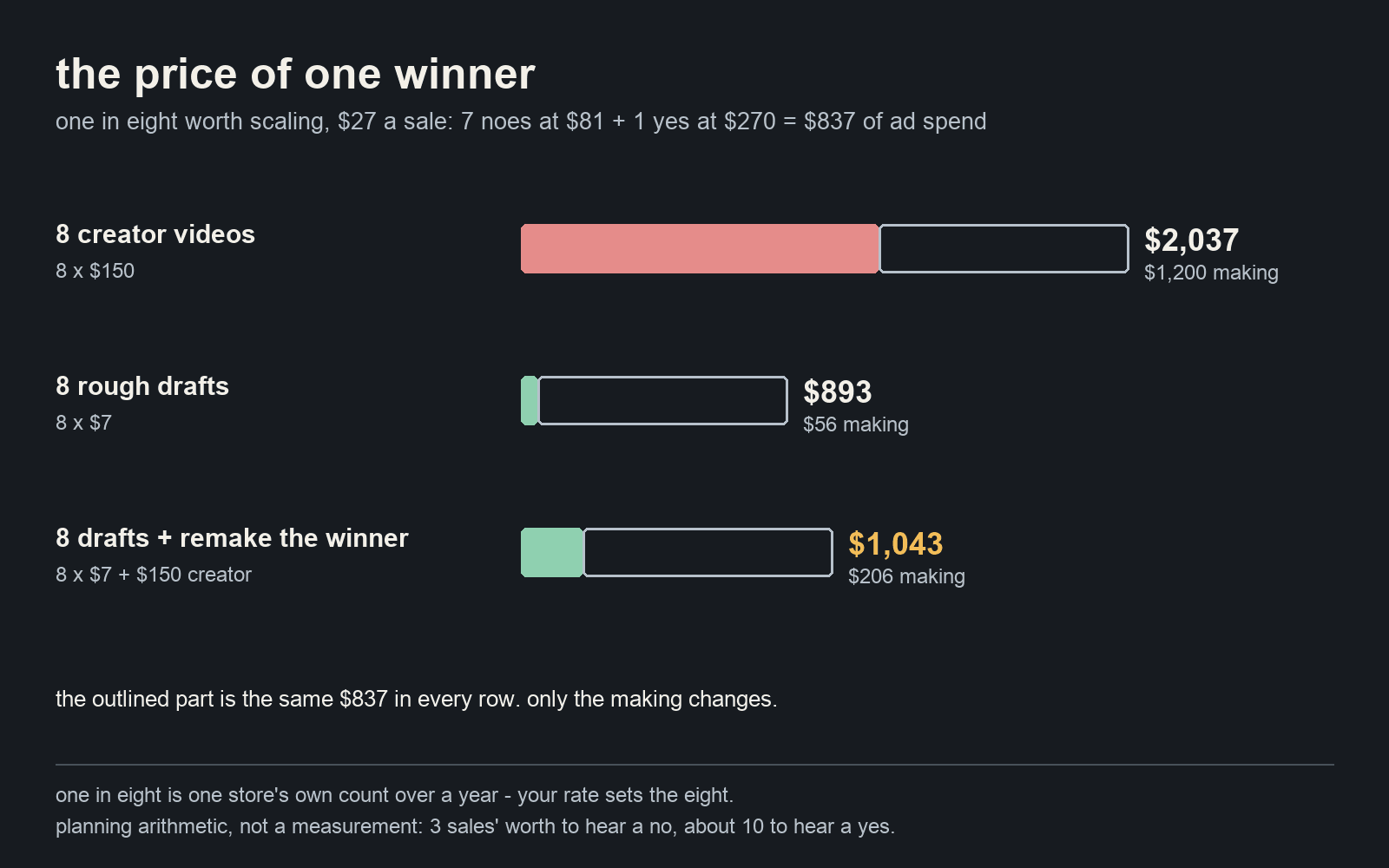
Planning arithmetic on one store's own one-in-eight hit rate. Your rate sets the eight; your cost per sale sets the $81 and the $270.
how many you can read in a week. this is the one that sets the pace, and it is one division:
your weekly budget ÷ (3 × your cost per sale) = new videos you can read to a no each week
at $40 a day and a $27 cost per sale, that is $280 ÷ $81, about three new videos a week. make more than that and the extras sit in the campaign unread. they do not fail, they just never get the spend to tell you anything, and they get filed as tried. i went through what a pooled ad set does with the ads it never shows in an earlier piece; the short version is that a creative you cannot afford to read is one you paid for twice — once to make, once in the idea you threw away.
so the answer to "is the usual strategy to test a lot of creatives with a small budget, find winners, and then put more money behind them?" is yes, with the number filled in. "a lot" is whatever your budget can read, and at $40 a day that is about three a week, not thirty. at that pace, eight creatives and a confirmed winner is about three weeks of the whole budget. that is slower than anyone wants, and it is the honest speed of testing on $40 a day.
three a week only counts as three if they are three different ideas. three cuts of the same video with different opening lines are one question asked three times, and they cost three reads. each draft in the week should carry a different reason to buy — a demo against a before-and-after against a price point — so that whichever one wins tells you something you did not know. i wrote a whole piece on telling ideas from variations; it is the cheapest ten minutes in this method.
and a note on tools against people at this volume. the same store owner's advice to anyone making fewer: "if you're at less than about 15 creatives a month it's honestly not worth the subscription, just pay a creator." three a week is about thirteen creatives a month, right at that line. which way you go matters less than it sounds, as long as each untested draft stays under one sale's worth. at $40 a day you cannot afford a creator for every draft, but you can afford a creator for the one draft that wins — which is the next section.
Where to spend, and where not to
if a test is going to cost around 31 sales' worth of ad spend however you make the videos, then the money that is not going on a film crew should go to two places: the thinking before a draft, and the winner after it.
before a read, spend almost nothing on finish. no studio, no actors, no music licence, no colour grade, no three versions of the edit. a rough draft can tell you whether an idea stops people and sells. it cannot tell you whether the polish was worth it, so do not pay for polish yet. the founder at the top is doing exactly this: drafts built from their own product page, nothing more.
make the drafts from the content you already have. your product page, your product photos, footage you already shot for something else, a screen recording, a phone. the replies that founder said were most useful, in their own edit, all point the same way: test sound-on statics, gift the product to people who will film themselves with it, batch rough versions of different hooks before polishing any, and lean on real customers where you can. none of those needs a production budget.
the drafts don't need a shoot or a creator either. this is one product photo turned into a new ad, step by step: https://clear-cortex.com/playbooks/how-to-make-an-ad?src=x-video-test-budget-mid
before a read, do spend on the thinking. this is the one place a small brand's budget should be generous. which reason to buy does each draft carry, and what happens in its first two seconds? a draft that carries a weak idea fails for $81 whether it was rough or polished. a draft that carries a strong idea can win rough. the idea is what you are testing, so the idea is where the effort goes.
after a read, spend on the winner, and spend properly. this is the point where a UGC creator, a real customer or a proper edit stops being a waste and becomes the best money in the account, for three reasons.
one: the winner is the creative you are about to scale. a draft that won on $270 of reading is about to have the campaign's budget put behind it, week after week. making it as good as it can be is no longer a bet on an unknown idea, it is an upgrade to a known one.
two: a cheap version may tire faster. the advertiser who paid $150 to $400 a video ran the same script both ways in one campaign, a real creator against an AI version. for two weeks the cost per purchase was close, the AI version ahead in the first. in week three its cost jumped by about 40% while the real one held. the explanation, in their words: "the AI version just burned through the audience faster." one test, one account, and it is exactly the risk you take scaling a rough winner without remaking it.
three: some claims need a real person. if the idea that won is somebody vouching for the product from their own experience, a generated face is not a cheaper version of that, it is a different claim — i went through that split in the piece on AI talking-head ads. a real person is what you buy once that idea has earned it.
what not to do is pay a creator to find out whether an idea works. at a $27 cost per sale, two creator videos at $150 each are $300 of making for two questions that cost $162 to ask. the same $300 makes the eight drafts that find the winner, and pays for that winner's proper remake, with change left over.
One account, worked end to end
this is a small skincare brand too, run by a beginner, and the person running it wrote down enough to work it properly. "my winning facebook ad got rejected, don't know how to produce ad videos on a small budget."
what happened, from their post: they found an ad that was converting well — 10 sales on about $270 of spend. meta rejected it, and they were fairly sure it was over one line in which the person on camera said a surgeon had recommended the product. they cut the line and reposted. the new version did 3 sales on the same spend. they want to try a new ad on the same angle, but the angle needs someone with an actual scar, they cannot film it themselves, and creators look expensive:
"i'd rather put that into an AI video tool and try producing something myself than spend it on a couple of UGC creators, they seem pricey for what i've got, but i might be wrong about that."
the bills. the winning ad sets the cost per sale: $270 ÷ 10 = $27. so a no costs about $81 of spend and a yes about $270. the original ad already had its yes: ten sales on ten sales' worth of spend is a read, not a fluke.
the read on the edited version. 3 sales on $270 — meta gave it ten sales' worth of spend and it brought three. if the edit were as good as the original, three or fewer on that spend would happen about one time in a hundred. so the edit is genuinely worse, not unlucky. the line that got cut was carrying the ad. the angle works; this execution of it does not.
the question they asked, answered by job rather than in general. AI or real UGC is the wrong way round. it is both, for two different jobs.
- the scar angle has been read, and it is a testimony. it already sold ten on its own yes, and its whole persuasive weight is a real person showing a real scar. that is the one place in this account where paying a creator is right. at $150 to $400 that is 5.6 to 14.8 sales' worth — a lot against $27, and worth it, because it is buying the upgrade to an idea that has already sold. the brief is the original without the surgeon line, so it does not get rejected twice. this is the one spot where their instinct to avoid creators is backwards.
- every other angle is unread, and gets drafts. each under $27 to make, from the product page and the photos they already have, each a different reason to buy — what the product feels like to use, what it replaces, what it costs per week.
the week, priced. say they run $40 a day. that is $280 a week, which reads three things to a no. so: the creator remake of the scar angle, plus two new drafts, each with its own $81. the remake is a proven idea in a new execution, so it gets read like anything else before it carries the budget. making, that week: $150 to $400 for the remake, under $54 for the two drafts. reading: $243 of the $280.
the month. if the remake comes back near $27 a sale, they have their winner back, and it goes into the main campaign with the budget to scale. the drafts carry on at two a week alongside it, in the same campaign, each in its own ad set. if something like one in eight holds for them, a second winner turns up after about eight drafts — around a month at two a week — and when it does, it gets the same treatment the scar angle did: a proper version, made once it has earned it.
what the plan avoids. the version they were weighing — a couple of creators on new, unread angles — would have been $300 to $800 of making for two questions that cost $162 to ask, with the proven angle left on a tool that cannot show a real scar. the plan above spends the creator money in the one place the account has already proved it works.
The part i cannot prove
the three and the ten are arithmetic on top of the platform's own thresholds, worked out in earlier pieces. they assume sales arrive at random at a steady rate, which real delivery does not quite do. the one-sale rule is my judgement, not a finding — it follows from the three, and you could set the line at two sales and defend it. none of this is my own account. i do not run one at this spend, and both worked accounts are other people's, read from what they wrote.
the one in eight is one store's count of its own creatives, over a year, in home goods. it is the most honest hit rate i found, and it is one store. the week-three fatigue of the AI version is one advertiser's single test. the $40 a day in the worked example is mine, not theirs; their post gives the spend on one ad, not the daily budget.
and there is one thing i genuinely do not know. a rough draft that loses might have lost because it was rough. the whole method assumes a strong idea can win in a rough draft and that polish mostly lifts a winner rather than rescuing a loser. if that is wrong for your product — if your buyers only respond to finished work — then cheap drafts are throwing good ideas away, and the reading bill is being spent on the wrong test. i have not found anyone who took their losing rough drafts, remade a few properly, and kept count of how many came back. if you have, i would rather have your numbers than be right.
if any of this is wrong, say so. a correction is worth more to me than agreement.
the budget in a test should go on reading ideas, not making them. that's the part clear cortex does — the next draft from the product photo you already have, for pence: https://clear-cortex.com/?src=x-video-test-budget-end