 Clear Cortex
How to find your cheapest hook without scaling the loudest one
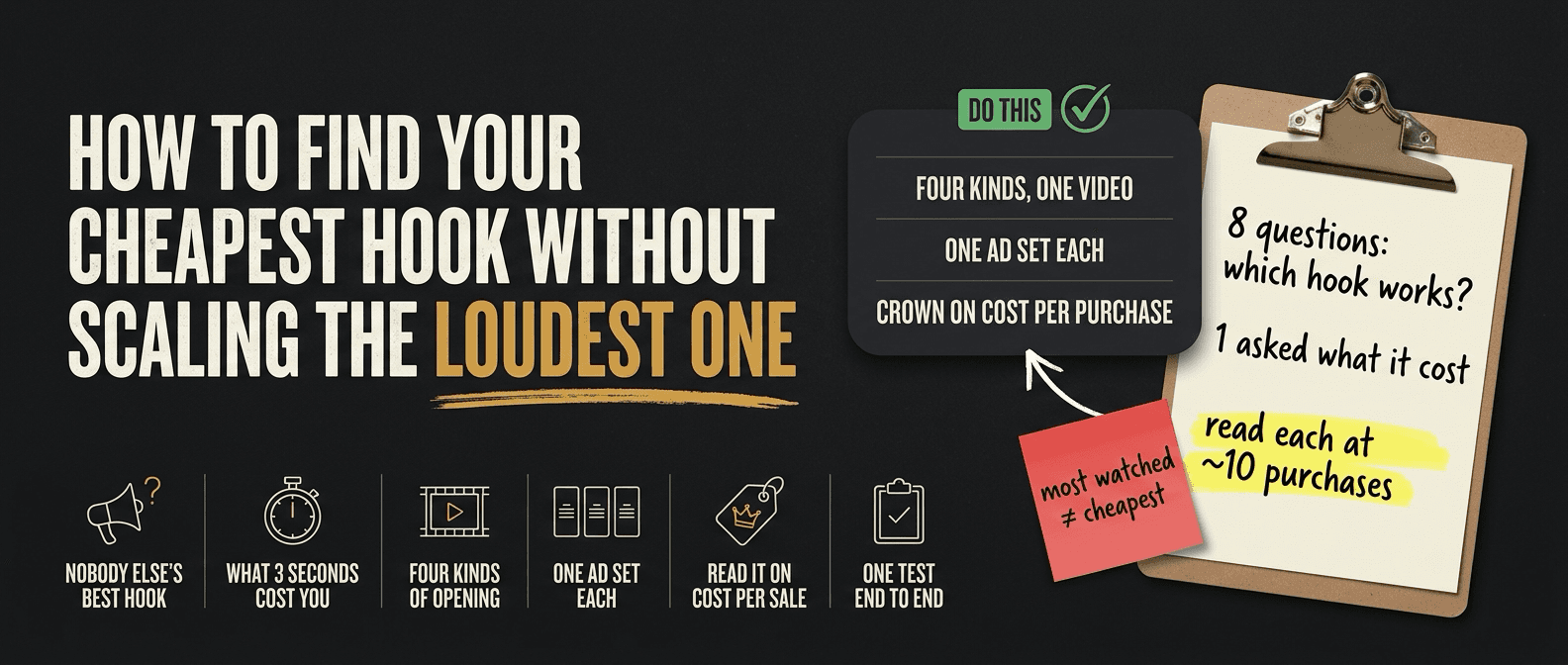
8 questions about which hook works. 1 asked what it cost.
i went looking for how people choose the opening of a video ad, and found those eight questions in six separate threads. five of the threads ask what works, what is best, what converts. one asks which hooks brought in the lowest cost per purchase — for your niche, lately — and that is the one worth answering, because it is the only version with a price in it.
here is how they put it:
"what kind of three second hooks have brought in the lowest cost per purchase for your niche lately?"
"what kind of hook actually worked in the first 2-3 seconds?"
"what's actually working for your hooks right now?"
"what's your highest-converting hook, and how do you come up with it?"
and the one that says what not knowing costs: "trying to figure out what kind of ad hooks actually convert, and then wasting days burning cash on complex video editing or expensive enterprise agencies."
the good news is that the first question has an answer. it is just not in anybody else's account. the asker already put the two phrases that matter into it — your niche and lately — and both of them point the same way: the hook that brings in the cheapest purchase is a fact about your product, your buyers and this month, and you can find it out for yourself, in about two weeks, for a budget you can work out before you start. you also come out of it with an opening you can scale the campaign on, which a list of somebody else's hooks cannot give you.
one boundary first, because i have written the neighbouring pieces and this is not them. whether the hook is the problem at all — rather than the offer or the page — is the piece on whether it's the hook. where the words of a good hook come from is the piece on paying a creator to guess. which number should decide a test in general is its own piece. this one starts after you have picked the idea and the video, and you need to know which opening sells it cheapest.
so here is the whole thing. why nobody else's best hook is yours, what the first three seconds actually do to your cost per purchase, the four kinds of opening worth writing, how to run the test so meta cannot pick for you, how to read the winner on cost per purchase and work out why it won, and one test worked end to end. at a $30 cost per purchase it comes to a test budget of about $1,000 over two weeks, and the sums are here so you can run them on your own budget and your own number. nothing is held back and there is no gate on any of it.
the cover on this piece was made in clear cortex for about 8p, on the cheapest model that could spell the headline. that's the studio i'm building, and it's the only ask in this piece: https://clear-cortex.com/?src=x-cheapest-hook-top
Why nobody else's best hook is yours
the answers under questions like these are nearly always lists. somebody's five best hooks, somebody's swipe file, a screenshot of a ugc opening that did well. some of those hooks are genuinely good. the trouble is what they were good at, and for whose product, at what price.
look at how the creative advice is usually scored. one post put the whole case for hooks like this: "a great creator with a bad hook will get 2K views." and then: "an average creator with a killer hook will get 50K." that is probably true, and it is measured in views. a view is somebody stopping. it is not somebody buying, and the question at the top of this piece is about buying.
there is a second problem, and it is the one that makes your niche the most important words in the question. the shape of opening that wins changes from room to room, even when the thing being measured is as simple as a like.
i keep a corpus of about 29,000 organic posts across four feeds — x, instagram, tiktok and youtube — with the first line of every post sorted by its shape: a number, an instruction, a how-to, a comparison, a question and so on. then each shape is ranked against the others in its own feed by median engagement. the same shape lands in very different places:
- a number or a result in the first line ranks 1st of 17 shapes on x and 1st of 16 on youtube — and 7th of 17 on instagram and 8th of 12 on tiktok.
- an instruction — "do this", "stop doing that" — ranks 1st on instagram and 13th on x.
- a comparison ranks 2nd on tiktok and 15th of 16 on youtube.
be clear about what that measures, because it is not ads. these are organic posts, not paid ones. the engagement is likes and replies (views on youtube), not purchases. and it is the first written line of the post — the first spoken line on youtube — not the first three seconds of a video. i am not using it to tell you which shape to write. i am using it for one thing: if the best opening reshuffles this much between feeds on something as cheap as a like, there is no reason to expect it to hold between niches on something as specific as a purchase.
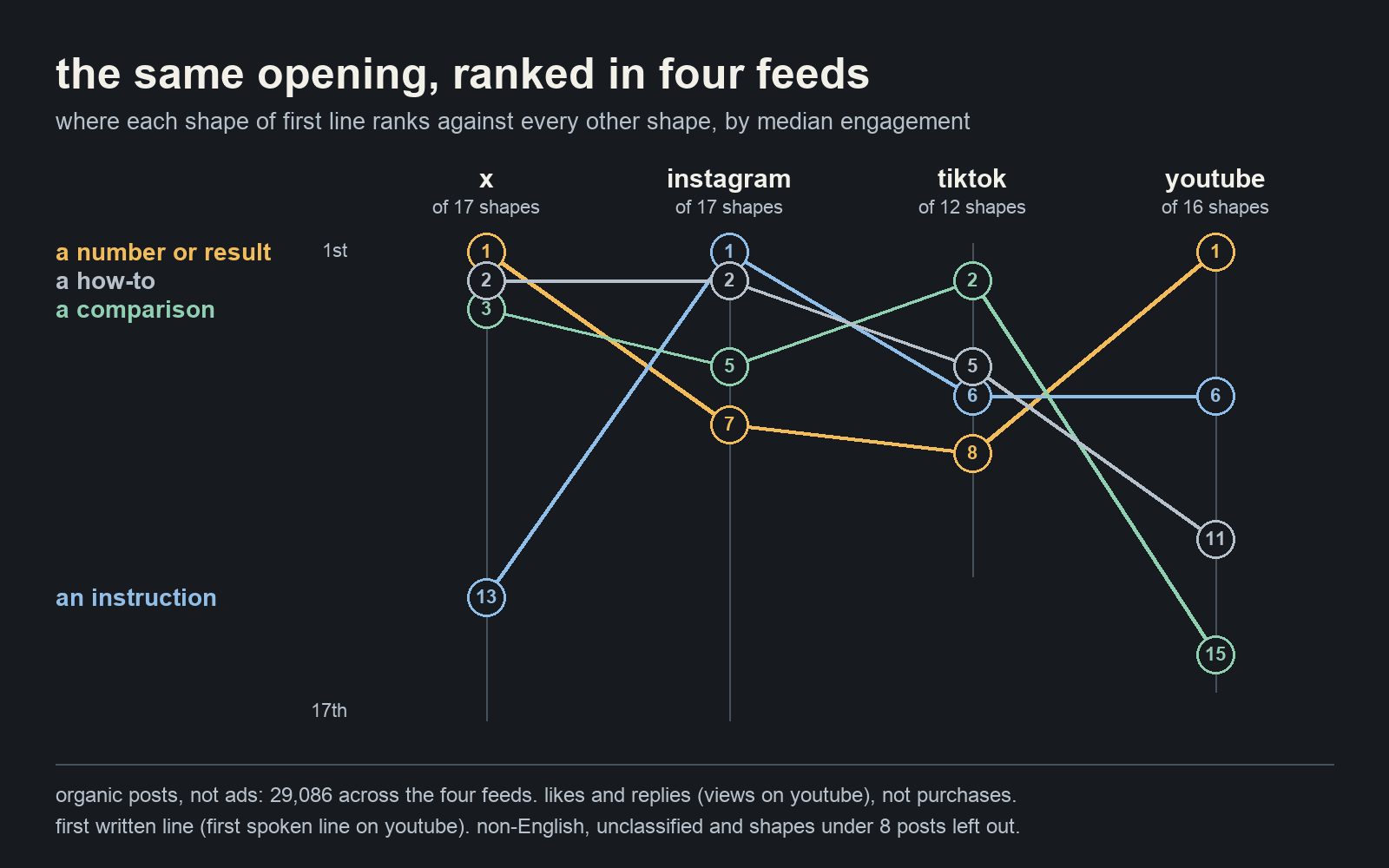
Organic posts, not ads; median engagement, not purchases; ranked by the shape of the first line. Shapes with fewer than 8 posts, non-English posts and unclassified lines are left out.
people who have run a few budgets already know this from the expensive side. one put it plainly: "some small brands waste their first ad budget copying hooks that don't fit their product/audience." the same post's example was that for a product people need to trust before they buy, "viral hooks" often underperform. that is the room changing the answer.
and lately is the other half. a hook that carried a campaign in the spring gets seen, copied and tired. the post the question came from says that when a winning video starts dying, the fix is to swap the first three seconds for a fresh hook and relaunch it. which means the answer to what kind of hook works for us is not something you find once. it is something you keep a running record of. that sounds like more work, and it turns out to be less, because the record is what stops you starting from zero every time.
so the honest answer to the question is not a hook. it is a way of finding yours, and the rest of this piece is that.
What three seconds do to your cost per purchase
the post the question came from put the standard view in one line: "the first three seconds decide whether the user skips your ad." that is true. it is also half of what the first three seconds do, and the half everybody measures.
start with the sum, because once you see it the rest of the method follows from it.
cost per purchase = what 1,000 impressions cost ÷ purchases per 1,000 impressions
and purchases per 1,000 impressions is three shares multiplied together:
- how many are still watching at three seconds — the hook rate, three-second plays divided by impressions.
- how many of those click through — of the people still watching.
- how many of those clickers buy — on the page.
a hook moves the first share directly. that is the stopping job, and it is the one the views-and-likes advice is about. but it also moves the other two, because it decides who is still there. an opening that stops everybody spends your budget keeping a lot of people who were never going to buy — the curious, the bored, people who like the visual. they stay, a few click, almost none buy, and the campaign pays for every one of them. an opening that names who the product is for loses most people in the first second, and the people it keeps are disproportionately the ones it was for.
so the first three seconds have two jobs, and they pull against each other: stop the right person, and let the wrong one go. a hook that only does the first will usually top the hook-rate column. whether it tops the cost-per-purchase column depends on how many of the people it stopped were buyers — and that column is the price you actually pay for each sale. the hook-rate column cannot tell you that.
this is why the hook-rate question is the right first question for a dead ad and the wrong last question for a live test. "did the first 3 seconds actually stop the scroll, or did it start slow?" is a good check when nothing is working — nobody can buy from an ad they skipped. it is not how you pick between four openings that all stop some people, because then the question is which of them stopped the people who pay.
the good news is that everything you need to split a hook's result into those three shares is already in ads manager: impressions, three-second video plays, link clicks, purchases, spend. you do not need a tool. you need to divide.
one more term in the sum and then the method. what 1,000 impressions cost is not always the same for every opening — meta's delivery responds to how people react to the ad, so two versions of one video can be priced differently in the same auction. you do not have to model that. it lands in the bottom line with everything else, which is one more reason only the bottom line gets to crown a winner: the price per sale, not the price per view.
Four kinds of opening worth writing
the test is four openings on one creative — one video, usually a ugc clip or a product demo. before the four, two rules about what stays fixed.
keep the promise fixed. every opening sells the same reason to buy — the same problem fixed, for the same person. picking that promise is a different job, and the piece on paying a creator to guess covers it: the words come from your customers, and you choose the frustration before you write a single hook. if the four openings promise four different things, you are testing four creative ideas, and the result tells you which idea won, not which kind of opening.
keep everything after second three identical. same footage, same creator, same voice, same captions, same call to action, same page. this is the isolation rule from the piece on whether it's the hook, and it is the only reason the result means anything. one complication worth saying: an opening is a line and a shot together, so write them together. if a new line needs a new first shot, that is fine — as long as the shot changes and the body does not.
then, instead of four versions of one opening, write one opening of each kind. the unit you are learning about is the kind, not the line. one person on x put the question exactly: "do fear based hooks work better than comparison hooks for you?" — for you being the part that matters. four lines of one kind can only tell you which line; one line of each of four kinds tells you which kind, and the kind is what you can write again next month.
the four kinds that sort people most differently from each other:
- the call-out. the first second names who it is for — the situation, the job, the age, the problem in their own words. it stops the fewest people and sorts the hardest. in the organic data above, the audience call-out is the last-ranked shape on instagram, 17th of 17. that is not evidence against it in an ad. it is built to make most people leave.
- the pain point. the problem, said the way the customer says it, before the product appears — the classic ugc opening. it stops the people who have the problem, and a fair number who just recognise it.
- the proof. the result first — a number, a before-and-after, a review on screen — and what the product is after. it stops people who want the outcome, and it asks them to believe something in second one, which filters a different way from the other three.
- the pattern break. something visually unexpected — a contrast, a movement, a thing that should not be there. it stops the most people and sorts the least. it usually wins the hook-rate column. that is exactly why it belongs in the test: it is the one that tells you whether stopping power is what your niche is short of.
if your product shows well, a fifth kind is worth swapping in for whichever of those you trust least: the product already doing the job in the first frame, no set-up. but four is the right number for the budget below, and four that differ is worth more than six that half-overlap.
the same four kinds work on a static creative, where the first three seconds become the first glance — the headline and the first thing the eye lands on. the read that follows is the same.
this is also cheaper to make than it sounds. the price people quote for testing hooks is the price of four ugc videos: "a couple hundreds on a video adds up fast when you want to test more than one hook." one person was quoted "$1,400 for a hook plus 3 variants" by one creator and "$400 for the same scope" by another. but four openings on one body is not four videos. it is one ugc video and four short clips that replace its first three seconds, which is an edit, not a shoot, and not four creator fees.
four openings on one body is the same ad built once with one part changed, and that is the part that should cost pence rather than another shoot. this is how to make an ad so the next version is a change to one piece: https://clear-cortex.com/playbooks/how-to-make-an-ad?src=x-cheapest-hook-mid
How to run the test so meta cannot pick for you
the obvious way to run four openings is to put all four in one ad set and see which one meta likes. that tests meta's first guess, not your openings, for two reasons i have gone through in other pieces. inside one ad set, meta backs whichever ad gets a small early lead and the rest barely spend. and four openings on one body are exactly what meta describes grouping as variations of one creative — ads that look and feel alike — so it has even less reason to spread money across them. you would end up with one opening at 90% of the budget and three you never read.
so each opening gets its own ad set.
- same audience, same placements, same conversion event — purchase — and the same daily budget in each. budgets at ad set level for the test, not pooled at campaign level, so nothing can starve one of them.
- launched the same day. four openings run against each other this week, not against last month's auction.
- no edits once it is live. no fifth opening added halfway, no budget changes on the one that looks good on day two.
before launch, write three numbers down. your target cost per purchase — break-even, or what your current best ad is costing. the screen line. the crown line. the test is two stages, and both lines are set in purchases' worth of spend, which is spend divided by your target cost per purchase.
stage one, the screen: three purchases' worth each. at a $30 target that is $90 of budget per opening. any opening with zero purchases at that point is out, and it is a real no: an opening exactly as good as your target shows nothing after three purchases' worth of spend only about 5% of the time. everything with one or more carries on. this is the same first checkpoint as the piece on when to switch an ad off, and the reason for it is the same — a zero this early is cheap to believe and expensive to argue with.
stage two, the crown: about ten purchases' worth of spend each. that is the floor from the piece on what a test has to cost — roughly ten purchases per creative before the gaps between them are bigger than the wobble of one ad against itself. at $30, $300 of spend per surviving opening, so $210 more budget for each one still in.
the whole price of the test budget, at $30:
screen: 4 openings × 3 × $30 = $360
crown: up to 3 survivors × 7 more × $30 = up to $630
total: up to $990, against $1,200 for reading all four to ten
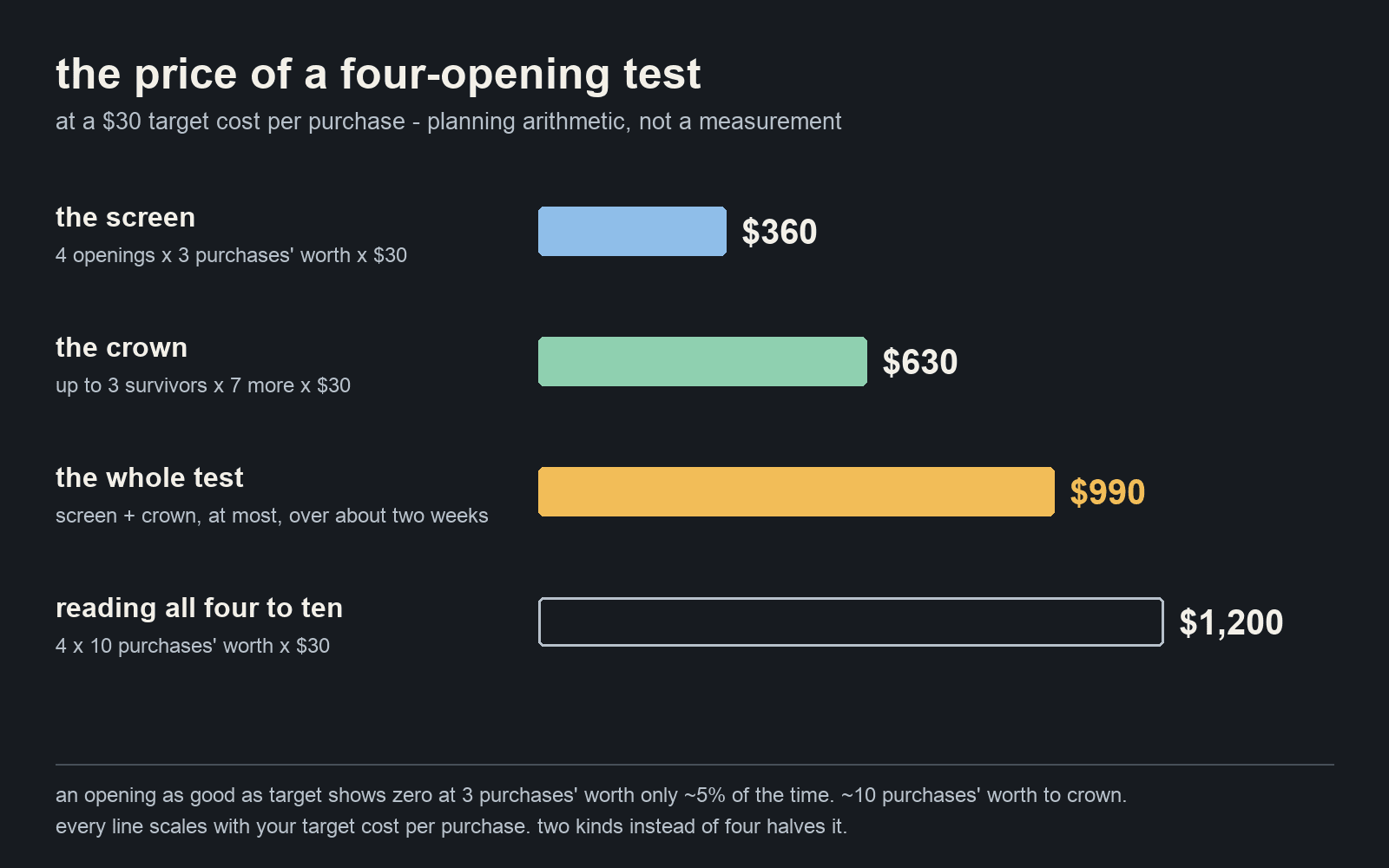
Planning arithmetic, not a measurement. Put your own target cost per purchase in; every line scales with it.
if that is more than your budget can carry in a fortnight, cut the test, not the reading. two kinds instead of four halves the budget — pick the call-out and the pattern break, because they sort the most differently. or read one step up from purchases, on add-to-cart, which arrives more often for the same money; the piece on which number picks the winner has the rule for when you have to. what you should not do is run four openings on a budget that can only read one, because that buys four shrugs.
Reading the winner on cost per purchase
at the crown line, compare cost per purchase. not hook rate, not click rate, not the one that looked good on day two. the asker had this right from the start.
a lead has to be big to be real at these numbers, and it is the budget that sets the numbers. with around ten conversions a side, the purchase counts themselves are still moving a lot from luck. a working rule: on equal spend, one opening needs about twice the purchases of another before you can treat the gap as real — ten against twenty is roughly a one-in-twenty chance from two openings that are actually the same. a smaller lead is ahead, not proven. that is still useful: you back the one that is ahead, give it the campaign's budget, and keep reading it there. you just do not write it into the record as a rule yet.
a tie is a good result, not a failed test. two openings that both clear your target cost per purchase are two ways into the same creative, and the second one is the spare you swap in when the first one tires — which, per lately, it will.
then do the part almost nobody does, which is the reason the test is worth the money twice: split the winner's result into the three shares and see which one won it.
- it won on how many were still watching — the stopping job was your niche's bottleneck. the next round tests more kinds that stop hard.
- it won on how many of the watchers clicked — the opening set up the body better. look at what it promised in second one and whether the body paid it off.
- it won on how many clickers bought — it sorted. it kept fewer people and better ones. the next round tests more kinds that select, and stops paying for reach the page cannot convert.
and write it down, by kind, with the date. a line per test: the four kinds, the cost per purchase each reached, which share won it. after three or four tests that page is your answer to what kind of three second hooks have brought in the lowest cost per purchase for your niche lately — your niche, because it is your account, and lately, because every line is dated. it is also what turns the next brief from a guess into a choice. the alternative is the one somebody described in a single line about an account that had "tried multiple creatives and hooks but still, very bad result" — every opening tried, none of them read, nothing learned that carries to the next round.
the winner does not stay in the test. its opening goes on the video in your main campaign — added as a new ad, which does not reset the ad set the way an edit does — and it is the opening the scaling budget goes behind. its kind becomes the default first three seconds on the next creative you brief, and it is the thing the next test is trying to beat.
One test, worked end to end
this example is constructed to show the method, not taken from an account, a campaign or a client. every figure in it is a "say".
say you sell a $45 product, your break-even cost per purchase is $30, and 1,000 impressions cost $15 on every version of the creative. you have one 25-second ugc video that sells one reason to buy, and you cut four openings for it: a pattern break, a pain point, a proof and a call-out. same body after second three.
here is what each opening does per 1,000 impressions, if you could see the truth:
- pattern break: 420 still watching at three seconds. about 10 clicks, 1.05% of impressions. 2% of clickers buy — 0.21 purchases per 1,000. $71 a purchase.
- pain point: 300 watching. 12 clicks, 1.2%. 4% buy — 0.48 per 1,000. $31.
- proof: 260 watching. about 10 clicks, 1.04%. 5% buy — 0.52 per 1,000. $29.
- call-out: 180 watching. about 11 clicks, 1.08%. 8% buy — 0.86 per 1,000. $17.
look at what each column would have crowned. hook rate crowns the pattern break, the most expensive opening by a distance. click rate crowns the pain point, which sits on break-even. the click rates are within a fifth of a point of each other across all four, so in practice it crowns nothing. only cost per purchase picks the call-out — the opening with the worst hook rate in the test, keeping fewer than half the watchers the pattern break kept, and selling at less than a quarter of its price.
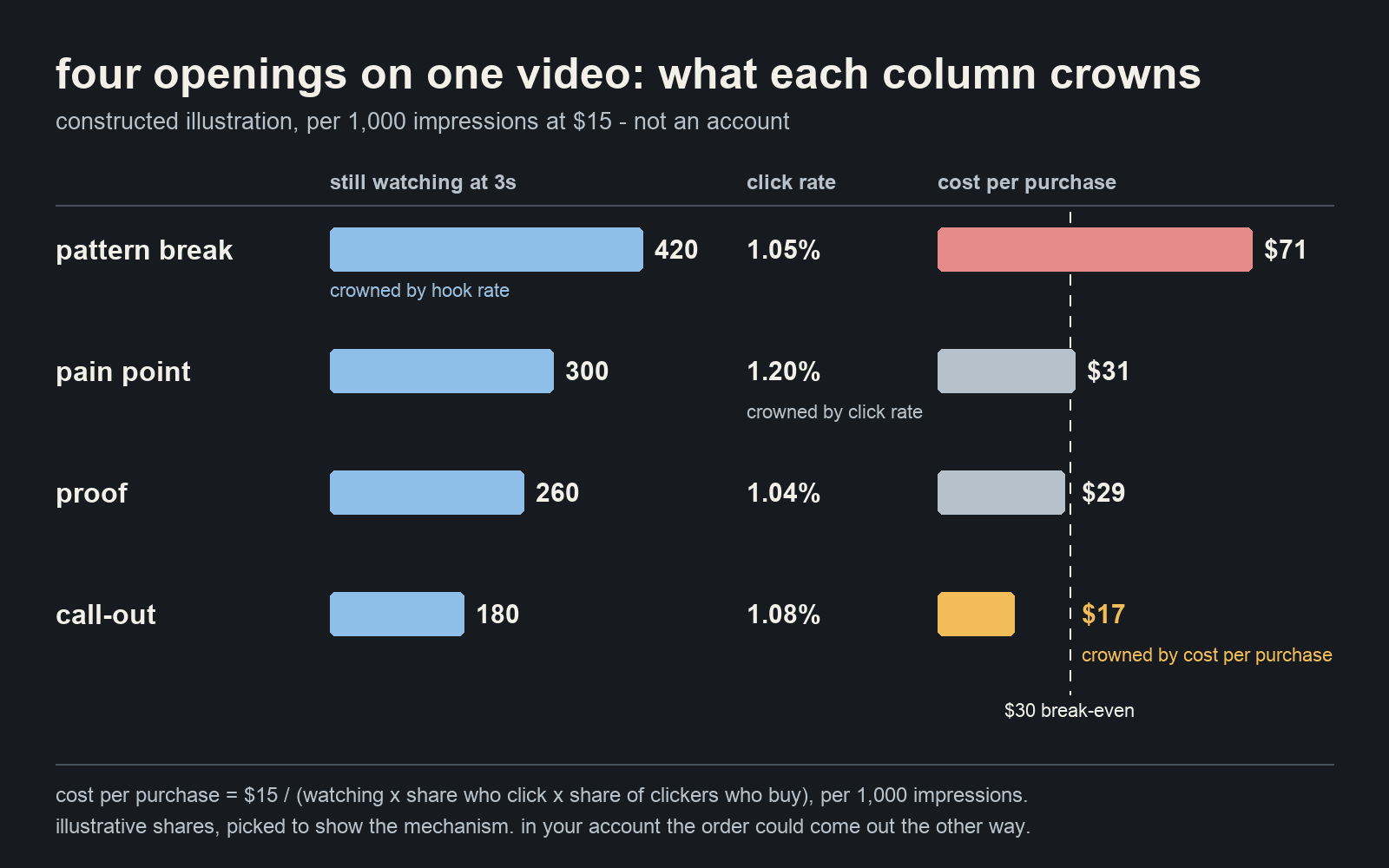
Constructed illustration, not an account. The ordering could come out the other way in yours — finding that out is what the test is for.
the screen. $90 of spend per opening, $360 in all. say the pattern break gets 0 sales, the pain point 3, the proof 2, the call-out 5. the pattern break is out. note that it could easily have scraped one purchase and survived — at $71 a purchase it gets none in $90 only about 28% of the time — and that would have been fine, because the crown is there to catch what the screen lets through.
the crown. the other three run on to $300 each, $630 more spend. say they finish at 10 conversions for the pain point, 10 for the proof and 17 for the call-out: $30, $30 and $17.65.
the read. the call-out is ahead, 17 to 10 on the same spend. that is 1.7 to 1 — under the two-to-one line, so it is ahead, not proven; two openings that were really the same would split that unevenly about one time in eight. the pain point and the proof are both sitting exactly on break-even, which makes money for nobody, so neither is a winner, and neither is the spare.
what happens next. the call-out goes on the video in the main campaign as the opening to scale on, because it is ahead and well under break-even and nothing else is close. it keeps being read there, and the pain point and proof files are kept, not run. the record gets one dated line: call-out $17.65, proof $30, pain point $30, pattern break out at the screen. split into shares, the call-out won on how many clickers bought — four times the pattern break's rate — not on stopping anybody. so the next test keeps the call-out as the opening to beat, and puts it up against a kind the record has not seen yet, the product already doing the job in frame one.
the whole test budget was $990 over about two weeks — four ad sets at $22.50 a day for the screen, three for the crown. it bought a working opening at a little over half the break-even price, a lead you can scale on, and a first line in the record that turns what kind of hook works for us from a question into something you can look up.
The part i cannot prove
the worked example is constructed. the shares in it are illustrative, picked to show the mechanism clearly, and the ordering is not a prediction. in your account the pattern break might win on cost per purchase, and if it does, it won. the method is the claim here, not the result.
the organic rankings are measured, on posts in the corpus i keep, and they measure engagement on organic posts by the shape of their first line. they say nothing about ads or purchases, and i have used them only to show that the best opening moves between rooms.
how meta delivers inside an ad set — backing an early leader, grouping lookalike creative, pricing impressions partly by how people respond — is from the platform's own documentation and from what advertisers describe. none of it is my measurement, and i do not run an account at this budget. the three and the ten come from earlier pieces and are arithmetic on top of the platform's thresholds. the percentages assume purchases arrive at random at a steady rate, which real delivery does not quite do.
and one thing the test cannot fully isolate. even with the same audience settings in every ad set, meta uses the creative to find people, so a call-out may get shown to a different crowd from a pattern break. the test measures the opening plus who meta found with it. that is also exactly what you would get when you scale it, so i think it is the right thing to measure — but it is not a pure measurement of the opening.
the thing i genuinely do not know is how long a winning kind lasts. lately is in the question for a reason. if a niche's cheapest kind holds for months, one test a quarter is enough. if it turns over in weeks, the record needs a line a fortnight. i have not found anyone who kept that tally long enough to say. if you test openings by kind and have kept the dates, i would rather have your numbers than be right.
if any of this is wrong, say so. a correction is worth more to me than agreement.
the test is only as good as the four openings you can afford to put in it. that's the part clear cortex does — new openings for the ad from the product photo you already have, for pence: https://clear-cortex.com/?src=x-cheapest-hook-end