 Clear Cortex
How to know if your shop is ready for ads without paying to find out
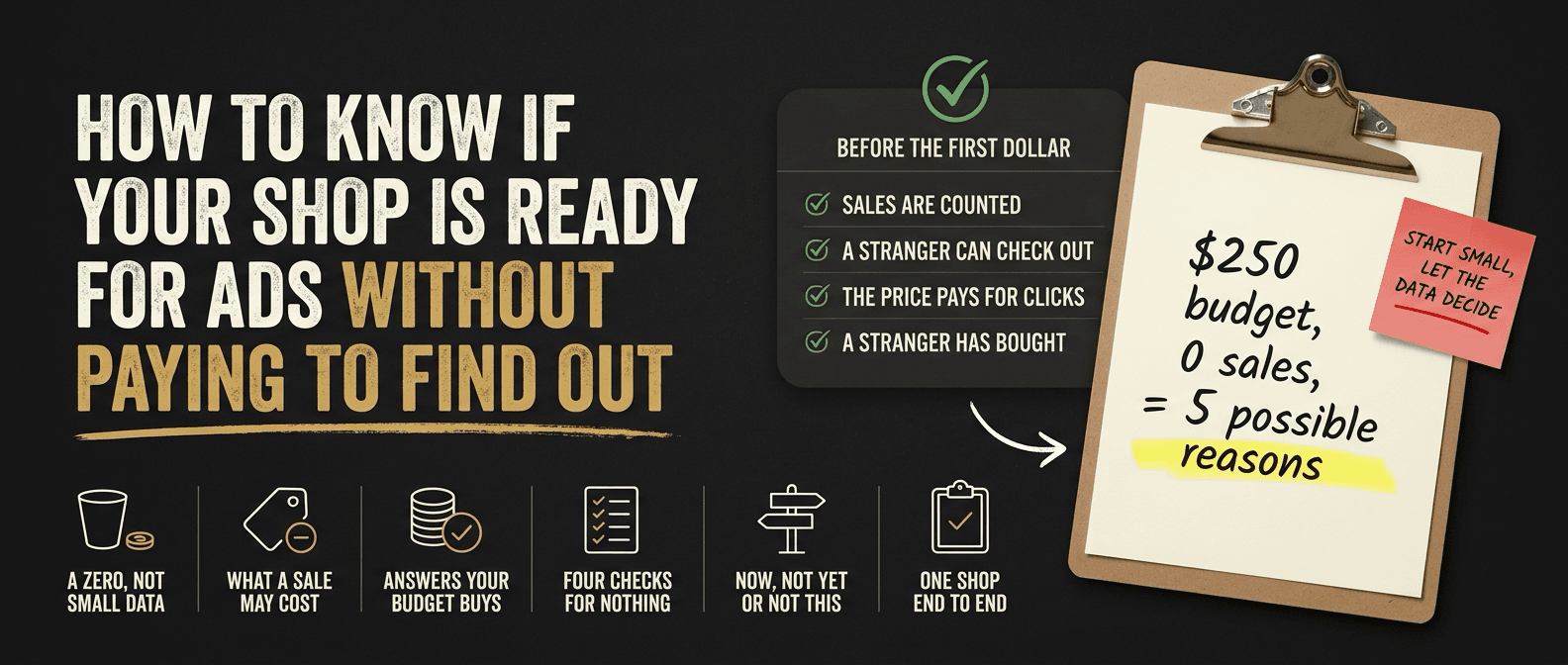
$250 and zero sales can mean five different things.
that was somebody's question before they had spent a cent. a first week's budget of $250, a friend's supplement shop, their first time running meta ads, and they wanted to know in advance what a zero would tell them: "if we spend the first $250 and don't get any sales, how do we figure out what's wrong?" and then the five suspects, in their own list: "is it usually the creative, the offer, the audience, the landing flow, or something else?" nobody can answer that after the money is spent. the zero looks the same whichever of the five caused it.
i went looking for people at this exact point — a product, a site, not much money, deciding whether to pay for traffic at all — and counted 9 separate threads. two of them had already spent and could not read what came back. only one asked, in so many words, what to check before the first dollar. here is how they put it:
"would you: spend on ads immediately or avoid them?"
"as a founder or developer, what's your checklist before spending a single dollar on ads?"
"this time i wanna try facebook and google ads but i don't know how it would work on my situation with a limited budget."
"with a limited budget, i don't think i'm financially stable enough to put money into ads on different platforms yet."
"so far we've relied purely on organic growth, but i want to try paid ads for the first time."
the first one came with the situation that makes it hard: "if you were down to your last £200/$200 but already had a product + website ready to go, how would you actually grow your e-commerce brand from there?"
the usual answer splits two ways. one half says avoid ads until organic is working. the other half, the louder one, says start with a small daily budget, a few dollars a day, and let the data tell you. one founder did exactly that and wrote down why: "i started running meta ads on a small budget because i was advised not to overspend before the account had data." i think that second answer is wrong, and it is costing people their first budget. not because ads do not work for small shops. because a small first budget does not buy small data. it buys a zero that nobody can read, and the zero gets read anyway — as ads don't work for us, or wrong platform, or wrong product — and the shop makes its next decision on a guess it paid for.
the avoid-them half is closer, but it gives you no number. avoid them until when? the honest answer to the question at the top is neither now nor never. ads become worth buying at the point where every question but one has been answered for free, and the one left is whether strangers buy from an ad on meta. that is the only question ad money is good at, and it is the last one to ask.
one boundary first, because i have written the neighbouring pieces and this is not them. setting the account up, getting a new one out of learning limited, telling the ad apart from the landing page, how much a creative test has to cost — those are separate. this one is before all of them. you have a product and a site and some money. do you spend it on traffic, and what do you check first.
so here is the whole thing. why a small first budget buys a zero you cannot read, the one sum that says what a sale is allowed to cost you, how many answers your budget can actually buy, the four questions to answer for free before the first dollar, and the three ways the decision comes out: ads now, not yet, or not this product. about an hour, most of it without opening an ad account. nothing is held back and there is no gate on any of it.
the cover on this piece was made in clear cortex for about 8p, on the cheapest model that could spell the headline. that's the studio i'm building, and it's the only ask in this piece: https://clear-cortex.com/?src=x-ready-for-ads-top
A small budget buys a zero, not small data
start with why "start small" sounds right, because it is right about the thing it is worried about. nobody should put their last $200 behind an untested campaign and hope. the advice is protecting you from a big loss, and that part is sound.
what it gets wrong is the idea that a small budget gives you a small amount of information, the way a small sample of anything does. it does not, for two reasons.
the first is that a sale is a lumpy thing to measure. sales arrive a few at a time and a bit at random, so even an ad that works will often go a while without one. a creative that brings one purchase for every $25 it spends will, on its first $25, show no purchase at all about 37% of the time. after $50, about 14%. after $75, about 5%. so money spent in amounts smaller than a couple of sales' worth produces a zero most of the time whether the creative works or not. that is not a little data. it is no data, and it looks exactly like bad news.
the second is the one in the opening line. suppose you spend enough for the zero to mean something — a $250 budget at a $25 cost per result is ten sales' worth, and a campaign working at that level would almost never bring none. now the zero is real. something is broken. but the money has bought you the fact that one of five things failed, and not which:
- the sales happened and meta never counted them, because the purchase conversion is not being tracked.
- the people arrived and the page or the checkout lost them.
- the price cannot carry the cost of a paid sale at all.
- strangers do not want this, at this price, from a shop they have never heard of.
- the creative — the video or the image — did not reach or move the right people.
a paid zero is all five of those at once. only the last one actually needed ad money to find out. the other four could have been checked for nothing, and then the $250 would have bought an answer to the last one.
and spreading the $250 budget across several creatives makes it worse rather than better, which is the second half of the usual advice: "is the usual strategy to test a lot of creatives with a small budget, find winners, and then put more money behind them?" four videos in one ad set on a $250 budget at a $25 cost per result is two and a half sales' worth each — and that is the even split, which meta never does; it backs whichever one it likes first. at that level every one of them can come back empty and still be fine. you have run four tests too small to read instead of one test that could have said something.
this is what the advice costs, and it is mostly not the $250. it is the conclusion that comes after it. one fragrance brand had run on organic and creator content for a year, put its first budget into four videos, and wrote the result as a title: "$400 spent, 0 sales — should a fragrance brand bet on meta or stick with tiktok?" and then the honest version of the doubt: "just trying to figure out if i'm bleeding money on the wrong platform or just being impatient." the zero could not say which. so the next move on the table was to take the same unanswered questions to a different platform and pay to not answer them again.
What a sale is allowed to cost you
the first of the checks that cost nothing is a sum, and every other number in this piece hangs off it.
take the price of one order and subtract everything that order costs you before any advertising: the product itself, the packaging, the shipping you pay, the payment fees, and an allowance for returns. what is left is the most you can pay to get that order from a stranger and not lose money on it. that is your break-even cost per sale. i went through it at more length in the piece on fixing a stuck account, where it is used to size a gap on a campaign that is already running. here it does a different job: it decides whether you start one.
do it before you know anything about ad prices, because it is the one number that does not depend on them. a shop selling a $40 product that costs $24 all in to sell can pay $16 for a sale. not $17. no ad, no audience and no clever setup changes that, because it is not in the ad account. it is in the price.
then turn it into something you can picture: how many clicks can one sale pay for? divide the break-even by what a click costs. you will not know your cost per click until you buy some, so try a few: at 50 cents a click, $16 pays for 32 clicks. that means at least one in every 32 strangers who click has to buy, just to break even. at a dollar a click it is one in 16.
that is the question to sit with before spending anything. is one in 32 believable for your shop, from people who have never heard of you? you have a way to judge it, if you have sold anything at all. people who already know you — friends, followers, people who came from a post, a marketplace listing or an email — buy more readily than strangers who clicked an ad on meta on their way somewhere else. so if one in 32 — a conversion rate of about 3% — is more than your shop has ever converted from people who know it, strangers will not do better, and no ad will close that gap.
this is where low-priced products get caught, and it is worth being plain about. one seller coming back after losing their marketplace shop described their range as "low ticket product, max price i could sell is around $30 + shipping", and wanted to move to their own site with facebook and google ads. their own worry was the right one: none of their competitors ran ads anywhere but the marketplace, and they wondered whether that was because it did not pay. the sum is how you find out before spending. say a $30 product leaves $9 after everything. at 50 cents a click, one sale pays for 18 clicks, and whether one in 18 strangers buys a gift from a shop they found that minute is a question the margin asks before any ad does.
if the sum comes out tight, the fix is almost never in the ads. it is in the order: a bundle, a second item at checkout, a larger pack — anything that makes one sale worth more, so it can pay for more clicks. that change costs nothing in ad spend, and it makes every later ad pound go further.
How many answers your budget can buy
now count the budget in the unit that matters. divide the budget by your break-even cost per sale. that is how many sales' worth of money you hold, and it decides what kind of question you can afford to ask.
two thresholds do almost all the work, and both come from earlier pieces.
three sales' worth buys you a no. a creative that has spent three times your break-even and brought nothing at all is very unlikely to be working — that happens about 5% of the time to an ad that does. so three sales' worth is the price of a clean no on one ad. i worked out the full ladder in the piece on when to switch an ad off.
about ten sales' worth buys you a yes. to say one ad is actually better than another, or that this one is reliably profitable, you need something like ten conversions on it, and it is the least you want behind an ad before you scale its budget. that is from the piece on what a test has to cost, and below it the gaps between ads are smaller than the week-to-week wobble of one ad against itself.
so put the $200 through it. at a $16 break-even, $200 is twelve and a half sales' worth. that is four noes, or one yes and nothing else. four creatives read one at a time, each alone in its ad set, to three sales' worth each, at $48 apiece, or one ad read all the way to ten for $160. not twelve creatives on a few dollars a day each. that version spends the same $200 and buys no answer on any of them.
the four-noes version is the one most new shops should want, and the reason is worth saying. your first video or image is unlikely to be the one. you are not yet trying to find the best ad. you are trying to find out whether strangers buy this at all. one no tells you that ad did not work. three or four noes in a row, on genuinely different reasons to buy, start to tell you something about the product and the price, and that is the thing you most need to know before you scale anything.
and here is the uncomfortable part. if the budget is under three sales' worth, it cannot buy any answer at all. at a $16 break-even that is anything under $48. at a $60 break-even, anything under $180. money below that line is not a small test. it is a donation to the zero, and the honest choice is to keep it until there is enough to read one ad properly.
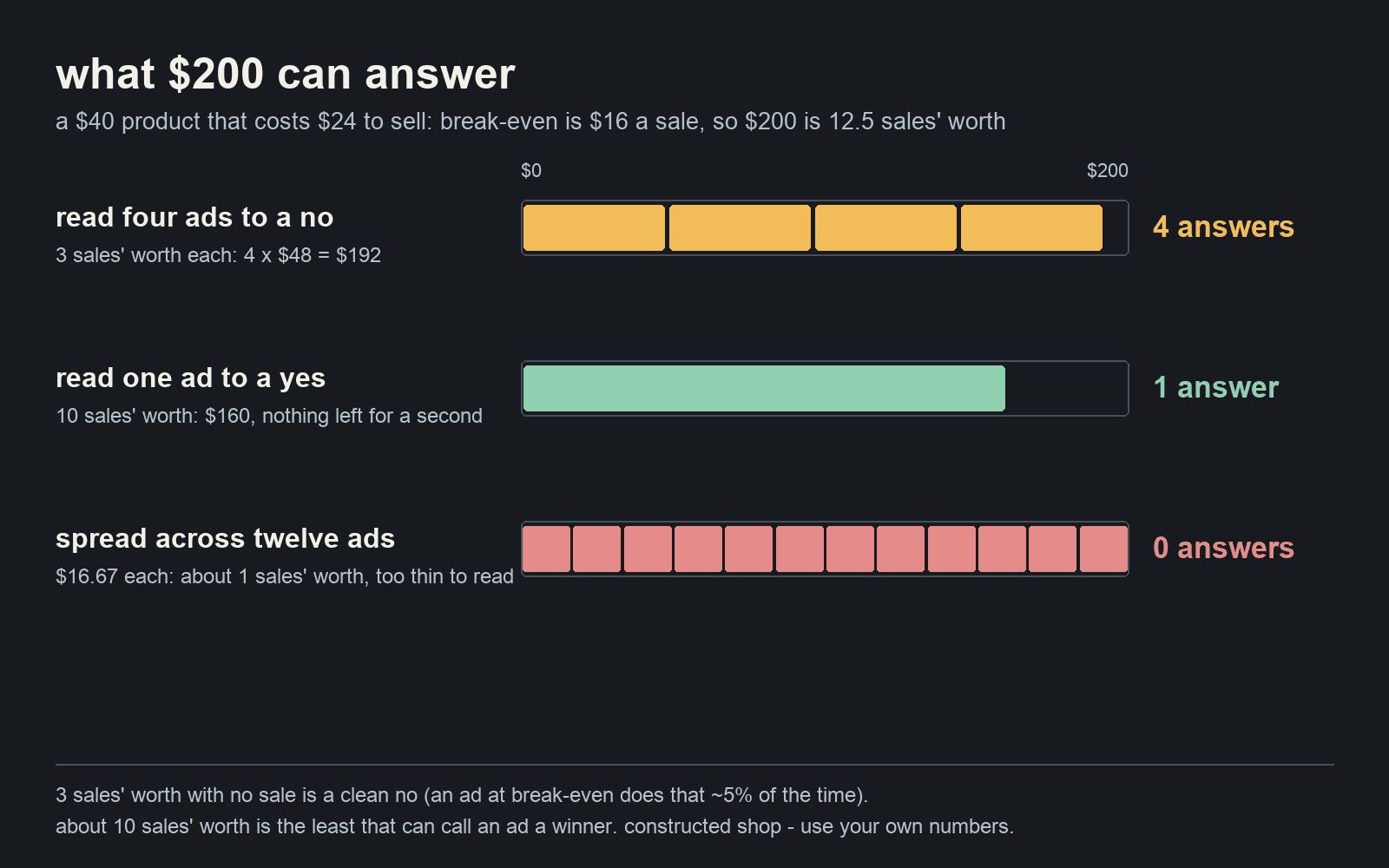
Constructed shop for clean arithmetic: a $40 product that costs $24 to sell. Put your own price and costs in.
Answer everything else for free first
back to the five suspects. four of them can be cleared without spending anything on ads, and clearing them is the whole point — not because it saves money on the test, but because it means that when the test comes back, it can only be saying one thing.
one: is a sale counted when it happens? go through your own shop as a customer, buy the product, and check the purchase shows up as a conversion in meta's events manager, then refund yourself. it takes an afternoon and costs one transaction fee. i went through it properly in the piece on new accounts and learning limited. if you skip it, every later zero has a fifth explanation you cannot rule out.
two: can a stranger get through the page and the checkout? hand your phone — or better, a link — to three people who have not seen the shop, and ask them to buy the thing while you watch and say nothing. you are looking for the moment they hesitate: the shipping cost that only appears at the last step, the size they cannot find, the page that loads slowly on mobile data, the payment option they expected and did not see. three people will find most of it. the piece on the page and the ad covers what to do when paid traffic is already arriving. this is the version before any arrives, and it costs nothing.
three: can the price carry a paid sale? that is the sum from the section above. it costs nothing, takes ten minutes, and it is the one most people skip.
four: does anyone who does not know you buy this? not your friends. not your family. somebody who found the shop from a post, a listing, a message or a search and paid full price. this is the question the avoid-ads half of the advice is really asking, and it is right to ask it. it does not need to be many sales. one or two strangers buying at full price tells you the product and the price can work on people who owe you nothing. zero after real effort on the unpaid channels is also an answer, and a far cheaper one than a paid zero.
the asker of the $200 question listed the unpaid channels themselves — organic short video, influencers, cold messages, an email list, marketplaces. read against the five suspects, those are not alternatives to ads. they are how you answer question four before the ads, for the cost of your time.
one founder, writing up eight weeks on a genuinely tiny budget, put the temptation at this stage better than i can, about a landing page template, a logo and a plugin bought before any traffic had arrived: "looking back, that $60 was me trying to buy confidence instead of traffic." the paid-ads version of that is spending before the other four answers are in. it feels like action. it buys a number you cannot read.
Ads now, not yet, or not this product
with the four questions answered and the sum done, the decision makes itself. there are three ways it comes out, and only one of them is a campaign.
not this product — the sum fails. if one sale cannot pay for more clicks than your shop has ever needed to make a sale from people who know it, ads will lose money on every order, and more ads will lose more. that is not a reason to give up on the product. it is a reason not to buy cold traffic on meta for it at this price. raise what one order is worth — a bundle, a bigger pack, a second item — and run the sum again. or sell it where people are already searching for it.
not yet — one of the four questions is open. tracking not checked, nobody has watched a stranger try the checkout, no stranger has bought. close it first. it costs time rather than money, and the budget stays in the bank for the campaign it will eventually fund. and there is one more not-yet that has nothing to do with the shop: if losing the whole test budget would end the business, it is not a test budget. a read to a no is a read that is expected to end in a no most of the time. the person who said they were not "financially stable enough to put money into ads" yet was describing exactly that, and was right to wait.
ads now — everything else is answered. the purchase is counted, strangers can get through the checkout, the sum says a sale can pay for a believable number of clicks, and at least one stranger has bought. now the only open question is the one ads are for. run it like this:
- one campaign, one ad set, one creative. nothing for the budget to split between, so nothing can starve.
- the ad says the reason the strangers already bought. you know it now — it is what they said, or what they clicked on, or what they asked before paying. that is your first creative, as a video or an image. not a mood video, not the product on a white background with your logo. the reason.
- fund it to three sales' worth and read it there, not before. no sale by then is a real no. one or more at or near break-even means it is alive, and it earns the next budget — the full ten-result read, and after that the right to scale it.
- if it is a no, the next creative is a different reason to buy, not a recolour of the first. three or four noes on genuinely different reasons is when you go back and question the product and the price.
the first creative doesn't need a shoot or a video from a creator. if you have a product photo, this is how to turn it into an ad, step by step: https://clear-cortex.com/playbooks/how-to-make-an-ad?src=x-ready-for-ads-mid
that is the whole answer to "spend on ads immediately or avoid them?" — not immediately, and not avoid. spend the moment the only question left is one that money answers, spend it so it can answer, and scale only what has answered yes.
One shop, worked end to end
the clearest case in the pile is a shop that had already done most of the unpaid work, and then spent anyway in the way the advice says. it is worth running the checks on it because it shows what they would have said before the money went in.
a solo founder selling smart camera glasses for $99.99 on their own store. the four checks, from their own post:
- strangers buy. about 35 lifetime orders, and "growing month over month organically (roughly $375 → $600 → $670 → $820 across the last 4 months) with minimal consistent paid spend." that is question four answered, and answered well: people who do not know the founder are buying at full price, more each month.
- the page and checkout work. "ruled out so far: checkout mechanics (clean, free shipping, standard express checkout options), message match (ad promise matches page headline), price complaints (none)." question two, answered by the founder.
- tracking is the open one. "meta ads: ~$970 lifetime spend across all campaigns, 9 tracked purchases." nine tracked against 35 orders in all is not proof of a problem — most of those orders were organic — but it is the question that was never closed, and it is why every number below has to be read as a floor.
the sum. the post does not give the cost of the glasses, so say they cost $40 to sell, all in, including the free shipping and the fees. break-even is then about $60 a sale. the ads, on the tracked numbers, cost $970 for 9 sales: about $108 a sale, for a product that sells for $99.99. but the best of them did much better: "best historical campaign hit $46-60 cost per purchase" — at or under the $60 line. so the product can carry a paid sale. the ad that does it exists. this shop passes.
how many answers the budget bought. the founder was running $25 a day. at a $60 break-even, that is $175 a week, just under three sales' worth: one clean no per week, and a yes about every three and a half weeks. spread across all campaigns as it was, the $970 bought nine sales and no read the founder trusted. read one ad at a time, the same $970 is five clean noes, or one clean yes and over half of a second.
the zero they were worried about. the post's question was this: "current problem: last 4-5 days, near zero sales despite the ad account looking healthy — 8-9% CTR, ~$0.45-0.50 CPC." four or five days at $25 is $100 to $125 — under two sales' worth at a $60 break-even. an ad working exactly at break-even brings zero or one sale on that much money roughly 40% to 50% of the time. near-zero over four or five days is close to a coin toss for an ad that is fine.
and their own question — "at $25/day, how many days/sessions would you actually wait before concluding something's broken" — has a plain answer from the sum: three sales' worth is $180, which at $25 a day is about seven days. zero sales after seven days at $25 is a real no on that ad. near-zero after four is not yet anything. the post also shows the clicks still arriving and the shoppers still adding to cart and reaching checkout, and none buying. that is a page-and-checkout pattern rather than an ad one, and it is exactly what the open tracking question has to be closed against first: if the purchase is not being counted, shoppers reaching checkout and no purchases recorded is exactly what it would look like.
so the read on this shop. ready for ads, by every check but one — on the constructed cost, the sum passes too. the next dollar does not go on a new campaign. it goes nowhere until a test purchase shows up as a tracked purchase. then one campaign, one ad set, one creative — the ugc-style comparison video that hit $46 to $60, because it is the one creative with a record at the line — read at three sales' worth, about a week each at $25 a day. if it reads alive, that is the ad to scale on.
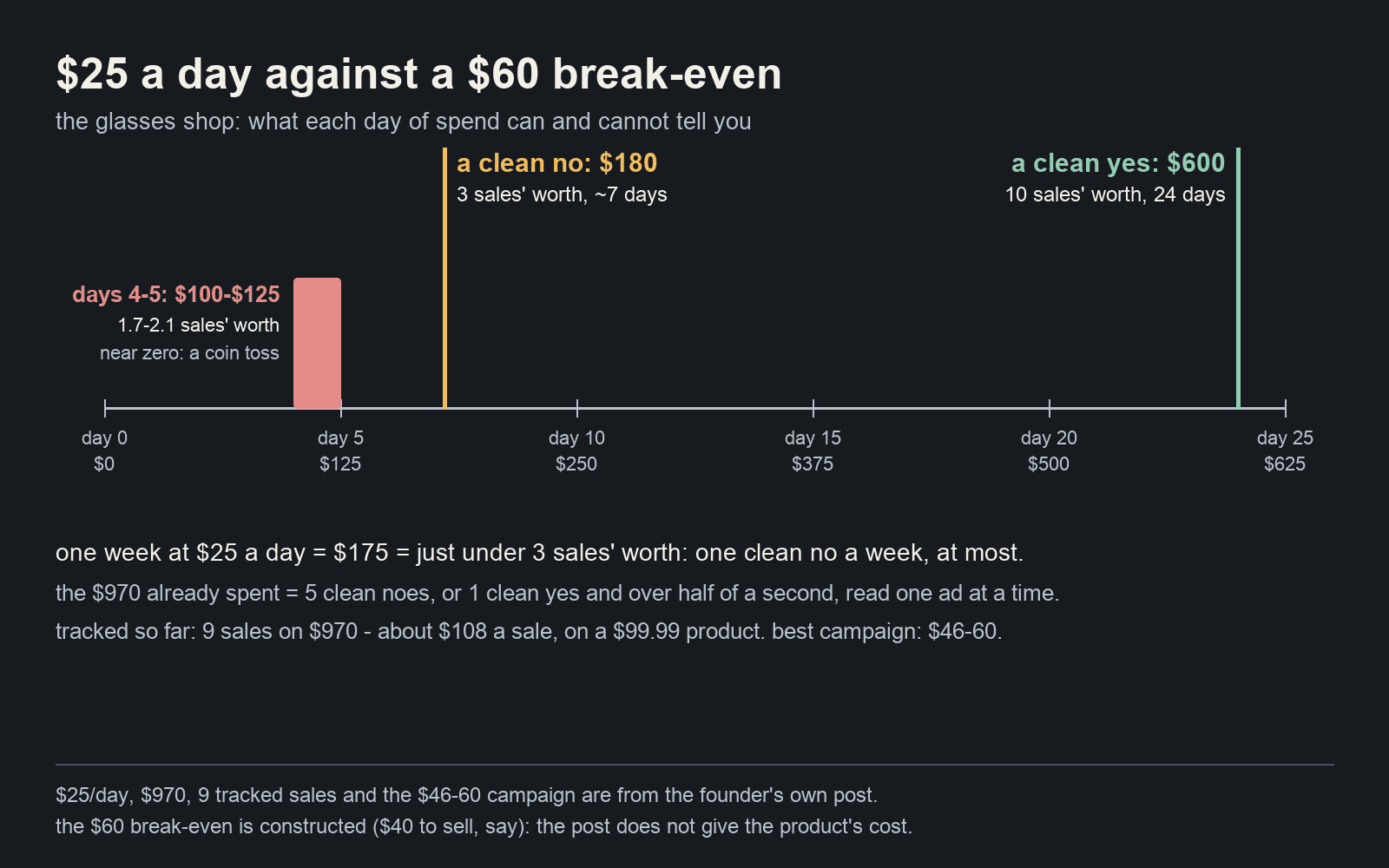
The $25 a day, the $970 and the sales figures are from the founder's own post. The $60 break-even is constructed — the post does not give the product's cost.
The part i cannot prove
i do not run a shop at this size, and the worked example is somebody else's, read from what they wrote. the cost of the glasses and the $16 shop in the middle are constructed so the arithmetic is clean, and they are flagged where they appear. every number that came from the founder is theirs.
the percentages assume sales arrive at random at a steady rate. real delivery is lumpier than that, especially in the first days of a new ad, so treat the 37% and the 5% as the shape of the risk rather than its exact size. the three and the ten come from earlier pieces and are arithmetic on the platform's own thresholds, not a statistical result.
the claim that people who already know you buy more readily than strangers from an ad is reasoning, not something i have measured. i think it is almost always true, and it is what makes the unpaid check a ceiling for the paid one. if your shop is the exception — strangers buying more readily than your own followers — the sum is pessimistic for you and the rest of the method still holds.
and there is one thing this method cannot do. a shop can pass all four checks and still find that strangers do not buy from ads. that is what the money is for, and it is why the first read is sized for a no. what i do not know is how often a shop that passes everything still gets four noes in a row. if you started ads only after strangers were already buying, and kept count of how the first few reads came out, i would rather have your numbers than be right.
if any of this is wrong, say so. a correction is worth more to me than agreement.
the read only pays if the next ad is cheap enough to make every week. that's the part clear cortex does — a new ad from the product photo you already have, for pence: https://clear-cortex.com/?src=x-ready-for-ads-end