 Clear Cortex
UGC, polished product creative, or statics — what actually wins
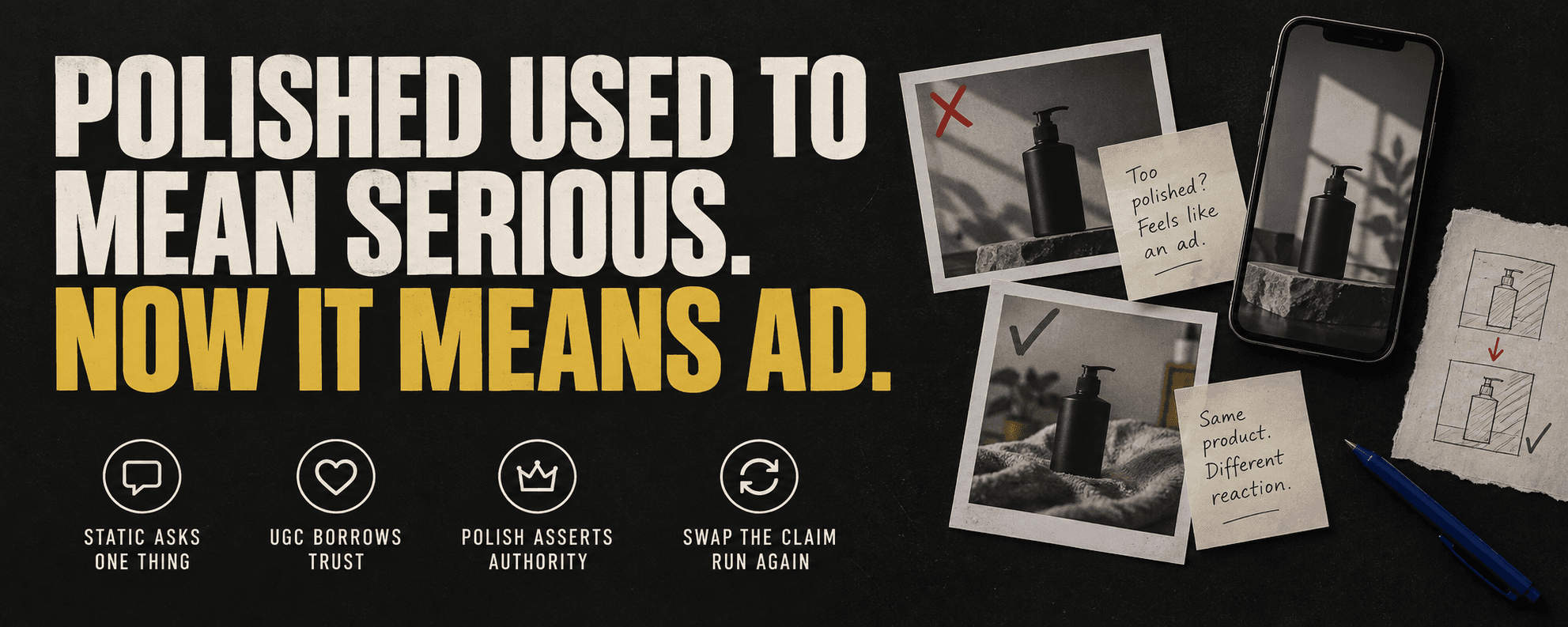
$0.15 buys a polished explainer. polished is the problem.
i went looking for whether UGC-style video, polished product creative or plain statics wins, and read 129 lines from people running all three, across 48 threads. one of them explains the whole thing in a sentence and it has nothing to do with which is better:
"viewers have been trained on years of polished advertising, so the second a reel reads as produced, the brain files it as an ad."
that is the mechanic, and it inverts the question. production value used to be a signal of a serious company, because only a serious company could afford it. it is now a signal of an advert, because anyone can afford it — the cut has a polished explainer at $0.15 and a studio quote at "$6,000-$35,000+" for the same job. when quality stops being scarce it stops carrying information, and the thing it used to say gets said by something else.
so here is the whole thing: what each of the three formats is actually for, why "which wins" is the wrong question in a way that costs money, the one case where polished still beats everything, and how to run all three against each other for about £300 without fooling yourself. about fifteen minutes, nothing held back, no gate on any of it.
the three formats do different jobs
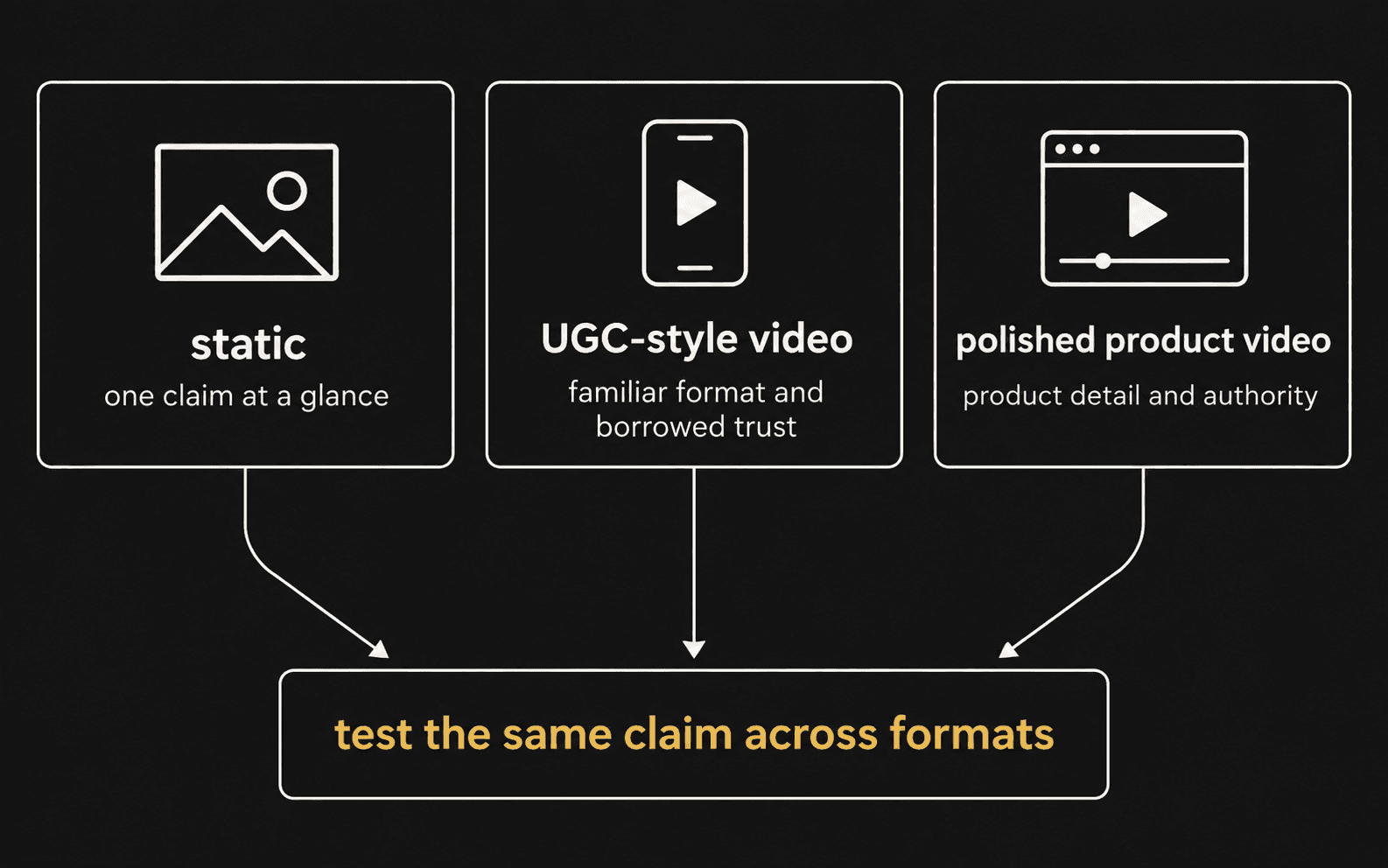
they are not three qualities of the same thing. they are three different mechanisms, and comparing them on a single "which converts better" axis is why the argument never lands.
a static asks the eye to stop and the mind to read one thing. it has no time dimension, so it can carry exactly one claim, and it carries it instantly. its strength is that it cannot be scrolled past slowly — a viewer either takes the claim or does not, in under a second. its weakness is that it can only ever make one.
a UGC-style video borrows trust from a format. its persuasive weight comes from resembling something that was not an advert. everything about it — the propped phone, the imperfect light, the ordinary room — is a costume that says "this was not made to sell you something", and that is precisely why it works and precisely why it stops working when everyone wears it.
a polished product video asserts. it says "we are a real company, this is a real product, here is what it does" in a register nobody mistakes for a friend's recommendation. it does not borrow trust, it claims authority.
those are three different arguments, not three grades of the same argument. an account running only UGC-style creative is making the same kind of case over and over, which is a concentration risk nobody prices.
the trap in "which wins"
here is where the money goes.
if you test a static against a UGC video against a polished spot, you will get a winner. and if you then move your whole budget to that format, you have learned something narrower than you think: you learned which format won for that claim, on that product, against that audience, in that week.
the cut contains people who have swung entirely one way:
"used it this to scale my ecom brand to $200k days — this format is beating every studio shot creative i've tested this year."
"I built a Claude skill that animates any static ad."
both are real and both are format-level conclusions drawn from claim-level tests. the second one is quietly the more interesting: it treats a static as the source and the video as a derivative, which is the right relationship and almost nobody runs it deliberately.
the thing that actually varies more than format is the claim. you can spend a quarter discovering that video beats statics by 15% while sitting on an untested angle that would have beaten your control by 200%. format is a modifier; the claim is the term it modifies.
where polished still wins outright
the "polished reads as an ad" line is real but it is not universal, and the exception is specific.
polished wins when the purchase is considered and the risk is the company, not the product. a £2,000 B2B tool, a financial product, anything where the buyer's private question is "will these people still exist in two years". there the register is the argument — a handheld clip in a kitchen actively undermines what needs asserting.
and it wins on anything where the product's appearance is the product. furniture, clothing, food, jewellery. the cut has the prompt language for exactly this:
"Soft natural studio lighting, clean beige background, slow camera movements, premium fashion aesthetic, ultra-realistic, shallow depth of field, 4K vertical video."
nobody is buying a sofa off a shaky phone video. the polish is not decoration, it is information about the object.
so the real rule is not "polished is dead". it is: polish where the thing being judged is the product or the company; strip the polish where the thing being judged is the claim.
the £300 test, run properly
three arms, one week, and the discipline is in the parts people skip.
- one claim, held identical across all three. this is the whole test. if the static says one thing and the video says another you are comparing claims, not formats, and you will not know it.
- one arm each, own ad set, own fixed budget. in a single ad set the delivery system picks a winner in hours and starves the other two — you will read the incumbent's dominance as a verdict.
- write the pass gate before launch. minimum spend per arm and the CPA that counts. set afterwards, every result reads as encouraging.
- let each arm spend past comfort. stopping at £40 an arm buys noise.
- then swap the claim and run it again. this is the step that separates a real answer from a format superstition. if format A wins on both claims, that is a finding about your audience. if it wins on one and loses on the other, you have learned that format is downstream of claim — which is the more common result and far more useful.
and count what each arm cost you to make, including everything discarded. an arm that wins by 10% and costs four times as much to produce has not won.
what usually goes wrong
people run one claim, get a format winner, and rebuild the whole account around it. step 5 exists to stop exactly this and is the one people skip.
people compare a curated asset against an uncurated batch. your best studio shot is already the survivor of a shoot; twenty unselected AI clips are not. that is the shortlist against the applications.
people treat "UGC-style" as a quality level rather than a costume. it is a deliberate imitation of non-advertising, and it only works while the audience has not learned the costume. the cut already contains people saying they have: "people are sick of ai slop, and ai ads."
people forget the static. it is the cheapest thing to make, the fastest to read, and the best instrument in the set for testing a claim before anyone films anything — which is the highest-value job available and almost nobody uses it that way.
the honest answer
are people seeing better results with UGC content, more polished product creatives, static images, or something else entirely?
all three, and the split is not about quality. UGC-style borrows trust and works until the costume is recognised. polished asserts authority and wins where the company or the object is what is being judged. a static carries one claim faster than anything else and is the cheapest way to find out whether the claim is any good.
and the format is the smaller variable. the reason people get different answers is that they are running different claims and attributing the difference to the format. test the claim on a static, cheaply, before you spend anything on production — then let the claim choose the format, rather than the other way round.
i'm building the version of this where the same claim renders as a static, a UGC-style video and a polished spot from one brief on one canvas, so testing the format is a click rather than three separate productions. if you want to see it when it lands: https://clear-cortex.com/early-access?src=x-05-ugc-vs-static