 Clear Cortex
How to know how often to add creatives without paying for video you never read
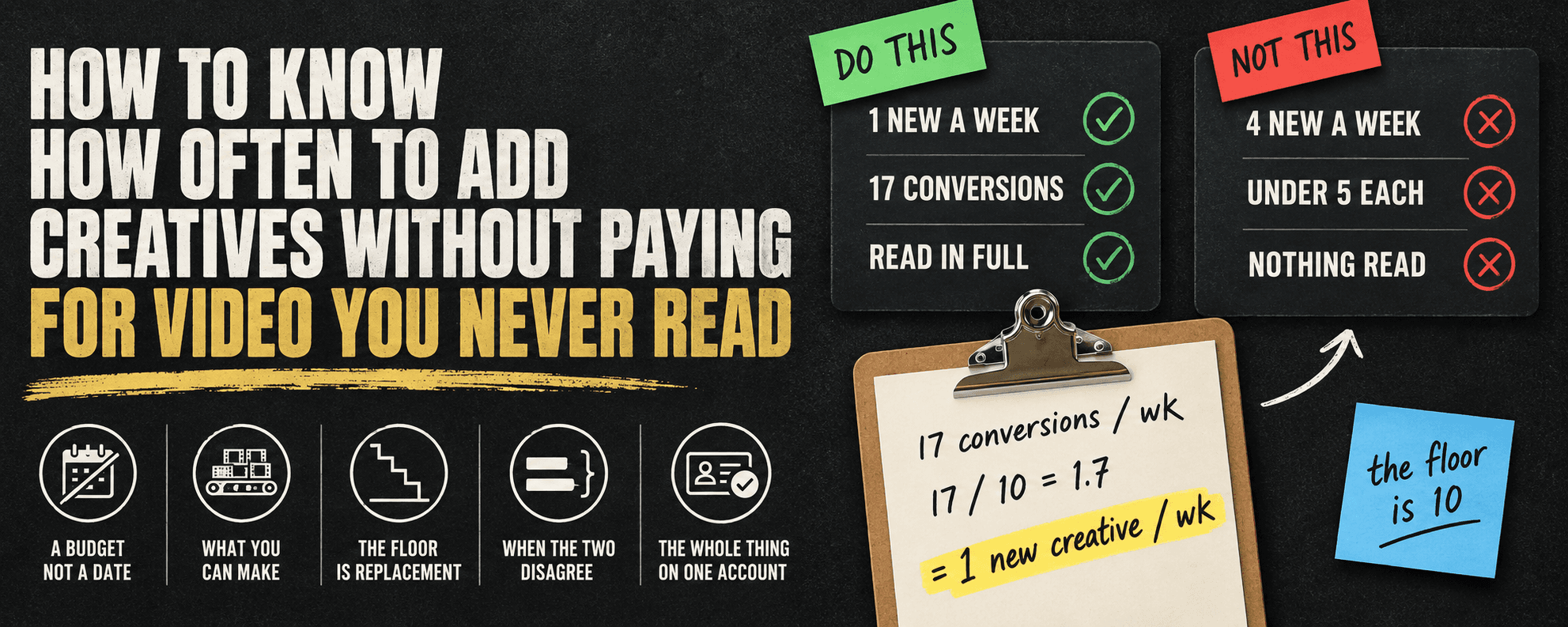
4 new creatives a week is a 40-conversion-a-week bill.
i went looking for where that number is supposed to come from and counted 45 people asking some version of the same question across 37 separate threads. the thing they have in common is that most of them supply their own candidate answer inside the question — once a week, ten at a time, a batch a month — which is what people do when they have never seen it worked out and are hoping somebody confirms the guess.
the question in their own words:
"how often should i add new creatives? once a week?"
"how often are you producing and testing new creatives?"
"how many creatives do you test at the same time?"
"do you batch a month of variants up front, swap one variable at a time, keep a swipe file, something smarter?"
"at what point did you stop worrying about budget and start worrying about whether your team could physically produce enough good creative to keep up?"
that last one is the same question arriving from the other side, and it gives the game away. the number is not a preference and it is not a discipline. it sits between two ceilings — what your budget can read and what your team can make — and almost nobody has worked out where either of theirs is.
so here is the whole thing, in the order to run it. two ceilings and one floor, about ten minutes with numbers already in your campaigns, and at the end you will have a number of new creatives per week that belongs to your account rather than to somebody else's. nothing is held back and there is no gate on any of it.
if you want to see the thing i'm building while you're here, it's the only ask in this piece: https://clear-cortex.com/early-access?src=x-how-often-top
The answer is a budget number, not a date
"once a week" is an answer shaped like a calendar. nothing about a week is meaningful to the system you are buying from, and there is no setting anywhere that cares what day it is.
what the calendar is standing in for is your budget. specifically: how many new creatives your spend can get a genuine read on before the week is out. a video that goes live and never accumulates enough results to be told apart from the one next to it has not been tested. it has been bought.
the arithmetic underneath that is settled and i am not going to re-derive it, because i wrote it out in an earlier piece: an ad set needs roughly fifty conversions a week for delivery to optimise properly, and dividing that across the creatives inside it means that under about ten conversions per creative per week you are looking at noise. take both as given.
turn them into a weekly number and you get the only formula here:
weekly conversions ÷ 10 = new creatives your budget can read
not a best practice, not a schedule, just a division. and the first thing it says is that the answer moves every time your spend or your cost per result moves, which is why nobody can hand you a number and why every answer in those threads was wrong for most of the people reading it.
one thread does the working on a specific account, and i am going to use their figure rather than invent one: "at $50 a day and a $20 cpa you're producing about 17 conversions a week."
seventeen conversions, divided by ten. that budget reads one new creative a week, and on a good week two.
so for that person "once a week" is very nearly right — not because a week is a unit, but because one is what seventeen conversions buys. run the same division on other budgets and the same phrase becomes badly wrong:
- $50 a day at a $20 cost per result — 17 conversions a week — 1.7 new creatives
- $50 a day at $46 — 7 conversions a week — 0.7
- $100 a day at $20 — 35 conversions a week — 3.5
- $150 a day at $25 — 42 conversions a week — 4.2
- $200 a day at $20 — 70 conversions a week — 7.0
the second line is the one to sit with. same $50 a day, a cost per result that is real and ordinary, and the budget cannot read even one new creative a week. it reads about three a month. somebody on that row who was told "once a week" is launching four times the video their spend can say anything about, and paying for all four.
and it divides again across your campaigns. the fifty is per ad set, which means the number above is per ad set too, and almost everybody reads it as if it were per account.
if your daily budget is split across three campaigns, or one campaign with three ad sets under it, you do not have one pool of seventeen conversions a week. you have three pools of six, and six conversions cannot rank anything at all. the read you thought you were buying was divided by three before any creative went live.
so before you calculate anything: count the ad sets the budget is actually spread over, and do the division inside each one. an account running $150 a day through five ad sets is, for the purposes of this question, five accounts running $30 a day — and five accounts at $30 a day can read nothing. consolidating is usually the cheapest way to raise your own number, and it costs nothing but granularity you were never able to read anyway.
The second ceiling is what you can actually make
the read side is a division. production is a supply chain, and it is quoted in months, because that is the unit everything in it is sold in — retainers, shoot days, batches, turnaround.
here is what the ceiling looks like when people state it plainly, each describing their own set-up:
"one of our dtc clients had the classic problem: prospecting budget sat there waiting, but we could only ship four creative variants a month because every test needed a new shoot, talent booking, and edit cycle."
"for a while we paid a ugc agency around 4k a month for maybe 12 to 15 videos, which sounds fine until you realize half of them never beat the control and you're basically paying for swings."
"austin boutique studio: $6,500/mo, beautiful deck, 4-week turnaround per batch which is a non-starter when we iterate weekly."
"the answer i landed on after $6,800 on a 2-month agency trial that shipped 9 assets, 4 unusable."
put all of those in the same unit as the read side:
- in-house, every test needs a shoot — 4 videos a month — 0.9 a week
- ugc agency retainer, ~$4,000 — 12 to 15 videos a month — 2.8–3.5 a week
- $6,800 over two months, 9 shipped and 4 unusable — 2.5 usable a month — 0.6 a week
- an editor hired on a volume brief, "25+ finished videos per month" — 25 a month — 5.8 a week
two things fall out of that list and both matter more than the numbers.
the unusable ones do not count. nine assets for $6,800 is $756 each, which sounds survivable. five usable videos for $6,800 is $1,360 each, and five over two months is 0.6 a week — a pace at which a four-creative test takes seven weeks to assemble. the person who wrote that line had already done this arithmetic, which is why they wrote "4 unusable" rather than "9 shipped". the ugc retainer has the same problem stated as an outcome rather than a defect: "half of them never beat the control."
and turnaround is invisible in a monthly number. $6,500 a month at a four-week turnaround per batch is not a steady supply of video; it is one delivery, once, at the end of the month. the monthly figure and the weekly figure agree on paper and the campaign still starves for three weeks out of four. when you write your own production ceiling down, write the delivery pattern next to it, not just the total.
there is also a floor on what production is worth buying at all, and somebody states it straight: "if you're at less than about 15 creatives a month it's honestly not worth the subscription, just pay a creator." that is a purchasing rule derived from the same ceiling logic, arrived at independently, by somebody counting their own output.
The floor is replacement, and it is not zero
both ceilings are about how fast you can go. there is also a number below which you are going backwards, set by how long the winners already running keep working.
the corpus is full of people watching that clock:
"is a week of creative lifespan normal at this spend level?"
"ads work great for a week or less, then they just stop converting for 3 days or more if i leave it running."
i want to be careful here, because i have written a whole piece arguing that most of what gets called creative fatigue is not fatigue — it is a small conversion count arriving at its average, the auction getting more expensive, or somebody editing a live ad. somebody in the corpus puts it harder than i did: "creative fatigue is one of the most overused diagnoses in facebook advertising and it's causing people to waste money on new content they don't need." so assume the diagnosis has been done properly and you genuinely are replacing winners that have genuinely stopped winning.
then replacement is another division:
creatives live at once ÷ weeks each one lasts = new creatives a week just to stand still
four live, each lasting four weeks, is one new video a week — every week, forever — before you have tested anything. four live at six weeks each is 0.67. two live at four weeks is 0.5.
everything above that floor is the only part that is actually a test. which produces the most uncomfortable result in this article: an account whose whole output goes into replacement is not testing, it is maintaining. it will feel busy, the calendar will be full, video will arrive every week, and the account will learn nothing new for as long as it goes on.
it is also the honest reading of the pressure everybody feels from posts like this one: "the brands keeping cac in check since ios are shipping more ad creative per week than their competitors." probably true, and useless as an instruction, because it does not say whether their extra video is buying reads or just covering decay. those are opposite situations wearing the same weekly number.
When the two ceilings disagree
they usually do, and the lower one decides everything you do next. there are four situations and people reliably act on the wrong one.
production above what the budget can read. you can make fifteen videos a month and the campaign can read four. this is the expensive one, and it is the one the tooling conversation encourages, because everything sold into this problem sells production. the symptom is a queue: creatives launched together, none with enough results behind it to rank, a screen of rows with different numbers on them because rows always have different numbers on them. you are paying full price for video and full price for the media carrying it, and buying a verdict on neither. the fix is not to make less — it is to launch less at once, stagger the rest, and put the surplus production money into fewer, better videos.
budget above production. the campaign could read six a week and one arrives. this is the situation behind "prospecting budget sat there waiting" and behind that second question entirely — the point where spend stops being the constraint and the team becomes it. here the idle asset is the money, and the honest options are to buy capacity, lower the bar for what counts as a new creative, or accept a slower pace and stop calling the delay a strategy.
both below the replacement floor. you can read one a week, make one a month, and four live creatives at a four-week life need one a week to hold position. that account is declining on a schedule and no testing framework touches it. the move is to cut the number of live creatives until replacement fits inside production — two live at four weeks needs 0.5 a week — which also raises the read on each survivor, because the same conversions now split two ways instead of four. one lever, pulled once, helping in both directions.
both fine, and it is the same idea four times. four variations of one concept do not buy four reads. they rise and fall together, because to the person scrolling past they are the same ad, and they saturate on the same day. i argued the concepts-before-variations case in an earlier piece and won't re-run it; the version that matters here is that variations are cheaper to make and worth less per unit, so a production ceiling stated in videos per month flatters you if most of them are variants. count concepts when you work out what the budget can read, and count everything when you work out the bill.
the general rule is worth writing on something: the binding ceiling is the lower of the two, and the only work that changes anything is work on that one. buying a tool that triples output when the campaign reads four a month changes nothing except your monthly outgoings. raising the budget when nothing new is being made changes nothing except how fast the existing video burns.
The whole thing on one account
take the account from the first section, because its numbers are real and somebody else's: $50 a day, a $20 cost per result, about 17 conversions a week, all of it in one ad set.
- what the budget can read: 17 ÷ 10 = 1.7 new creatives a week.
- what the team can make: four a month, every test needing a shoot. 0.9 a week.
- binding ceiling: production, at roughly one a week.
- live creatives: four, and being honest about lifespan, call it four weeks each.
- replacement floor: 4 ÷ 4 = 1.0 a week.
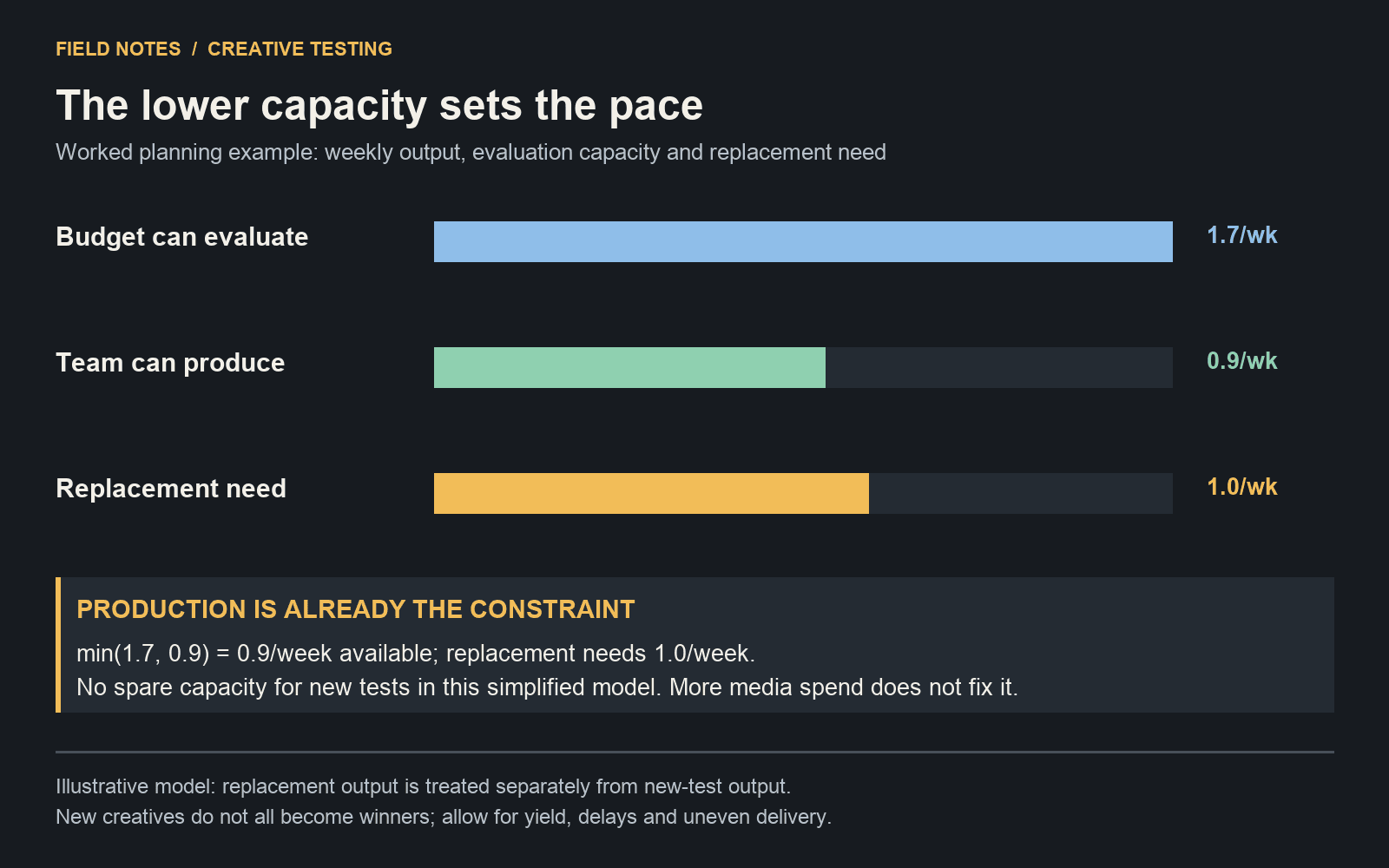
Planning illustration, not a throughput guarantee. Production is below replacement demand; more media spend alone cannot close that gap.
so this account can make about 0.9 a week, has a planning allowance to read 1.7, and needs one a week to stand still. its entire creative output is consumed by replacement, and its genuine testing rate is zero. everything it produces goes into holding the position it already has. a year of that is a year of video, a year of invoices, and nothing learned.
that is not a reason to stop advertising. it is a reason to stop calling it testing, and the next moves should address the constraint we actually found:
- run two live creatives instead of four. replacement drops to 0.5 a week, leaving about 0.4 a week of production capacity for new tests in this simplified model. if results were equally distributed, the two survivors would average 8.5 conversions each instead of 4.25; that is still below the draft’s ten-result planning allowance. this is free, and it is the move nobody makes, because going from four live ads to two feels like retreating.
- address production capacity. it is already the binding ceiling: 0.9 a week against a planning allowance of 1.7. improve usable output or delivery reliability, then check whether the extra output becomes effective replacements or useful tests.
- raise media spend only when evaluation capacity becomes the constraint. moving to $100 a day raises the planning allowance to 3.5 a week but leaves production at 0.9. it does not solve the bottleneck in this example.
now watch the ceiling swap as you scale, because this is what makes "once a week" permanently unanswerable. take the same account to $200 a day at the same $20 cost per result: 70 conversions a week, reading 7 a week. production is still four a month. the planning allowance is now about eight times production, the money is doing the waiting, and production remains the constraint it was before the increase. nothing changed because anyone decided it should. the arithmetic under it changed.
this is also why scaling the budget and scaling the creative have to be planned together and almost never are. every increase in daily spend raises what the campaign can read, and if production does not rise with it you have converted a testing problem into an idle-money problem and called it growth. the honest version of a scaling plan has two columns: what the new budget can read, and what the team will actually ship that month.
which gives the answer to the question. at the budget most people asking it are running, once a week is roughly right — for a reason that has nothing to do with weeks. it is right because ten conversions is what one creative costs to read, and ten conversions a week is about what a small daily budget produces. the moment your spend, your cost per result, the number of ad sets you split across, or your production changes, do the division again. the calendar was never involved.
The part i cannot prove
the fifty-conversions figure is platform mechanics and the ten-per-creative floor is arithmetic on top of it. i published both in an earlier piece and neither is my measurement. i do not run an account at this spend, and if i implied otherwise the first person to ask which one would be right to.
everything numeric after that belongs to somebody else — the $50 a day at a $20 cost per result, the four variants a month, the $4,000 retainer for 12 to 15 videos, the $6,800 that produced five usable assets. they are real, they are individual accounts, and four accounts is enough to work an example and nowhere near enough to be a benchmark. put your own numbers in; the whole calculation is two divisions.
and there is one thing i genuinely do not know, which somebody asked plainly and nobody in the thread answered: is a week of creative lifespan normal at a given spend level? the replacement floor above is only as good as that number, and i have no distribution for it — no sense of whether a winner typically lasts one week or six, or how hard that moves with budget, audience size or category. every lifespan figure in here is one person's account. if you have run the same video long enough to know your own answer, that number is worth more to me than anything in this piece.
if any of the above is wrong, say so — that is more use to me than agreement.
i'm building the version of this where the brief, the video and what came back sit on one canvas, so the thing you are deciding about still has its reasoning attached three weeks later. if you want to see it when it lands: https://clear-cortex.com/early-access?src=x-how-often-end
the campaign side of it is here: https://clear-cortex.com/use-cases/ai-ad-creative