 Clear Cortex
How to fix a stuck account without burning another month on tweaks
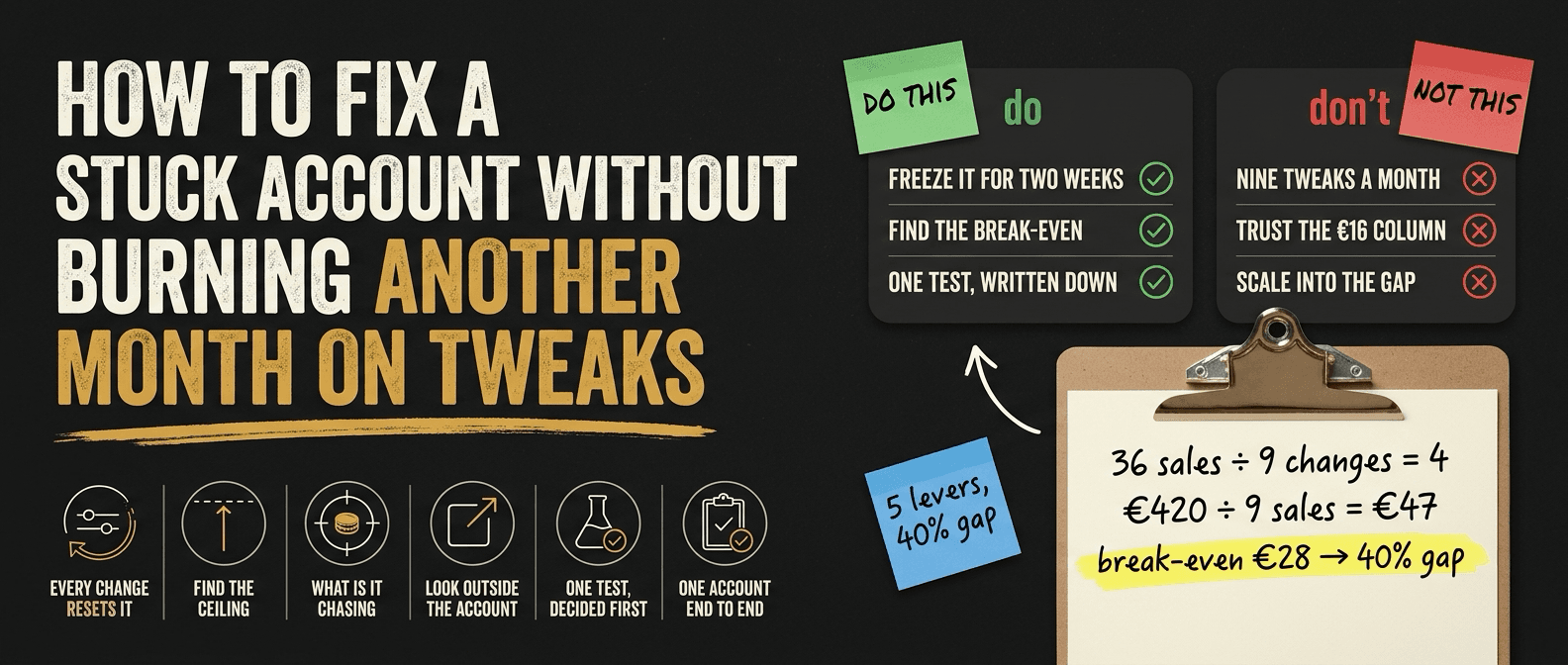
5 levers pulled, and the cost per sale didn't move.
i went looking for what people do when a campaign is stuck, and counted 18 versions of the question across 16 separate threads. what stood out was what was missing from them. seven of the 18 ask which suspect it is from a list — the creative, the audience, the targeting, the page — and six of those end on "or something else". only 4 of the 18 put the offer, the price or the product on the list at all. nearly everybody stuck is still searching inside the ad account, for one more setting to change.
here is how they put it:
"what do you do when you've gone through the usual optimization checklist and performance still isn't moving?"
"but what about those stubborn accounts where performance never feels good enough?"
"what's your go-to first diagnostic when a campaign stalls?"
"is it usually the creative, the offer, the audience, the landing flow, or something else?"
"is this most likely self inflicted (budget/ad churn disrupting the learning phase), or could something else explain…"
the usual answer to all of these is a longer checklist. more tweaks, less obvious ones, another new video, an analysis you have not run yet. that advice is wrong, and on a stuck account it is the thing costing you money. every lever you pull is a change the campaign has to relearn from, so a month of pulling them is a month of budget spent on reads that never come clean. and the checklist is built to move the last ten percent of a cost per purchase. when a campaign is stuck, the gap is almost never ten percent. it is the size of something that sits outside the ad account, where nothing on the checklist reaches.
so here is the whole thing, in the order to run it. count the changes, work out the cost per sale the campaign cannot beat, check what the bidding is actually chasing, look outside the ad account for something the size of the gap, and replace the checklist with one test. then one account, worked end to end, on meta or google alike. most of it is arithmetic on numbers you already have, and none of it is another tweak or another video of the same idea. nothing is held back and there is no gate on any of it.
the cover on this piece was made in clear cortex for about 8p, on the cheapest model that could spell the headline. that's the studio i'm building, and it's the only ask in this piece: https://clear-cortex.com/?src=x-stuck-account-top
Every lever is a change the account has to relearn
start with the checklist itself, because it is doing more damage than it looks like.
the question at the top lists it. the routine is targets and bids, locations, search terms, moving budget towards the stronger campaigns, and testing a new creative — usually a new video. five levers, and every one of them is sensible. pulled once, on purpose, with the results read afterwards, any one of them can help.
pulled in rotation on a stuck campaign, they do something else. both platforms say in their own documentation that a significant edit — a new bid target, a change to what the campaign optimises for, and on meta a big budget change or a new ad — sends the bidding back into a learning period while it recalibrates. so every change resets the clock you were about to read the last one on.
that is how a campaign gets stuck in the first place, and people describe it without quite naming it. one person running a small beauty brand on $10 a day had a new video from the same creator as their best ad, and it opened as well as the original: "the first week looked great, CPP $2.81 to $2.85, ROAS 9 to 10x, as good as the original's best weeks." then "over 4 days, CPP roughly tripled to ~$9, ROAS dropped to ~3x." and then the line that explains most of it:
"around the same time i was actively editing the account: bumped the daily budget up to $14 over a couple edits then walked it back down, and tested a carousel ad in the same ad set for a few days (barely spent, 1 sale, paused it)."
three edits to the budget and the ads in a few days, on a campaign making one or two purchases a day. maybe the new video faded. maybe the edits knocked the delivery off. the honest answer is that nobody can tell, including them, because the edits and the drop happened in the same week. that is the real cost of a tweak on a stuck campaign. not that it made things worse — that it made the next read impossible, and the budget spent that week bought nothing you can learn from.
another person had pulled most of the same levers and got the same result: "i've tried budget tweaks (+20% scaling), new creatives, and different bidding strategies without much success." a third had got as far as the right question and stopped at it: "should i consolidate the account to 4–6 proven creatives and stop making changes, or continue introducing new creatives?"
stop making changes is the right half of that. here is the check that tells you how badly you need to.
- pull the change history for the last 30 days. google and meta both keep one. count every edit to a bid or target, a location, a keyword or audience, a budget, an ad.
- count the purchases in the same 30 days. real ones, from your shop or your CRM, not the platform's conversion column. the next section is about why.
- divide purchases by changes. that is how many purchases of evidence each setting got before the next one replaced it.
if that number is in single digits, nothing on your list was ever read. every tweak was a guess, overlapping with the guess before it, and the campaign has spent a month of budget learning from settings that kept moving. the first fix is free: freeze it. no edits for two weeks, whatever the daily numbers do, so that you have one stretch of data where the campaign is not changing underneath you.
the freeze does not fix anything on its own. it gives you a clean baseline, which you need for the next two checks.
Find the cost per sale the account cannot beat
every campaign has a cost per purchase it cannot go above and still make money, and most stuck campaigns are stuck because they are above it by more than any tweak can close.
the number is your break-even cost per sale: what is left of an order after the product, the shipping, the fees and the returns. one single-product skincare brand wrote theirs out in two lines: "since my aov is stuck at ~38€ with no upsells until the range lands, i'm worried meta won't be profitable yet." and "gross margin is roughly 26-28€ before any ad spend." that brand can pay about €27 for a sale and break even. not €28. no amount of optimisation changes that number, because it is not in the ad account.
then work out what the campaign is actually paying. cost per sale is cost per click divided by the share of clicks that buy. at €1.20 a click and 2.5% of clicks buying, a sale costs €48. at €0.90 and 3%, it costs €30.
now put the two together. the gap between what you pay and what you can afford is the size of the problem, as a percentage:
- under about 10%, the checklist is the right tool. a better bid target, some negative keywords, budget moved to the stronger campaign — those are levers that move a cost per sale by a few percent, and a few percent is what you need.
- over about 30%, nothing on that list closes it. to take €48 down to €27 you would need clicks 44% cheaper or a conversion rate 78% higher. nobody gets that from location exclusions, or from one more video of the same idea.
this is the thing the checklist hides. it treats every campaign as slightly under-optimised, when a stuck one is usually a long way above its ceiling, and the ceiling was set before the first ad spent anything. one reply to a jeweller asking why their campaign capped at about one sale a day said it more bluntly than i would: "there's no ceiling to break through here, there's just a budget that buys exactly one conversion."
it is also why moving budget towards the stronger campaign so often makes things worse rather than better. a campaign above break-even loses money on every purchase, and more budget buys more purchases. scaling spend into it scales the loss. one post put it as a warning: "facebook advertising functions primarily as an amplifier, meaning that if your backend conversion funnel, scaling cadence, or creative rotation has hidden flaws, throwing a larger budget at the system will simply multiply your losses."
so before you pull another lever, write two numbers down: what a purchase costs you now, from a period where you did not touch the campaign, and what a purchase is worth after costs. if the gap is small, carry on with the checklist, slowly, one change at a time. if it is large, the rest of this piece is where the answer is.
Check what the bidding is actually chasing
there is one case where the gap looks small and is not, and it is common enough to check before you believe either number.
the cost per sale in the ad account is not a cost per sale. it is a cost per whatever you told the account to count as a conversion. if that is purchases and only purchases, fine. if it is purchases plus add to carts, or sign-ups plus trials plus paid subscriptions, the platform is reporting a cheap blended number, and its bidding is chasing the cheap events because they are the easiest way to hit your target.
one person running google ads for a software product wrote the whole pattern up. the title was the finding: "your google ads account can be 'winning' while your business is losing". their funnel was "search, register, trial, paid", and the problem was in what got counted: "but 'conversion' in our case was a mix of signups, trial starts, and actual paid subscriptions." the campaign looked optimised against a number that counted people who registered the same as people who paid. and then a question that belongs on every stuck account: "makes me think: how many accounts are 'performing' on metrics that stopped mattering?"
the lead version of this is worse, because it hides for longer. somebody running ads for a solo lawyer posted "client fired me over 'lack of qualified leads' but i was hitting ~$50 CPL." by their own read, "by any CPL benchmark i know for this vertical, ~$50 is fine-to-good." the campaign was hitting its target. the target was leads, and the client was paying for cases. their own second-guessing landed on exactly the right question: "should i have refused to scale until signed-case tracking existed?"
this is why the checklist feels like it is working while nothing changes. every tweak on it is tuned against the conversion column. if the column counts the wrong thing, each tweak improves the wrong thing, the platform reports progress, and the bank balance does not move.
the check takes about ten minutes:
- list every action counted in the conversions column. on google ads, the ones marked primary are the ones the bidding chases. on meta, it is the event the ad set optimises for.
- compare the platform's count to your own for the same 30 days. orders in the shop, paid customers in billing, signed clients in the CRM. if the platform reports three times as many conversions as you have purchases, it is spending your budget bidding for something else.
- make the money event the one it bids for, or feed the real outcome back where you can. if the money event is too thin to bid on, say so to yourself, and read every result against your own purchase count rather than the column.
expect the reported cost per conversion to get worse the day you fix it. nothing has got worse. the number has stopped flattering you, and for the first time the gap from the last section is real.
Look outside the account for something the size of the gap
once you have a clean cost per purchase and an honest break-even, the gap is a fact. if it is large, the question is no longer which setting to change. it is what is big enough.
this is the part the 18 questions mostly skip. seven of them list suspects, and the lists are mostly inside the ad account — creative, audience, targeting, retargeting, the learning phase. one person, who was selling ad angles as it happens, asked it the right way round: "would faster ugc angle testing actually help media buyers find better hooks, or is the bigger bottleneck usually the offer/page once clicks are already coming in?"
the things big enough to close a 40% gap almost all live outside the ad account:
- what an order is worth. a bigger order raises the most you can pay for a sale. bundles, multi-packs, a threshold for free shipping, an add-on at checkout. the €38 skincare brand above had already found the wall: "it's hard to justify a higher price, and i have nothing else to bundle with it yet." that is the real constraint on that brand's spend, and it is a product decision, not a campaign one.
- the price. a price rise of a few euros goes straight into the break-even, and on a stuck campaign it is often the single biggest lever available. it is also the one nobody puts on the checklist, because it is not in the ad account.
- the offer. a guarantee, a trial, a starter size. anything that changes the reason a stranger would buy the first time.
- which product leads. if one product cannot clear its own cost per sale, a different product leading the ads might, with the first one sold to people once they are customers.
- the page after the click. if clicks are healthy and few of them buy, the gap may sit between the click and the checkout. that is its own diagnosis, and i wrote it up separately. here it is enough to say it is outside the ad account too.
and the one lever inside the ad account that can move a gap this size is a genuinely new reason to buy. not a new version of the same video, not a new hook on the same argument — a new video making a different argument, for a different buyer, about a different problem the product solves. a creative like that can change who clicks, which changes the conversion rate, which is the half of the sum the bid and budget tweaks barely touch. on meta especially, where the targeting is mostly the creative now, it is the closest thing to a new audience you can buy.
you do not need all of these. you need the one that is big enough. take the gap from the last section and price each candidate against it. a bundle that most buyers will never take does not close a 40% gap. a price rise that does close it, if purchases hold, is worth testing first.
Replace the checklist with one test
the checklist fails on a stuck campaign for two reasons: each tweak is too small for the gap, and pulling several at once makes every result unreadable. the replacement fixes both. one change, big enough for the gap, held long enough to read, with the decision written down before it starts.
somebody asked it as a question — "how do you decide whether a ppc test is worth running before you launch it?" — and answered it themselves with a list of the decisions a test should be attached to, among them "keep or kill an offer angle", "rewrite the landing page around a different pain" and "stop chasing a low-intent keyword". then: "without a decision attached, the test becomes more reporting work." that is exactly what a month of checklist optimisation is. reporting work.
here is the test, written down before it runs:
- the gap. what a purchase costs you now, from the frozen baseline, and what it is worth after costs.
- the one change. a price, a bundle, an offer, a new video with a different argument. picked because it is big enough to close the gap if it works, not because it is easy.
- what it has to show. turn the gap into a number you can count. at least 44% of orders are the bundle is a test. see if the bundle helps is not.
- how many purchases before you read it. if you sell nine a week, a month gives you about 36. that is enough to tell "about half" from "about a quarter". it is not enough to tell 44% from 38%, and you should know that before you look.
- what you will do either way. if it clears the line, keep it and scale. if it does not, the next test is the next candidate on the list, not five small tweaks.
and while it runs, nothing else changes. no bid edits, no new locations, no budget moves. the whole point is that this time the campaign spends its budget learning from one thing.
if the one change is a new reason to buy, the video that carries it should not need a shoot. this is how to make one from the product photo you already have: https://clear-cortex.com/playbooks/how-to-make-an-ad?src=x-stuck-account-mid
One account, worked end to end
here is the whole thing on one account. the numbers are constructed to keep the arithmetic clean — they are not from an account i run, and not the skincare brand above — so put your own in.
a shop sells one kitchen product at €42. after the product, shipping and fees, €28 is left, so €28 is the most it can pay for a sale. it spends €60 a day across meta and google, €420 a week, at about €1.20 a click, which buys 350 clicks a week. the dashboard says 27 conversions a week at €16 each, comfortably under €28. the owner has spent four weeks working the checklist anyway, because the bank account says the campaigns are not making money.
step one, count the changes. the change history for those four weeks shows nine edits: the cost target lowered twice, two locations excluded, two rounds of exclusions on search terms and audiences, budget moved between campaigns twice, and one new video. five levers, nine pulls. the shop's own orders for the same four weeks: 36. that is four sales of evidence per change. none of the nine was ever read. they freeze the account.
step two, find the ceiling. from the shop's orders, not the dashboard: 9 purchases a week on €420 of spend is about €47 a purchase. against a €28 break-even that is a gap of 40%. to close it inside the account, clicks would have to fall from €1.20 to €0.72, or the conversion rate — 9 sales from 350 clicks, about 2.6% — would have to rise to 4.3%. no bid target or location exclusion does either. the four weeks of tweaks spent €1,680 against 36 purchases worth €28 each: about €670 more than they earned back, and no answer.
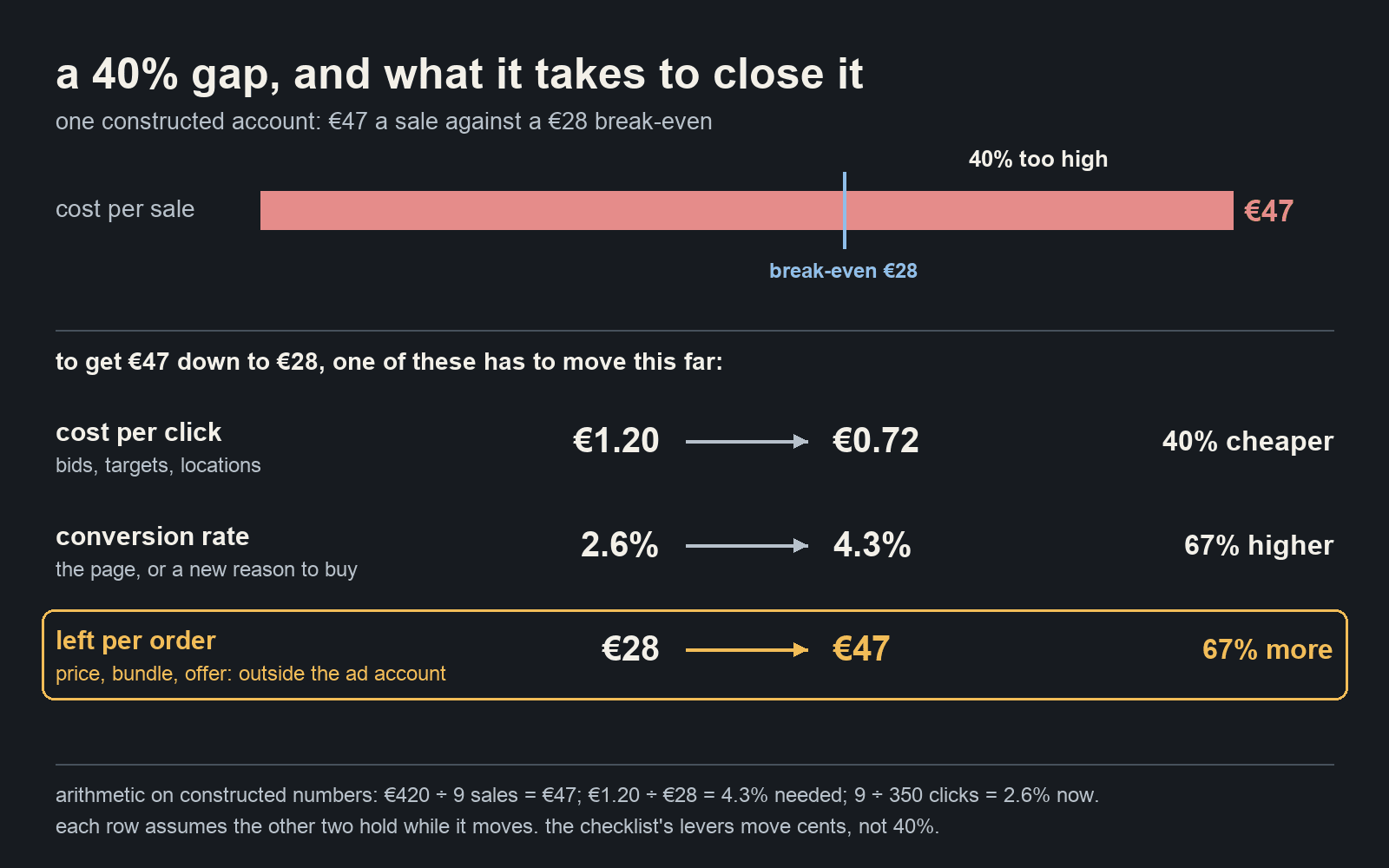
Arithmetic on constructed numbers, not a real account. Each row assumes the other two hold while it moves.
step three, check what the bidding is chasing. so why does the dashboard say €16? the 27 conversions a week are 9 orders and 18 add to carts — add to cart had been left counting as a conversion when the account was set up, and the cost target the owner kept lowering was a target on that blend. they make the purchase the only conversion the bidding chases, and the dashboard jumps from €16 to €47 overnight. nothing got worse. the number stopped lying, and it now agrees with the shop.
step four, look outside. the €28 is the thing to move. they cannot raise the price this month. they can add a three-pack at €105, which leaves €70 after costs. if every buyer took the single, an order is worth €28. if every buyer took the three-pack, it is worth €70. at the current €47 cost per order, the account breaks even when about 44% of orders are three-packs, assuming the number of orders a week holds.
step five, one test, written down first. the three-pack goes on the page, at the top, for four weeks. nothing else changes in the account. the line, written before it starts: at least 44% of orders are three-packs, at no more than €47 an order. about 36 orders to read it on.
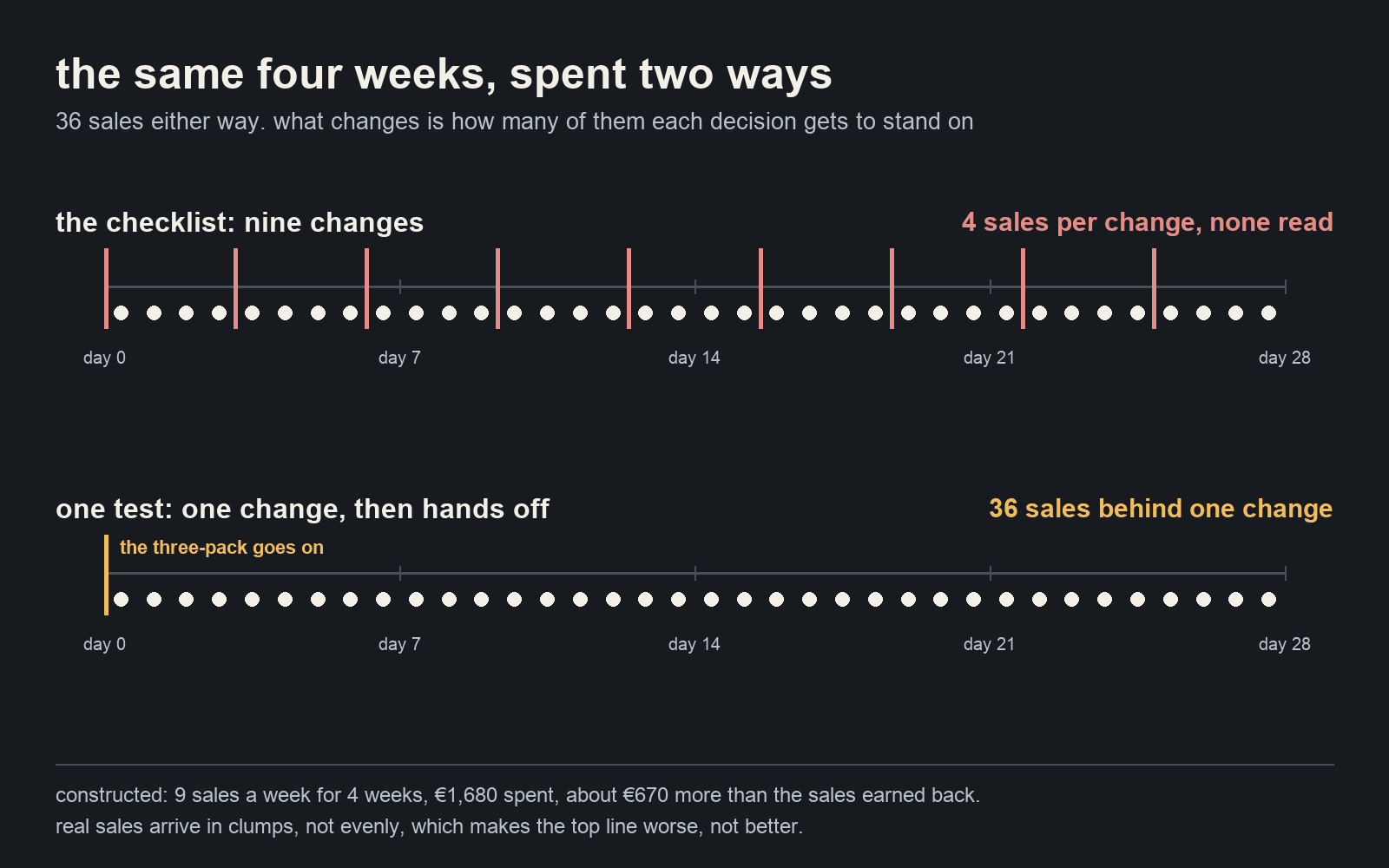
Constructed numbers. The sales are spread evenly here to make the point; real ones arrive in clumps, which makes the top line worse, not better.
the read, either way. if half the orders are three-packs, an order is worth €49, above the €47 it costs, and for the first time the account is worth scaling — and now the checklist is useful again, because the gap is a few percent. if a quarter are, an order is worth €38.50, still about €8 short, and the decision is already made: the bundle alone does not close it, so the next test is the price, a different product leading the ads, or a new video arguing a different reason to buy. what they do not do is go back to the five levers. those were never going to close 40%.
The part i cannot prove
the arithmetic is arithmetic: cost per sale is cost per click divided by conversion rate, break-even is what is left after costs, and a gap of 40% does not close with changes that move a few percent. that edits send the bidding back into a learning period is google's and meta's own documentation, not my measurement. the rest is ordinary practice — keep a change log, read one change at a time, count the money event. none of it is something i discovered, and i do not run a shop at this spend. the worked example is built for clean sums, not taken from an account.
the real figures in this piece are other people's, from what they wrote about their own accounts: the $2.81 that tripled to about $9 in the week the budget was being edited, the ~$50 lead that still got somebody fired, the €38 order with €26-28 left in it. i am taking their word for what happened, and in the first case nobody can know which of the edits or the creative did it. that is the point i used it for.
and there are two things i genuinely do not know. the 10% and 30% lines for when the checklist is the right tool are my judgement, not a measurement — somewhere between them is a grey zone, and i do not know where yours sits. and i cannot tell you how often a stuck account turns out to have no fix at all — a product that does not sell to strangers at any price this channel allows. if you have frozen an account, fixed the conversion signal, tested the offer and it still did not clear break-even, i would rather have your numbers than be right.
if any of this is wrong, say so. a correction is worth more to me than agreement.
once the test says what to change, the next creative should cost pence, not a shoot. that's what clear cortex does — test ads from a product photo, in minutes: https://clear-cortex.com/?src=x-stuck-account-end