 Clear Cortex
How to write for cold traffic without paying to reach the people who already know you
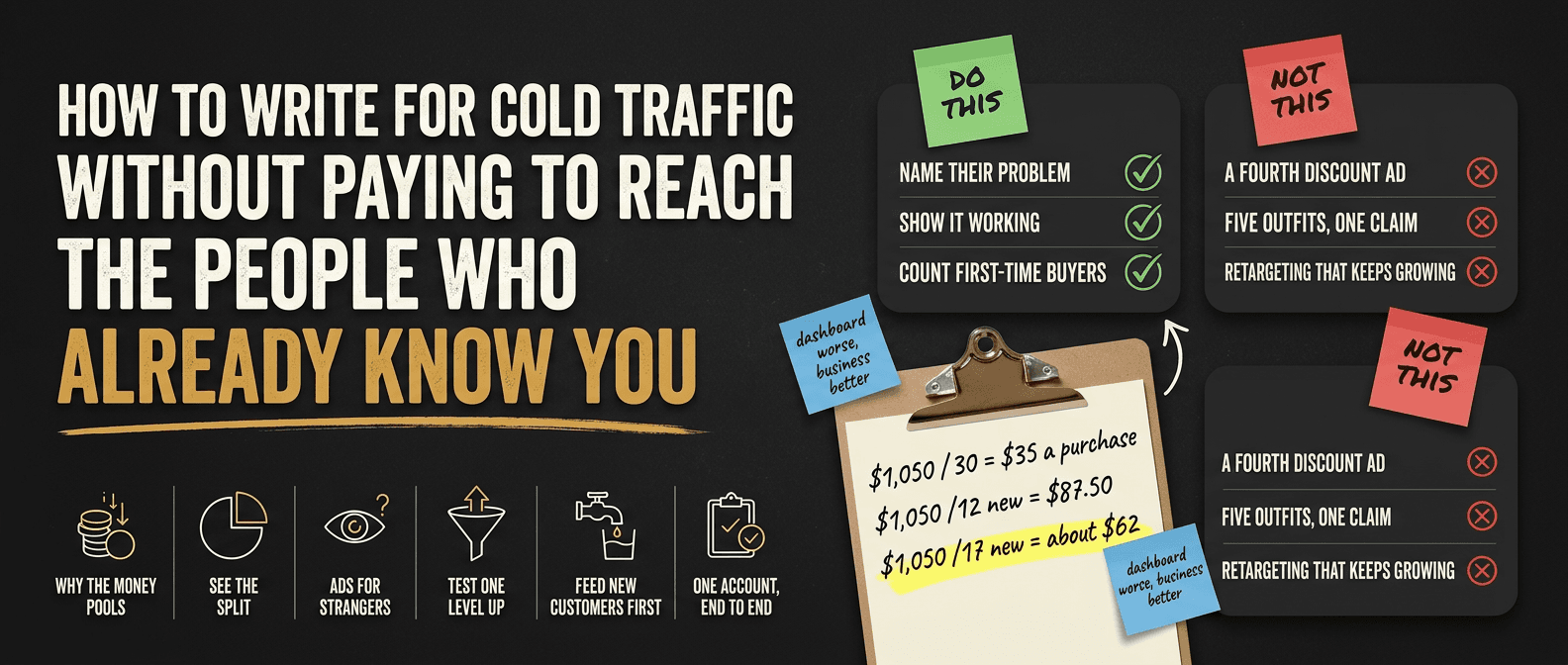
4 new ads a month. the prospecting budget sat waiting.
that was one small performance shop describing a client, and it is the most useful sentence i found on this. the money for reaching new people was there. the ads for reaching new people were not, "because every test needed a new shoot, talent booking, and edit cycle." i went looking for how people stop their spend drifting towards customers they already have, and counted 14 versions of the question across 13 separate threads. the thing i did not expect is how rarely the words for it turn up. retargeting and prospecting together appear 15 times in about 54,000 words of people describing their own ads. budget turns up nearly 400 times. nobody is asking a funnel question. they are asking where their money went.
it gets asked in a few shapes and it is one question:
"i know creative is a big driver of performance but what's the best way to structure it so metas not just solely focusing on retargeting?"
"what BOF concepts would you test next if discounts, testimonials and guarantees weren't moving the needle?"
"would you keep testing and iterating for a BOF creative concept that closes the sale, or is the TOF/BOF creative style distinction becoming less relevant with broad targeting and meta's current delivery system?"
"and what's actually working for you - better creatives, broader targeting, retargeting, or something else?"
"anyone tested cold vs warm with identical creative?"
the good news, and it is genuinely good news, is that this is one of the few problems in paid social where the fix is in your hands rather than meta's. spend drifts towards people who already know you for a mechanical reason, and the mechanism runs on the ads you give it. change what you give it and the spend moves.
so here is the whole method, in the order to run it. where the money is going and how to see it in about fifteen minutes, what an ad for a stranger has to do that an ad for a regular never does, why the next bottom-of-funnel concept to test is usually a top-of-funnel one, and how to set the account up so new-customer spend gets fed first. there is a worked example at the end with every number shown. nothing is held back and there is no gate on any of it.
the cover on this piece was made in clear cortex for about 8p, on the cheapest model that could spell the headline. that's the studio i'm building, and it's the only ask in this piece: https://clear-cortex.com/?src=x-prospecting-or-retargeting-top
Why the money pools with the people who already know you
start with what the delivery system is actually doing, because once it is clear the rest of this follows from it.
you give meta a budget and an event to optimise for, usually a purchase. it then spends that budget where it expects the next purchase to come from most cheaply. it is not trying to find new customers. it is not trying to find old ones either. it is trying to find the cheapest purchase, and it does not care which kind it is.
the cheapest purchase in almost every account is somebody who already knows you. they have been to the site, they have the product in a basket, they bought last year, they are on the email list. they need one nudge. a stranger needs to be told what the product is, why it matters to them, and why they should trust a brand they have never heard of — which is a lot more work for one video to do, and so a stranger costs more to convert.
put those two facts together and the drift is not a bug. an ad that works mainly on people who already know you will be spent mainly on people who already know you, because that is where it produces the cheapest purchases. broad targeting does not change that. it widens who can see the ad, and then delivery still goes looking for whoever the ad actually works on.
which means the ad is the instruction. the targeting settings used to decide who saw an ad. now the ad decides who responds to it, and delivery follows the response. i made the general version of that argument in the piece about letting the platform run the campaign, so i will not re-run it. the specific version that matters here is simple: if every ad in the account is written for somebody who already knows the brand, the account will spend on people who already know the brand, however broad the targeting is.
the person who ran the test in the last question above described doing exactly the thing that shows this: "got tired of arguing about creative, so i ran a clean test." the same ad, to a cold audience and a warm one, "30 days, real budget." their question afterwards was "did audience temperature dominate for you too?" — which is the right question. the same ad is two different ads depending on who is looking at it, and the warm version will nearly always look better.
and this is why a winner stops scaling. a video that wins at $50 a day and falls apart at $200 is often not a bad video. it is a warm one. at $50 a day there are enough people who already know you to fill the budget cheaply. at $200 delivery runs out of them and starts paying for strangers the video was never made for, and the cost per purchase jumps. scaling a warm winner is scaling into a pool that does not get bigger when you raise the budget. how to raise a budget on a winner is its own piece and i have written that one separately; the part that belongs here is the useful one — the videos that scale are the ones that work on strangers, because strangers are the only pool big enough to take the extra money.
that is also why the reported numbers mislead you in one consistent direction. retargeting takes credit for purchases from people who were already on their way. the returns look excellent, the budget flows towards the excellent-looking returns, and nobody new arrives. it is a very comfortable way to shrink.
How to see how much of it is going there
before changing anything, measure it. this takes about fifteen minutes and it is the step people skip, which is why the argument about retargeting goes round in circles — everybody has an opinion and nobody has the split.
one of the sharpest lists of questions i found was somebody asking what separates a real winner from a fake one. three of them are the whole measurement:
"did it bring new customers or cheap retargeting conversions?"
"did MER improve or only platform ROAS?"
"did backend revenue match platform reporting?"
here is how to answer each, cheapest first.
one: count first-time customers in the store, not purchases in ads manager. most store platforms can split orders into first-time and returning customers. take a normal week. divide the ad spend for that week by the number of first-time customers. that is your new-customer cost, and it is the number that tells you whether the ads are growing the business. put it next to the cost per purchase meta reports. if the new-customer cost is two or three times the reported one, the gap is people you already had.
two: ask meta to split it for you, where it can. meta lets you define who counts as an existing customer and who counts as engaged — a customer list, site visitors, people who have interacted with your pages — and on the campaign types that use those definitions you can break results down by them. the menus have moved more than once and will move again; the idea does not. if you can get a breakdown of spend and purchases by new versus existing, you have the split directly.
three: look at total revenue against total spend. that is what MER means — all revenue divided by all ad spend, from the store, not from meta. if reported returns go up and MER does not, the ads are claiming purchases that would have happened anyway. that is the most common signature of spend pooling at the bottom.
do one of the three this week. it does not matter which. what matters is that you stop reading the reported cost per purchase as if it described new customers, because the whole problem is that it does not.
one person looking back on what they had spent put the cost of skipping this in a single line: "$3,000 cost per new customer for a $2,000 annual subscription for a year was stupid, but 'we' had likes and clicks." a number that looked healthy on the dashboard, and a number that described the business, and nobody had put them side by side.
What an ad for a stranger has to do that an ad for a regular never does
once you can see the split, the fix is creative. not more creative — a different kind.
an ad for somebody who already knows you gets to skip the first three steps. they know what the product is. they know roughly what it costs. they have some opinion of the brand. so the ad can go straight to the last objection: a discount, a guarantee, a review from somebody like them, a reminder that the thing in the basket is still there. those are good ads. they are also ads that only work on people who are nearly there.
an ad for a stranger has to do the three steps the regular skipped, and it has to do them in the first few seconds of a video that nobody asked to see:
- say what it is. a stranger does not know. if the product is not identifiable in the video with the sound off and the logo covered, the ad is relying on recognition it has not earned.
- say who it is for, by naming their problem. not the brand's story, not the offer. the situation the buyer is in before they buy. somebody who has that problem stops; somebody who does not scrolls on, and that second part is useful — it is delivery learning who the ad is for.
- show it doing the thing. a demonstration carries more trust for a stranger than a claim, because it is evidence rather than assertion. a stranger has no reason to believe you yet; they have every reason to believe their own eyes. this is most of why ugc-style video works on cold traffic when it works at all: somebody like the viewer, using the thing, on a phone.
there is a quick test for whether an ad is built for strangers. show it to somebody who has never heard of the brand — or, failing that, cover the logo and the product name and watch the video muted. if you cannot tell within three seconds what is being sold and who would want it, it is a warm ad, whatever campaign it is sitting in.
the piece of the method that people get wrong most often is what to vary. that same shop found it the expensive way: "the outfit swaps, which is where most of their production budget had been going, did essentially nothing." a stranger does not stop for a different shirt. they stop for a different problem. so a new video for cold traffic is a new reason to care — a different situation named, a different buyer addressed — and the production should go on that rather than on dressing one idea five ways.
and each of those different reasons is, in effect, a different audience. with broad targeting the ad that names the gym problem finds the people with the gym problem, and the ad that names the gift problem finds the gift buyers. five genuinely different claims is five different pools of strangers the account can reach. five outfits on one claim is one pool, five times.
that is what makes this fixable rather than a matter of luck. you do not need the algorithm to change its mind. you need to give it ads that work on people who do not know you yet, and it will go and find them, because that is where those ads produce the cheapest purchases.
Why the next BOF concept to test is usually a cold one
now the bluntest version of the question, and it has a better answer than the one people expect.
"what BOF concepts would you test next if discounts, testimonials and guarantees weren't moving the needle?"
discounts, testimonials and guarantees are the three strongest closing arguments there are. if all three have been tried and none of them moves anything, the likeliest reason is not that the closing argument is wrong. it is that there is almost nobody left to close.
a bottom-of-funnel ad can only convert people who are already at the bottom of the funnel. that pool is filled from the top. if the account has been spending mostly on people who already know it, nobody new has been added for weeks, and the pool is the same people who have already seen every discount and every review. a fourth closing argument will not help, because the problem is the number of people it can be shown to.
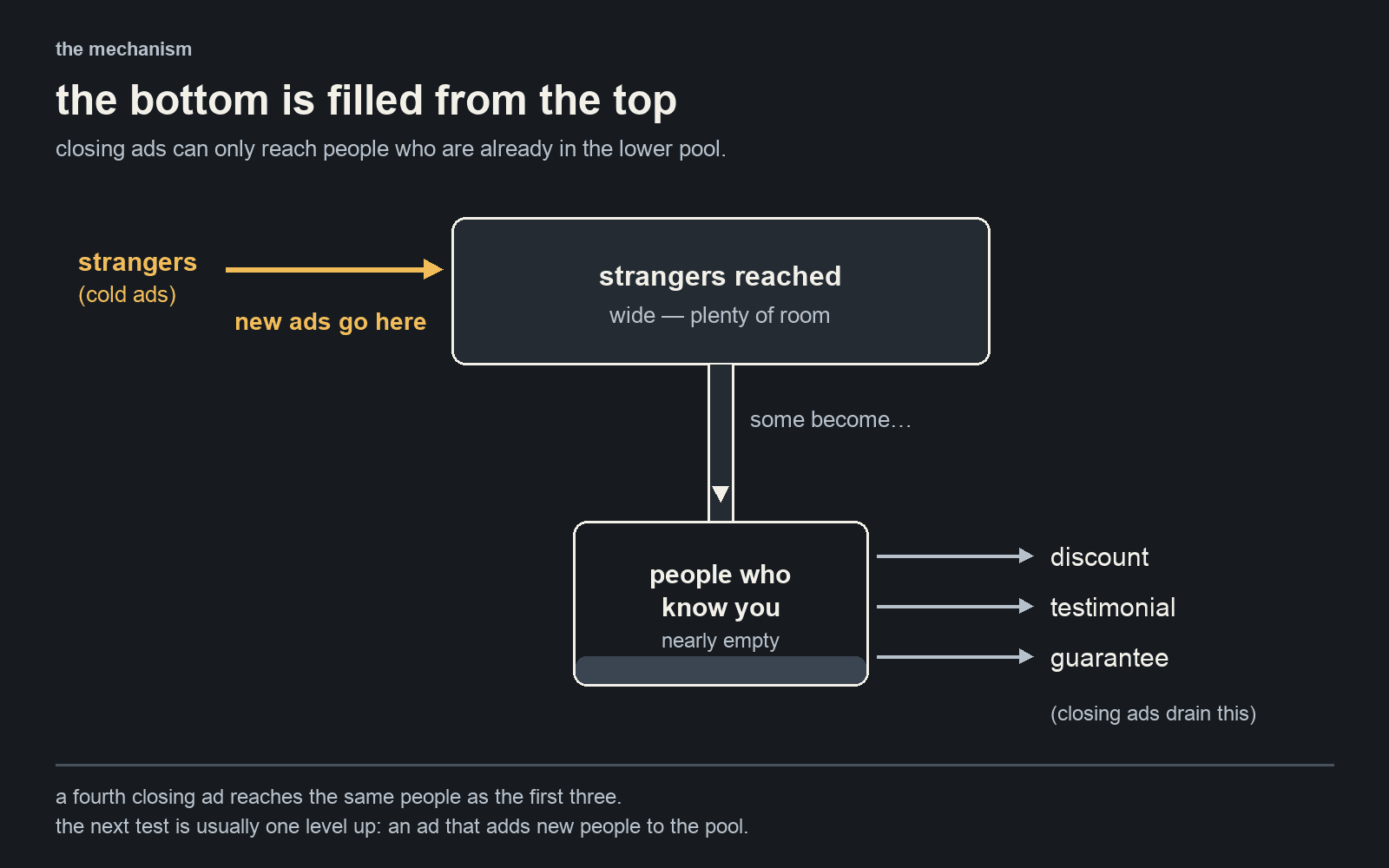
When closing ads stop working, the pool they draw on is usually what ran out.
so the next thing to test is usually one level up: an ad that brings new people into the pool, whose results you then read partly in next month's retargeting numbers. that is the positive version of the answer, and it is the one worth acting on. it also changes where the creative money should go. one creator-pricing post i read listed quotes for "60s testimonial for retargeting $350 to $1,200." that is the most expensive ugc video in the list, bought for the smallest audience the account has. a cheaper cold video that brings a hundred new people into the pool does more for the next testimonial than another testimonial does.
the second question in the same thread was whether the distinction still matters at all — "is the TOF/BOF creative style distinction becoming less relevant with broad targeting and meta's current delivery system?"
it matters more, and it has moved. it used to live in the audience settings: a cold ad set here, a retargeting ad set there. with broad targeting the settings mostly stop sorting people, so the sorting happens in the ad itself. the best one-line brief i found for this was written as a question about hooks: "who in the funnel is this actually for, and does the hook match where they are?" put that at the top of every brief and most of this article takes care of itself.
which also settles a worry that came up more than once — whether it is a bad idea to put a hard-selling ad and a cold one in the same place: "is it a bad idea to mix a hard-selling 'pricing' creative with a top-of-funnel 'curiosity' creative in the same ad set?" and its follow-up, "will the algorithm get confused about who to target?"
it will not get confused. it will do exactly what it always does, which is give most of the money to whichever ad produces the cheapest purchases this week — and that will usually be the pricing ad, because it converts the people who already know you. the curiosity ad will look worse on the number meta shows you. so either give it room somewhere the pricing ad cannot outbid it, or judge the two on different numbers: the pricing ad on cost per purchase, the curiosity ad on how many first-time customers arrive in the weeks after it runs. the mistake is reading them on the same line and killing the cold one for losing a race it was never entered in.
How to set it up so new-customer spend gets fed first
the last question is structure: "what's the best way to structure it so metas not just solely focusing on retargeting?" there are two honest ways, and which one fits depends on how much the account spends. whether you have the volume for a second campaign at all is its own question, and i have written that one separately; this section assumes you have made that call.
if you run one broad campaign, do three things.
- tell it who your existing customers are, and limit what it can spend on them where the campaign type offers that. some of meta's automated sales campaigns have carried a setting for the share of budget allowed to go to existing customers; where it exists, it is the most direct lever there is on this whole problem. if the campaign you are running does not offer it, exclude a list of recent purchasers instead.
- make most of the ads in it cold ads. if eight of the ten ads are discount and review ads, the campaign is a retargeting campaign with broad settings. a rough starting point is the reverse: most of the ads built for strangers, one or two built to close.
- read it on new-customer cost, never on reported cost per purchase alone. the reported number will get worse when this starts working, because you are now paying for strangers instead of regulars. that is the fix showing up, not failing. the worked example below shows exactly how.
if you run separate campaigns for new and existing people, do the opposite of what the returns tell you to.
- size retargeting by how many people are in the pool, not by how good its returns look. its returns will always look best, because it is standing at the finish line taking credit. a small fixed budget, not one that grows every time it reports a good week.
- keep the two apart properly. exclude recent buyers and warm lists from the new-customer campaign so it cannot quietly spend on them, and do the same housekeeping the other way — one media buyer described it as "stratifying retargeting lists based on custom conversion data to avoid wasting budget on converted users."
- give the new-customer campaign the creative first. new videos go there. the retargeting campaign can run the proven closers for months; it is reaching the same small group and needs far less.
the shop in this piece could ship four ads a month because every one needed a shoot. this is the version without the shoot: https://clear-cortex.com/playbooks/how-to-make-an-ad?src=x-prospecting-or-retargeting-mid
then the question somebody asked about a win-back campaign — "is it wise to spend on retargetting like this?" — has a checkable answer rather than a feeling. it is wise at the size of the pool. once the retargeting budget is bigger than the pool can use, the extra money is paying for purchases that would have come anyway.
and back to the four-a-month shop, because this is where their sentence pays off. their prospecting budget sat waiting because cold videos were the scarce input and every one of them needed a shoot. that is the constraint worth fixing, and it is cheaper to fix than it used to be: the ads that feed prospecting have to be different claims, not polished ones, so they do not need a production cycle each. an account that can make fifteen genuinely different cold videos a month has somewhere to put new-customer budget. an account that can make four will find its money sitting in the one place its ads work — with the people who already know it.
The whole thing on one account
here is the method run end to end. the numbers are constructed to be arithmetically clean; the shape is the one the threads describe.
an online store spends $150 a day on one broad campaign, $1,050 a week. ads manager reports 30 purchases a week, a cost per purchase of $35. it looks fine. the owner has been told to scale it by raising the budget.
step one, the split. the store's own order report for the same week shows those 30 orders were 18 returning customers and 12 first-time ones. $1,050 divided by 12 is $87.50. so the account is paying $35 per purchase on the dashboard and $87.50 for each new customer, and the first order of a new customer makes the store about $30. scaling this campaign as it stands would buy the same returning customers faster, which is why the dashboard would look good and the bank balance would not.
step two, the creative. of the eight ads running, six are discount, review and guarantee videos and two are product demos. that is a retargeting campaign with broad settings. three new cold videos get made — three different problems the product solves, each showing the product doing it, each passing the logo-covered test. two of the six closing ads get switched off.
step three, the setting. a list of everyone who bought in the last 180 days goes in as existing customers, and where the campaign offers a cap on existing-customer spend, it gets set low. the daily budget stays at $150. that is two changes in one week, the creative and the setting, so the read will not say which of them did the work — only whether the pair did. keeping the budget flat stops it becoming three.
step four, the read, three weeks later. suppose ads manager now reports 25 purchases a week, a cost per purchase of $42. on the dashboard that is worse, and this is the moment most people undo the change. but the store's own report shows 17 of the 25 are first-time customers. $1,050 divided by 17 is about $62. the reported number went up by $7 and the number that describes the business came down by more than $25.
that is the whole trick of this problem in one line: the fix makes the dashboard look worse and the business better, and unless you are counting first-time customers in the store, you will read it as a failure and switch it off.
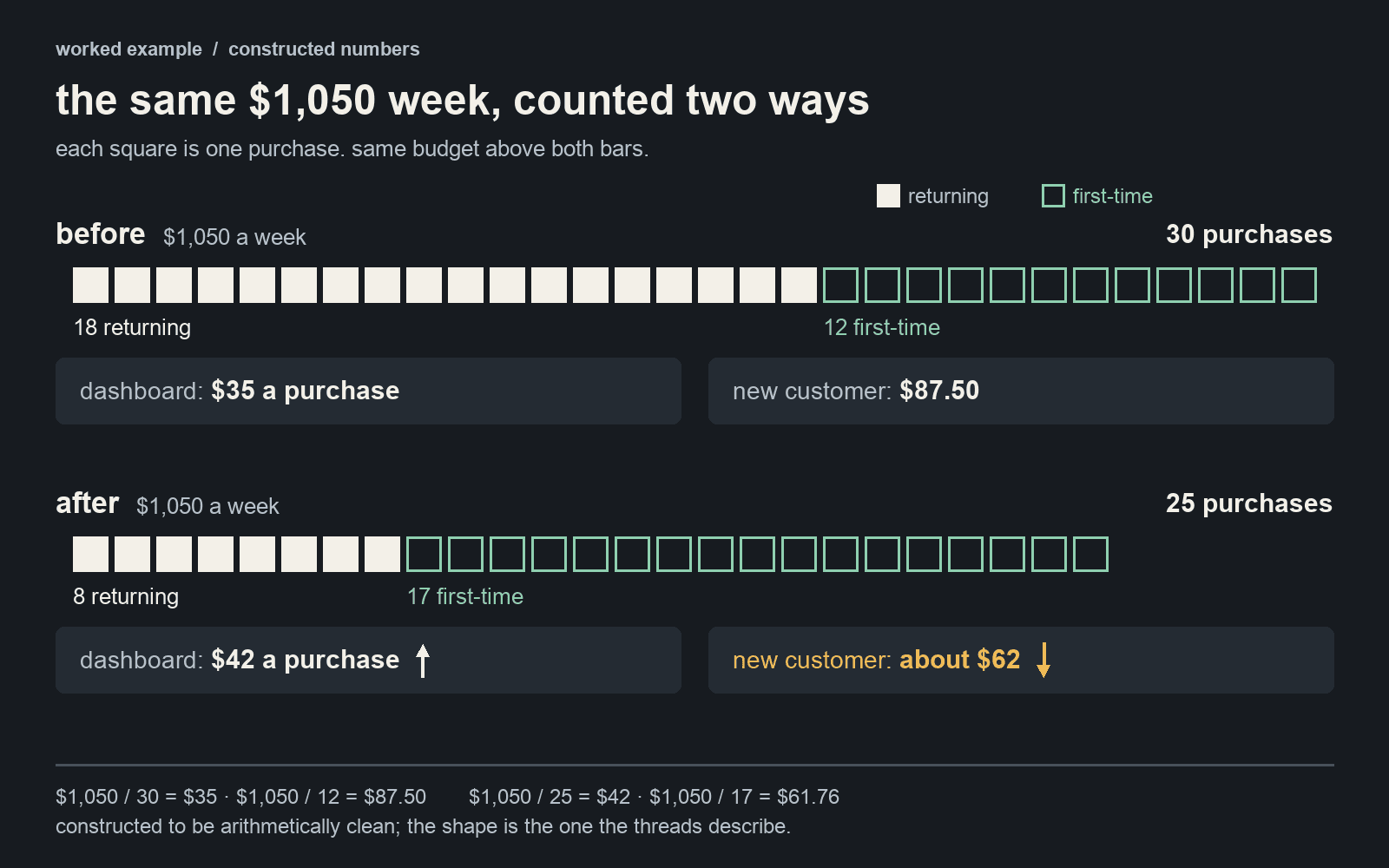
Constructed numbers from the worked example. The reported cost goes up while the cost of a new customer comes down.
the counter-case is worth stating, because it is also useful. if the first-time count had not moved — still around 12 — the new cold videos were not reaching anybody new, and the next thing to change is the videos rather than the settings: different problems named, a clearer demonstration, a first three seconds a stranger can follow. the method tells you which, and that is the point of it.
The part i cannot prove
the mechanism here — delivery spending the budget wherever it expects the cheapest purchase — is how meta describes its own optimisation, and the rest is ordinary practice: count new customers separately, judge cold ads on the customers they bring, give them room to run. none of it is my measurement. i do not run an account at this spend, and if i implied otherwise the first person to ask which one would end it.
the settings i mention change often. whether your campaign type offers a cap on existing-customer spend, and what the breakdown by new and existing customers is called this month, is something to check in your own account rather than take from me.
the numbers in the worked example are constructed to be clean. the lines i have quoted — four ads a month, the outfit swaps, $3,000 per new customer on a $2,000 subscription, $350 to $1,200 for a retargeting testimonial — are other people's, from what they wrote about their own accounts and quotes.
and there is one thing i genuinely do not know. how much of the budget should go to people who already know you. i have given a direction — most of the creative for strangers, a small fixed amount for regulars — and not a percentage, because the right share depends on how big the pool of existing customers is and how often they buy again, and a store selling refills is a different business from one selling a sofa. if you have found the split that works on your account, and how you found it, i would rather have your number than be right.
if any of this is wrong, say so. a correction is worth more to me than agreement.
the stranger ad is the one to make first, and the one that runs out fastest. clear cortex makes the next one from a product photo, for pence: https://clear-cortex.com/?src=x-prospecting-or-retargeting-end