 Clear Cortex
Is the era of AI UGC over? What the ban panic is actually made of
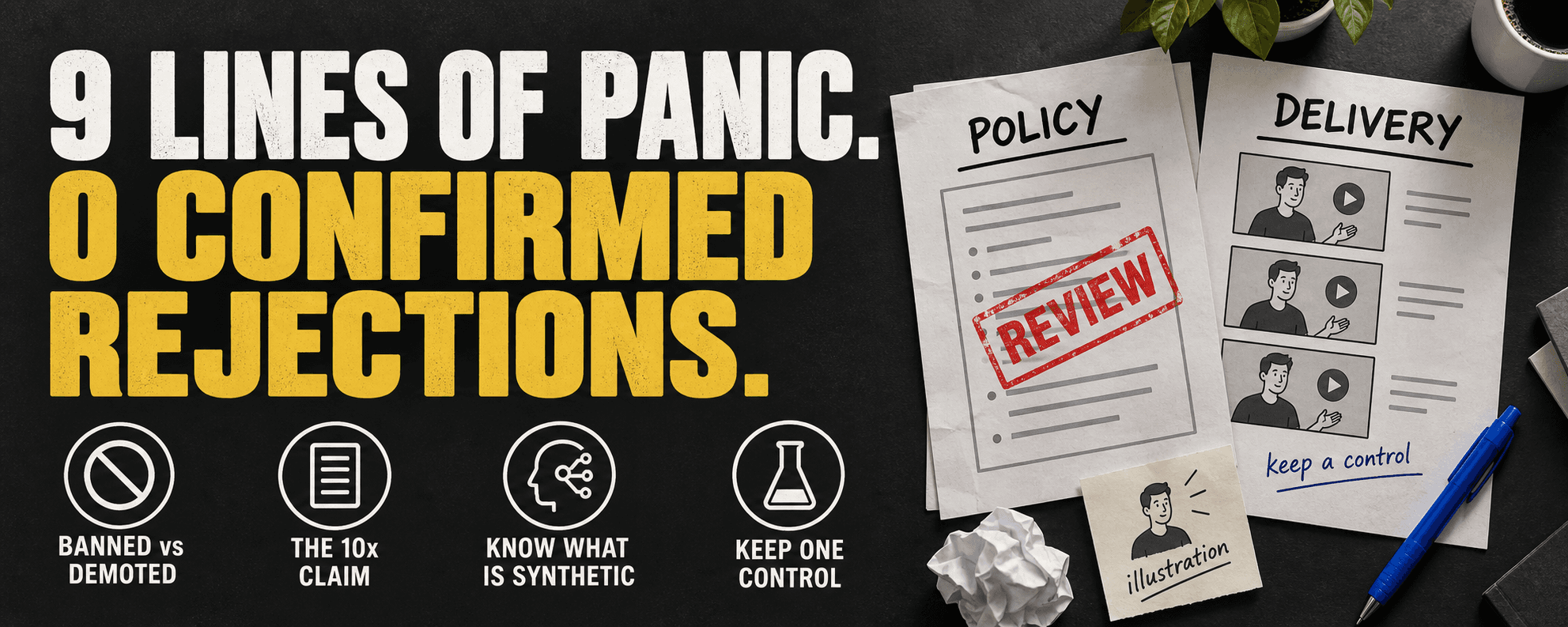
9 lines of panic about AI ad bans. 0 confirmed rejections.
i went looking for people worried that the platforms are about to shut AI creative down, and found nine of them across six threads. two of those nine are somebody asking, directly, whether it has actually happened to anyone: "Has anyone had an AI UGC ad rejected by Meta or TikTok for being AI-generated?" and "Has anyone actually had an ad flagged or rejected specifically because it was AI-generated?"
both threads went unanswered. that is the whole finding, and it is worth more than any prediction i could make. the fear is loud, the first-hand evidence is absent, and nobody in the room has noticed that those two facts are sitting next to each other.
so here is the whole thing: what actually happened at Snapchat and what it does and does not cover, why "banned" and "demoted" are different problems with opposite fixes, the one measured claim anybody made about labelling and why you should not trust it, and what to change in a creative pipeline so that a policy shift costs you a week instead of a quarter. about fifteen minutes, nothing held back, no gate on any of it.
what people are actually saying
"Snapchat just banned AI content. Is the era of AI UGC over?"
"If Instagram and TikTok follow Snap in banning or demoting AI content, which I was already expecting to happen, what happens to all the companies and platforms currently selling us AI UGC?"
"AI UGC ads are getting taken down. AI UGC accounts are getting banned. Real UGC is still under priced."
"Is full content automation the future, or will platforms crack down on AI generated floods?"
read those four in order and you can watch a fear assemble itself. one platform does something, a second person extrapolates to two more platforms, a third states it as an ongoing fact in the present tense, and by the fourth it is a general question about the future of the whole category.
nobody in the chain produced an example.
banned and demoted are not the same problem
this is the distinction the panic collapses, and everything downstream depends on it.
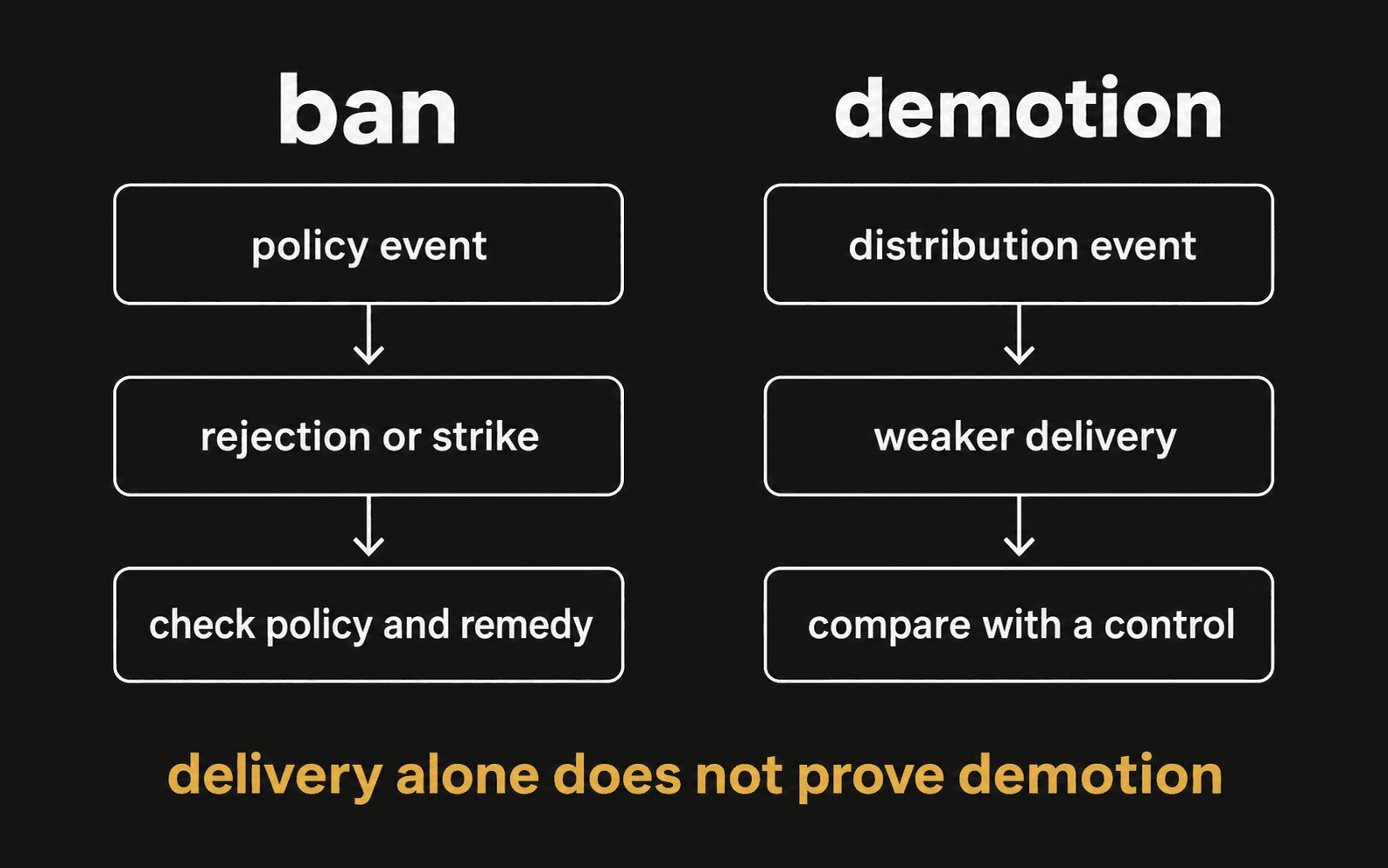
a ban is a policy event. your ad is rejected, your account gets a strike, and you find out immediately because something breaks. it is loud, binary, and — this is the important part — appealable and adaptable. you know within hours, and you change the creative or the account.
a demotion is a distribution event. nothing is rejected. nothing tells you anything. the ad runs, the delivery is just quieter than it should be, and your CPMs drift up by an amount you will attribute to seasonality, competition, or creative fatigue. you find out never.
the second one is the real risk and almost nobody is talking about it, because a ban makes a good tweet and a demotion makes no signal at all. the person above who wrote "gets buried by the platform" is describing a demotion, and they are the only one in the whole cut who is.
and the fixes point in opposite directions. against a ban you want to know the policy and stay inside it. against a demotion you want a control — something running that is not AI-generated, so that when your AI creative's delivery degrades you can see whether everything degraded or only that.
if you have no control, you cannot tell a demotion from a bad week. that is the actual exposure, and it exists today whether or not any platform ever announces anything.
the one measured claim, and why to distrust it
there is exactly one line in the whole cut that reports a number:
"as a person who has made a 'ton' of real looking AI UGC, i can tell you from experience the AI UGC content not labeled AI performs 10X better than the content labeled AI"
10x. if true it is the most important sentence in the topic, because it means the exposure is not a future ban at all — it is a live, present tax on anything correctly disclosed.
treat it as unverified, and here is exactly why, because the reasoning matters more than the verdict:
- it is one person, self-reported, with no account named and no window given
- "performs" is undefined — impressions? CTR? CPA? each would mean a different thing
- and the labelling was almost certainly not randomised. the creator chose which to label, which means the labelled set and the unlabelled set probably differ in other ways too
that is not a reason to dismiss it. it is a reason to run it yourself, and it is cheap: same creative, same audience, same budget, label one, do not label the other. somebody in the corpus is already asking whether anyone does this:
"Are any PPC teams already splitting AI-labeled creative vs non-labeled creative as a separate testing variable, or is this still too early to matter?"
that thread also went unanswered. two people have now independently arrived at the right test and nobody has run it.
what actually happened at Snapchat, stated carefully
i am going to be precise about the limits of what i can tell you here, because the whole point of this piece is that the room is repeating things nobody checked.
what the corpus supports: a person stated on 2026 that Snapchat banned AI content, and it was read and shared by others in the same room. that is the extent of the first-hand material i have.
what the corpus does not support: that the ban covers paid advertising rather than organic posts, which are governed by entirely different policies on every platform. that Meta or TikTok have followed. that any specific ad was rejected for being AI-generated.
do not act on my summary of a policy. go to the policy. every platform publishes theirs, they change, and a secondhand account in a tweet — including this one — is worth less than five minutes on the source page.
what i will say is that the shape of platform policy in this area has been consistent and is not hard to predict: platforms restrict deception, not synthesis. an AI-generated actor saying true things about a real product has never been the target. an AI-generated actor impersonating a doctor, a real person, or a customer who does not exist making a specific claim, is — and always was, before any of this existed, when it was done with a paid actor.
the thing worth building either way
here is the practical version, and it is worth doing whether or not a single platform ever changes anything.
1. know which of your creatives are synthetic, in a list you can query. most accounts genuinely cannot answer "which of our live ads are AI-generated" in under an hour. if a policy lands on a wednesday, the entire cost of complying is that lookup. this is the cheapest insurance in the whole piece and almost nobody has it.
2. keep one non-synthetic control running. one real creative, permanently, small budget, same audience. it is your instrument for detecting a demotion. without it every distribution change looks like creative fatigue.
3. separate the asset from the pipeline. the exposure is not "we use AI video". it is "our entire creative supply is one model on one platform's terms". if the whole chain — brief, script, render, edit, test — lives somewhere you control, then a model or a platform becoming unusable is a swap. if the chain is one vendor's product, it is a rebuild.
4. label deliberately, and record what you did. whatever you decide about disclosure, decide it once, apply it consistently, and write it down — so that if the 10x claim above turns out to be real, you have data rather than a mess.
what usually goes wrong
people prepare for the loud risk and eat the quiet one. every hour spent forecasting a Meta announcement is an hour not spent building the control that would detect the demotion already happening.
people treat "real UGC" as the safe hedge. the line "Real UGC is still under priced" is in the cut, and it is a reasonable position — but it is a bet on price, not a bet on safety. a human creator making a deceptive claim gets the ad rejected exactly as fast. the axis platforms police is not who made it.
people read a policy summary instead of a policy. including this one.
the honest answer
is the era of AI UGC over?
nothing in what people are actually saying supports that. nine lines, six threads, one platform event that may or may not cover advertising, and two direct requests for a single confirmed rejection that nobody could supply.
what the cut does support is smaller and more useful: there is a real risk here and it is the quiet one. not a ban you will hear about, but a delivery penalty you would currently have no way of detecting, because almost nobody is running the control that would show it.
the thing to build is not a contingency plan for an announcement. it is the instrument that tells you what is already happening.
i'm building the version of this where the brief, the render, the label and the test all sit on one canvas — so "which of our live creatives are synthetic" is a question you can answer in a second rather than an afternoon. if you want to see it when it lands: https://clear-cortex.com/early-access?src=x-02-platform-crackdown