 Clear Cortex
How to make video ads for other countries without a shoot in each one
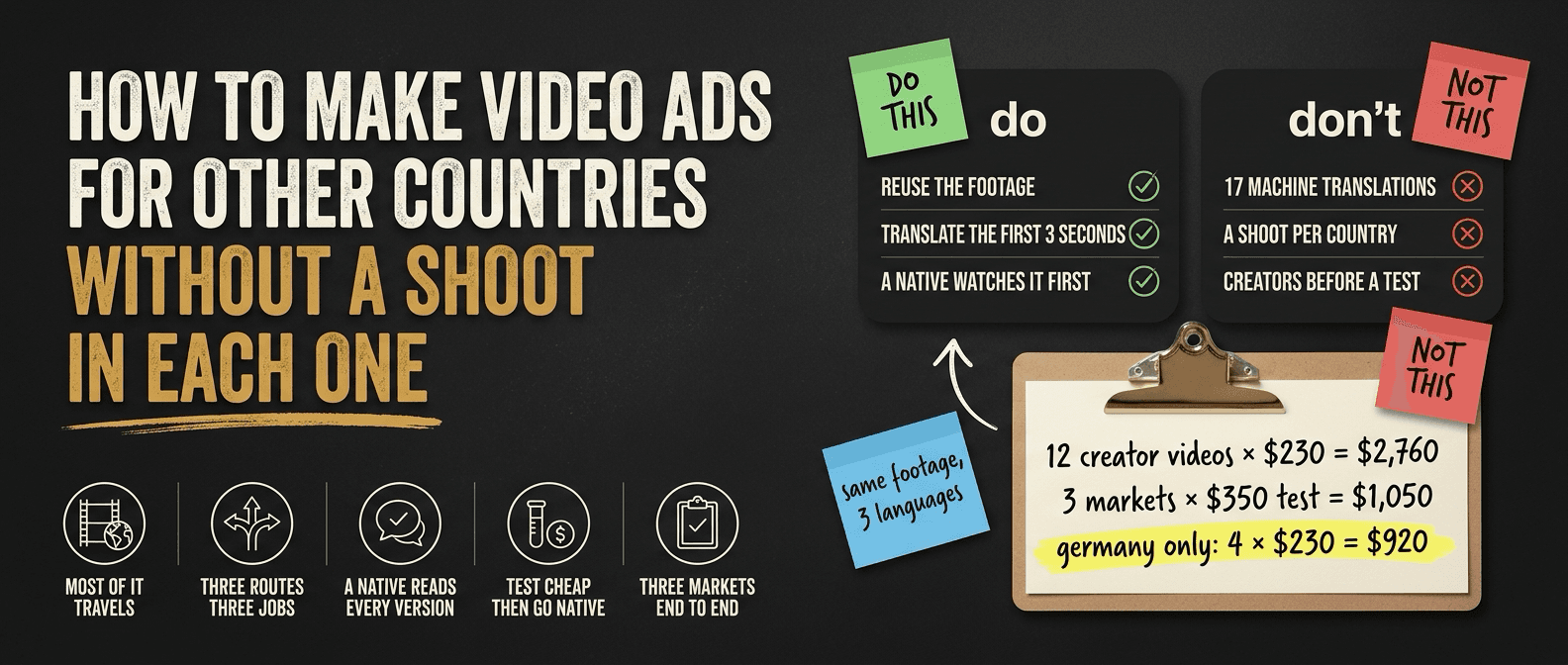
17 translations of one ad, and the danish one was nonsense.
that came from someone going through the ad library looking at brands that advertise across europe. one brand had taken a single english video and pushed out 17 other language versions of it, all machine-made. the greek one had lost its accented letters, the norwegian one stopped mid-sentence, and the danish one was dubbed by a synthetic voice reading a translation that meant nothing at all. it was live in the campaign, with budget behind it, in front of people who could not understand it.
i went looking for how people actually make video ads for other countries, and found the question asked 8 times across 7 separate threads. that is not many, and the thinness is part of the answer. the same ad-library audit found brands still running one english original with english subtitles into france, italy and spain, and others that had switched to local UGC in one market and never tested it in the others. plenty of accounts never ask the question at all, they just put the home campaign's content in front of everyone. the one that put the whole decision in a single line was this:
"how is your team currently sourcing video creatives for your international campaigns, are you scripting native KOC content, using factory footage, or relying on AI generators?"
and here is how the others put it:
"why doesn't she just hire 5 real creators in 5 countries?"
"if you're buying Meta ads for Brazil or LatAm, how are you handling creatives right now?"
"may be an obvious one but are there any tools and solutions, which have made it easier to translate and localise campaigns?"
"is it true that meta analyze the voice over and the caption and decide which audience to serve ?"
"can you swap hooks, change CTAs, localize?"
the good news is that you do not have to pick one of those three routes, and you do not need a shoot in every country. most of a video ad travels. the product, the hands using it, the demo, the before and after — none of that needs translating. what does not travel is a much shorter list: the words on screen, the voice, the offer, and sometimes the face. each of the three routes is good at exactly one part of that list, and the expensive one — UGC creators in every country — only needs buying in the market that has already earned the budget.
so here is the whole thing, in the order to run it. which parts of the ad travel, what each route is actually good for, the one check that stops the 17-translations problem, how to test a market before you pay for native creative, and one worked example across three countries. nothing is held back and there is no gate on any of it.
the cover on this piece was made in clear cortex for about 8p, on the cheapest model that could spell the headline. that's the studio i'm building, and it's the only ask in this piece: https://clear-cortex.com/?src=x-other-countries-top
Most of the ad travels. Find the part that doesn't
start by taking one of your winning creatives apart, because the decision about how to source creative for a new country is really five smaller decisions, and four of them are cheap.
a video ad is built in parts, and they do not cost the same to change:
- the footage. the product, the hands, the unboxing, the demo, the result. this is the part that cost the most to make, and it is the part that travels best. a phone case shown surviving a drop is the same phone case in munich and madrid.
- the words on screen. the hook text, the captions, the claim, the call to action. these have to be in the viewer's language, like every other piece of content in the campaign, and they are the cheapest part to change, because they are text.
- the voice. the line spoken over the footage. it has to be in the language, and ideally in the accent people in that market actually speak.
- the offer. the price, the currency, the delivery promise, the returns line, the size or plug or spec that differs by country. this is the part people forget, and it is the one that quietly breaks a translated ad that reads perfectly.
- the face. the person on camera, if there is one. this is the only layer where being from that country can matter on its own, and it is the most expensive one to change, because it means a new person filming a new video.
once you see it that way, the question at the top stops being which of the three routes to pick, and becomes which layer each route should fill. and the order to work through them is cheapest first: words, voice and offer before you go anywhere near a new face.
if you can only afford to localise one thing, localise the opening. the post the question came from said it plainly: "the biggest takeaway is that you cannot afford any slow build ups because the first three seconds decide whether the user skips your ad." that holds in every language. a video whose first line of text is in english and whose first spoken word is in english has lost a german viewer before the product has even appeared. the footage can stay exactly as it is. the first three seconds of words and voice cannot.
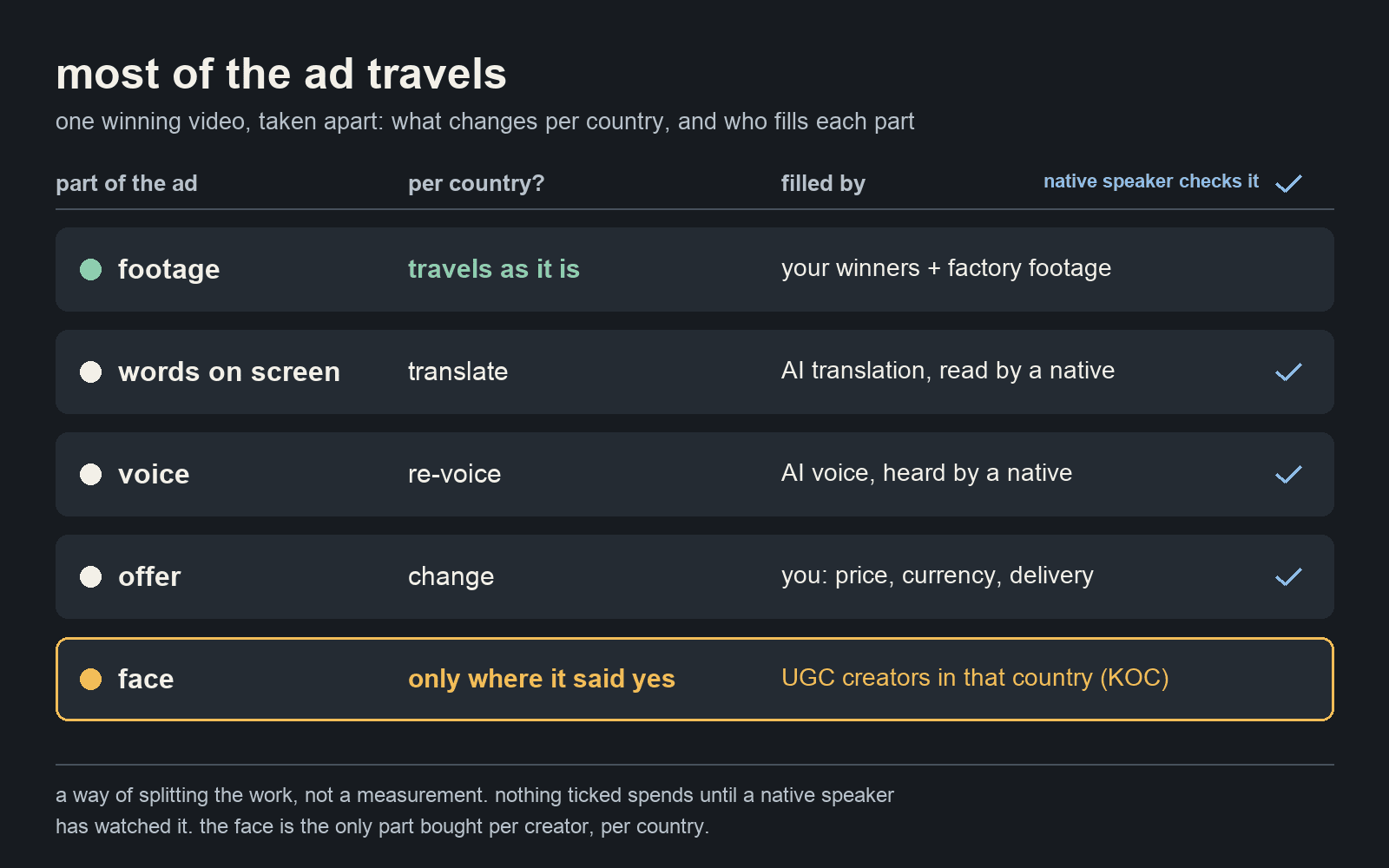
A way of splitting the work, not a measurement. Which layer matters most will differ by product and market.
there is one caveat on the footage layer worth saying now. footage travels when it shows the product doing its job. it does not travel when it shows a place, a joke, a gesture or a reference that only lands at home. a kitchen that looks unmistakably american, a plug socket that only fits one country, a pun in the hook — those are footage problems, and they are the case for reshooting. look for them shot by shot. most product ads have none, and the ones that do usually have one or two shots to replace, not a whole video.
What each of the three routes is good for
the question at the top names three ways to fill those layers. each is right for one job and wrong for the others, and most of the trouble comes from using one of them for everything.
factory footage is a footage layer, and nothing more. if you sell something made by a supplier, there is usually footage of it being made, tested or used, and it costs you nothing. it is real, it shows the product working, and it has no language in it, which makes it the most portable footage you will ever get. the problem is that it looks like a supplier made it — because one did — and anyone else selling the same product from the same supplier can run the same clip. people running paid social say the same about polish in general: "clean, aesthetic videos are great for your IG grid, but on paid social, 'native' wins." so use factory footage as material, not as the ad. cut the strongest few seconds of it into a video that has your words, your voice and your offer on top, and it stops looking like everyone else's.
UGC creators in each country — the KOC route — are a face layer. KOC means everyday customers filming themselves with the product, as opposed to an influencer with a following: UGC, sourced locally. in a new country, it means people from that country, speaking the way people there speak, using the product in a home that looks like theirs. nothing else gets you that, and it can be the difference in a market where a foreign face reads as an import. but it is the one route that costs per creative, per country, and the spend lands before you know whether the market wants the product. somebody who runs paid social for a beauty brand sent one brief to 14 creators and wrote down what came back: "same brief, same brand, same product, sent to 14 creators: 15s tiktok native quotes came back $180 to $650." they moved most of their buying onto creator marketplaces, and the price settled: "effective per-piece settled at $230 for 15s tiktok, $310 for 30s meta, $480 for 60s testimonial." a seller on another platform put the trade-off in one line: "the native route is just paying more affiliates or a UGC creator per video, which looks unmistakably real but costs per asset and doesn't scale on our margins." multiply that by every country you sell in and it is a creative budget that scales with the number of markets instead of with the results — which is the reason most accounts never localise at all.
AI generators are a words-and-voice layer — with a person reading the output. this is where AI genuinely changes the cost: AI translation for the text, an AI voice for the first line. one post about AI labelling described where paid creative already is: "AI creative is becoming normal in paid acquisition: generated variants, AI-assisted edits, synthetic voiceovers, translated versions, and automated testing." translating on-screen text and re-voicing the first line are exactly the jobs it does well, and they are the jobs that used to make localisation too expensive to bother with. what it does badly is know when it is wrong. that is the 17 translations at the top of this piece, and it gets its own section.
the honest answer to the question, then, is all three, each in its place: footage you already have or got from the factory, words and voice made per language with AI and checked by a person, and UGC creators bought only where a market has shown it is worth the spend.
there is one boundary with the piece on variations, because the two get confused. a translated version is the same idea in another language, not a new idea. it does not count as testing a new angle, and it does not need to be judged like one. you are not asking whether this is a better ad. you are asking whether the ad that already works at home works here. that is a smaller and much cheaper question.
Never let a translation spend before a person has read it
back to the 17 versions. the person who found them was looking for brands to pitch a captioning service to, and contacted one brand's performance marketing team. their reason was simple: "they can increase their conversions by translating properly - so their 100k views in EU would actually understand their message better." and their reaction, on finding the versions had been made by an automatic translation feature rather than by the brand, was: "is Meta (the big Meta) pushing features, not even beta but pre alpha, without proper testing???"
i can't tell you how often that happens, and neither could they — it was one brand. but the failure has a shape that matters for anyone using machine translation, from a platform feature or from a tool of your own. the version that is wrong looks exactly like the version that is right to anyone who does not speak the language. the ad is the right length, the captions are timed, the voice sounds like a voice. the only person who can see the problem is someone who reads danish, and in most accounts that person is never shown it.
so the fix is one rule, and it costs an hour per language, not a shoot: no budget goes behind a version until somebody who speaks that language has watched it, with the sound on. not read the script — watched the finished video, because that is where a dropped accent, a line cut off by the caption box, or a word split across a line break shows up.
the best phrasing of the check i found came from an account making content in five languages, which sends every finished video to a native speaker with one question: "does this read as natural in your country?" that question is better than asking whether the translation is correct. a translation can be correct and still sound like a manual. what you want to know is whether a person in that country would scroll past it as foreign.
three things to ask them to look for, in order:
- the first three seconds. does the opening line of text and voice sound like something a person there would say? this is the part the ad lives or dies on, and the part most worth an extra rewrite.
- the offer. is the price in their currency, is the delivery promise true for their country, is anything mentioned (a sizing system, a plug type, a payment method) that does not exist there?
- the words that broke. accents and special characters, lines cut off, a caption covering the product, a word split in two.
if you are using a platform's own translation feature, the same rule applies, and it is harder to follow because the versions may never be shown to you before they run. find out where your platform shows the translated versions, look at every one, and if you cannot see them, do not let it translate for you. a version you have not seen is a version you are paying for blind.
and the question about whether the platform reads the voiceover — somebody running ads spoken in lebanese arabic asked it, worried their sessions were not turning into sales because "meta isn't understanding what i am saying and serving it to the wrong audience". i do not know how much the delivery system reads speech, and i have not seen anyone outside the platform who does. what you control is simpler and matters more: the country you target, the language setting on the ad set, and whether a person from that country understands the video. get those three right and the question mostly stops mattering.
Test the market on the cheap version first
this is the part that turns localisation from a cost into something you can afford to try. you do not need native UGC to find out whether a market wants the product. you need it once a market has said yes, and the budget is about to scale there.
the order:
- take the creatives that already win at home. not new ones. the point of the first test is to ask whether the market responds to what already works, and the only fair way to ask is with the same footage.
- make one version per language from each. words on screen translated, the first line re-voiced, the offer changed to that country's price and delivery, each version watched by a native speaker before it goes anywhere. same footage, same structure, same length.
- give each market its own small, equal, fixed budget for a fixed time, and decide before it starts what result counts as a yes. the cleanest yes is a cost per sale near the one you get at home, read against your break-even rather than against the other new markets.
- buy native UGC only for the market that said yes, then scale the budget there. that is where the face layer earns its price — when the product has already shown it sells there, and a local face is the thing most likely to make it sell better as the spend goes up.
somebody asked the budget version of this: "would it be better to focus on one country or split the budget across multiple countries?" for a test like this, split it — equally, with a fixed end date — because the job is to rank the markets, and you cannot rank one. then concentrate: once one has answered, the budget and the native creative both go there.
keep each country's budget separate while you test. if all three countries sit in one campaign under one shared budget, the platform decides where the budget goes, and it goes where people are cheapest to reach rather than where they buy. one reply described the end of that road exactly: "Meta burns through the easy pocket in whichever cheap countries it finds first, and once that's exhausted there's nothing in your data telling it who else is worth chasing, so it just stalls." a campaign or ad set per country, each with its own fixed spend, is what makes the three results comparable at all.
and if you do not have four winners at home to start from, the base video is the one part you make once, and it does not have to come from a shoot either. this is how to make one from a product photo, step by step: https://clear-cortex.com/playbooks/how-to-make-an-ad?src=x-other-countries-mid
and when a market says no, check the offer before you blame the video. a translated ad that reads perfectly can still lose because the price converts to an odd number in that currency, delivery takes two weeks instead of two days, or the page it lands on is still in english. those are offer and page problems, and a UGC creator would have hit exactly the same wall at $230 a video. the localised version is the cheap way to find that out.
Three markets, worked end to end
here is the whole thing on one account. the numbers are constructed to keep the arithmetic clean — they are not from an account i run — except the $230, which is the settled marketplace price for a 15-second creator video quoted above.
a shop sells in the UK, where four videos are working and break-even is $45 a sale. it wants to try germany, france and spain.
the native route, the way most people price it. four UGC creator videos per country, three countries: 12 videos. at $230 each that is $2,760 in creator fees, and at the top of that 14-creator quote range ($650) it would be $7,800. all of it is spent before a single sale in any of the three countries, on a bet that each market wants the product at all.
the layered route. the four UK winners stay as they are. for each country, the on-screen words are translated, the first line is re-voiced, and the offer is changed to euros and local delivery. each of the 12 versions is watched by a native speaker before it runs. no new shoot, no new creator, and what it costs is the hours of that checking rather than $230 a video.
the test. each country gets its own campaign at $50 a day for 7 days — $350 of spend each, $1,050 across the three, with the same four creatives in each. the read at the end of the week:
- germany: about $40 cost per sale, under the $45 break-even — close to what the same videos do at home.
- spain: about $58 cost per sale. over break-even, but near enough to deserve a second week.
- france: about $95 cost per sale, and the native speaker had flagged that the page the ads land on was still in english.
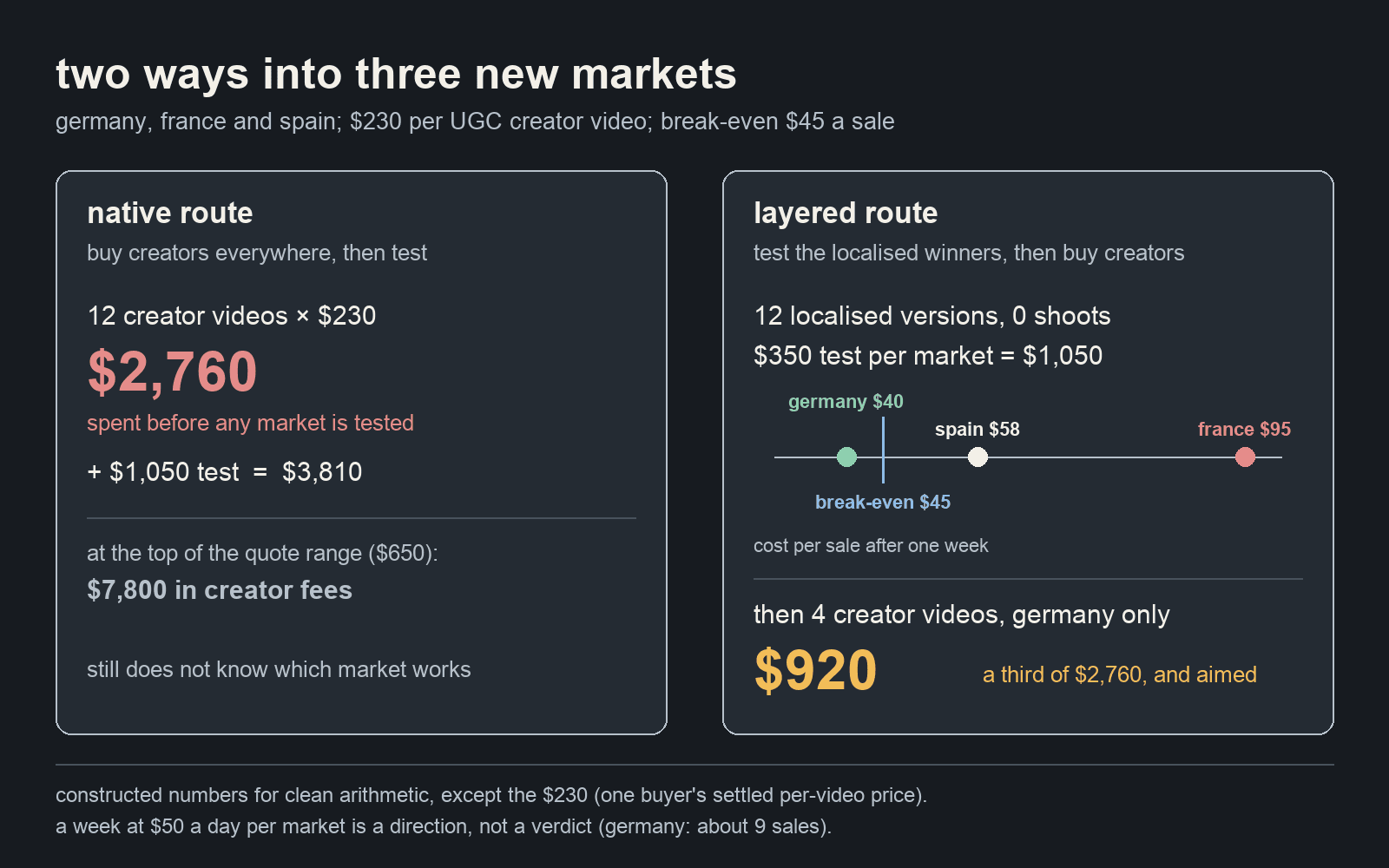
Constructed numbers for clean arithmetic, except the $230, which is a real settled per-video price from one buyer. A week at $50 a day is a direction, not a verdict.
what they do next. germany gets the native creative: four UGC creator videos at $230, $920, because that is now a market where a local face is the most likely thing to make a working ad work better. the localised versions keep running beside them, and the budget goes up once the new creatives have had their own week. spain gets a second week of test budget on the same localised versions before anybody spends on creators for it. france gets its landing page translated before anybody touches the video, because a perfect ad sending people to a page they cannot read is a page problem.
the totals, before the first market has proven itself. the native route has spent $2,760 on creators plus the same $1,050 of testing, $3,810, and still does not know which market works. the layered route has spent the $1,050 and some hours of checking, and knows. its creator budget, when it comes, is $920 into the one campaign that earned it — a third of the native route's $2,760, and aimed.
about nine sales in germany is not a large number, and i want to be straight about that. a week at $50 a day ranks three markets roughly; it does not prove anything about any of them. that is why the creator budget goes to the campaign that came back strongest rather than the one that came back first, and why spain gets a second week rather than a verdict.
The part i cannot prove
none of the method is a measurement of mine. splitting an ad into layers, testing markets before localising deeply, and having a native speaker check every version are ordinary practice for anyone selling across borders, not something i found. the worked example is built for clean sums, and i do not run a shop in three countries.
the real figures here are other people's, from what they wrote about their own work: the 17 machine-made versions of one brand's ad, which i have not seen myself and am taking from the person who audited them; the $180 to $650 that 14 creators quoted for one brief, and the $230 it settled at, which is one buyer in one category; the native-speaker check, which comes from a viral account of an AI content business whose revenue figures i cannot verify. i am borrowing the check, not the numbers.
and there is one thing i genuinely do not know. i have argued that the face is the last layer to pay for, and that the localised version is enough to find out whether a market wants the product. i cannot tell you how often that is wrong — how many markets would have said yes to a native creator and said no to a translated ad, so the cheap test turned them away. for some products in some countries, a foreign face may be the whole reason it fails. if you have run both in the same market and seen the gap, i would rather have your numbers than be right.
if any of this is wrong, say so. a correction is worth more to me than agreement.
the part that changes per country is the cheap part once the base video exists. clear cortex makes that base — test ads from a product photo: https://clear-cortex.com/?src=x-other-countries-end