 Clear Cortex
How to get a new account out of Learning Limited without paying for the data twice
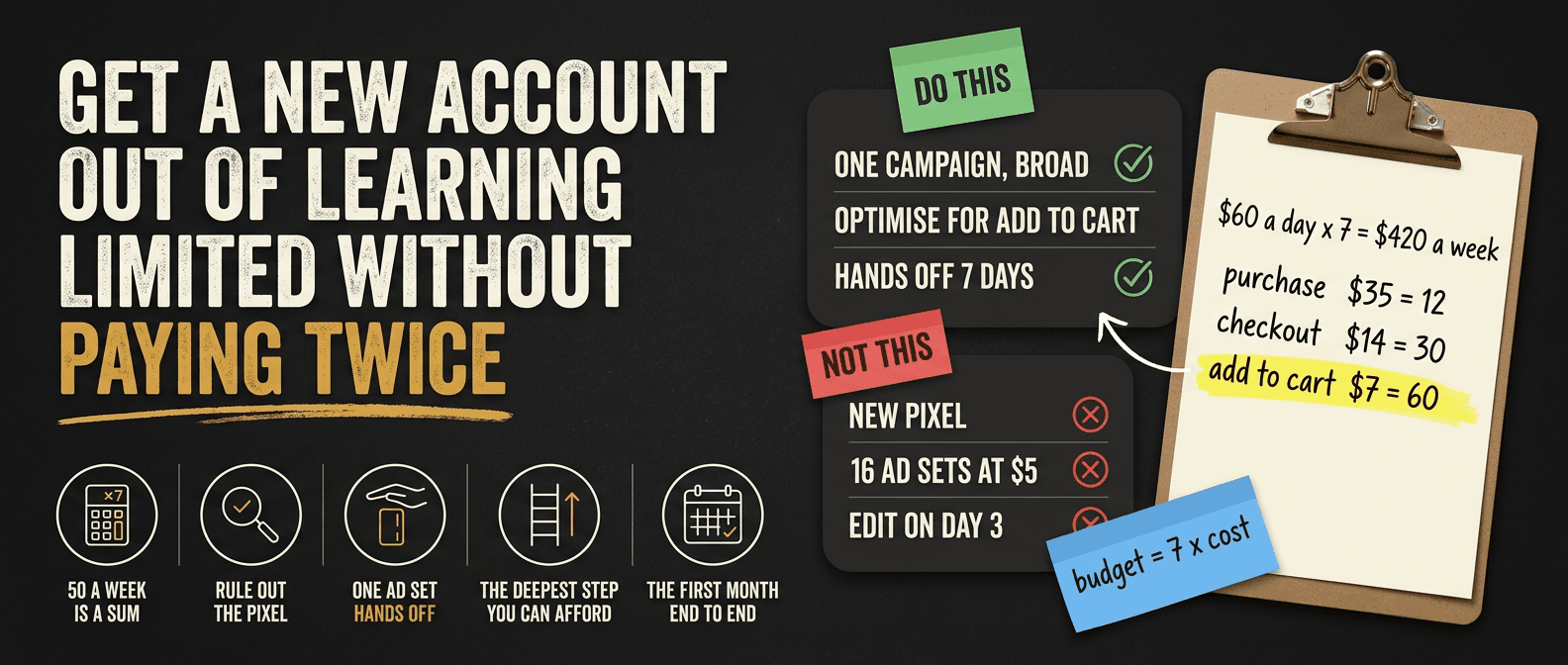
50 conversions a week. a new account has none.
i went looking for a straight answer on what to do about that and counted 24 people asking some version of it, 28 questions between them. the thing i did not expect was which suspect they reach for first. 11 of the 28 mention the pixel or the tracking. about half as many, 6, ask what the campaign should be optimising for — and it is that choice, far more than the pixel, that decides whether a new account ever gets out.
it gets asked in a lot of shapes and it is one question:
"and when an ad set gets stuck in the learning phase, what's your go-to move to break the ice?"
"but based on my traffic i struggle to believe that something isn't wrong with my pixel."
"is the play to stop optimizing for purchase entirely and buy a cheaper signal (atc, initiate checkout) until there's volume?"
"has advantage+ changed enough that i should be setting campaigns up differently?"
and the one that says the whole problem in a sentence, from somebody describing their own tests: "from my own recent cold-start experiments, suffocating a new pixel with strict interest filters usually leaves it permanently trapped in learning limited because the system struggles to hit those 50 weekly conversions."
the good news is that this is fixable, and most of the fix is arithmetic you can do before you spend anything. a new account is not broken for being in learning limited. it is short of one number, and there are exactly three ways to close the gap: more budget, fewer places to spend it, or a cheaper thing to count. the expensive mistakes all come from the same place — paying for the same learning twice, usually without noticing.
so here is the whole route, in the order to run it. one sum that tells you which of the three you need, a pixel check that takes an afternoon, a setup that leaves meta alone long enough to learn, a rule for what to optimise for, and a new store's first month worked through end to end. nothing is held back and there is no gate on any of it.
the cover on this piece was made in clear cortex for about 8p, on the cheapest model that could spell the headline. that's the studio i'm building, and it's the only ask in this piece: https://clear-cortex.com/?src=x-new-account-top
Learning Limited is a budget sum, and the sum has an answer
start with what the label actually means, because it sounds like a verdict and it is not one.
meta puts an ad set into learning when it starts or when it is significantly edited, and it wants roughly fifty of the thing you are optimising for — fifty purchases, fifty leads, fifty add to carts — within about a week to settle how it delivers. if it cannot get there, the status changes to learning limited. that is the whole mechanism. it is not a penalty on the account, it does not stop delivery, and your ads keep running. it is a note saying this ad set is buying too few results to learn much from them.
so the first question is not what is wrong with the account. it is how many results this budget can actually buy in a week — and that is one line:
daily budget × 7 ÷ cost per result = results per week.
put your own numbers in. at $50 a day and a $40 cost per purchase, that is 350 ÷ 40, about nine purchases a week. nine is not fifty and never will be at that spend. somebody in exactly this spot — "current state: ~4 videos live, ~$400 spent, 0 sales" — asked "is 4 creatives / $400 just way too little data to judge anything?" and the sum answers it before anyone has to guess: at, say, a $40 cost per purchase, $400 buys about ten sales, spread across four videos, which is two or three sales a creative. yes, too little to judge the creatives on. not too little to judge the budget on. one reply in the middle of all this put somebody's account the same way: "meta requires roughly 50 conversions per ad set per week to optimize, and with ~1 purchase/day you are giving it only about 7."
turn the sum round and it gives you the number that matters: to reach fifty a week, the daily budget has to be about seven times what one result costs. at a $40 cost per purchase that is roughly $285 a day in one campaign. at a $15 cost per initiate checkout it is about $105. at a $6 cost per add to cart it is about $42.
that one comparison answers most of the questions above before anything else is checked. if your daily budget is well under seven times your cost per purchase, no pixel fix, no interest tweak and no new account will get a purchase-optimised campaign out of learning limited, because the sum does not allow it. you close the gap with one of the three moves:
- more budget in the one ad set, until it is about seven times the cost per result.
- fewer places to spend it, so the conversions you already get all land in one campaign and one ad set instead of being split three or four ways across creatives, audiences and funnels.
- a cheaper thing to count, an event further up the funnel that you can afford fifty of.
every one of those is available to a brand new account on day one. the questions in the pile are almost all asked as if something is broken, and usually nothing is. the budget and what it is optimising for just do not match yet.
the sum also answers somebody's question about what normal looks like at the start — "trying to plan my budget properly and want to know what “normal expensive” looks like for a new account versus “something is actually wrong.”" if the budget buys nine sales a week and you got seven, nothing is wrong. if it should buy nine and you got none in two weeks, something might be, and that is when you look at the pixel.
Rule the pixel out in an afternoon, then stop suspecting it
the pixel is the most-suspected thing in the pile — 11 of the 28 questions mention it or the tracking — and it is also the one you can settle fastest. the reason it gets blamed is understandable. the ads get clicks, the store gets visits, the sales do not show up, and the pixel is the only part of the chain you cannot see.
"we've tested our pixel over and over in any and every scenario and seems to be fine."
testing it over and over is what people do when the check did not give a clear answer. here is one that does, and it only needs running once.
one: make a real purchase. your own card, a cheap product or a discount code, all the way through checkout. then open events manager and look at the test events view, or the event history. you are checking three things: that a purchase event fired, that it fired once rather than twice, and that it carried the order value. if you send events from the server as well as the browser, the two should be deduplicated into one, and events manager will tell you whether they were.
two: compare a week of purchase events against a week of store orders. not the purchases in ads manager — those are the ones meta attributes to an ad inside its attribution window, and they will always be lower than your orders because plenty of people buy without clicking an ad. the comparison is the raw count of purchase events received in events manager against the raw count of orders in your store over the same seven days. if those two are close, the pixel is working. some gap is normal — ad blockers, people declining cookies — but it should be a gap, not an absence.
three: check the pixel is the one the ad set is optimising on. it sounds obvious, and a surprising number of new setups have two pixels, an old one from a theme or a previous developer, and the campaign pointing at the one that never fires.
if all three pass, the pixel is fine, and that is a result rather than a shrug. you can take it off the list. the questions that remain are about budget, structure and what the campaign optimises for, which is where the fix actually is.
what not to do is start again. one of the questions in the pile asks exactly this — "would you recommend me to create a new pixel or ad account perhaps?" — and it is the first way to pay for the data twice. a new pixel starts at zero. every purchase the old one recorded, every visitor it matched, is history meta could have used and now cannot. if the pixel passed the three checks, a new one gives you the same pixel with less behind it. if it failed them, fix the one you have.
and if the pixel passes and the store still has 0 sales, the problem is further along than the ads. one reply put the list in the right order: "whatever broke is downstream: landing page, offer, price, out of stock, or tracking (pixel/capi/ios/attribution window)." tracking is one item on that list. it is the easiest one to check, which is exactly why it should be checked first and then crossed off.
One campaign, one broad ad set, and hands off for a week
once the sum is done and the pixel is cleared, the campaign setup is the next place a new account loses its conversions — not by having too few, but by spreading them too thin to count.
every ad set learns on its own. if you run three at $20 a day each, you have not got one $60 test, you have got three $20 tests, each trying to reach fifty on its own, each at a third of the pace. that is the second way to pay for the data twice, or in that case three times: the same budget buying the same learning in parallel, at a fraction each.
somebody asked the exact question — "running two funnels at once, did i split the learning phase and slow everything down?" — and the answer is yes, by roughly half. another described the extreme version of the setup most people start with: "launched with 4 campaigns / 16 ad sets split by angle and audience, ~$5/day per ad set." sixteen at $5 a day is sixteen separate tests that will each need months to see fifty of anything. the same person's fix was the one this section is about: "killed everything, moved to one campaign, one broad ad set, ~2x the daily budget, winning creative only." on their own account that did not lower the cost per lead by itself — they say the landing page was still the bottleneck — and that is the honest limit of it. consolidating gives meta enough to learn from. it does not fix what happens after the click.
so a new account gets one campaign and one ad set. put the three or four creatives you believe in most into it — the videos you would bet on, not ten of them. the more creatives share the budget, the thinner each creative's read becomes, and at a new account's spend you need the few you have to get a real number. testing ten concepts is a job for when the account can afford the test.
and the ad set is broad. country, age if the product genuinely demands it, and not much else. this is where the cold-start line earns its place: strict interest filters on a new pixel shrink the pool meta is allowed to look in, at exactly the moment it knows nothing about who buys. it has no history to find buyers with and a fence around where it may look for them. broad is not a mystical setting. it just gives an empty pixel the widest room to find its first fifty.
which answers the advantage+ question, for a new account at least. what advantage+ has changed is who picks the audience. more of that choice now sits with meta, and interests you add are increasingly treated as a suggestion rather than a fence. what it has not changed is the sum. an advantage+ campaign still needs its fifty results a week, still learns ad set by ad set, and still cannot learn faster than the budget buys conversions. so yes, set a new account up differently than you would have a few years ago — fewer ad sets, fewer interests, more room — but do not expect it to rescue a budget that is too small for what it is optimising for.
then leave the campaign alone for seven days. no new creatives, no tweaks. this is the rule people find hardest and the one that costs most to break. significant edits put the ad set back into learning: changing the targeting, changing what it optimises for, swapping creatives, a large budget change, or pausing it for a week or more. every one of those restarts the count, and every restart is the third way to pay twice — you bought four days of learning and then threw it away to buy it again.
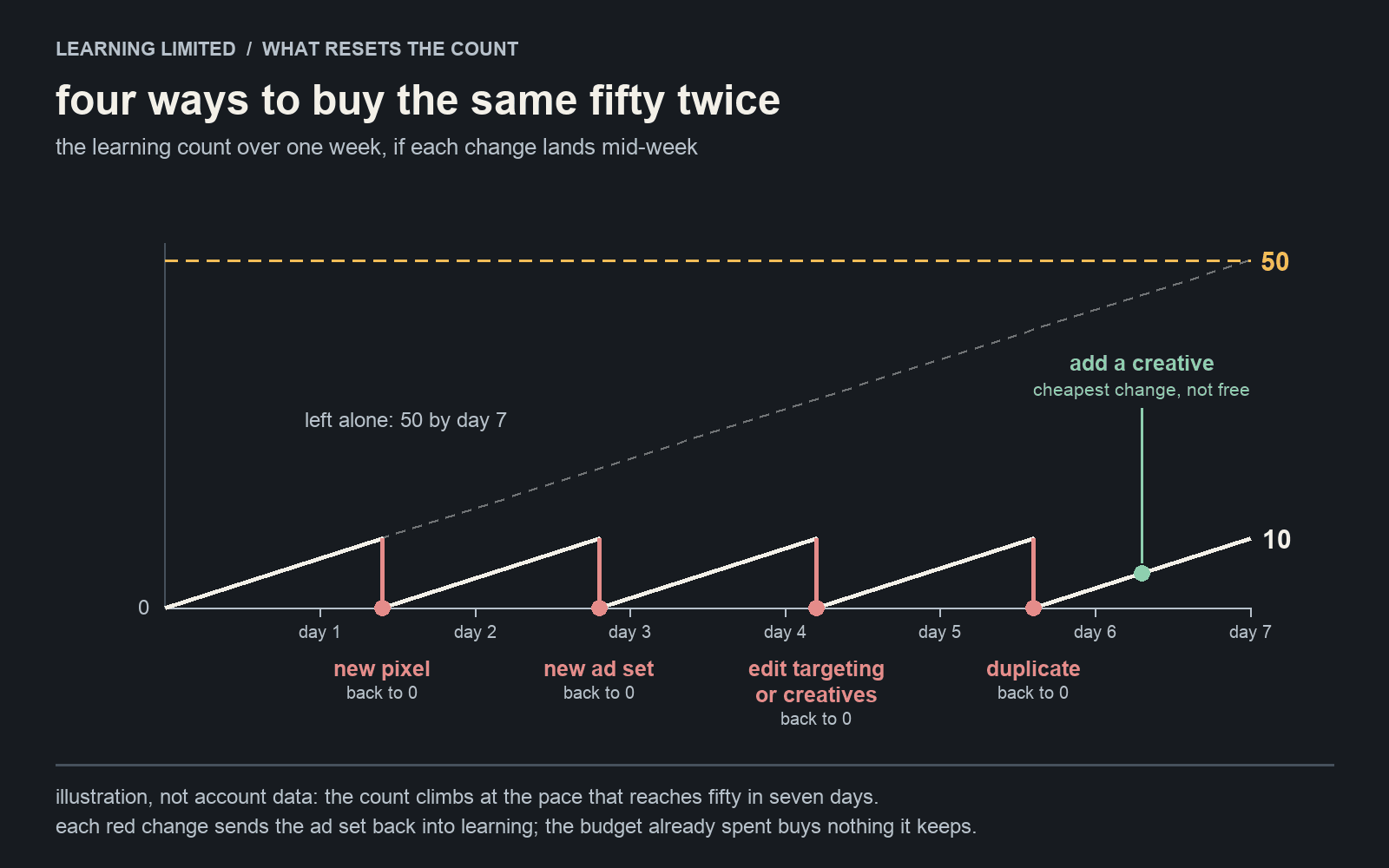
Constructed illustration. Four changes send the count back to zero; adding a creative is the cheapest change, not a free one.
duplicates do the same thing. a reply in one of the threads put it plainly: "a duplicated ad is a brand new ad with no history and no accumulated engagement." duplicating is a way to start again, which is sometimes what you want. it is never a way to keep what you had.
the question of when to kill a single ad on a new account comes up too — "are the rough rules of turn off ads that reach 1.5-2x cpa and things like that still the same with a brand new account and pixel that haven’t got and data to go off …" — and a cost-per-purchase rule needs purchases to measure with. in the first fortnight there are only a handful. a spend rule is steadier: an ad that has spent two or three times your target cost per purchase with no sales is telling you something. one that has spent less has not had the chance.
Optimise for the deepest step you can afford fifty of, and plan the way back
this is the question the pile asks least and the one that gets most new accounts out.
"is the play to stop optimizing for purchase entirely and buy a cheaper signal (atc, initiate checkout) until there's volume?"
yes, often — and the sum from the first section tells you exactly when. write out the ladder from the bottom of the funnel up: purchase, initiate checkout, add to cart. for each one, estimate what it costs and run the sum. optimise for the deepest step you can afford fifty of a week at your budget. not the cheapest, the deepest that clears.
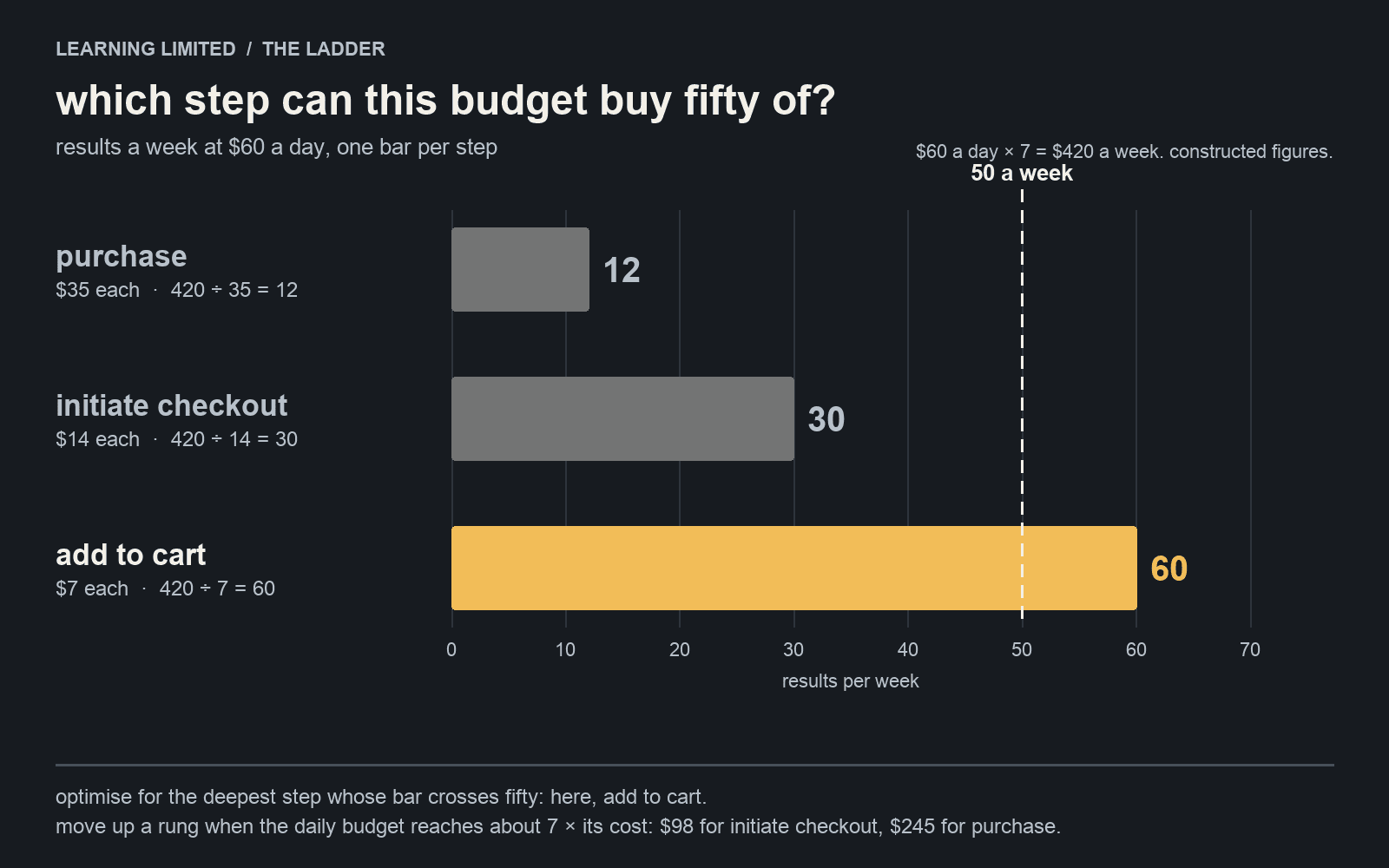
Constructed figures from the worked example. Optimise for the deepest step whose bar crosses fifty; move up a step when the budget reaches about seven times its cost.
that rule does two jobs. it keeps you as close to the purchase as your budget allows, because every step up the ladder is a step away from what you actually want. and it gets the campaign out of learning limited, because by definition you have picked a step it can reach fifty of. you are no longer asking meta to learn from nine sales a week. you are giving it sixty signals.
here is the cost, and it is real. optimising for add to cart is an instruction to go and find people who add to cart. meta will follow it faithfully, including towards people who add to cart and never buy. that is why you judge the campaign on sales, counted in your store, and never on the add to carts it reports. the cheaper signal is how you steer. the sale is still how you score.
one lead-gen advertiser wrote this up in instalments and it is the clearest version of both halves i found. optimising on an earlier step, a quiz start, rather than a submitted lead, they got cheaper delivery and the same outcome: "the quiz-start-optimized ad set also found cpms of ~$22 vs $80 on the lead-optimized one — same cpl from both, wildly different routes." that is the upside. then leads dropped to nothing for over a week, and after ruling out bots, placements and bugs they "converged on optimization-event decay" — which, as i read it, means the cheaper event had drifted away from the people who actually filled in the form. they switched the optimisation back to the real lead on a duplicate, and "cpl went from a 9-day zero streak to $15-25/lead in 48 hours." their own figures for the flipped duplicate: "5 leads at $14.85 (real crm leads, phone + consent, not pixel counts)."
three things in that are worth taking whole. the cheaper event worked, for a while, at a quarter of the cost to reach people. it stopped working in a way that only showed up in the real outcome, not in the step it was optimising for. and they caught it because they were counting leads in their own system rather than trusting the pixel's count — which is the rule above, scoring on the thing you actually want.
so plan the way back before you start. a cheaper signal is a rung, not a destination, and the move back up is the one time paying for data twice is the right call — as long as you do it once, on purpose, when the sum says you can.
the trigger is the same sum again. when your budget reaches about seven times the cost of the next step up, you can afford to optimise for it. at a $15 initiate checkout that is around $105 a day; at a $40 purchase it is around $285. move up one rung at a time, by duplicating onto the new step rather than editing the old ad set — changing what it optimises for resets it anyway, and a duplicate leaves you something to go back to. give the new ad set its week, and keep whichever one produces the lower cost per purchase in your own store.
the other question people ask here is when to start scaling — "and what's a realistic timeline and trigger for scaling (increase by 20% every x days after y purchases, or wait until you exit the learning phase)?" — and one reply in the pile answers it better than i can: "the 20 percent budget rule assumes you're scaling something that already exited learning." which is the point. the rung you pick is what gets the ad set out of learning. scaling its budget is the step after that, not a way to get there.
A new store's first month, worked end to end
here is the whole route on one account. the costs are constructed to keep the sums clean; the method is the part to copy.
a new store, a new pixel, $60 a day to spend. the products sell for about $45 and the store can afford around $30 to win a first purchase. guesses at what each step will cost, taken from the first few days and adjusted as real numbers arrive: $35 a purchase, $14 an initiate checkout, $7 an add to cart.
day 0, the sum. $60 a day is $420 a week. at $35 a purchase that buys 12 purchases, at $14 an initiate checkout 30, at $7 an add to cart 60. only one of those clears fifty. so the campaign optimises for add to cart — the deepest rung the budget can afford — and the plan is written down now: move to initiate checkout when the daily budget reaches about $98 (seven times $14), and to purchase at about $245 (seven times $35).
day 0, the pixel. one real order on a discount code. the purchase fires once in events manager, carries the right value, and the server and browser events deduplicate. crossed off.
week one, the setup. one campaign, one ad set, the whole country, adults, no interests. three creatives, the three videos the owner believes in most. $60 a day. and then nothing gets touched for seven days, including on day three when the numbers look bad, because day three always looks bad.
end of week one, the read. the campaign reports 61 add to carts, clears fifty, and comes out of learning. that is the label handled. but the add to carts are the steering, not the score. the store recorded 12 sales; events manager received 11 purchases. the pixel is fine — one missing out of twelve is a blocker or a declined cookie, not a fault. $420 across 12 sales is $35 each, against a $30 target. close, and on 12 sales, too thin to act on either way.
week two, the one change. one creative has spent $95 and made no sales, which is past three times the $30 target, so it goes. a new video is added rather than an existing creative being edited — adding is the change that costs least — and the other two are left exactly as they are.
the new video is the cheap part if you make it from the product photo you already have instead of booking a shoot. this is how, step by step: https://clear-cortex.com/playbooks/how-to-make-an-ad?src=x-new-account-mid
weeks three and four, scaling the budget. the ad set has exited learning, so the 20 percent rule now applies to it: it goes up about a fifth at a time, $60 to $72 to $86 to $100, a few days apart, watching the cost per sale in the store after each step. at $100 a day the sum for the next rung up is $700 ÷ $14, 50 initiate checkouts a week. it clears.
end of the month, the move. the ad set is duplicated onto initiate checkout at $100 a day and the add-to-cart one is paused, kept rather than deleted. this is the deliberate pay-twice: the new ad set starts learning from nothing, and that is accepted, once, because it moves the optimisation one step closer to the sale. a week later the two are compared on the only number that decides it — cost per sale in the store. if initiate checkout is lower, it stays. if it is higher, the old ad set goes back on and the move waits until the budget is bigger.
what did not happen. no new pixel, no new ad account, no second campaign to test an interest, no ten creatives, no edits in week one, no judging on add to carts. every one of those is a way this month could have bought its first fifty results twice. and the account was out of learning limited inside its first week — not by fixing anything, but by choosing a step the budget could reach.
the counter-case is worth stating because it happens. if the week-one read had come back with 61 add to carts and two sales, the answer is not a better signal or another campaign setup. that is the downstream list from earlier — the page, the offer, the price — and the add to carts are telling you people want it and something between the cart and the payment stops them. the route above gets the delivery working. it cannot make a store convert.
The part i cannot prove
the fifty-a-week figure and the list of edits that reset learning are meta's own documentation, not my measurement. switching to a result you can get more of is on meta's own list of fixes for learning limited, alongside combining ad sets, widening the audience and raising the budget; the sum that tells you which rung you can afford is arithmetic on top of it. none of it is something i discovered, and i do not run a new account at these numbers — if i pretended otherwise the first person to ask which one would end it.
the costs in the worked example are constructed. the numbers quoted from real accounts — the sixteen ad sets at $5 a day, the $22 against $80, the nine-day zero streak and the $14.85 leads — are other people's, from what they wrote about their own campaigns. put your own costs into the sum. it is multiplication and one comparison.
and there is one thing i genuinely do not know. how long a cheaper signal keeps pointing at buyers before it drifts. the lead-gen account above ran well on its earlier step and then fell off a cliff, and they named it decay; i cannot tell you whether that takes weeks or months, whether it depends on the product, or whether add to cart drifts faster than initiate checkout. my guess is that it depends on how many of the people who take the cheaper step go on to buy, and that the only way to see it coming is to watch cost per sale in your own store every week. if you have run an account on add to cart for a long stretch and watched it drift, i would rather have your number than be right.
if any of this is wrong, say so. a correction is worth more to me than agreement.
the one thing this plan asks you to keep doing is feed it new creative without resetting it. that's what i'm building clear cortex for — test ads from a product photo, in minutes, for pence: https://clear-cortex.com/?src=x-new-account-end