 Clear Cortex
How to get unstuck on Meta ads without paying for another agency
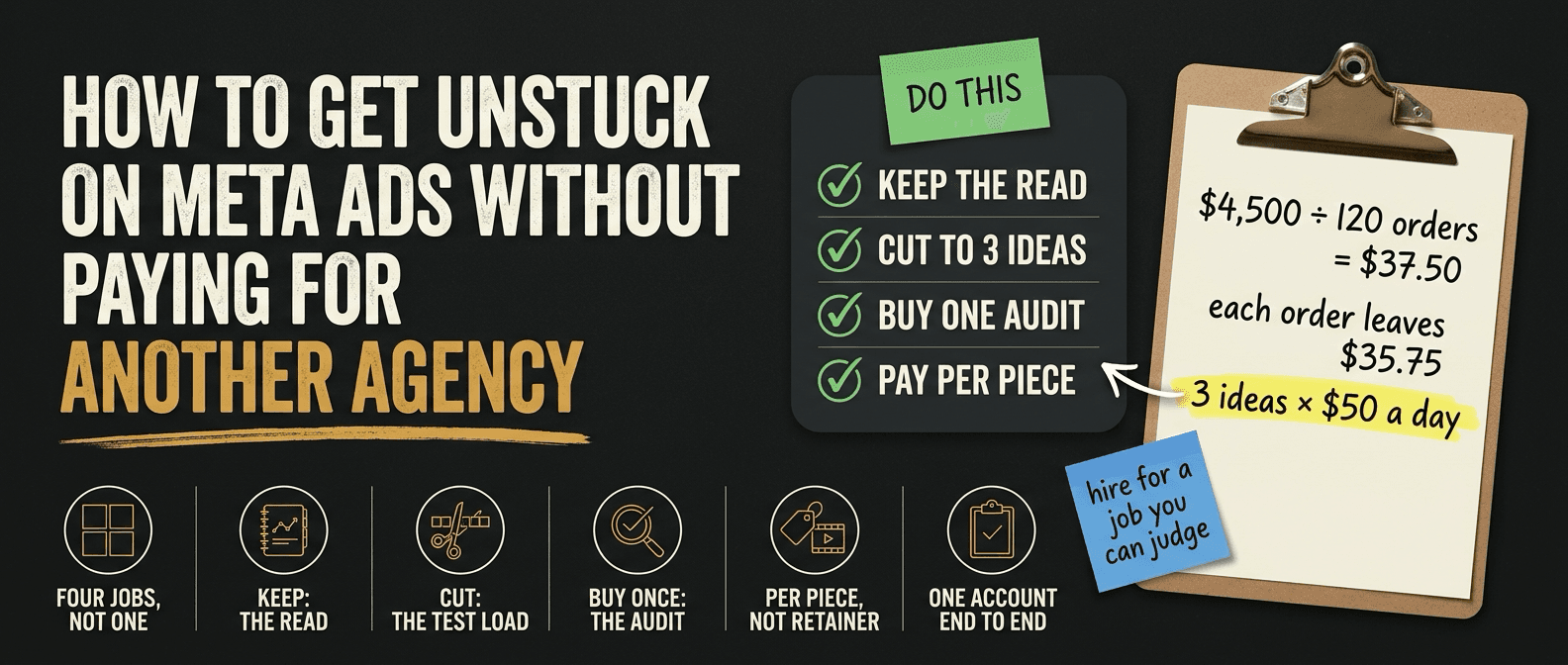
2 months of agency fees, still telling it what to test.
i went looking for how small brands decide who should run their ads — keep learning it themselves, buy an audit, hire a freelancer, sign another agency — and counted 14 versions of the question across 13 separate threads. the loudest came from a two-founder skincare brand four or five months into meta, and it put every option on the table at once. i read the 17 replies to it that i could get to. seven of them answered the question it actually asked, and those seven said four different things: don't hire yet, keep it in house, get the one-time audit, never hire an agency. the other ten mostly diagnosed the account instead.
here is how the question arrives:
"or is this one of those stages where: founders should keep learning themselves · get a one-time audit/creative strategist instead · simplify testing · and just keep iterating internally?"
"for brands spending at this level is it normal to rely on outside creative agencies or how do you do it?"
"do you make them yourself, hire freelancers, or use an agency?"
"should I personally run the ads in the beginning so I understand everything before hiring a media buyer?"
"for anyone experienced with agencies/e-commerce ads: does this sound like a normal pace after about 5–6 weeks live?"
the good news is that the four answers are not really disagreeing. the founder's list is not four alternatives to choose between. it is four different jobs, and the account needs every one of them done by somebody. "running the ads" is a bundle. once you pull it apart, each piece has an obvious owner, most of it costs far less than a retainer, and the stuck feeling turns out to be the bundle, not the account.
that is also what went wrong with the agency. by the founder's own account, its designers were good at following instructions and very little strategy or creative direction came back the other way — which is why two months of fees ended with the founder still deciding what to test. that is not proof agencies don't work. it is what happens when a brand buys the part of the job it could already do and still has the part it couldn't.
so here is the whole thing, in order. the four jobs hiding inside "running the ads", which one you keep, which one you cut down, which one you buy once and which one you pay for by the piece — then one account worked end to end, and the signal that tells you when a retainer is finally the right answer. nothing is held back and there is no gate on any of it.
the cover on this piece was made in clear cortex for about 8p, on the cheapest model that could spell the headline. that's the studio i'm building, and it's the only ask in this piece: https://clear-cortex.com/?src=x-get-unstuck-top
The stuck stage is four jobs, not one
when people say "running meta ads" they mean four jobs that run at different speeds and need different skills:
- the read. once a week: is the business making money on the ad spend, and is that getting better or worse. this is judgement about your own numbers.
- the test load. how many creatives are live at once, on what budget, chasing which goal. this is setup, and at this stage it is mostly about doing less.
- the check. is anything broken underneath the campaign — what it is optimising for, whether the tracking agrees with the store, where the clicks are coming from, whether the page keeps the ad's promise. this is an inspection by somebody who has seen a lot of accounts.
- the making. the creatives themselves — the videos, the statics, the UGC. this is production, and it is the only one of the four that grows as the budget scales.
an agency on a retainer sells all four for one monthly price. the trouble at this stage is that the four are not worth the same to you. the read has to stay yours, because it is the decision about what the money is for. the check is worth paying an expert for, but once. the test load mostly needs cutting, which costs nothing. and the making is the one job that is genuinely worth handing off — by the piece first, and on a retainer only when the volume is there.
put the founder's list next to that and it maps almost one for one:
- the read is "founders should keep learning themselves"
- the check is "a one-time audit/creative strategist"
- the test load is "simplify testing"
- the making is "just keep iterating internally"
the option that is missing from the right-hand side is the one they were weighing up — another agency — and that is not because agencies are bad. it is because at $100–150 a day, a retainer is a monthly fee for four jobs when two of them should be yours and one of them should only happen once.
the most useful reply in the thread got close to this. it said not to jump straight to another agency, and split the problem into separate questions — whether the business maths still works, whether what they need is guidance, execution or leadership, and this one, which is the one most people skip:
"is the creative system producing meaningfully different tests?"
that reply also gave the place to start, and it is the first job.
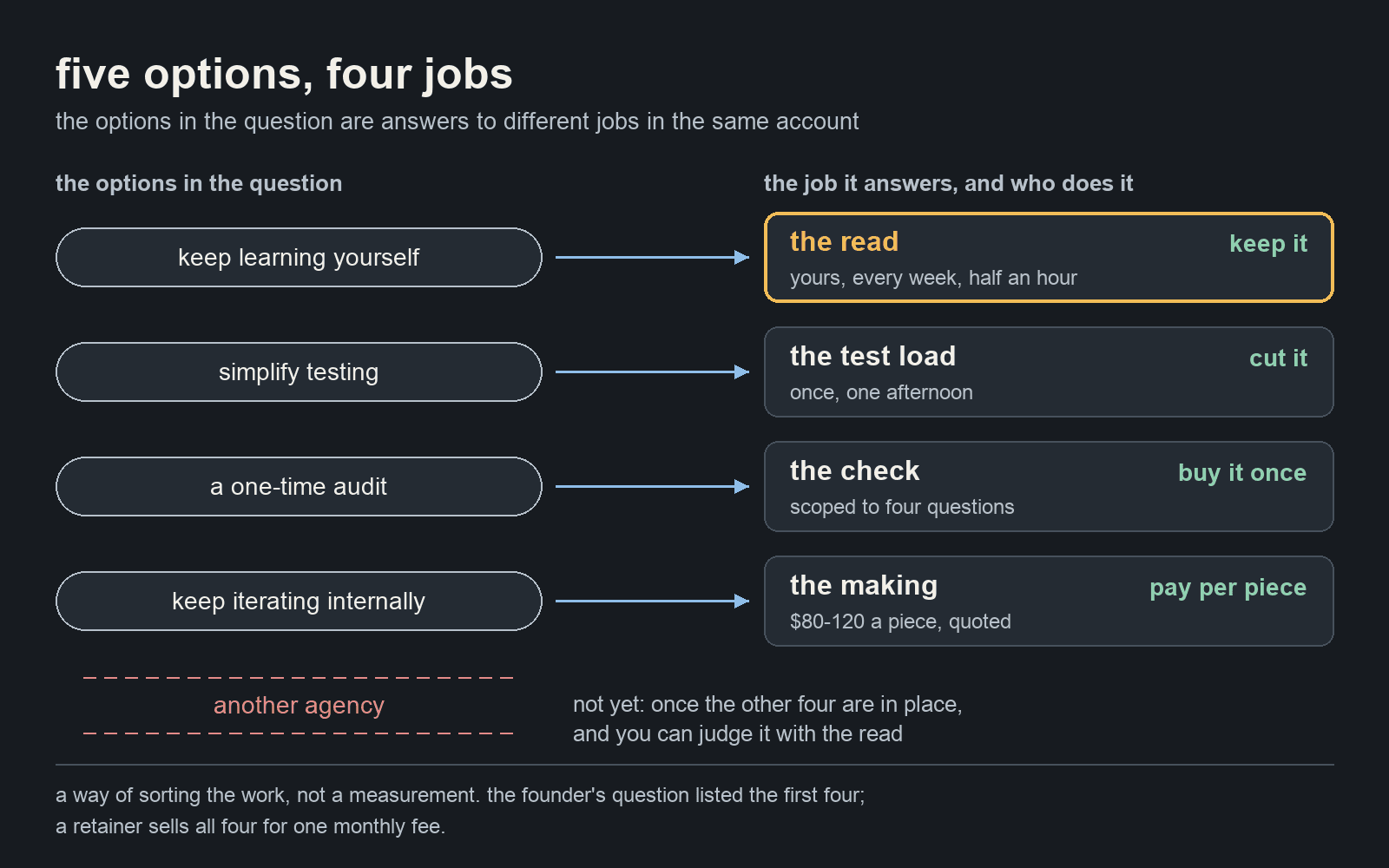
How the options in the question map to the jobs in the account. A way of sorting the work, not a measurement.
Keep this one yourself: the read
the read is the one job you cannot hand off, and the reason is simple. whoever does it is deciding whether the ad spend is working. if that is the agency, then the agency is marking its own work.
it is also much less than it sounds. the reply that split the problem said to start here: "first, pull this out of ads manager and look at the business view" — one row per month with net sales, cost of delivery, gross profit, ad spend and contribution profit. and it defined the terms so nobody talks past anybody. cost of delivery is "product cost, packaging, pick/pack, outbound shipping, payment processor fees, and return handling." and the one that changes how you read the whole account:
"blended CAC = total ad spend divided by total orders from shopify for the same period, not meta's cost per purchase."
that sentence is most of the read. meta counts every purchase it can reasonably claim. your store counts orders. those two are rarely the same number, and only one of them pays for the stock. so the weekly read is one comparison: what an order costs you to get, from the store's numbers, against what an order leaves you after the product, the shipping and the fees. if the first is under the second, the campaign is making money and the job is to scale the budget. if it is over, the campaign is losing money on every order and the job is to fix it before adding budget.
that matters most for the goal the founder set: "goal is to scale this to $1M+/year eventually". scaling a budget into an order that loses money scales the loss. the read is the thing that tells you when more budget is worth spending, and nobody whose fee rises with your spend is the right person to make that call for you.
that is half an hour a week once the sheet exists, and it is the half hour that makes everything else in this piece possible. it tells you which of the other jobs is urgent. it tells you whether an audit found something real. and it is the only way to judge an agency later, because an agency's report will be in meta's numbers and your read will be in the store's.
the read is also where most of the panic goes. the founder described creatives pulling click-through rates of 20–30% while conversion fell below 1% — numbers that feel like the account is falling apart. maybe it is. but a strange click rate is a fact about one creative, and the read is a fact about the business. if blended CAC is still under what an order leaves you, you have a working campaign with an odd creative in it. if it is not, you now have a specific gap in dollars and a specific question to take to the check. either way you have stopped guessing.
what "founders should keep learning themselves" should mean at this stage, then, is narrower than it sounds. not bidding strategies, not audience theory, not every setting in ads manager. the read, and enough of the test load to know what you are asking for. everything else can be bought.
Simplify this one: the test load
this is where the replies were most in agreement, and the good news is that it costs nothing to fix. the founder was running one campaign at $100–150 a day with 10–15 creatives in it at a time. the replies said it in several ways:
"$150 per day does not let you test 10 - 15 creatives at one time."
"you are spreading your budget too thin across too many ads."
"added too many creatives (i feel at that budget 15 is a lot)." — from somebody spending about the same, listing what had broken their own results.
and the mechanism, from someone asking the right follow-up: "meta will identify a couple creatives that get you sales and allocate all the budget on them, especially with your current structure." so most of the fifteen are not really being tested. they are sitting in the ad set at a few dollars a day while two of them take the budget, and the founder is reading all fifteen every morning as if they were. another reply put the platform's side of it: "meta says learning limited happens when there are not enough optimization events, so $100–150/day with fragmented tests can stay noisy."
i have written the arithmetic of what a creative test has to cost separately, so here is just the simplification, in four moves:
one goal. the first question in the thread is the right first question: "is the campaign goal traffic or purchases?" a campaign asked for clicks will find people who click. if it is not set to purchases, nothing else in this section matters yet.
three ideas, not fifteen. at a $150 daily budget, fifteen creatives is $10 each if the budget were split evenly — and it will not be. three is $50 each, which is enough for each to show you something within a week or two. one campaign, one ad set, three ideas. the number three is not magic. it is what this budget can feed, and it goes up when the budget scales.
make the three genuinely different. this is the question from the split reply again: "is the creative system producing meaningfully different tests?" the founder said many of the new creatives were variations of previous winners. three variations of one winning video is one idea in three outfits, and the platform will treat them that way. three ideas means three different reasons to buy — for a skincare brand, say, one UGC video built on proof (reviews, before and after), one on the ingredient, one static on the offer.
three genuinely different ideas do not have to mean three video shoots. here is one product turned into six different ads: https://clear-cortex.com/playbooks/one-product-six-ways?src=x-get-unstuck-mid
then leave it alone for a week. the founder described their days going on analysing old winners, making iterations, trying new hooks and reverse-engineering what changed. that loop feels like work and mostly resets the thing it is trying to measure. three ideas, purchases as the goal, seven days untouched, then the read.
the time this gives back is the real prize. the hours that went on daily iteration are the hours the read and the briefs need, and simplifying is the step that frees them.
Buy this once: the audit
the check is the job where somebody else's experience is worth the most, because the person doing it has seen many accounts and you have seen one. it is also the job where a monthly fee makes the least sense, because the questions it answers have answers. once the tracking is confirmed and the placements are cleaned up, paying every month to have them confirmed again is the retainer trap in miniature.
so buy it once, and scope it before anyone starts. bring three things: your read for the last three months, the simplified test plan, and access to the ad account. ask four questions, in writing:
- is every campaign optimising for purchases, and does the tracking agree with the store? if meta reports 160 purchases in a month and the store shows 120 orders, somebody needs to say where the other 40 came from.
- where are the clicks coming from? the founder saw the audience suddenly skew to 65+ and click rates above 20%. three of the replies independently suspected bot or low-quality traffic, and one of them said to start with the placement breakdown. that is a breakdown an auditor can read in minutes and a founder can spend weeks guessing at.
- does the page keep the ad's promise? the reply that listed what to check on a skincare page ended on the one that matters most at a 20% click rate: "how fast the page explains why this product beats the 50 other skincare options". i wrote the whole post-click check up separately; the audit only needs to say whether the page is the leak.
- is the structure right for the budget? one campaign or two, how many ad sets, how many creatives per ad set, at what you actually spend.
what you should get back is a ranked list, not a proposal. what to change, in what order, what to leave alone, and which number in your read each change should move. if the findings do not touch the numbers you brought, it was a sales call with a report attached.
the same rule covers the other half of that option, the "creative strategist". at this stage that is one session that produces the brief for the three ideas — the reasons to buy, the proof for each, what the first three seconds of each video should show — not a monthly seat. the brief is the expensive thinking. once you have it, the making is the cheap part.
Pay per piece before you pay a retainer
the making is the only job that grows with the account, and it is the one where a founder's time runs out first. the founder in the loudest thread was making founder UGC, statics, testimonials and AI video, all at once, mostly alone. it is also the job with the clearest market price, because people post their quotes:
"when i started paying freelancers for statics early last year the going rate for decent work was $45-60 a creative."
"same tier of freelancer now quotes me $80-120, and two of them added minimum batch sizes."
and the other end of the market, from the same founder: "agencies ive talked to dont even want the conversation under a $2-3k/mo retainer."
put those prices next to a simplified test. three ideas live, one new idea replacing the weakest each week, is four new creatives a month — videos, statics or UGC, whatever the idea needs. at $80–120 a piece that is $320–480 a month — against a retainer whose price starts at $2,000–3,000, whatever the brand spends. the question somebody asked has exactly the right shape: "for ad creative, would you just pay an editor per video/creative at first or hire someone part-time once you're producing a lot of ads?" yes, per piece first: a price per video or per static, paid when you need one. a person, part-time, once the per-piece bill is bigger than the person would cost. you will know that number from your own quotes when you get there.
so when is an agency the right answer? when the other three jobs are already in place. the read is yours and weekly. the test load is three ideas on one goal. the check is done and its list is worked through. and you are still the bottleneck, because the budget has scaled past what one person can feed — there are not enough hours in the week to brief, make, launch and read. that is the point where paying for the bundle makes sense — and, more importantly, the point where you can tell whether it is working.
the founder five or six weeks into an agency shows why the order matters. the setup was "$2,500 USD/month retainer 10% of ad spend (ONCE PROFITABLE)", on ad spend of around $6k a month, with ROAS around 1.2x — and "not yet profitable from paid ads (if retainer taken into account." that retainer is over 40% of the spend. then the question:
"what should I be asking them during the weekly meetings, and should I insist on getting access to the actual ad account?"
the answer to both halves is the read. bring the store's numbers to the meeting, ask what each change was meant to move and whether it moved it, and yes, own the ad account — it is the record of everything your money has learned. hire for a job you can already judge. that is the whole rule, and it is the reason the read comes first.
One account, worked end to end
here is the whole thing on one account. the numbers are constructed to keep the arithmetic clean — they are not the founder's, and not from an account i run — so put your own in.
a two-person shop spends a $150 daily budget, about $4,500 a month, on one campaign with 12 creatives live — a mix of video and statics. conversion has slipped, a couple of creatives have strange click rates, and the founder is spending most mornings in ads manager.
week one, the read — one evening. last month the store took 120 orders at an average of $55: $6,600 in net sales. cost of delivery runs at 35%, so $2,310, leaving $4,290 gross profit. take off $4,500 of ad spend and contribution is minus $210. meta, meanwhile, reports 160 purchases at about $28 each, which looks comfortable. the store's figure is $4,500 over 120 orders: $37.50 to get an order that leaves $35.75. every order costs $1.75 more than it makes.
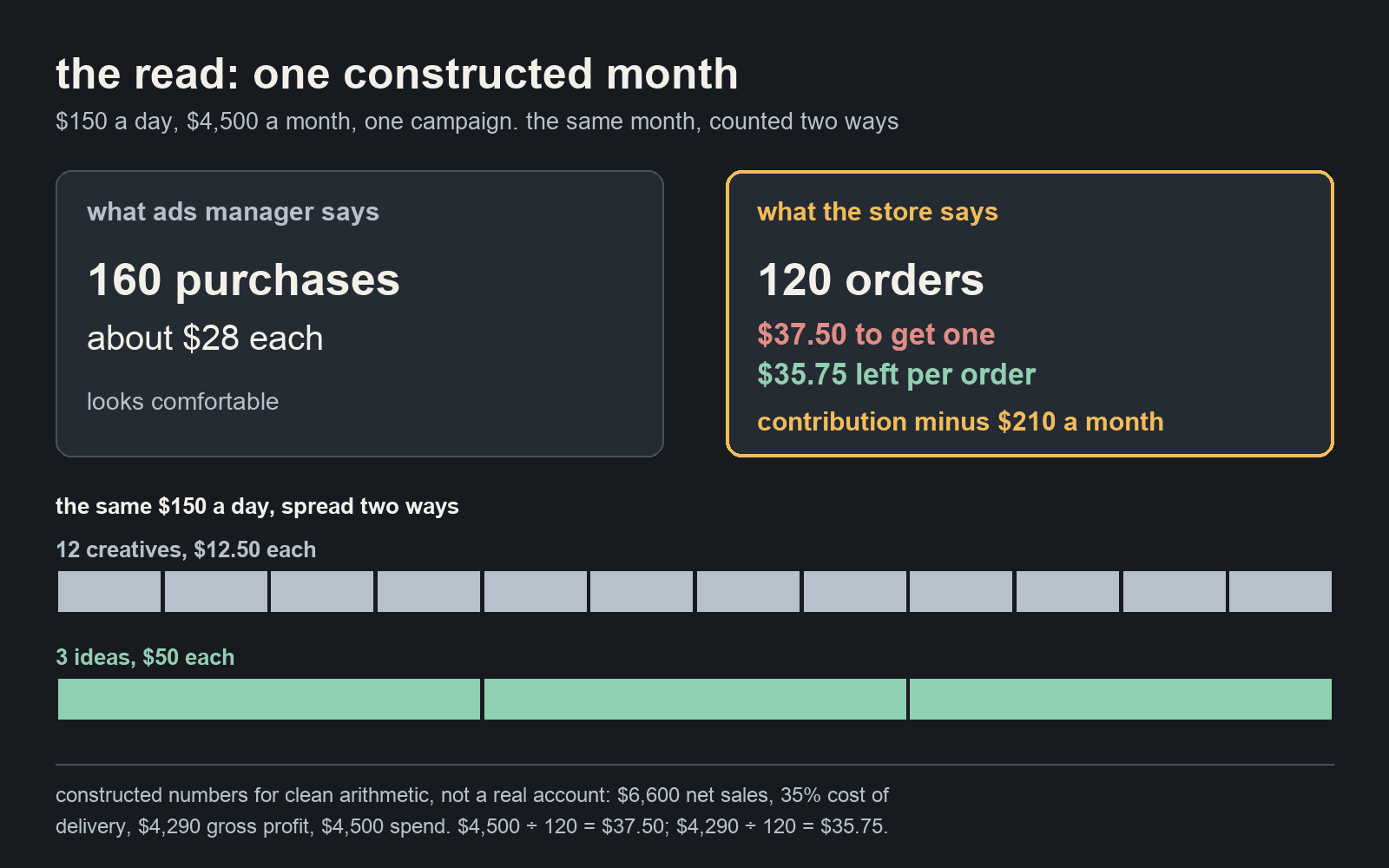
Constructed numbers for clean arithmetic, not a real account. The gap between the platform's purchases and the store's orders is illustrative.
that is good news, and it is worth saying why. the account is not collapsing. it is $210 a month underwater, and the gap is small and specific. on the same spend, six more orders a month closes it — $4,500 over 126 orders is $35.71. so does a bundle at the top of the page that lifts the average order by under $3, because at $57.70 an order leaves $37.50. either is a far smaller job than a new agency.
week one, the test load — one afternoon. twelve creatives become three ideas: a proof video, an ingredient video, an offer static. $50 a day each, the campaign confirmed on purchases, and then nobody touches it for seven days. the mornings in ads manager stop.
week two, the check — bought once. the founder sends an auditor the read, the plan and account access, with the four questions. the list that comes back, in this example: the 40 purchases meta counts and the store does not are mostly attribution, not missing orders, so stop reading meta's $28; most of the 20%+ click rates come from one placement, which gets switched off; the page opens on the single product while two of the three ideas sell the bundle, so the top of the page changes. each item names the number in the read it should move.
weeks three to six, the making — by the piece. each week the weakest of the three ideas comes out and a new video or static goes in, made by a freelancer at a price per piece: four a month, $320–480 at the quoted rates. the founder's time is half an hour on the read and an hour on the brief each week.
week six, the decision. two questions. is blended CAC under what an order leaves? and is the founder the bottleneck because of judgement or because of hours? if it is hours — there are more good ideas than time to brief and launch them, and the read says the budget is ready to scale — that is when an agency or a part-time person is worth paying, with the read in hand to judge them. if it is still judgement, another month of the same, because no retainer fixes not knowing what you want from it.
nothing in that six weeks needed a retainer, and none of it was guesswork. the founder kept one job, cut one, bought one once and paid for one by the piece.
The part i cannot prove
the four-job split is a way of sorting the work, not something i measured. it fits the founder's own list almost exactly, which is why i used it, but a different split would be defensible.
the worked example is constructed for clean sums, and the audit findings in it are invented to show the shape of a useful list — they are not what any audit found. the real figures in this piece are other people's, from what they wrote about their own accounts: the $100–150 a day and the 10–15 creatives, the 20–30% click rates and conversion under 1%, the $2,500 retainer on about $6k of spend at 1.2x, the freelancer rates going from $45–60 to $80–120. i am taking their word for all of it.
what i could not find is a price for a one-off audit. nothing i read quoted one, so i have not put a number on it, and how much it should cost against a month of retainer is the one comparison this piece cannot make for you. i also cannot tell you what was actually wrong with the skincare account. the replies suspected the page, the placements, bot traffic and the number of creatives, and some of them were probably right. the method here is how you would find out, not a diagnosis.
and one honest limit on the agency point. one agency that followed instructions and brought no strategy is one agency. there are agencies that do the read for you and do it well. the argument is not that they don't exist. it is that until the read is yours, you cannot tell which kind you have hired.
if any of this is wrong, say so. a correction is worth more to me than agreement.
once the read is yours and the test is three ideas, the job that keeps coming back is making the next one. that's the part clear cortex does — test ads from a product photo, for pence per image: https://clear-cortex.com/?src=x-get-unstuck-end