 Clear Cortex
How to make variations without making the same ad 31 times
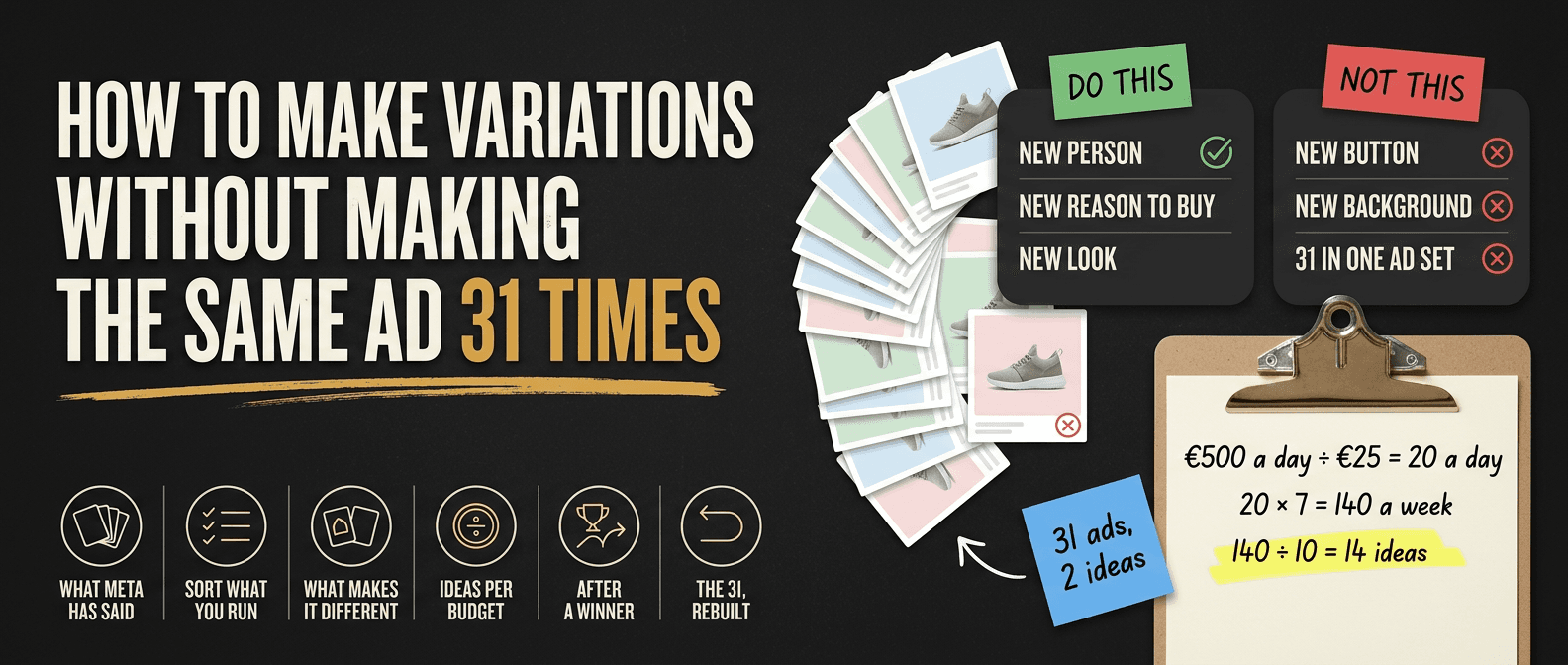
31 variations of one product in one ad set.
that is one person's last launch, in their words: "last one had 30+ image variations of the same product line, all in one ad set, with a daily budget of about 500 euros total for all 31 of them." and what happened next is the part everybody who has done this will recognise: "once one ad gets a tiny early lead, it grabs almost all the budget and the rest barely gets shown, so you never really know if the others would have worked too."
i went looking for how many variations is the right number and counted 20 questions about it from 15 different people. half of them ask how many — how many per winner, per concept, per ad set, per month. only five ask what kind, and every one of those five is framed as a choice between two things: small tweaks or a fresh concept, iterate on one video or test new angles. the closest anyone gets to asking what makes one ad different from another is a single question about fatigue — and that is the question the number depends on.
the questions, as they were asked:
"does andromeda change how you build out variants now, more distinct ideas instead of small tweaks?"
"once you find a winner, how many variations do you make from it?"
"would one campaign, one group and 10 different ad variations be good for a 1.5k euro budget a month?"
"when a winning asset finally hits a wall, do you prefer small, iterative adjustments to hooks and thumbnails, or do you dive straight into an entirely fresh concept overhaul?"
"how many creatives per persona before you admit you're just making variants?"
the good news is that this is more workable than it feels from inside an ad set with 31 things in it. meta has now said in plain words how it treats ads that look alike, and once you take that at face value, most accounts need fewer new ads than they are making, not more — just different ones.
so here is the whole method, in the order to run it. what meta has actually said, three questions that sort any ad you already have into ideas, a division that tells you how many ideas your budget can carry, and a rule for what to make once something wins. about half an hour with the ads you already have running. nothing is held back and there is no gate on any of it.
the cover on this piece was made in clear cortex for about 8p, on the cheapest model that could spell the headline. that's the studio i'm building, and it's the only ask in this piece: https://clear-cortex.com/?src=x-distinct-ideas-top
What meta has actually said about near-copies
there is a lot of folklore about andromeda, so it is worth separating what meta has published from what people have built on top of it. i am going to be strict about that line, because the whole method rests on it.
what is documented. andromeda is the retrieval stage of meta's ad delivery. meta's engineering team described it in december 2024 as the step that narrows tens of millions of candidate ads down to a few thousand before the ranking models decide what actually gets shown. that is the plumbing. it is not, on its own, a statement about your variations.
the statement about your variations came a year later, in a meta for business post on creative diversification in december 2025. this is the sentence that matters, in their words:
our ads system also analyzes creatives and groups together ads that share key visual and thematic attributes. when multiple ads look or feel alike, these are seen as variations of the same creative, meaning learnings and delivery optimizations are shared at the creative level – not just the individual ad level.
the same post describes andromeda's job in one line that is worth having in its exact words — it selects a few thousand candidates so only the most relevant and distinct creatives move forward. and it gives the example of what a genuinely different ad is: one that speaks to a different motivation or use case — emotional appeal against product features.
read that sentence slowly, because it answers the first question in the pile. yes, it changes how you build variants. thirty-one ads that look and feel alike are, by meta's own description, thirty-one copies of one creative as far as learning is concerned. the system is not evaluating thirty-one ideas. it is evaluating one or two, thirty-one times over.
what is not documented, and what i am inferring. meta does not publish where the line is — how alike is alike, which attributes count, or how many groups your account contains. there are blog posts circulating with similarity scores and thresholds and talk of "entity ids"; i have not found those numbers in meta's own documentation, so none of them are in this piece. everything below that goes further than the quoted sentence is my reading of it, and i will say so each time.
one inference i am fairly comfortable with, because it follows directly: the budget-grabbing behaviour in that opening quote is what you would expect if the 31 were one creative to the system. if learning is shared across a group of near-copies, there is very little reason for delivery to spread money evenly across them. it finds the one that is slightly ahead and backs it. the rest barely get shown — and the uncomfortable, useful part is that they probably would not have done much better. near-copies of a winner mostly perform like the winner. forcing spend onto them would buy you thirty readings of one idea.
that is also the honest answer to the person who wrote "when an ad fails, they make a lazy tweak, changing the background from blue to green, or changing the button from 'shop now' to 'learn more.' post-andromeda, this is useless." useless is slightly too strong — those ads still run, and they still spend. what they no longer do is count as a new test.
Sort what you already run before you make anything new
before producing a single new ad, find out how many ideas you are actually running. it is almost always fewer than the number of ads, and the gap is the whole problem.
take every live ad in the ad set and answer three questions about each one. write the answers down in a few words — not a description of the ad, the answer to the question.
- who is it talking to, in what situation? not the targeting — the person the ad is visibly addressing. a parent in the morning rush, a founder doing their own books, someone who has already tried two competitors.
- what reason to buy does it give? the angle. it saves time, it costs less, it works where the other thing failed, it looks good in your kitchen. one line.
- what does the first second look like? the visual world. a person talking to camera, a product on a plain background, a screen recording, a before-and-after, a lifestyle shot. this is the visual half of what meta says it groups on.
then sort. any two ads with matching answers on all three are one ad, whatever else differs between them. the background colour, the button, the headline wording, the music, the first three words of the voiceover, the thumbnail, the crop — none of those change any of the three answers, so none of them make a new idea.
the number of piles is the number of ideas in your account. the number of ads is just the number of ads.
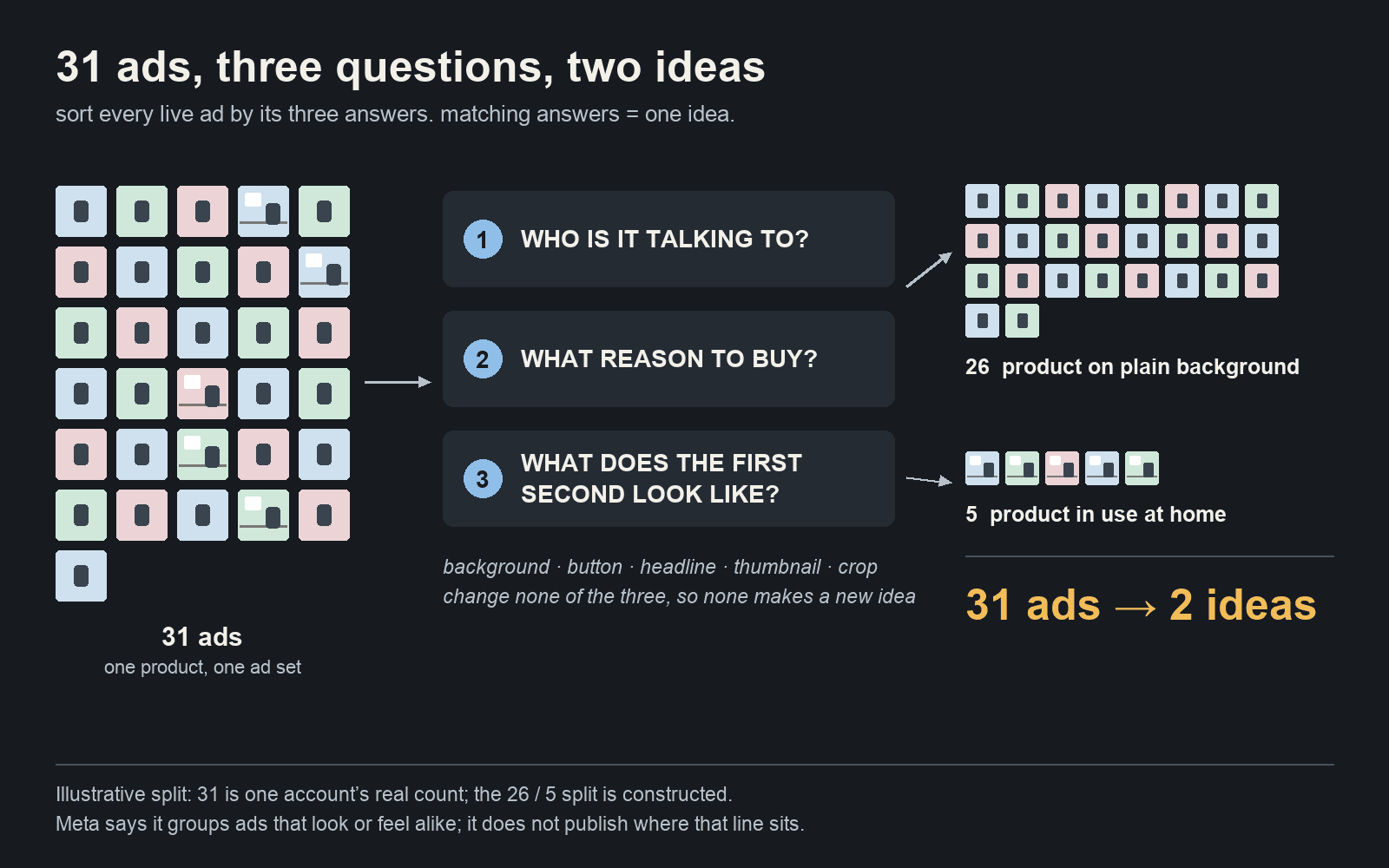
Illustrative split. Meta says it groups ads that look or feel alike; it does not publish where that line sits, so the sort is a working test, not Meta's rule.
it works identically on video, and video is where it matters most, because video is where a tweak is cheapest to make and easiest to mistake for a new ad. one ugc video with four different hooks cut onto the front of it is four files, four rows in ads manager and, by the three questions, one idea — the person, the reason and the world all arrive intact after second three. a new creator saying something else in a different setting is a new idea even if you shot it on one phone.
this sounds obvious written down, and it is striking how rarely it gets done. the question "do you mostly test completely new e-commerce angles, or is your volume driven by iterating on 1 ugc video with 3-4 different hooks?" is somebody who has noticed their volume might be one pile wearing four hooks, and has not yet counted.
two things usually come out of the sort.
the first is that the account is running one or two ideas. most variation work happens inside the pile that already won, because that is where the confidence is. so an ad set with twelve ads is often two ideas: the winner and eleven near-copies of it, or the winner, nine near-copies and two genuinely different ads that never got spend because the near-copies were cheaper to make.
the second is that you find out where your next ideas are. a pile is defined by three answers, so the gaps are visible. if every ad in the account is a person talking to camera about saving time, you already know three directions that are untouched: a different person, a different reason, a different visual world.
What makes a variation a different idea
so what counts as distinct? this is the question that got asked five times as a false choice — small tweaks or a fresh concept — and the useful answer is that there is a middle, and the middle is where most of the good work is.
a tweak changes nothing on the three questions. new background, new button, new headline wording, new thumbnail, a new hook laid over the same body. meta's description says ads that "look or feel alike" are grouped, and a tweak by definition keeps both the look and the feel. treat every tweak as the original ad. it is not wasted — it can be a better version of that ad — but it is not a new idea and it will not be read as one.
a new idea changes at least two of the three, and one of them is the look. a different person and a different world. a different reason to buy and a different visual. here is the reasoning, and it is an inference, so i want to show it rather than assert it: meta's sentence groups ads that share visual and thematic attributes, and gives look or feel alike as the test. read strictly, an ad that changes only its argument but keeps the exact same template might still look alike, and an ad that changes only its template but says exactly the same thing might still feel alike. i do not know which way the system leans in any given case, and meta does not say. changing both is the only version where i would expect it to be read as distinct under either reading.
the move between the two is an adjacent idea, and it is the one to reach for most often: keep one answer that you have evidence for, and change the other two.
- same reason to buy, new person, new world. the argument that won, said by somebody else in a different setting. it keeps what you know works and gives the system something that neither looks nor feels like the original.
- same person, new reason, new world. the face or voice your audience already responds to, making a different case in a different format.
- same world, new person, new reason. only worth doing if the visual format itself is the thing you have evidence for — a founder-to-camera style that keeps winning, say.
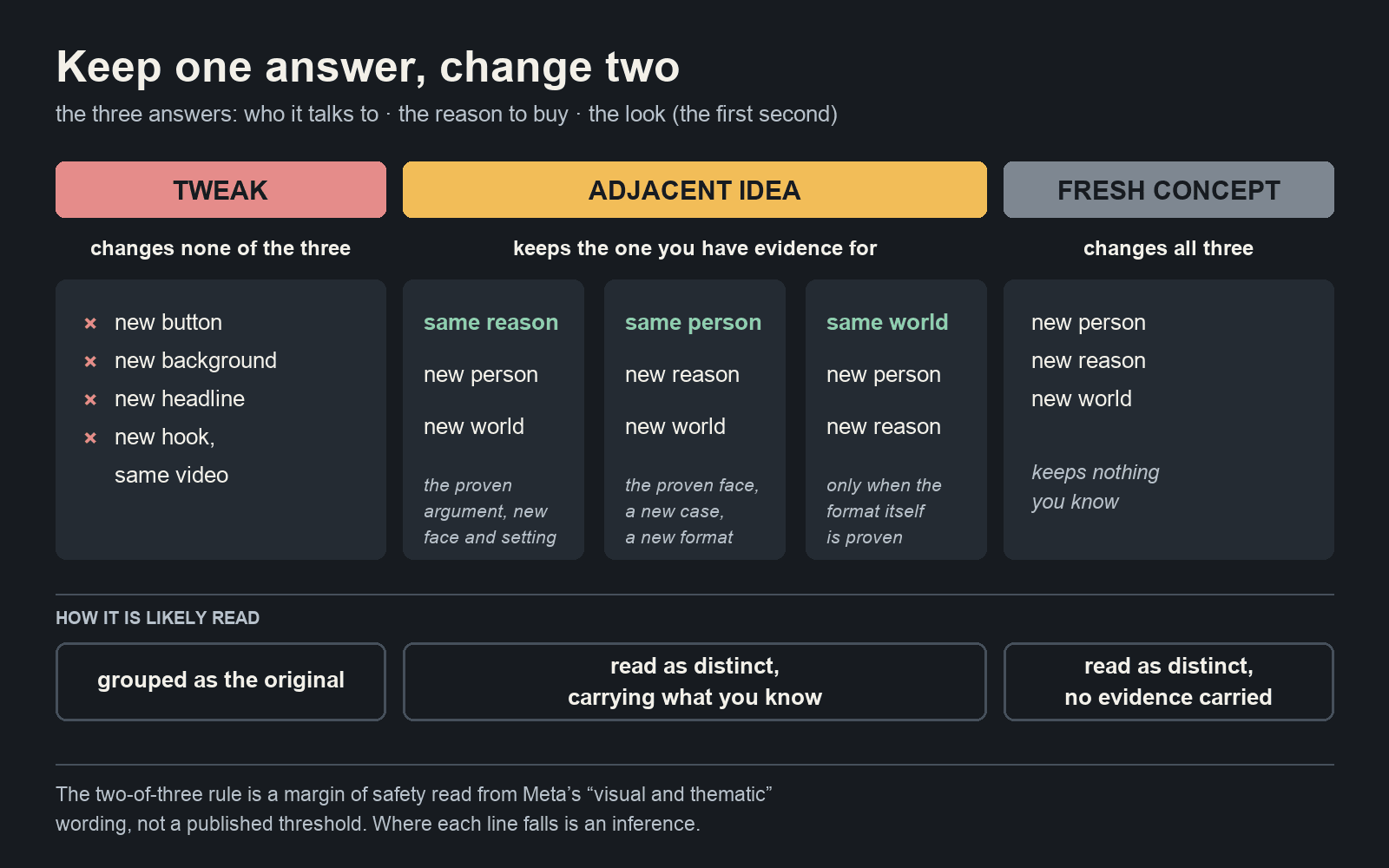
The two-of-three rule is a margin of safety read from Meta's "visual and thematic" wording, not a published threshold.
an adjacent idea costs about what a tweak costs to brief, and it is a new idea rather than a new version. that is the trade the whole "more distinct ideas instead of small tweaks" question is really asking about, and it is available to almost every account.
this is what that looks like in practice — one product, six genuinely different worlds, not six recolours: https://clear-cortex.com/playbooks/one-product-six-ways?src=x-distinct-ideas-mid
for a product that is a screen rather than a thing, the question comes up in exactly this shape: "and for saas specifically, where the 'product' is a ui and not a physical thing, what kind of variation actually resets fatigue vs just looks different?" the trap with software is that the product never changes how it looks, so every ad drifts into the same screen recording with new captions — one pile. the three questions still work. a different person (the manager who reads the report, not the analyst who builds it), a different job the product does (the one screen that saves them friday afternoon, not the dashboard tour), a different world (the person at their desk talking, not the screen at all). the ui can appear in all of them. it just cannot be all of them.
and personas are this test from the other side. somebody asked "how many creatives per persona before you admit you're just making variants?" — the honest answer from the three questions is: the second ad for a persona is a variant the moment it repeats the first one's reason in the first one's world. one persona can carry several ideas, but only if the reasons or the worlds differ.
How many ideas your budget can carry
now the number, because half the questions were about it. the answer is a count of ideas, not of ads, and the budget sets it.
the arithmetic underneath it i have written out in earlier pieces and will not re-run: an ad set needs roughly fifty conversions a week for delivery to optimise, and below about ten conversions per creative per week the differences between them are noise. take both as given. then:
weekly conversions ÷ 10 = distinct ideas your budget can read at once
the useful change andromeda makes to this formula is in the word ideas. if near-copies share learning, as meta says they do, then the thing that divides your conversions is the number of piles, not the number of ads. i want to be careful here — that is my inference from the published sentence, not something meta has quantified — but it is the reading that matches what people describe, where a set of near-copies behaves like one ad that happens to have thirty files.
so run it on the question that was asked: "would one campaign, one group and 10 different ad variations be good for a 1.5k euro budget a month?"
€1,500 a month is about €50 a day. i do not know their cost per result, so here it is at two illustrative figures:
- at €20 a result: 2.5 a day, about 17 a week. that budget reads one or two ideas.
- at €35 a result: about 10 a week. that budget reads one idea.
the dollar version of it was asked too — "how many ad sets/creatives per ad set in the abo testing phase, and what daily budget would you start at, $50/day?" — and the answer does not change. $50 a day at a $20 cost per result is about 17 conversions a week, so one testing campaign with one or two ideas in it, not five. if the plan was five creatives in that ad set at $50 a day, it only works if those five are one or two ideas, which is exactly the relief below.
and here is the part that should be a relief: ten variations is fine, as long as they are two ideas. five versions of each of two genuinely different ideas is a perfectly reasonable ad set at that budget, because — on the reading above — the variations inside each pile are not competing for separate reads. what would not be fine is ten different ideas at €50 a day — that is ten piles sharing seventeen conversions a week, and none of them will ever have enough behind it to say anything.
that division, pointed the other way, is what makes the 31 interesting. €500 a day is a lot of reading capacity. at €25 a result that is 20 conversions a day, 140 a week — enough to read about fourteen distinct ideas at once. at €50 a result it is still 70 a week, room for seven. the budget was never the constraint on that ad set. it could have been testing somewhere between seven and fourteen ideas, and by the sort above it was very likely testing one or two.
that is the most common shape of this problem, and it is why the positive version of the andromeda answer is true: most accounts do not need more ads. they need the ads they already make to be spread across more piles.
What to make once something wins
"once you find a winner, how many variations do you make from it?" is the question with the most money attached, so it is worth being specific about what variations of a winner are for. they have two honest jobs, and testing is not one of them.
the cleanest way to say it: new ideas are how you test, and variations are how you scale. somebody asked "how many ad variations do you test before scaling?" and the answer that falls out of meta's sentence is that variations are not really tested at all — they share the winner's learning, so they belong on the scaling side, in the campaign that is spending the money, not in the testing campaign that is trying to find the next idea.
job one: fit. one idea in the shapes your placements need — the vertical cut for stories and reels, the square or 4:5 for feed. these are one ad, deliberately, and meta grouping them is exactly what you want. make as many as you run placements. usually that is two or three.
job two: a better version of that idea. a stronger opening, a tighter edit, a clearer first frame. these compete inside the pile and delivery will back whichever does best, which is the behaviour from the opening quote working for you rather than against you. two or three is plenty. past that you are paying to make files the system will largely treat as one.
so my working number is the placements you run plus two or three, and then stop. that is a judgement, not a finding, and i say more about it at the end. what i am confident about is the direction: the thirtieth near-copy of a winner buys almost nothing that the fifth did not.
everything after that goes into adjacent ideas. the winner has told you one of the three answers is right — usually the reason to buy, sometimes the person. keep that one and change the other two. that is how a single win turns into a queue of new ideas, each of which has a better chance than a blank-page concept because it carries the one thing you have evidence for.
and the other half of that question — "when a winning asset finally hits a wall, do you prefer small, iterative adjustments to hooks and thumbnails, or do you dive straight into an entirely fresh concept overhaul?" — gets a matching answer. a new hook and thumbnail is a tweak, and it stays in the same pile as the ad that hit the wall. a fresh concept throws away the one thing you know. the adjacent idea is the move in between, and it is usually the right first move. whether the wall is the ad wearing out or something else entirely is its own diagnosis — i wrote that one separately and it is worth running before you make anything.
The 31, rebuilt
here is the whole thing on the account from the opening line. i only know what they wrote — 31 image variations of one product line, one ad set, about €500 a day — so the sort below is illustrative, and the cost per result is an assumption, not theirs.
step one, the sort. say the 31 go through the three questions and come out as two piles: 26 are the product on a plain background with different colours, crops and headline wording, all making one argument to one person. five are the product in use at home. two ideas. the budget-grabbing makes sense now — one ad took the lead inside the big pile, delivery backed it, and the other 25 near-copies had nothing to add.
step two, the budget. at an assumed €25 a result, €500 a day is 140 conversions a week. that reads roughly fourteen ideas. even allowing a generous margin, eight is comfortable.
step three, what stays, and where the spend goes. the best ad from each of the two piles, plus its fit versions for the placements in use. four or five files, two ideas, and they keep carrying most of the spend while the new ones are read.
step four, what gets made. six new ideas, each built by changing at least two of the three answers and always including the look:
- the winning reason to buy, said by a person on camera in a short ugc video instead of shown as a product shot — adjacent: same reason, new person, new world.
- the winning reason again, as a before-and-after video — adjacent: same reason, new world, and a situation rather than an object.
- a different reason to buy (whichever one the product's reviews mention second), as a product shot — new reason, and a new layout so it does not look like the 26.
- that second reason as a short ugc-style video — new reason, new person, new world.
- a different person entirely, in their own setting — whoever the product is bought for rather than by, if those differ.
- one genuine wildcard — a format nothing in the account uses, which for an all-image account is almost any video.
eight ideas in the ad set instead of two, and fewer than twenty files instead of 31. the production bill goes down, and the number of things the account actually learns from goes up about fourfold. each new idea gets one fit version for the second placement and nothing more until it wins. when one does, it gets its two or three better versions, and its adjacent ideas go into the next round.
that is the whole change, and it is also what makes the account worth scaling again: when one of the eight wins, it is the one that gets varied for fit and given more spend in the campaign, instead of a thirty-second near-copy being added to a pile that already had 26. the budget did not move. the output got smaller. the ideas got further apart.
The part i cannot prove
the documented part of this is two things: that andromeda is meta's retrieval stage, from meta's engineering post in december 2024, and that meta's system groups ads that look or feel alike and shares learning across them, from its own creative diversification post in december 2025. both are quoted or described as published.
everything built on that second sentence is my inference, and i have tried to mark it every time. in particular, i do not know where meta draws the line between alike and distinct, and meta does not publish it. the rule that a new idea should change at least two of the three answers, one of them the look, is my reading of meta's own wording — visual and thematic attributes, look or feel alike. it is a sensible margin of safety, not a measured threshold. if you have seen something in your own account that shows the line sitting somewhere else, that is worth more than this paragraph.
the fifty-conversions figure is platform practice and the ten-per-creative floor is arithmetic on top of it; neither is my measurement. the idea that near-copies divide the budget's reading capacity as one creative rather than many follows from meta's sentence and is not something i can show you on a live account. i do not run an account at this spend, and if i dressed this up as my own results the first person to ask which one would be right to.
the 31, the €500 a day, the €1,500 a month and the early-lead behaviour are other people's, taken from what they wrote about their own campaigns. the costs per result, the 26-and-5 split and the six new ideas are constructed to show the method, and i have said so where they appear. put your own ads through the three questions — the sort takes ten minutes and the division takes one.
and the number i genuinely do not know: placements plus two or three, for variations of a winner. i am confident the right number is small, because every extra near-copy shares the learning of the first. i cannot tell you whether it is three or six, or whether it moves with budget. if you have made twenty versions of one winner and can say where they stopped adding anything, i would much rather have your number than be right.
if any of this is wrong, say so. a correction is worth more to me than agreement.
once the sort says you're running two ideas, not 31, the next job is making the third. clear cortex makes it from the same product, a new world around it, for pence: https://clear-cortex.com/?src=x-distinct-ideas-end