 Clear Cortex
A creator you own and never book — what that is actually worth
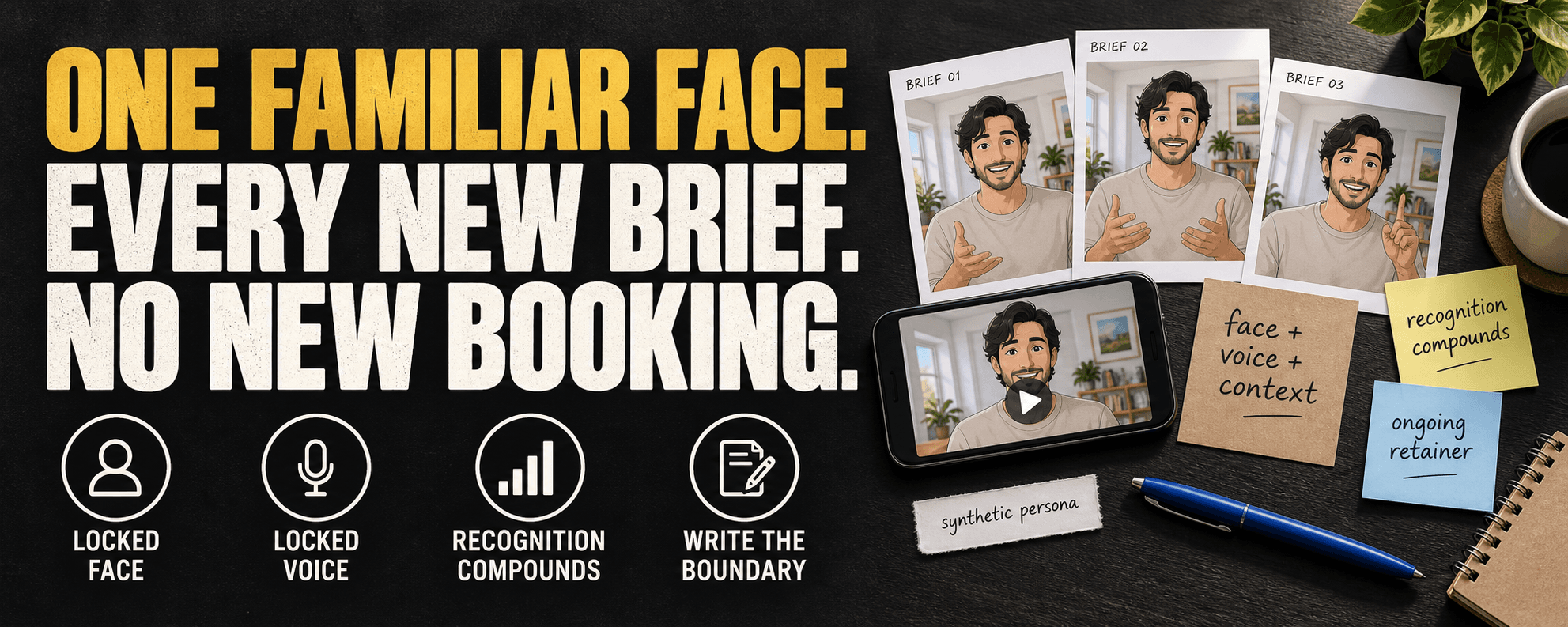
$12,000 in brand deals booked for a face that does not exist.
i went looking for what people are paying for creators and what happens when the creator is generated, and read 298 lines across 172 threads. one person asked the pricing question directly and nobody answered it:
"What would u charge a brand for a UGC creator they own but never have to book?"
it is a better question than it looks, because it has no comparable. every price in the market is a price per booking — "$180 per video", "$150–$500 per video", "$25 an hour", "Hire your first UGC creator for $500/mo". all of those price an event. an owned creator has no events. so the honest answer is that nobody knows yet, and the people quoting a number are guessing.
so here is the whole thing: what you are actually buying when you own a face, the four assets that make it worth anything, what it does and does not replace, and a way to price it that does not depend on pretending it is a person. about fifteen minutes, nothing held back, no gate on any of it.
what "owning a creator" actually means
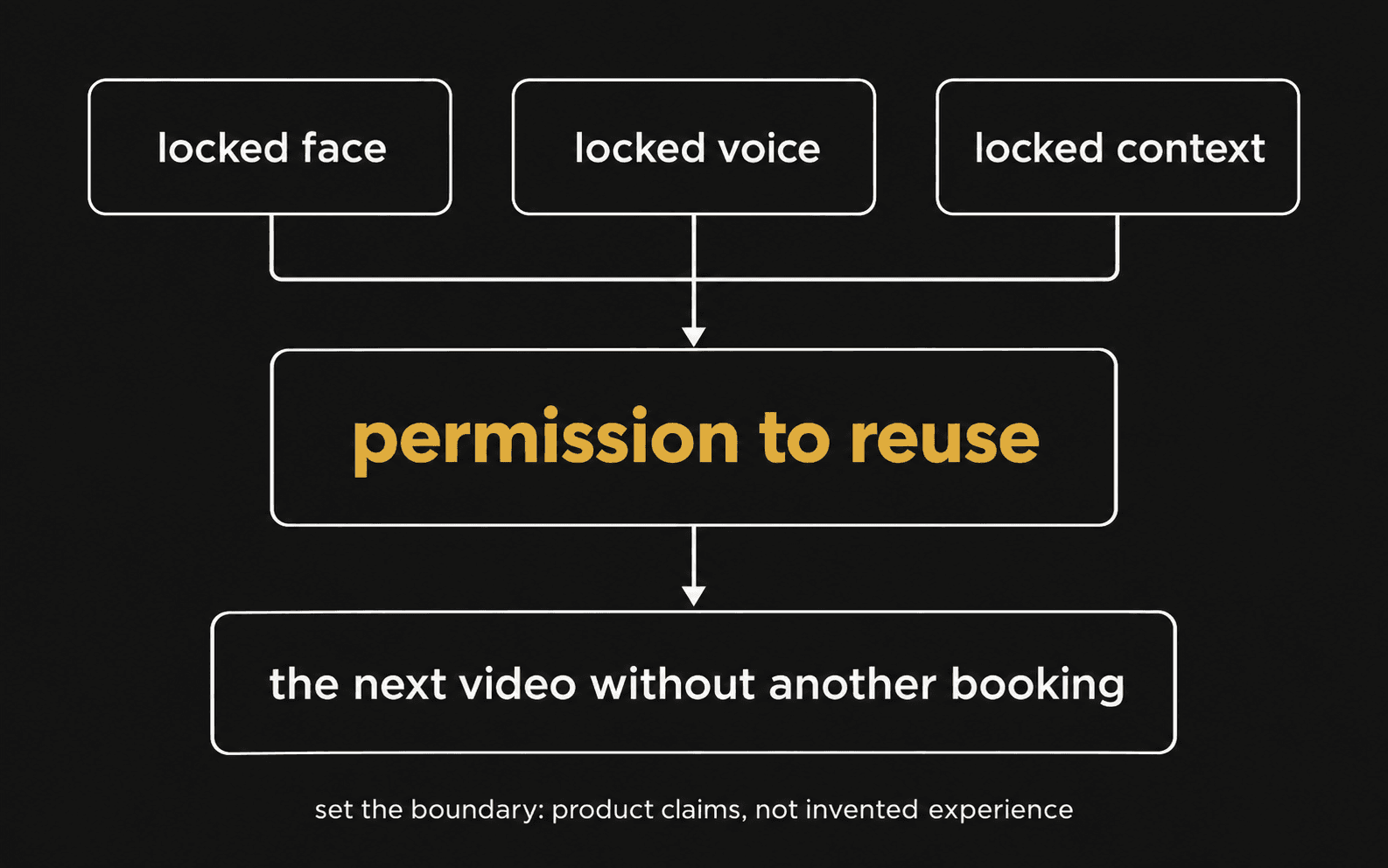
strip the language and it is four things, and only four:
- a locked face — one image reference that produces the same person across every generation
- a locked voice — the same delivery, not re-rolled per clip
- a locked context — a wardrobe and a room that persist across a set
- the right to use all three forever, at will, without asking
the cut describes exactly this, sold as a product:
"Inside the library: Character lock — one face held across every cut. Voice formula that never drifts between scenes. Full ad template — fill the brackets, render."
the fourth item is the whole value and the first three are the engineering. a booking buys you one video. this buys you the ability to make the next one at 2am on a bank holiday without a conversation, and to make the two hundred after that.
what it replaces, precisely
not the creator. the booking.
that distinction is doing all the work, and it is why arguments about this go nowhere. one side says a generated face cannot replace a real creator, which is true. the other says they are producing at a fraction of the cost, which is also true. they are talking about different things: the first is about the persuasive value of a real person, the second is about the transaction cost of getting a video made.
the cut has the transaction cost stated plainly:
"cheaper, because you hire a creator by the hour instead of per video"
that is already an attempt to unbundle the booking from the person — paying for time rather than deliverables. an owned face is the same move taken to its end: the deliverable becomes free and the booking disappears entirely.
and it has the other half too, the part that does not transfer:
"$12K IN GARAGE BRAND DEALS BOOKED FOR A FACE THAT'S NEVER SEEN A WRENCH."
read that carefully, because it is the sharpest line in the topic. it is not celebrating. it is pointing at a face making an implicit expertise claim it cannot support — the persona is a mechanic and there is no mechanic. that is the exact boundary: an owned face can carry a claim about a product; it cannot carry a claim about its own experience.
the four things that make it worth anything
if you are building one rather than buying one, this is what separates an asset from a folder of clips.
1. consistency that survives a set, not a clip. the cut is full of the failure — "No face changes, age changes, hairstyle changes, clothing changes, duplicate people, warped hands". a face that holds for one video is a generation. a face that holds across forty is an asset, and the difference is a stored reference rather than a description.
2. a voice that does not drift. the same issue one layer down, and more noticeable — people forgive a slightly different jumper and do not forgive a different person's voice.
3. accumulated recognition. this is the one nobody prices and it is where the real value is. a face that has appeared in two hundred ads to the same audience is doing something the first ad could not: it is familiar. that is an asset that grows, and it is the only part of this that compounds.
4. a boundary written down. what this persona will and will not claim. "will describe the product, will not claim to have used it for six months, will not claim a profession." decided once, in writing, before anyone is under pressure to ship.
how to price it, without pretending
back to the unanswered question. three defensible bases, and they give very different numbers.
cost-avoided. what the brand would otherwise spend on bookings over the term. if they run twenty videos a year at $180, that is $3,600 of bookings, and this replaces the bookings but not the judgement about what the videos say. simple, conservative, and it undervalues the asset because it ignores the ones they never would have made.
capability-priced. what becomes possible that was not. twelve languages, forty variations, a version per audience segment — none of which was ever going to be commissioned. this is where the number gets big and it is also where it gets speculative.
retainer, which is what the market is actually doing. the cut has "Average retainer: $2,800" and "The retainer is what closes it". that is not pricing the asset at all — it is pricing the ongoing judgement and coordination and letting the asset ride along. it is probably the right answer, because the asset without somebody deciding what it says is worth very little, and the person deciding is the thing that keeps earning.
say which basis you are using. most quotes in this market do not, which is why they sound arbitrary.
what usually goes wrong
people build the face and skip the boundary. then eight months in, under deadline, the persona claims a profession, and the $12,000-brand-deal problem is yours.
people treat it as a saving rather than an asset. the saving is the small part. the compounding recognition is the large part and it only exists if you actually run the same face consistently — which most people do not, because a new model comes out and the face changes.
people assume owning it removes the work. the cut is unambiguous: "try to run it yourself and it eats 80% of your time and still fails", and "trying to hire people to do AI UGC is awful — no one knows how to do DR copy even if they can make good looking AI". the scarce skill moved from operating a camera to writing a direct-response script, and it did not get less scarce.
people let the model choice destroy the asset. switching generator changes the face. if the face is the asset, the model is now a dependency you cannot casually upgrade — which nobody thinks about until the upgrade lands.
the honest answer
what would you charge a brand for a UGC creator they own but never have to book?
price the retainer, not the face. the face is cheap to make and worth little standing still. what earns is the judgement about what it says and the coordination that keeps it consistent across two hundred assets — and both of those keep costing you something every month, which is exactly what a retainer is for.
and be honest about the boundary. an owned creator replaces the booking, not the person. anywhere the persuasion depends on a real human having really done the thing, you have not bought a cheaper creator — you have bought a different and weaker claim, and pretending otherwise is how the $12,000 line ends up being about you.
i'm building the version of this where the face, the voice, the wardrobe and the boundary live as one object on a canvas and every render inherits them, so consistency across two hundred assets is structural rather than remembered. if you want to see it when it lands: https://clear-cortex.com/early-access?src=x-07-creator-you-own