 Clear Cortex
CBO or ABO: how to set the budget without wasting the test
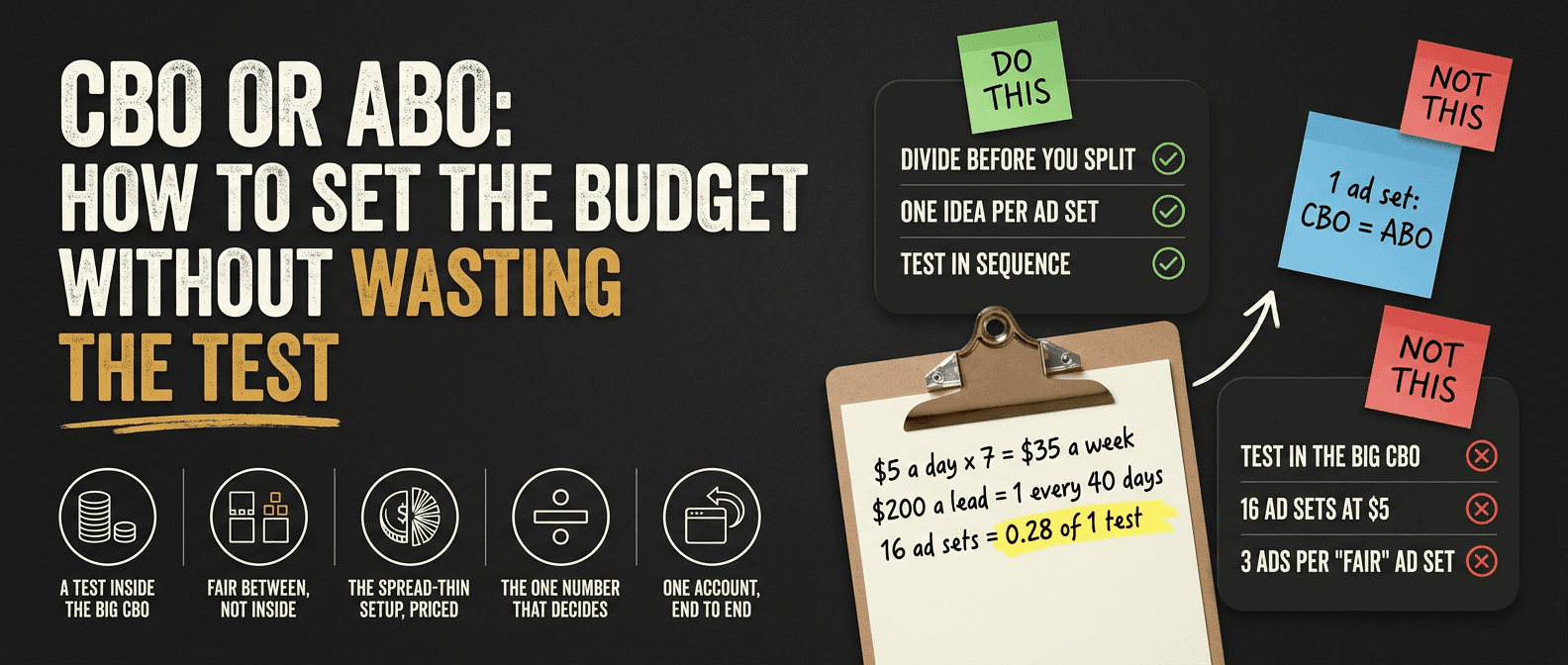
16 ad sets at $5 a day. one lead per set every 40 days.
that is a real setup, described by the person who ran it: "launched with 4 campaigns / 16 ad sets split by angle and audience, ~$5/day per ad set." their real cost per lead, counted in their own crm rather than the pixel, was about $200. at $5 a day, an ad set spends $200 every forty days. so each of the sixteen tests was on course to produce one lead somewhere in the sixth week, and the whole thing was being read after a few days.
i went looking for where the money should sit when you test — at campaign level or at ad set level, inside the campaign that is already running or in a new one — and counted 15 separate posts asking it, 18 questions between them. the thing i did not expect was the vocabulary. in the same body of writing, some form of waste — wasted, wasting, waste — turns up 43 times. the word for what actually happens to a test on these setups, starved, turns up once. people can see the bill. the mechanism that runs it up barely has a name.
here is how it gets asked:
"if it's a new ad set, should it be inside the big cbo campaign created 2 days ago or a fresh new one?"
"how many ad sets/creatives per ad set in the abo testing phase, and what daily budget would you start at, $50/day?"
"is $5/day abo enough to find winners, or should i consolidate budget / test cbo at this stage?"
"do you put a min spend floor on a test adset inside the same campaign, run a separate test campaign, or is there something better i'm missing?"
"how much budget do you give each test?"
and the one that says what it costs: "we have a small budget but we do need to run these ads, and i just hate how much spend is being wasted on such bad results."
i am going to argue that the usual answers to these are the reason the money is being wasted. there are two standard setups. one drops the new test into the campaign that is already running and lets the campaign budget sort it out. the other gives every creative its own ad set with a small fixed budget so each gets "a fair go". they look like opposites. on a small budget they fail the same way: both divide the money until no single test can reach an answer, and then you read the noise as a result.
so here is what each setting actually does to a new video, the one number that decides which you are allowed to run, and what to do on a budget that can afford neither. about ten minutes, using your own cost per result. nothing is held back and there is no gate on any of it.
the cover on this piece was made in clear cortex for about 8p, on the cheapest model that could spell the headline. that's the studio i'm building, and it's the only ask in this piece: https://clear-cortex.com/?src=x-cbo-or-abo-top
What a campaign budget does to a test you drop into it
start with the mechanics, because most of the damage comes from assuming the two settings are two flavours of the same thing.
with the budget at campaign level — cbo, which meta now calls advantage campaign budget — you give the campaign one daily figure and meta decides, continuously, how much of it each ad set gets. it is not trying to be even. it is trying to buy the most results for the money, and it moves spend toward whatever it currently predicts will do that. that is the whole point of the setting and it is very good at it.
now put something new into it. you have a campaign that has been running for a while, one ad set in it with ads that have been converting, and you add a second ad set with three new videos. the incumbent has a record. the newcomer has none. meta has every reason to keep backing the thing it has evidence for, so the newcomer gets a sliver — enough impressions to exist, rarely enough to prove anything. a week later the new ad set has spent a small fraction of the budget, has a handful of results or none, and looks like a loser. it was never given the chance to be anything else.
people describe it from the inside without naming it. "then on day two, meta suddenly decides one ad is the favourite and starts pushing most of the budget into it, even if it hasn't converted yet." and more bluntly: "i see one ad is getting all the budget and ignoring other." that is not meta misbehaving. that is a campaign budget doing exactly what it was set up to do, which is to stop spending on things it is not confident in. a test is, by definition, a thing it is not confident in.
the "created 2 days ago" detail makes it worse, not better. a campaign two days old has not established anything. whichever ad set is ahead on day two is ahead on two days of noise. drop a new ad set in beside it and you now have two unknowns competing for one pot, with the allocation decided by whichever got lucky first. i said a short version of this in the piece about adding creatives — a new ad set inside a live cbo competes with the old one for the same money — and the honest reading of the source question is that neither option it offers is a test. a fresh cbo just repeats the problem one level up the moment it has two ad sets in it.
the minimum spend floor is the fix people reach for, and it is abo with extra steps. you can set a minimum and a maximum spend per ad set inside a campaign budget. one account running at scale described exactly that: "we've got an account that spends $5k a day and there are clear winning ads that are pulling the account through", with the plan to "set minimum/maximum adset budgets to be x (likely 25-35% of overall campaign budget)". on $5k a day, 25% is $1,250 a day guaranteed to the test — more than eight times the whole daily budget of the $150-a-day account worked through at the end of this piece. that is a real test, and the minimum is doing the work. at $150 a day, the same 25% is $37.50, and a minimum of $37.50 does not protect anything. it guarantees the new ad set will be underfunded. the setting is not the problem. the number it is set to is.
What ad set budgets make fair, and what they don't
the usual reaction to all this is to move the new videos to ad set budgets — abo — so each ad set gets a fixed amount whether meta likes it or not. that is the right instinct and it solves exactly half of the problem.
ad set budgets make spend fair between ad sets. they do nothing about the ads inside each one. within an ad set, meta still decides which ad gets shown, by the same logic as before: it backs whatever it currently predicts will convert. so an ad set with three videos in it is a small campaign budget inside your "fair" setup, and the same starving happens one level down.
people find this out the hard way. "when i create iterations of a winning static and place them alongside other ads, the new ads often take most of the budget in an abo without producing comparable results." and asked as a question: "if you are doing one adset for all creatives, does meta rotate spend between creatives or its just fixating on one?" it fixates. it is built to. the budget setting you chose was one level above where the decision was being made.
this is what the $50-a-day question is really about. how many creatives go in each ad set of an abo test has a mechanical answer: if you want the ads in an ad set to get even spend, you want one. two or three per ad set is fine if you are happy for meta to pick among them — but then you are not running a controlled test of those creatives, you are running a small cbo and reading its choice. that is a legitimate thing to do. it is just not the thing most people think they bought when they chose abo.
so the only setup that genuinely forces every creative to get its share is one ad per ad set, on ad set budgets. which is the one that bankrupts a small budget. that is the next section.
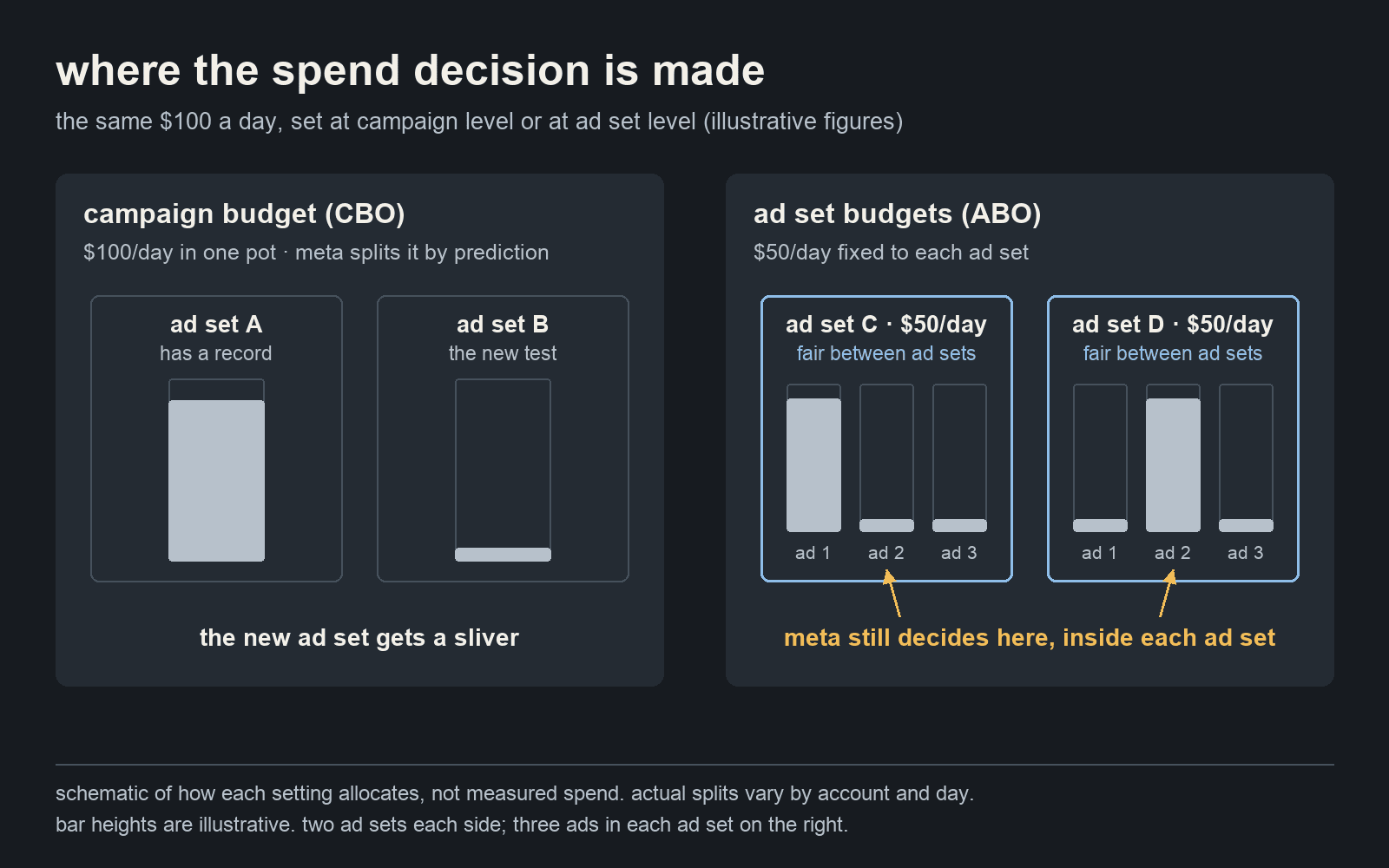
Schematic of how each setting allocates, not measured spend. Actual splits vary by account and day.
The spread-thin setup, priced
this is the setup people get sold as the careful option. one person described being handed it directly: "last week i spoke with a meta ads expert who advised me to split the creatives into 4 separate ad sets, with one creative per ad set and around €10/day each, so i could actually see which creative was winning or losing."
it is controlled. every creative gets exactly its €10. and it cannot answer the question it was designed to answer, because €10 a day is not enough money for any creative to separate from any other.
the number that matters is roughly ten conversions per creative per week — below that, the differences between your creatives are smaller than the wobble of one creative against itself week to week. i worked that out in full in the piece on what a test has to cost, so take it as given here. what it means for this setup is simple: four ad sets at €10 a day is €280 a week, and four creatives need forty conversions in that week between them. for that setup to be a test, every sale would have to cost seven euros.
the same person, a few lines later, had already hit the wall: "if only one ad has generated a sale, should i cut the others already or wait for more data?" and then, more precisely than anyone else in the pile: "where i'm struggling is knowing what 'clearly not working' actually means at this budget." at that budget, nothing means clearly not working. one sale is not a winner and zero is not a loser. the setup produced four numbers, and four numbers are always different.
the sixteen-ad-set account from the top is the extreme version. $5 a day each, a $200 cost per lead: one lead per ad set every forty days. sixteen ad sets, each of which needed ten leads to mean anything, so each needed four hundred days. that is not a slow test. it is sixteen of them that will never finish, run in parallel so it feels like progress.
and the $5-a-day abo question gets the same answer in one line. $5 a day is $35 a week. for that to reach ten conversions, each conversion would have to cost $3.50.
this is the part the negative case rests on. the spread-thin setup is not wrong because abo is wrong. it is wrong because it spends a fixed total across more ideas than that total can fund, and the one-ad-per-ad-set control that makes it feel rigorous is exactly what multiplies the cost. every extra ad set is another one that has to reach ten on its own.
and the cost does not stop at the test, because the test is only there to decide what gets scaled. the usual strategy, as one person put it, is to find winners and then put more money behind them — and a starved test still produces a winner, because some row is always on top. that row gets promoted, the budget goes up behind it, and you spend the next month scaling whichever video got lucky in week one. the money a spread-thin test wastes is small. the money it sends after the wrong video is not. how to raise a winner's budget safely is its own piece and i have written it; the only part that belongs here is that you can only scale what a test actually picked.
the sixteen-ad-set story has an honest ending worth keeping, because it is not a clean win. they consolidated, and the cost per lead did not fall: "cpl didn't improve much (~$239) because the landing page was still the bottleneck…" consolidating fixed the read. it did not fix the funnel. a structure change tells you which ad is working. it cannot make a page convert.
The one number that decides which setting you are allowed
everything above reduces to one division, and it is worth doing before you open ads manager rather than after.
daily budget × 7 ÷ (10 × your cost per result) = how many tests you can fund at once
that is how many ad sets your budget can carry at once — on ad set budgets, one idea each — where every one of them can reach ten conversions inside a week.
run it on the people asking:
- $5 a day, 16 ad sets, $200 a lead: $35 × 16 is $560 a week, against $2,000 for each one. 0.28 of one test. they were running sixteen.
- €10 a day, 4 ad sets: €280 a week. at any cost per sale above €28, under one test. they were running four.
- $50 a day, the ecommerce question: $350 a week. one test exists only if your cost per result is under $35. above that you have none, however you slice it.
- $150 a day, one campaign budget: $1,050 a week. at $105 a result, one test. at anything above that, less than one.
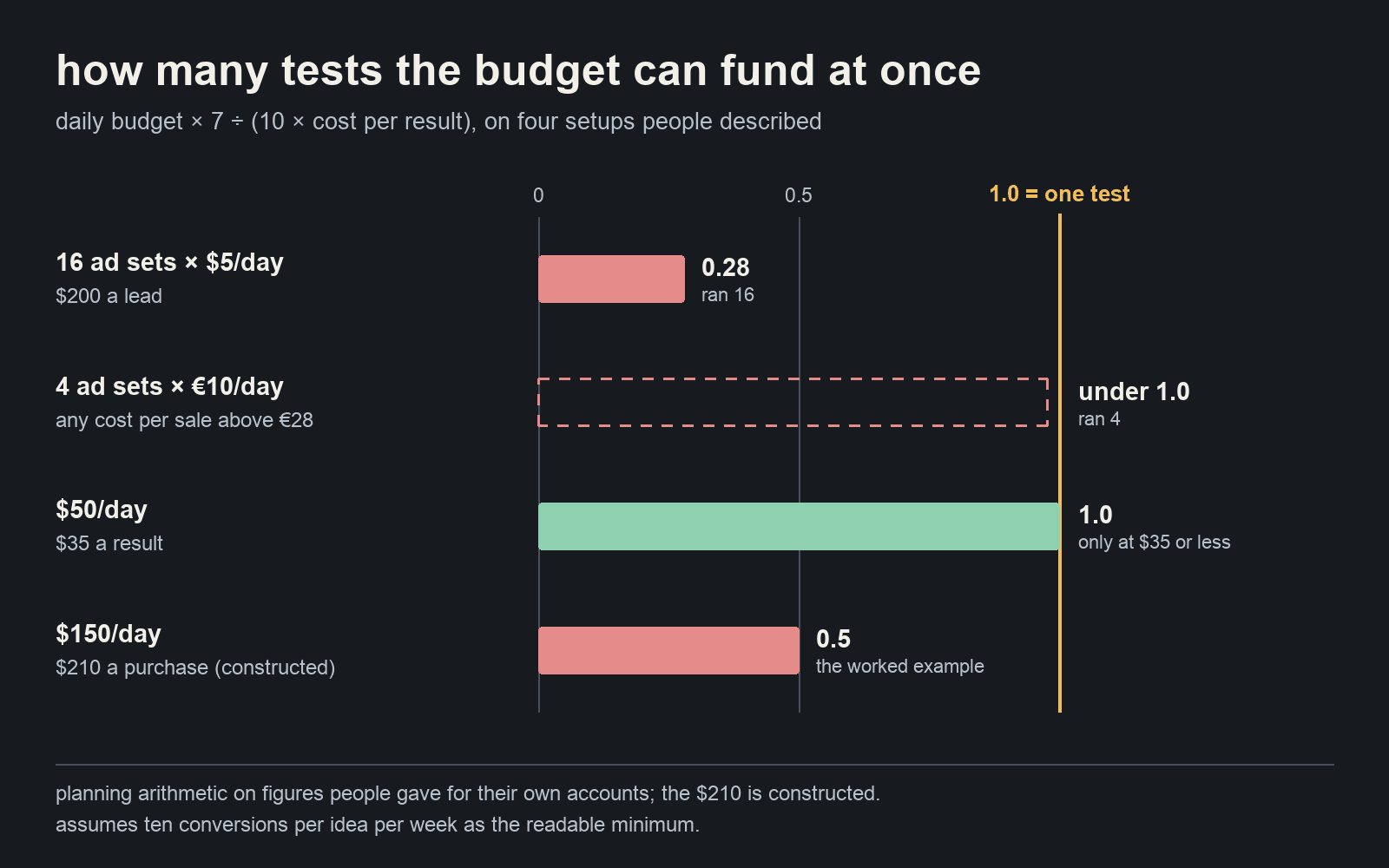
Planning arithmetic on figures people gave for their own accounts; the $210 is constructed. Assumes ten conversions per idea per week as the readable minimum.
three rules come straight out of the answer.
if it is two or more: run the test on ad set budgets in its own campaign, one idea per ad set, each ad set given enough to reach ten rather than an even share of whatever is left. keep the campaign that is making money on a campaign budget, scaling what has already won, and leave it alone. i went through why the two campaigns want opposite settings in the piece on splitting testing from scaling, so i will not repeat it; the part that belongs here is that the test campaign's per-ad-set budget is not a guess. it is ten times your cost per result, divided by seven.
if it is one: you have exactly one ad set's worth, and the cbo-or-abo question disappears. with one ad set, a campaign budget and an ad set budget are the same number. the only decision left is how many creatives go inside it, and the answer is two genuinely different videos, not five cuts of one — because meta will pick between them, and it can only pick meaningfully between things that are meaningfully different.
if it is under one: you cannot run a parallel test on this budget, and no setting will change that. what you can do is test in sequence — the next section is what that looks like.
this is the negative claim stated as plainly as i can: the usual setups are not wrong for everyone. they are wrong for the budgets of almost everyone asking. the four-ad-set abo test and the test-inside-the-cbo both come from accounts where the division above returns four or five. copied onto an account where it returns 0.3, they burn the whole budget producing numbers that cannot be read.
One account, worked end to end
this is the account that asked about the minimum spend floor, and it is worth doing properly because the person was unusually clear about their constraints.
"about $150/day, one cbo campaign, broad targeting." "at this budget i get a handful of purchases a week and never leave learning." and the constraint that rules out the easy answer: "not asking how to raise the budget, it is what it is for now."
they asked the question this whole piece is about — a min spend floor inside the same campaign, or a separate test campaign — and then two better ones: "and do you count that in spend or in days?" and "how many purchases do you want before you'll act on a comparison between two creatives?"
"a handful" is not a number, so i will make one explicit and you can swap in yours: call it five purchases a week. $150 a day is $1,050 a week, so that is about $210 a purchase.
the division. $1,050 ÷ (10 × $210) = 0.5. the entire account, every dollar of it, funds half of one test.
option one, the min spend floor inside the cbo. set the new ad set's minimum at 25%: $37.50 a day, $262.50 a week, about 1.25 purchases a week on the test. ten purchases takes eight weeks. by then the audience, the season and the rest of the account have all moved, and the test is measuring a different world from the one it started in.
option two, a separate test campaign. say $50 a day on ad set budgets. $350 a week, about 1.7 purchases a week, roughly six weeks to ten. and the $50 came out of the campaign producing the handful, which drops to about $100 a day and now has less to learn from as well. two campaigns, both starved.
what the account can actually do: test in sequence, inside the one ad set it has. keep one campaign, one ad set. when you want to test, add one genuinely new video — a different reason to buy, not a recut of the winning video — next to what is running, and do not edit what is running. then answer their own question with their own number: count it in spend, not days, and the spend is ten times your cost per result. at $210 that is $2,100 of spend on the new video before you judge it. that is two weeks of the whole account's money, and longer in practice, because the new video will not be given all of it. that is slow. it is also the only version that finishes.
testing in sequence only works if the next video is cheap enough to make every week. this is how to make one from a product photo: https://clear-cortex.com/playbooks/how-to-make-an-ad?src=x-cbo-or-abo-mid
and the number they asked for — how many purchases before acting on a comparison — is the same number. about ten on each side. below that the comparison is between two small numbers, and small numbers are different from each other for no reason at all.
the counter-case, so this is not only a counsel of despair. the $5k-a-day account with its 25–35% ad set minimums is doing the right thing with the same setting this account should avoid. 25% of $5,000 is $1,250 a day for the test alone. the setting is identical. the division is not. one account gets a working test out of a min spend floor and the other burns eight weeks on noise, and both would describe their setup with the same four words.
The part i cannot prove
how a campaign budget allocates, that ad set budgets fix spend per ad set but not per ad, and that you can set spend limits inside a campaign budget are platform behaviour, from the platform's own documentation and from what advertisers describe. none of it is my measurement. i do not run an account at this spend, and if i implied otherwise the first person to ask which account would end it. the settings have also been renamed more than once and may have moved again by the time you read this, so check the names in your own ads manager rather than trusting mine.
the ten-per-creative figure is arithmetic on top of the platform's own learning threshold, not a statistical result, and i said so in the piece where i worked it out. the $210 in the worked example is constructed from "a handful" — the person gave no figure — and the $200, $239, €10, $5 and $5k are other people's, taken from what they wrote about their own accounts.
and there is one thing i genuinely do not know. somewhere between $150 a day and $5,000 a day, a campaign budget with ad set minimums stops being a worse version of a separate test campaign and becomes the better one — cheaper to run, less to manage, and the winner never has to move. i do not know where that line is. the division tells you when a test is affordable; it does not tell you which of the two settings wastes less once it is. if you have run both on the same account and found the point where it flips, i would rather have your number than be right.
if any of this is wrong, say so. a correction is worth more to me than agreement.
if the sum says you can fund one test, the budget goes on the test and the video should cost pence. that's what clear cortex is for: https://clear-cortex.com/?src=x-cbo-or-abo-end