 Clear Cortex
How to split testing from scaling without starving both campaigns
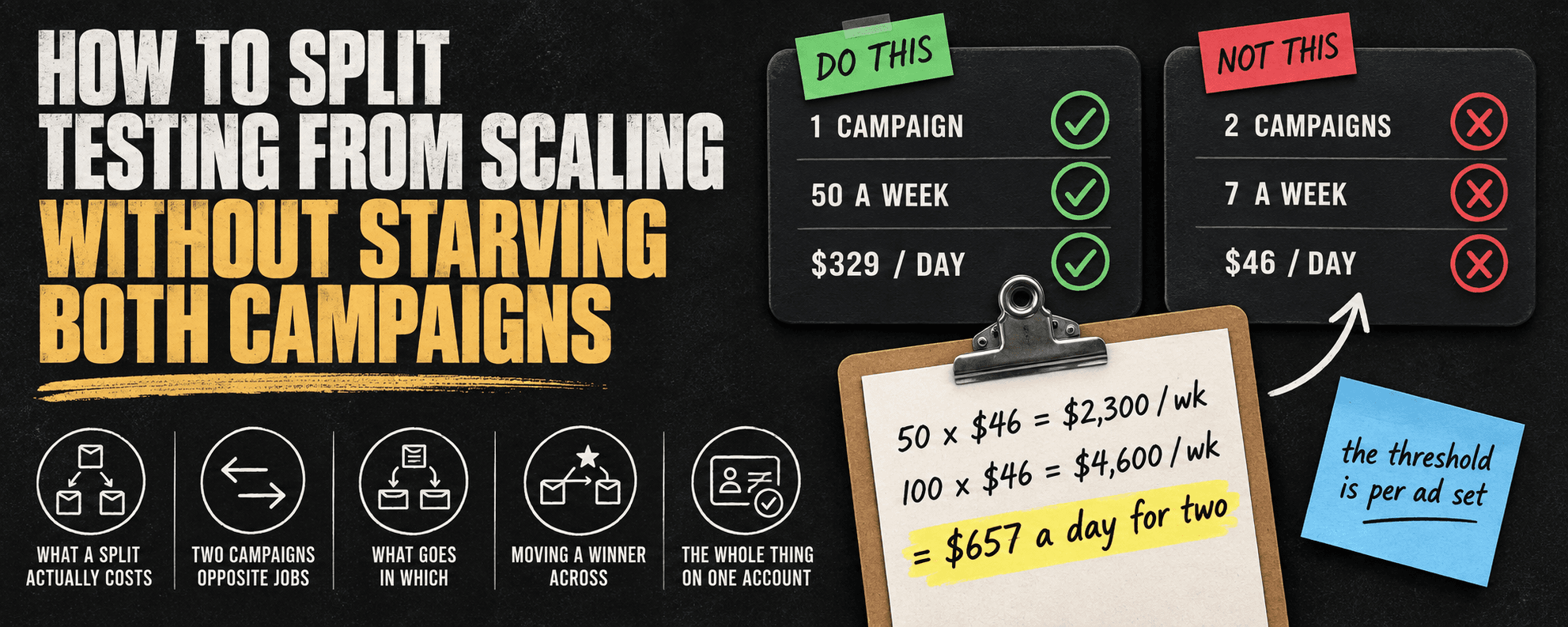
2 campaigns need 100 conversions a week, not 50.
i went looking for a straight answer to how an ad account should be laid out, and counted 22 people asking it across 20 separate threads. the loudest version of it got three serious replies and not one of them was about structure. all three said the same thing in different words: the account does not have the volume to support the question.
the question arrives in six shapes and it is one question:
"is my campaign structure wrong? should i continue with, or should i move toward — and if so, should the scaling campaign focus on one proven product with multiple creatives, while the prospecting campaign tests multiple products?"
"do you usually create one campaign just to test creatives, then move the winning creatives into another campaign with a bigger budget?"
"how much of your total budget do you typically allocate to the testing campaign versus your scaling campaign?"
"since budget is split across 4 campaigns, should i consolidate into fewer campaigns?"
"would you keep these as separate campaigns to test different acquisition angles, or consolidate everything into a single campaign with multiple ads and let meta allocate the budget?"
"do you run multiple campaigns for different creatives?"
everybody answers these with a diagram. a testing campaign here, a scaling one there, arrows between them. the diagram is not the answer, because the same one is right on one account and ruinous on the next, and what separates them is not strategy. it is a number.
so here is the whole thing, in the order to decide it. one threshold, two multiplications, about five minutes, using numbers already in your account. most of the time it will tell you that you are not allowed the structure you were about to build, and it will tell you what that structure would cost if you wanted it. nothing is held back and there is no gate on any of it.
if you want to see the thing i'm building while you're here, it's the only ask in this piece: https://clear-cortex.com/early-access?src=x-campaign-structure-top
What a second campaign actually costs
the threshold everything hangs off is not per account and it is not per campaign. it is per ad set: roughly fifty conversions a week before delivery has enough signal to optimise properly. under that, it is guessing, and it says so in the interface.
read that again with structure in mind, because it is the whole piece. the threshold attaches to the ad set. it does not care how many campaigns you own. so the cost of a campaign is not the campaign — it is the ad sets you have to put inside it to make it a campaign at all.
one campaign with one ad set has to find fifty conversions a week. split testing from scaling and you now have two ad sets, minimum, one in each. that is a hundred. you did not add a strategy. you added a second threshold, at full price, out of the same budget.
turn it into money by multiplying by your own cost per result. somebody in one of these threads posted theirs plainly: "cpa stayed around $46, so scaling didn't make sense."
- one ad set, clearing the threshold: 50 × $46 = $2,300 a week, or $329 a day.
- testing and scaling as separate campaigns: 100 × $46 = $4,600 a week, or $657 a day.
that is the price of the diagram. not a philosophy, not a preference — $657 a day at that cost per result, and proportionally whatever your own number makes it.
the same person was spending $46 a day. $322 a week, at a $46 cost per result, is seven conversions a week in total across everything they own. seven against a threshold of fifty, and they were asking whether to divide it in two.
three people answered, and none of them answered the structure question:
"increase budget or consolidate ad sets first, structure isn't your issue, data volume is."
"at $46/day and a $46 cpa, meta is basically getting one purchase worth of learning per day, so splitting that budget into more campaigns could make it worse."
"you don't have enough volume to feed two campaigns' worth of learning, you'd just double the noise."
they are right, and the reason they all arrived at it independently is that it is arithmetic rather than opinion. a structure is something you buy, and the price is one threshold per ad set.
so before anything else: take last week's conversions for the whole account, and divide by the number of ad sets you are proposing to run. if the answer is under fifty, you have designed a structure your budget cannot buy, and no arrangement of the boxes will fix it.
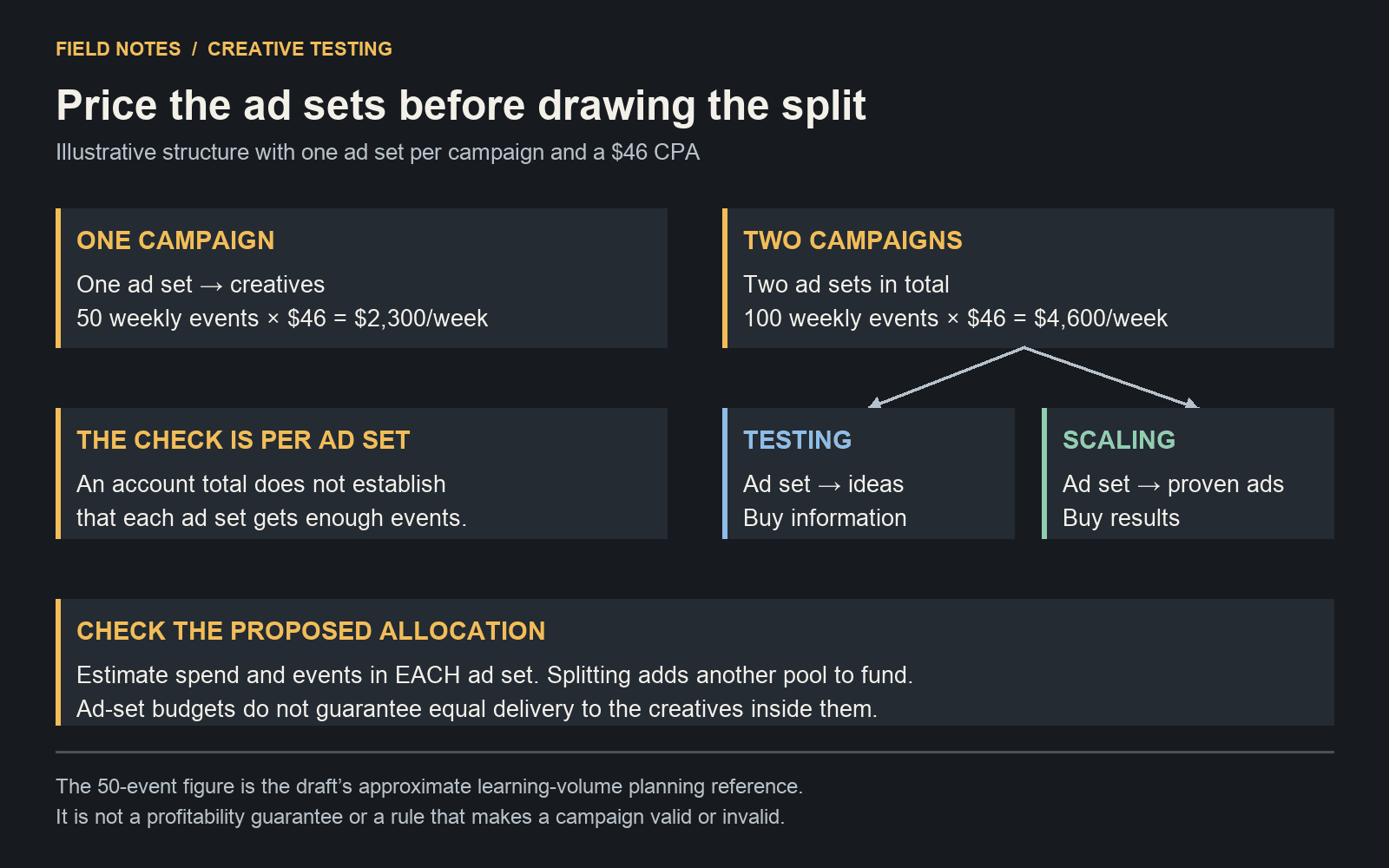
Illustrative allocation, using the draft’s approximate learning-volume reference. Check each ad set separately; campaign totals can hide uneven delivery.
The two campaigns have opposite jobs
now assume the numbers do clear it, because the rest of this is for when they do.
the mistake that survives even at a healthy spend is running the two as though they were copies of the same thing with different budgets. they are not. they have opposite jobs, and they should be judged on opposite measures.
the testing campaign is buying information at a deliberately bad price. its job is to produce a confident answer about which idea works. it will have a worse cost per result than the rest of the account, permanently, by design — because it is spending money on things that have not earned it yet. a testing campaign with a good cost per result is usually a testing campaign that has quietly stopped testing and is coasting on last month's winner.
the scaling campaign is buying results at the best price it can find. its job is volume at an acceptable cost, and it should be boring. nothing new goes into it on a whim, because every new thing in it takes budget away from something that was already working.
get the jobs the wrong way round and you get the two most common failures in this whole area. judge the test side on cost per result, or on roas, and you will kill every new idea in week one, because new ideas always look expensive next to a proven one. roas is the right measure for the scaling side and the wrong one for the other, and it is the same number on the same screen, which is why people apply it to both without noticing.
this also answers the budget-split question that gets asked in every version of the thread. there is no correct percentage, and anybody who gives you one is guessing. the test budget is not a share of anything — it is the number that buys a decision, which is the per-creative floor times your cost per result. whatever is left over after that goes to scaling. if nothing is left over, you do not have a test yet; you have an aspiration.
where the money sits is the other half of the same decision, and it is the abo-or-cbo argument that every version of this thread ends up in. the two jobs want opposite answers. on the test side you want the budget at ad set level, because the whole point is that each idea gets a fair, controlled amount of money whether the system likes it early or not — abo is doing exactly what you want when it spends evenly on something that is losing. on the scaling side you want the budget at campaign level and the system free to chase the winner, because there is nothing left to be fair to. somebody put the complaint about using the wrong one plainly: "i tried abo and it does spend evenly, but then it just burns the budget whether the ad works or not." that is not abo misbehaving. that is abo on the side of the account where you no longer want fairness.
one more reason to keep them apart, and it is the one people discover late: a single campaign asked to do both will quietly stop doing the first. the delivery system will find the thing that is already working and put the money there, which is exactly what you asked it to do, and your test creatives will starve in the corner with forty impressions each. it will not tell you this has happened. you will read the report as "the new creatives didn't work".
What goes in which
the source question has a specific version of this buried in it: should the scaling campaign hold one proven product with multiple creatives, while the testing campaign tests multiple products?
the second half is right and the first half is nearly right, but the axis is wrong, and the axis is what matters.
you do not split by product. you split by what the campaign is being asked to learn.
hold one thing constant and vary the other, or the result cannot be read. run four products in one campaign against four different creatives and something will win, and you will not know whether it won because of the product or because of the ad. you will then make more of the wrong one. that is not a testing campaign, it is a lottery with a report attached.
so the shape that works:
in the testing campaign: one variable. if you are testing ideas, hold the product still and vary the claim — the angle, the promise, the problem you are naming. if you are genuinely testing which product to sell, each product needs its own ad set with its own budget, and now re-run the arithmetic from the first section, because four products is four ad sets is two hundred conversions a week. testing multiple products at once is the single most expensive thing in this article and almost nobody prices it before starting.
in the scaling campaign: yes, one proven product with multiple creatives — but the creatives have to be variations on the thing that won, not a second pile of untested ideas wearing the winner's campaign as a disguise. the point of the scaling campaign is that everything in it has already earned its place.
and the number of creatives inside each ad set is bounded by the same threshold, one level down. every creative you add is another thing the same budget is split across, and under about ten conversions per creative per week you are reading noise rather than a result. i have written that arithmetic out properly elsewhere and will not re-derive it here; the thing to carry into a structure decision is that it multiplies. ad sets multiply the fifty. creatives divide whatever the ad set gets.
the room already knows the shape of the answer when it is forced to be concrete. one person, describing what they had settled on: "one campaign testing 3-4 ads max, with the budget concentrated rather than spread thin." another, after giving up on a sprawl: "killed everything, moved to one campaign, one broad ad set, ~2x the daily budget, winning creative only."
Moving a winner across, and what the move costs
this is the part of the structure that nobody specifies, and it is where most of the damage happens.
the common trigger for promoting a creative is a version of this: "once an ad had social proof and around 5–10 purchases, i'd move it into a scaling campaign with a higher budget."
five to ten purchases is not a winner. it is a creative that has been in front of enough people to have a number attached to it, and the number is mostly noise. promoting on five purchases is how accounts end up scaling the second-best idea for a month — you are not moving a winner, you are moving whichever of your creatives got lucky first.
so set the promotion gate before you run the test, in writing, and make it a conversion count rather than a feeling. then the move itself, which costs more than people expect:
the new ad set starts from zero. a creative that has proven itself in the testing campaign carries no delivery history into a new ad set. the audience is different, the budget is different, and as far as optimisation is concerned it is a new thing. the creative's performance does not transfer; only your confidence in it does. that confidence is worth having, which is the entire argument for the split — but do not expect the numbers to arrive pre-warmed.
there is a specific hope attached to this that is worth naming, because somebody asked it directly: whether a winning creative will get a noticeably lower cpm once it is moved into a bigger, more stable scaling campaign. i would not plan on it. cpm is set by the auction, the audience and the competition for it, not by which campaign the ad is filed under. if anything it goes the other way, because the scaling campaign is asking for more volume from the same audience, which is the more expensive end of it.
one thing genuinely does travel, and it is the only real argument for the "social proof" framing: if you use the same post rather than building a fresh ad, the likes and comments come with it. that is a real advantage and it is about the audience's reaction to the ad, not about the delivery system's memory.
The whole thing on one account
worked end to end on the account from the question, because the answer turns out not to be the one that was asked for.
one product, an $80 item. $46 a day. cost per result $46. the plan on the table: split into a prospecting campaign testing several products and a scaling campaign carrying the proven one.
- what they have: $46 a day is $322 a week, which at $46 a result is seven conversions a week across the entire account.
- what one ad set needs: 50. they are at fourteen percent of one threshold.
- what the proposed structure needs: two campaigns, one ad set each, 100 a week — $4,600 a week, $657 a day.
- and if the testing campaign tests four products properly, that is four ad sets, 200 a week, $9,200 a week. the plan as described costs roughly twenty times the current budget.
so the honest answer to "is my campaign structure wrong" is that the structure is not the problem and changing it will make things worse. at seven conversions a week, one campaign, one ad set, and every dollar pointed at the single best creative is the only configuration that is even trying to clear a threshold.
what that account can actually do:
- consolidate to one ad set and stop dividing the signal. this is free and it is the only move with no downside at this budget.
- decide whether $46 is a cost per result worth scaling at all. on an $80 product it is close to the edge before anything else is counted, and the structure question is a distraction from that one.
- raise the budget toward $329 a day if the economics survive that check, and get one ad set over the line before owning a second.
- split only when one campaign is reliably clearing fifty a week, at which point the second threshold is affordable and the split starts paying for itself.
now the other end of the same account, so the split is not just a thing to aspire to. the same structure at $700 a day: that is $4,900 a week, about 106 conversions at $46. two ad sets, one in each campaign, both clearing fifty. at that point the separation earns its keep immediately — the testing campaign can run three or four genuinely different ideas without touching the winner, the scaling campaign stays boring, and a promotion between them means something because the gate was cleared rather than guessed.
the structure does not change between those two accounts. the volume does, and the volume is what decides which structure is legal. the person on $46 a day and the person on $700 a day get opposite advice, and both of them will read the same diagram on the same day and one of them will be wrecked by it.
that is why the answer to "what structure should i use" is always a question back: what did the account convert last week, and how many ad sets are you proposing to divide it across.
The part i cannot prove
the fifty-conversions figure is documented platform behaviour and the doubling is arithmetic on top of it. neither is my measurement. i do not run an account at this spend, and if i implied otherwise the first person to ask which account would end it.
the costs per result in here are other people's, taken from what they wrote about their own accounts. they are real and there are not many of them — enough to work an example, not enough to call a benchmark. put your own cost per result in; the calculation is two multiplications and it is the only version of it that applies to you.
the things i am least sure of, said plainly rather than buried: i think the promotion gate should be a conversion count rather than a purchase count or a feeling, but i cannot tell you the right number, and the five-to-ten people use is clearly too low. and i do not know where the line is on the other side — the spend above which running everything in one campaign starts costing you more in confusion than the split would cost in thresholds. somewhere above $700 a day that must flip. i have not seen anybody write down where.
if you run this and the arithmetic says something different on your account, i would rather have your numbers than be right.
i'm building the version of this where the brief, the creative and the campaign it ended up in all sit on one canvas, so the reason a thing was promoted is still attached to it three weeks later: https://clear-cortex.com/early-access?src=x-campaign-structure-end
and the fuller version of what it is for is here: https://clear-cortex.com/use-cases/ai-ad-creative