 Clear Cortex
How to handle Advantage+ without rebuilding the campaign that worked
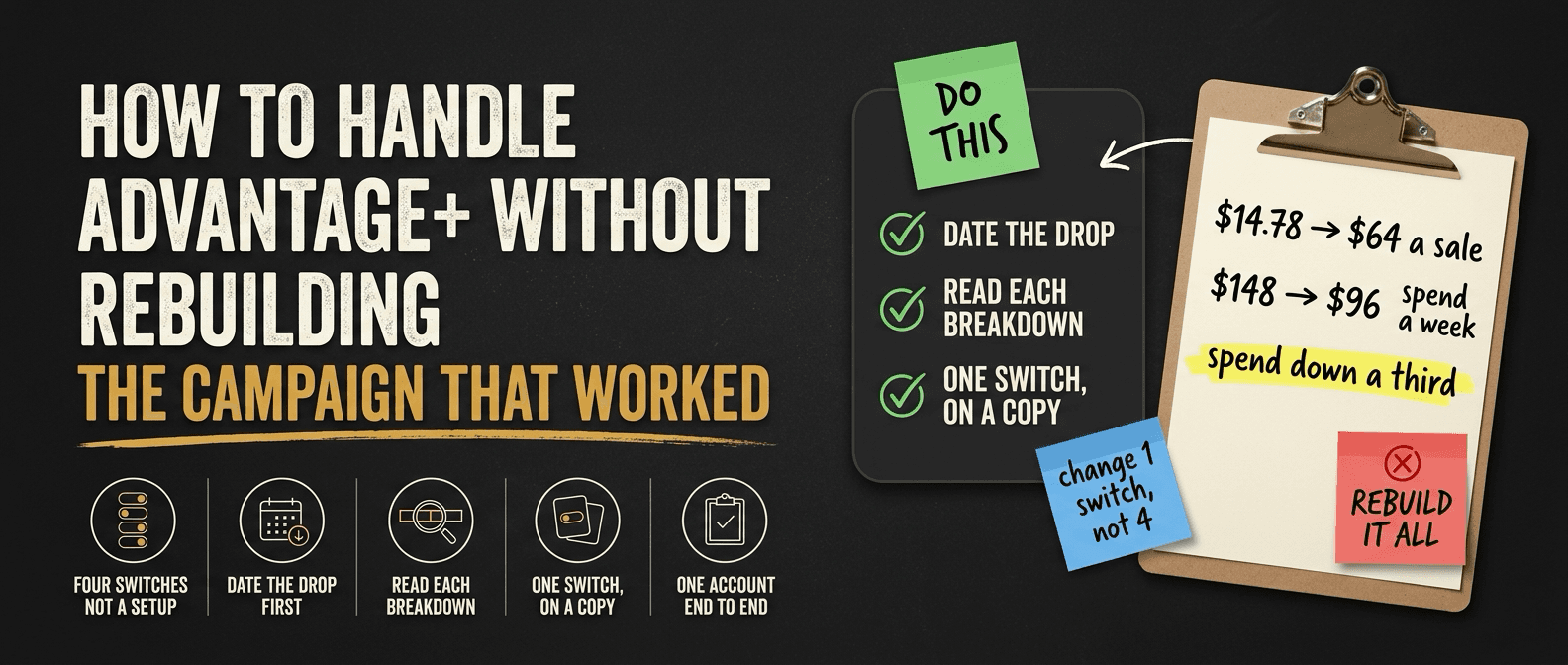
$14.78 a sale became $64, and nobody had changed a thing.
that is one small business owner's account, about eight months into running ads, selling a product priced at around $100. ten orders a week at the first cost per purchase, then three orders in a fortnight at more than four times it. i went looking for what people do when that happens and whether advantage+ means setting campaigns up differently now, and counted 12 versions of the question across 10 threads. underneath, nearly every one of them is asking the same thing: rebuild it the new way, or rebuild it the old way?
here is how they put it:
"has advantage+ changed enough that i should be setting campaigns up differently?"
"has anyone had better results going back to a more manual/simple setup?"
"are there new settings meta is automatically turning on?"
"is anyone else wondering if meta's recent ai/andromeda changes have basically broken older campaigns that used to perform consistently?"
"have your facebook campaigns experienced slower spending recently, and what do you think has had the biggest impact: algorithm updates, creative fatigue, or increased competition?"
there are two answers going round, and the owner at the top named both of them. one is to go back to a manual setup — interests, separate ad sets, the structure that worked a few years ago. the other is the one they said, in the same post, they did not want to hear: generic advice to make better creative. trust advantage+, go broad, put the effort into new video.
both answers are wrong for an account that was working, and they are wrong in the same expensive way. each one is a rebuild. a rebuild throws away the one thing a working campaign has that a new one does not — its history — and it changes so many things at once that when the numbers move, up or down, you will not know which change did it. the manual rebuild pays for the learning again, and the conversions it already had get split across a new test. the creative rebuild pays the price of new video to fix something that may never have been the video, and then tests it from zero. and neither of them answers the question the owner actually asked, which was the right one: what changed?
so here is the whole thing, in the order to run it. what advantage+ actually is, which turns out to be four switches rather than a way of setting up. how to find the day it turned before you touch anything. the breakdowns that show which switch is costing you. how to turn one off without resetting the rest. and the account from the top, worked through end to end. nothing is held back and there is no gate on any of it.
the cover on this piece was made in clear cortex for about 8p, on the cheapest model that could spell the headline. that's the studio i'm building, and it's the only ask in this piece: https://clear-cortex.com/?src=x-advantage-switches-top
Advantage+ is four switches, not a setup
start here, because the question of manual or advantage+ only makes sense if they are two different kinds of campaign. they mostly are not. advantage+ is meta's name for a set of settings, each of which hands one decision over to the delivery system, and there are four decisions it can take.
the audience. with advantage+ audience on, the ages, interests and lookalikes you give the ad set become suggestions rather than a fence. meta starts with them and is allowed to go past them when it predicts better results outside. switch it off — meta calls the alternative its original audience options — and what you set is a boundary again.
the placements. with advantage+ placements on, meta decides where the ad runs across facebook, instagram, messenger and the audience network, and moves spend between feed, stories, reels and the rest as it goes. switch it off and you choose the placements yourself.
the budget. with the budget set at campaign level, meta decides how much of it each ad set gets, continuously, and it is not trying to be even. i wrote up the budget question separately and will not re-run it here, except to say it is a switch like the others.
the creative. this is the one people forget is there. advantage+ creative is a set of enhancements meta can apply to the ad itself: adjusting the image, cropping and expanding it to fit a placement, adding music, adding overlays, trying variations of your text. some of them are on by default when an ad is created, and they are set ad by ad. the version people are being shown is not always the video or image you uploaded.
in meta's current setup, a sales campaign is labelled advantage+ when the budget, the audience and the placements are all handed over at once. turn any one of them back and ads manager calls it a manual campaign. so going back to manual is not a different campaign type. it is turning switches off. and "going back to a more manual/simple setup", done the way it usually gets done — a new campaign, new ad sets, interests back in, placements chosen by hand — is four switches flipped in one afternoon, on a campaign with no history.
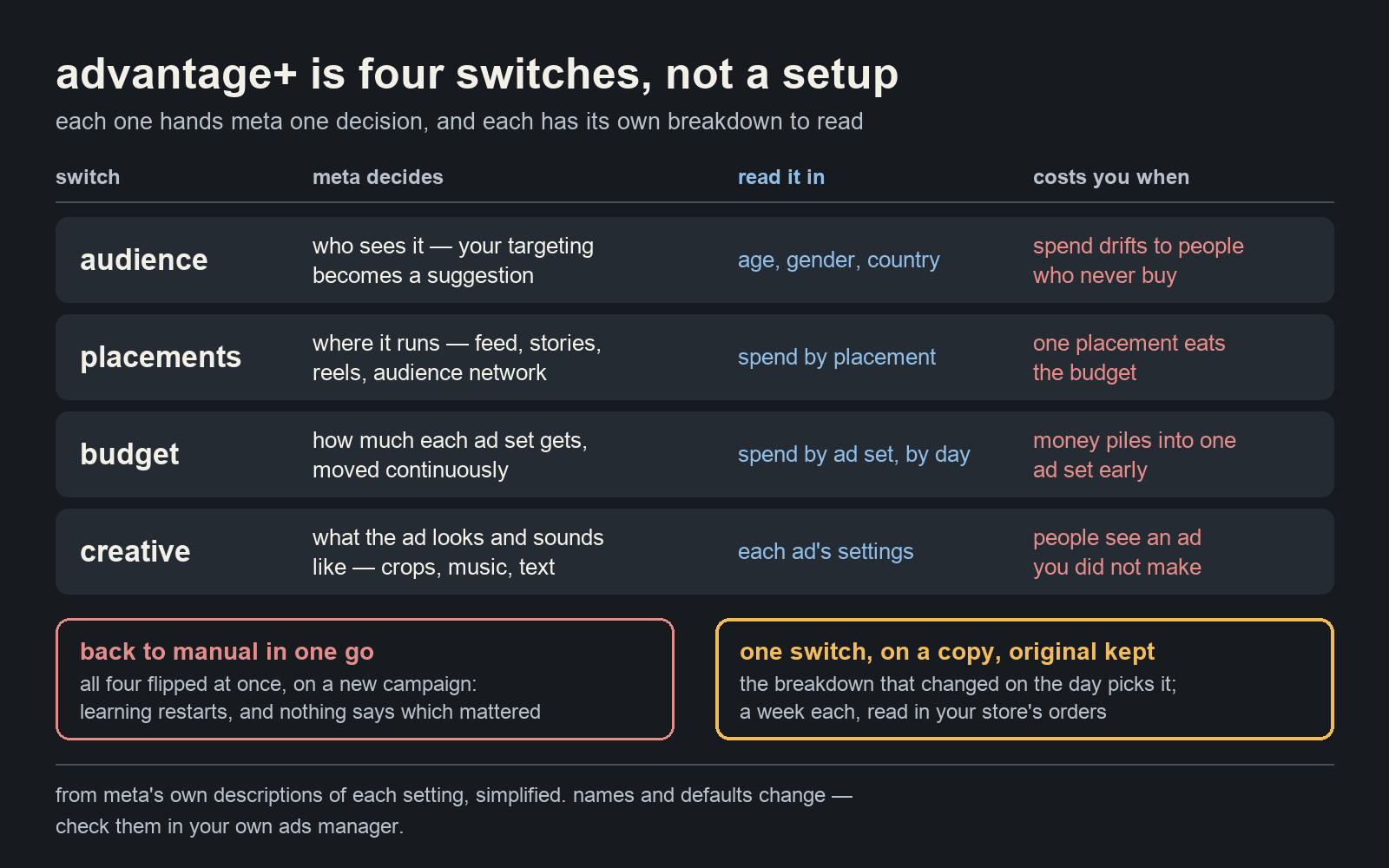
From Meta's own descriptions of each setting, simplified. Check the names and defaults in your own Ads Manager — they change.
the creative-first camp has a point, and it is worth saying exactly where. one post put the common line in a sentence: "the real competitive edge has shifted entirely to creative diversity, testing distinct conceptual angles like raw UGC versus product demonstrations rather than wasting time playing with manual targeting buttons." with the audience switch on, that is largely true. if meta picks who sees the ad, the ad does a lot of the picking — who stops for it tells the system who to find more of.
but that is one setting out of four. placements and creative enhancements are buttons too, they are on by default, and they spend real money on video and images shown in places that may not convert. a placement that takes half the budget and returns no conversions is not fixed by more creative diversity. it is fixed by a button. so is an enhancement that has put music under an ad that worked silent. stop playing with the buttons is right about the audience and wrong about the rest, and the rest is often where a working account breaks.
the people asking can feel this, even when they cannot name the switch. somebody setting up their first advantage+ campaign asked whether to group three countries in one ad set, because "i'm slightly worried the algorithm will just dump all the budget into the cheapest CPM region and ignore the others." that worry is correct. the system buys the cheapest results it can find, and the cheapest country, the cheapest placement and the cheapest audience are not the same thing as the best ones. it is the same mechanism whichever setting it runs through, and it is why each one needs reading on its own — and why a campaign that cannot scale often has one setting quietly spending in the wrong place.
Date the drop before you touch anything
the owner at the top did the most useful thing in the whole pile of questions, and almost nobody does it. they said they had made no changes, and asked what had changed inside meta instead. that is the right question. the rebuild — in either direction — skips it.
the job before any change is to find out what moved, and when. three steps, all inside ads manager and your store, none of which costs anything.
one: find the day it turned. set the date range to cover the good weeks and the bad ones, and look at the campaign day by day rather than as a seven-day average. averages smear a drop across a week and make it look gradual. day by day, most drops have a date, or at least a three-day window. write it down. everything else gets checked against it.
two: read the activity history around that date. ads manager keeps a history for each campaign, ad set and ad — every edit, when it was made and who made it. no changes is a memory. the history is a record. a new ad added a fortnight before, a budget nudged, a creative swapped, an automated rule firing — any of them would be there. if there is genuinely nothing near the date, that is a real result: it rules your own hands out, and it narrows the search to the switches meta controls and the world outside the account.
three: work out which of three things dropped — the spend, the sales, or the count. they look the same on the dashboard and they have completely different fixes.
- the spend. is the campaign still spending its daily budget? one advertiser described the version where it is not: "suddenly, the campaigns are barely spending the daily budget and our CPR has skyrocketed significantly (7-day click attribution)." a campaign that cannot spend has a delivery problem — the price of reaching people went up, with cpms rising, or the system has stopped predicting results at the price you are paying. that points at the switches and at competition, not at the page.
- the sales. are people still clicking, but not buying? clicks normal and sales gone is a problem after the click — the page, the price, stock — and i wrote that one up separately. no campaign setup fixes it.
- the count. compare the purchases ads manager reports with the orders your store actually took over the same days. if the store did fine and the reported number fell, nothing in the campaign broke. the measurement did — tracking, or the attribution setting, or how meta is counting. rebuilding a campaign to fix a reporting change is paying to fix nothing.
put the owner's own numbers through that, because they already say something. ten orders a week at $14.78 is about $148 of spend a week. three orders in two weeks at around $64 is about $192, or $96 a week. if those figures are right, this campaign is not only converting worse. it is spending about a third less than it was. that is a delivery change, and a delivery change has a short list of suspects, most of them switches.
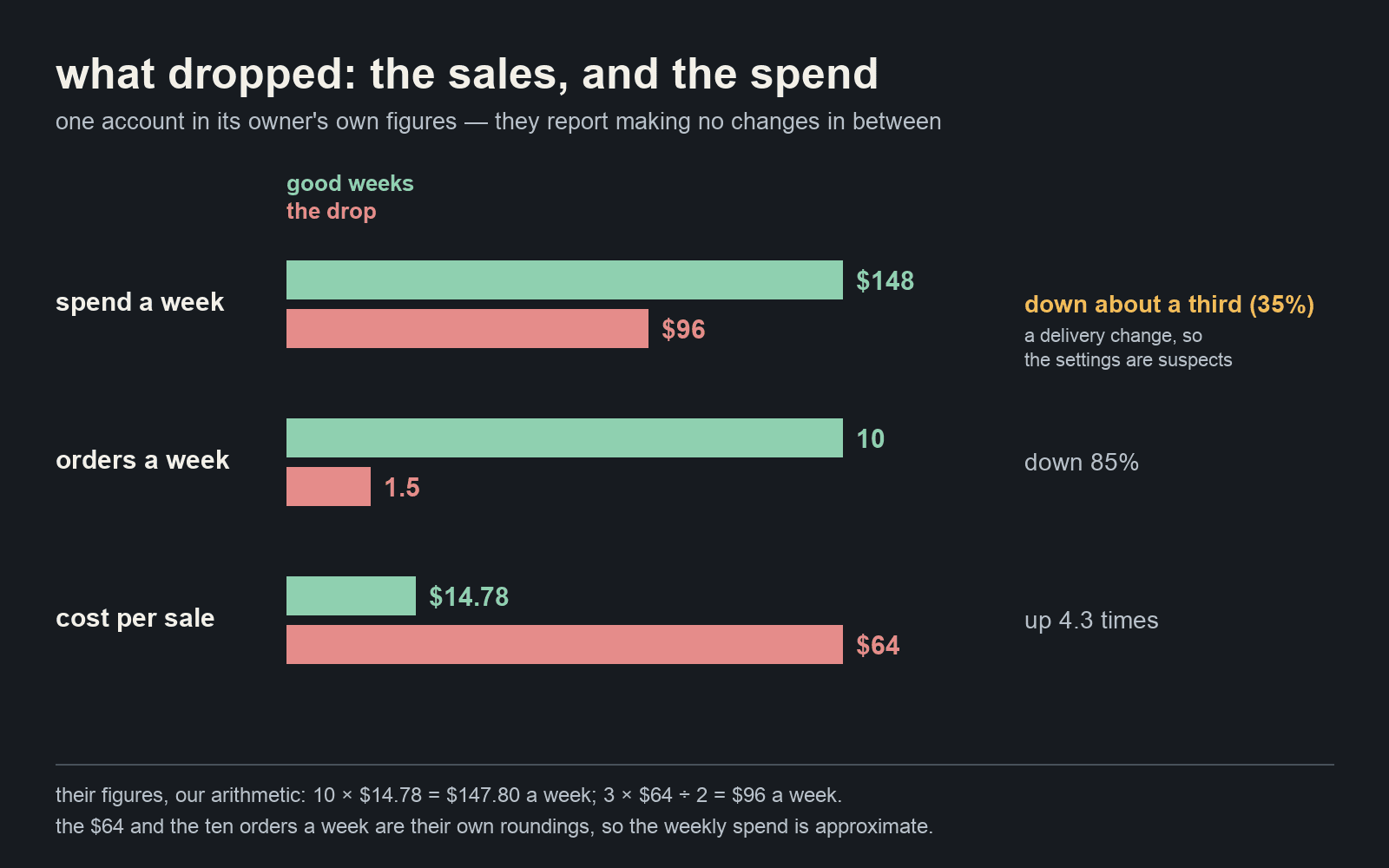
Their figures, our arithmetic. The $64 and the ten orders a week are their own roundings, so the weekly spend is approximate.
Read the breakdowns the switches hide
every switch that hands a decision to meta also hides that decision from the top-line numbers. the campaign row tells you the total. it does not tell you where the money went. each switch has a breakdown that does, and the one to look at is the one whose shape changed on the day you wrote down.
placements. this is the first one to pull, because it is the fastest and it is the one most often guilty. one advertiser who has run ecommerce accounts for years described it as the first thing they check: "break down results by placement and look for anything eating budget without producing conversions." and then the case that made the point: "i had an account earlier this year where reels was taking a huge portion of the daily budget, pulling in a ton of impressions, and producing basically zero sales." the ads were converting where they had always converted. one placement had started taking the money — impressions are cheap there, the price per sale is not — and the conversion rate on the account fell with it.
another put the same thing as a scaling problem: "when a campaign 'stops scaling,' it's often because one placement absorbed most of the budget at bad economics while your best placement is starved." and the check is one line: "pull the placement breakdown and see if you have a clear winner that's only getting 20-30% of budget." run the breakdown for the good weeks and the bad weeks side by side. if the split of spend between placements moved on your date, you have found your switch.
the audience. break the results down by age and gender, and by country if the ad set runs more than one. with advantage+ audience on, meta can drift outside the people you suggested, and this is where you see whether it did. a spend split that tilted towards an age group or a country that never bought from you is the audience switch costing money. the country worry from the first-time advertiser above is exactly this breakdown.
the budget. if the budget sits at campaign level, look at spend by ad set over the days around the drop. a campaign that moved most of its money into one ad set on your date has told you where to look next.
the creative. there is no neat breakdown for enhancements, so check it by hand. open each live ad, look at which enhancements are switched on, and use the preview to see what is actually being shown in each placement. if an ad that worked as a plain silent video is now running with music, or with a text variation you did not write, the ad you are judging is not the ad you made. that matters most for anything added recently — a new ad created a fortnight before the drop may have gone in with defaults the older ads never had.
none of these takes more than a few minutes. they will not always find the cause. but the breakdown that changed shape on your date is the strongest lead you will get, and finding it costs nothing. the rebuild costs weeks.
Turn off one switch, on a copy
once a breakdown points at a switch, the instinct is to fix everything while you are in there. this is the moment the money goes.
why not rebuild. a new campaign or a new ad set starts learning from nothing. meta wants roughly fifty conversions a week per ad set to settle, and this account was making ten in its good weeks, so it was never going to get there quickly. a manual rebuild usually makes that worse rather than better: interests split out into three or four ad sets means the ten orders a week are now spread across three or four separate tests, each learning at a fraction of the pace. and if you change the audience, the placements, the budget and the creatives all at once, and it gets better, you cannot tell which of the four did it. if it gets worse, you cannot tell which to undo.
so the rule is one switch, on a copy, with the original kept — and the copy is a test of that one setting, nothing else. most of the changes here — targeting, placements, the creative — count as significant edits, which means changing them on the live ad set puts it back into learning anyway. so do not edit the one that worked. duplicate it, change one switch on the duplicate, and keep the original paused rather than deleted, so you have something to go back to.
the order to try them in, cheapest to read first:
- the placement that is eating budget. if the breakdown shows one placement taking a large share of spend for no sales since your date, take it out on the copy. this is the change most likely to show up in a week, because it moves money immediately.
- the creative enhancements you cannot read. switch off the ones that change what the ad looks or sounds like — music, text variations, overlays — on the copy, and leave the videos and images exactly as they were.
- the audience, last. going back to narrow interests on a small budget shrinks the pool meta is allowed to look in, and on an account at ten orders a week that usually costs more than it saves. only switch the audience back if the breakdown clearly shows the spend drifting to people who never buy.
- the budget level, only if there is more than one ad set to move money between. one ad set has nothing for the switch to do.
turning enhancements off has one consequence worth planning for. the crops and fits meta was making for each placement become yours to make — at least a 4:5 version for the feed and a 9:16 for stories and reels, from the same product shot, so every placement shows the ad you meant. this is the size each placement needs and how to make the set from one product photo: https://clear-cortex.com/playbooks/product-images-by-platform?src=x-advantage-switches-mid
how to read it. if the budget is big enough to split, meta's own a/b test tool divides the audience between the original and the copy, so the two are not bidding against each other, and you get a cleaner comparison. at a small account's spend, splitting halves two thin tests. there the honest route is to move the full budget to the copy, give it a week, and compare its cost per purchase — counted in your store, not in ads manager — against the good weeks and against the bad fortnight. that is a before and after, not a controlled test, and it is the best a budget this size can buy. then the next switch, the following week, if you need one.
and do not scale while you are testing. a budget increase in the same week as a placement change is two changes, and you are back to not knowing which one moved the cost per purchase. scaling comes after: once the copy holds its cpa for a week or two, raise the budget in steps the way you would on any winner. a rebuild skips this too — it resets the very ad set you would have scaled.
The account from the top, worked end to end
here is the whole route on the account this piece opened with. the first part is the owner's own figures. everything after that is constructed — i do not have their account — to show what each check looks like when it finds something. put your own numbers in.
what is real. a product at about $100. about $14.78 a sale and ten orders a week, in a setup that had finally started working after eight months. then three orders in two weeks at around $64 a sale, with no changes made. from their own figures, roughly $148 a week of spend fell to roughly $96, orders fell from ten a week to one and a half, and the cost per sale rose a little over four times.
the advice they would get. go back to manual: a new campaign, three interest ad sets at a third of the budget each, placements chosen by hand. that is three ad sets each trying to learn on about $7 a day, from a standing start, with no way to tell afterwards which of the four changes mattered. or make better creative: a shoot or a batch of new video, at a price that could be several weeks of this account's whole ad spend, plus a test to find out whether the new video is any better, to fix an ad that was converting at $14.78 a fortnight earlier.
step one, the day. the daily view shows the turn inside three days, not a slow slide. that alone argues against creative fatigue, which tends to show as a gradual climb.
step two, the history. no budget edits, no targeting edits. but one new ad, added twelve days before the drop, went in with the creative enhancements at their defaults — the older ads predate them. nothing else.
step three, what dropped. the store took four orders in the bad fortnight against three reported, so the count is close; this is not a reporting problem. the spend is down by a third, so it is delivery, and the page is not the first suspect.
step four, the breakdowns. by placement, the good weeks had most of the spend in feed and stories, where nearly all the sales were. in the bad fortnight, reels and the audience network had taken over half the spend, almost all of it behind the new ad, for one sale. age and gender: no real change. one ad set, so the budget level does not apply.
step five, one switch. the ad set is duplicated. on the copy, the placements are set by hand to feed and stories, and nothing else changes — same ads, same audience, same budget. the original is paused, kept. the full $21 or so a day goes to the copy for a week.
the read. say the week comes back at seven store orders on about $148 of spend. that is about $21 a sale — not the old $14.78, and that is worth saying plainly, because a result that snaps all the way back would be the suspicious one. one switch explained most of it, not all of it. the next week's change is the second switch the history pointed at: on the copy, the enhancements on the new ad are turned off, with everything else left alone.
what did not happen. no new campaign. no interests. no three-way split of ten orders a week. no new video, and no test budget spent proving a new video was not needed. two switches, one at a time, a week each, on a copy, with the original kept. and at every step the owner knew what had changed, which is the whole point.
and the counter-case, because it happens. if the day had been a slow slide, the history empty, the store orders matching, the spend holding and every breakdown flat — then it is not a switch. it is the offer, the product's price, the page, the season or the price of the auction going up, and no setup, manual or advantage+, changes any of those. that is a real answer too, and it costs a lot less to reach than a rebuild that would have hidden it.
The part i cannot prove
the four switches, what each one does, which are on by default, how meta labels a campaign advantage+, and which edits put an ad set back into learning are all meta's own documentation as i understand it, and meta renames and re-defaults these settings often. none of it is my measurement. check every one against your own ads manager before you act on it. the placement and audience breakdowns are ordinary account analysis that the people quoted here describe doing, not something i discovered, and i do not run this account or one like it.
the real figures are the owner's, rounded by them: the $14.78, the ten orders a week, the three orders in two weeks, the $64. the weekly spend is my arithmetic on their roundings. everything in the worked example after that is constructed for clean sums, and a before and after on one campaign is not a controlled test — the week you change a switch is also a different week in the auction.
and there is one thing i genuinely do not know. whether something did change inside meta for everyone in that window. one post said "throughout 2026, meta introduced major updates to attribution, budget allocation, and risk control", and one of the questions above blames the platform's newer delivery system by name. some drops really are the platform moving under everybody at once, and the method above would find nothing, because there is nothing in your account to find. i cannot tell you how often that is the answer rather than a switch. if you have had a drop with no edits and found what caused it — or found nothing at all — i would rather have your numbers than be right.
if any of this is wrong, say so. a correction is worth more to me than agreement.
if the switch you turn off is the creative one, the versions meta was making for you become yours to make. clear cortex makes them from the product photo you already have — test ads in every shape a placement needs, for pence: https://clear-cortex.com/?src=x-advantage-switches-end