 Clear Cortex
The sticker price is $6.72. The bill was over $100.
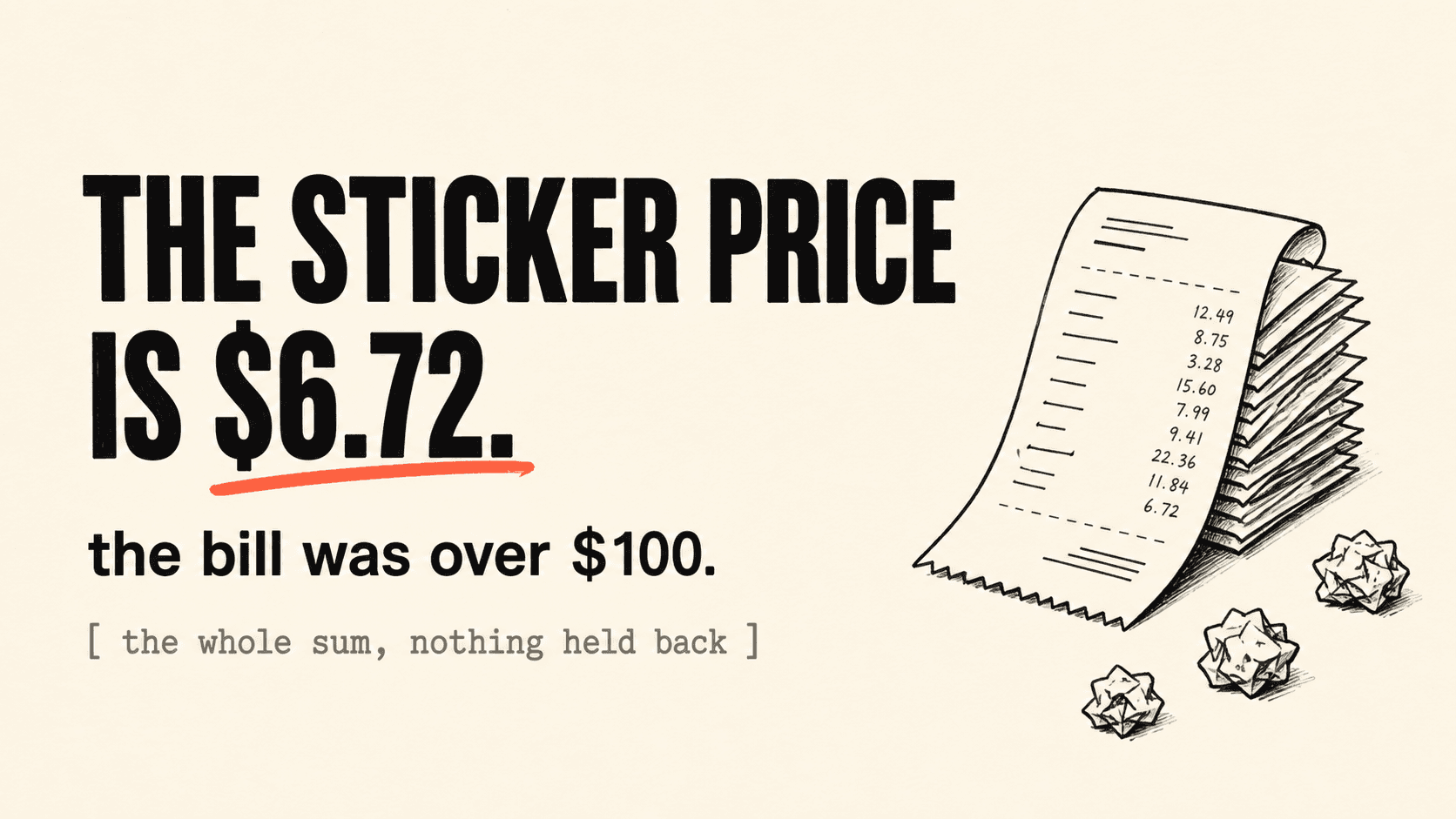
$6.72 a clip. over $100 to get one you would actually run.
both of those numbers are real and both of them are for the same eight seconds of video. the first one is on the pricing page. the second one is what somebody who had been through it actually paid, and the gap between them is the whole of this article.
here is where they came from. veo 3.1 pro runs about $0.84 per second for 4k. most generators cap out around eight seconds a go, so eight seconds is $6.72. that is the sticker price, and it is the number every comparison thread uses.
then the same person, in the same breath:
"then factor in needing to re-generate/refine prompts until you get something you want (could easily spend over $100 on a single asset)."
fifteen times the sticker price. and that is not a complaint about pricing. it is a description of how the thing actually works.
in this article you'll learn what one usable video actually costs you, and how to work that number out for your own account instead of taking anyone's word for it.
by the end of it you'll know:
- why the number on the pricing page is not the number you pay
- the one ratio that turns a price list into a budget, and how to measure yours in an hour
- the four things you are buying re-generations for, and which three are avoidable
- how to tell a defect that costs you the ad from one that only costs you credits
- what the $5-against-$300 comparison actually looks like once you correct it
it is arithmetic and a method, given away completely, with nothing held back for a product at the end.
if you already run the numbers this way and just want the thing i'm building off the back of it, it is not finished and the list to see it when it lands is here: clear-cortex.com/early-access?src=x-article-the-bill-top
Nobody is selling you a video
the question that gets asked underneath all of this is much better than "which tool is cheapest", and somebody put it exactly right:
"the number i actually care about is: how much does it cost me to get one video that i'm genuinely happy enough to put in front of customers?"
that is the number. and it is not on any pricing page, because no pricing page sells that.
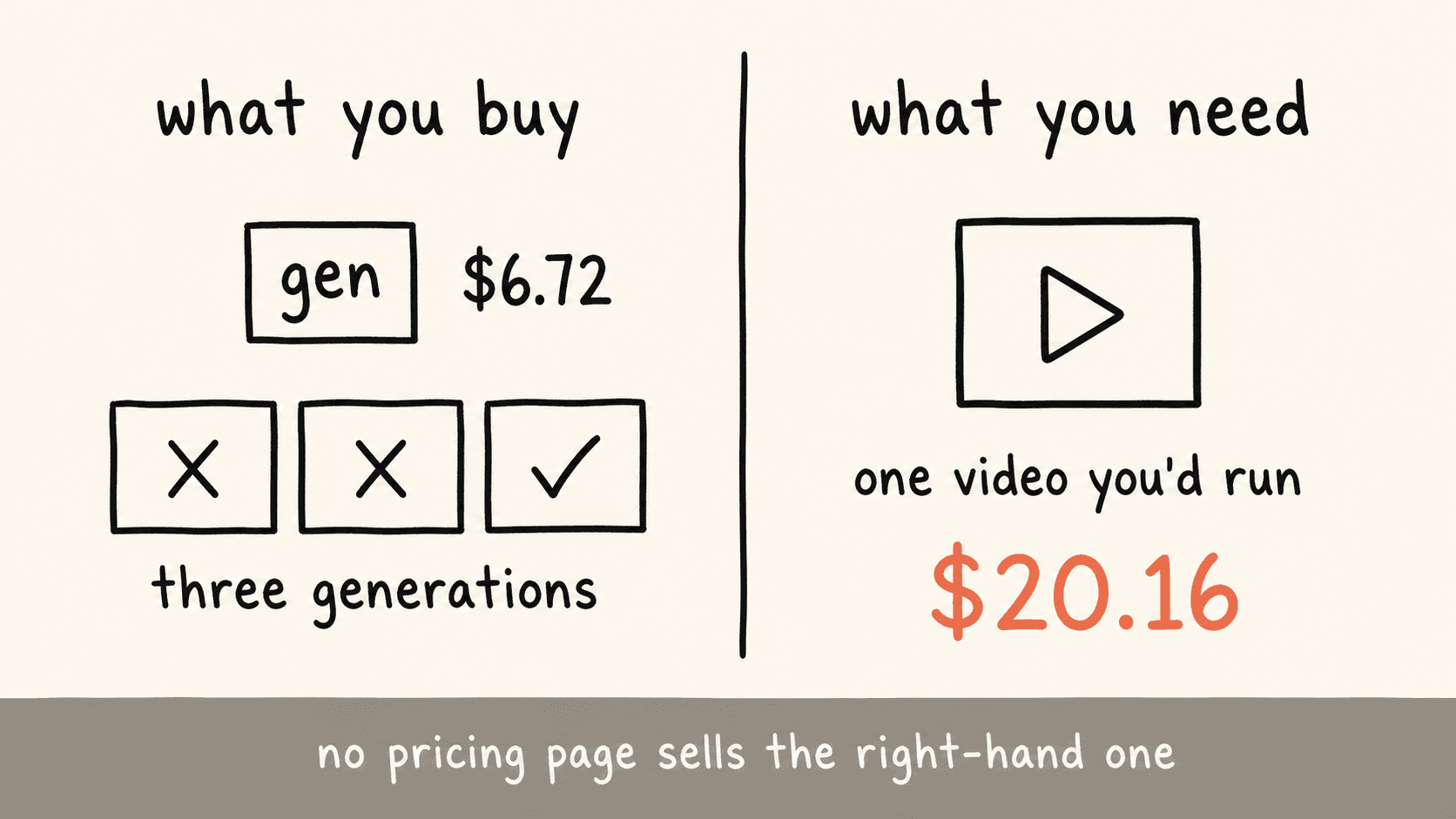
what you buy is a generation. what you need is a video you would put in front of a customer. those are different units and the exchange rate between them is not published, is different for every product, every prompt and every model, and is the single biggest line in your creative budget.
everybody prices the generation. almost nobody measures the exchange rate. so the budget gets planned on $6.72 and spent at $100, and the reason it feels like the tools are lying is that you are reading a price for one thing and paying for another.
The exchange rate has a name and you can measure it in an hour
call it what it is: how many generations you burn per usable video.
you already have the data. open the tool you used last week, count the generations in the project, count the ones that ended up in the ad. divide. that number is yours, it is specific to your product and your prompting, and it is the only thing that turns a price list into a budget.
then the sum:
cost per usable video = price per generation x generations per keeper
at $6.72 a generation and one keeper in three, a single usable eight-second clip costs you $20.16. a thirty-second ad needs four of those, so the ad costs $80.64 before you have touched audio, and that is a clean run with nothing rejected by the ad platform and no client changing their mind.
at one keeper in eight — which is not unusual on a product shot with text on it — the same ad is $215.
that is the range. not $6.72 to $8. $80 to $215, for one ad. run the count and you will know which end of it you are living at.
Four things you are paying re-generations for, and three of them are avoidable
they are not the same and they should not be budgeted the same way.
one. you did not know what you wanted yet. the first four generations were you thinking. the prompt changed each time because your idea of the ad was changing, and the model rendered each version of a moving target faithfully. this is the most expensive way to have an idea that has ever been invented. deciding on paper is free and it is the entire fix.
two. the model missed. you asked for the right thing and it gave you a sixth finger, warped text, a logo that drifted, a face that changed between shots. this one is not avoidable. it is the hit rate, it is what you are actually buying, and it is the only one of the four that belongs in the price.
three. you changed your mind mid-batch. clip three came back and it was good, and it made you see a better version of clip one. so you regenerate clip one, and now clip two does not match. this is real and it happens to everyone, and the cost is not one generation, it is the batch.
four. you are polishing past what the feed can see. this is the expensive one and it is the one nobody counts.
The polish nobody in the feed will ever see
somebody described it precisely:
"keep trying to make one perfect 15 sec ad, then wasting credits and right fixing every janky hand or tiny logo drift that nobody would even notice in the feed."
this is worth sitting with, because it is not laziness talking. it is a real observation about where the ad is going to be watched.
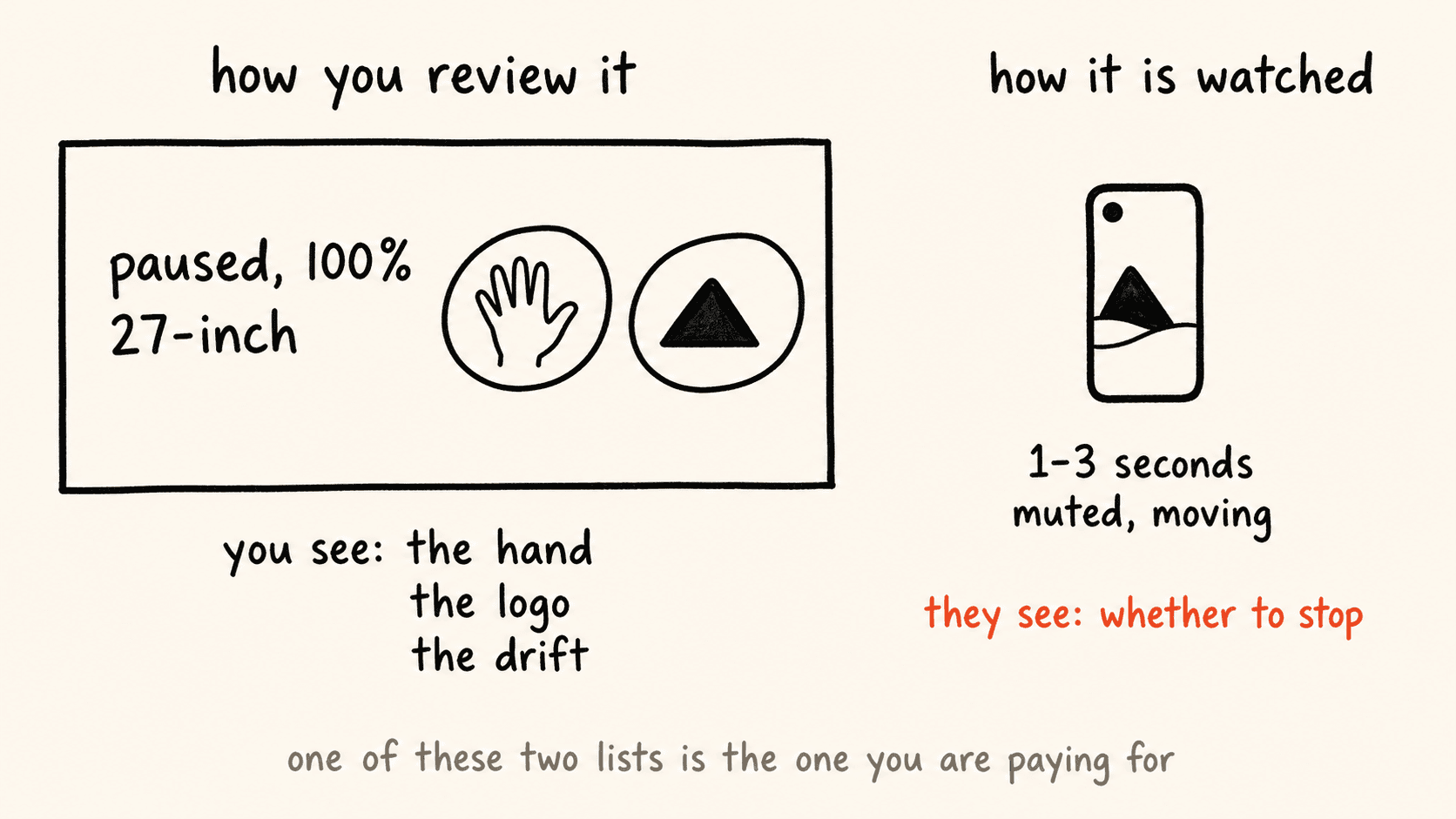
your ad plays in a scroll, on a phone, at whatever brightness the room is, quite possibly with the sound off, for somewhere between one and three seconds before a thumb decides. the hand in frame four is on screen for roughly a fifth of a second at the size of a postage stamp. you are looking at it at 100% on a 27-inch monitor with the video paused, which is a viewing condition no customer will ever be in.
so there are two different standards and you have been applying the wrong one:
- does it break the scroll? a face that changes identity mid-clip, text you cannot read, a product that does not look like the product. these cost you the ad and they are worth re-generating for.
- would it survive a paused screenshot? a slightly odd hand at the edge of frame, a logo a few pixels off. these cost you credits and they cost you nothing else.
the second list is where the money goes. and the reason it goes there is that the second list is the easy list — it is much more comfortable to fix a hand than to admit the hook is weak.
What this does to the comparison everybody is making
the argument for generated creative usually shows up like this:
"why would i pay a creator $300 when i can pay AI less than $5 to create the same lie."
and the case is real. but the comparison as written is $5 against $300, and $5 is the generation price. the honest version puts $80 to $215 against $300, and that changes the decision in a specific way.
at 60x cheaper, you test everything, because testing is free. at 2x to 4x cheaper it is still clearly worth doing, and it is still a budget, and the question of how many hooks you can afford to put into production has a real answer that is not "all of them". the difference between believing you are at 60x and knowing you are at 3x is the difference between a plan and a surprise at the end of the month.
there is a second cost sitting underneath this one that also does not make it into the comparison:
"i was sick of $20/mo minimums for tools i use in bursts."
"tired of juggling four different subscriptions for video, images, music and voiceover."
credits that expire are spend. four subscriptions for one ad is spend. if you are running in bursts — a batch this week, nothing for three weeks — a good fraction of what you pay is for months you did not generate anything in, and it belongs in cost per usable video like everything else.
Do this, this afternoon
- open last week's project and count. generations made, generations used. that ratio is your exchange rate.
- multiply it by your per-generation price. that is your real cost per usable video. write it somewhere you will see it.
- go back through the re-generations and tag each one — did i not know what i wanted, did the model miss, did i change my mind, or was i polishing something the feed cannot see. you will not enjoy the tally on the fourth one.
- set one rule before the next batch: the brief is written before the first generation, and it does not change until the batch is finished.
- watch the cut at phone size with the sound off before you fix anything. if you cannot see the defect under those conditions, it is not a defect, it is an expense.
step five alone will move the number more than switching tools will.
What this does not tell you
this is arithmetic, not a result. it says what one usable video costs you. it does not say that a cheaper usable video sells more, and nothing here measures that.
the per-second prices are the published ones and the $100 figure is one person's account of one asset, not a benchmark. your exchange rate is the only number in this piece that is actually about you, which is why step one is to go and get it rather than to take mine.
and it makes no claim at all about whether the video was any good. a cheap usable video of the wrong idea is a cheaper way to be wrong. that is a different article.
i'm building the version of this where the whole chain sits on one canvas, the brief never has to be retyped into the next tool, and the count is just there in front of you instead of being something you have to reconstruct afterwards. if you want to see it when it lands: clear-cortex.com/early-access?src=x-article-the-bill-end