 Clear Cortex
How to raise a winner's budget without killing it
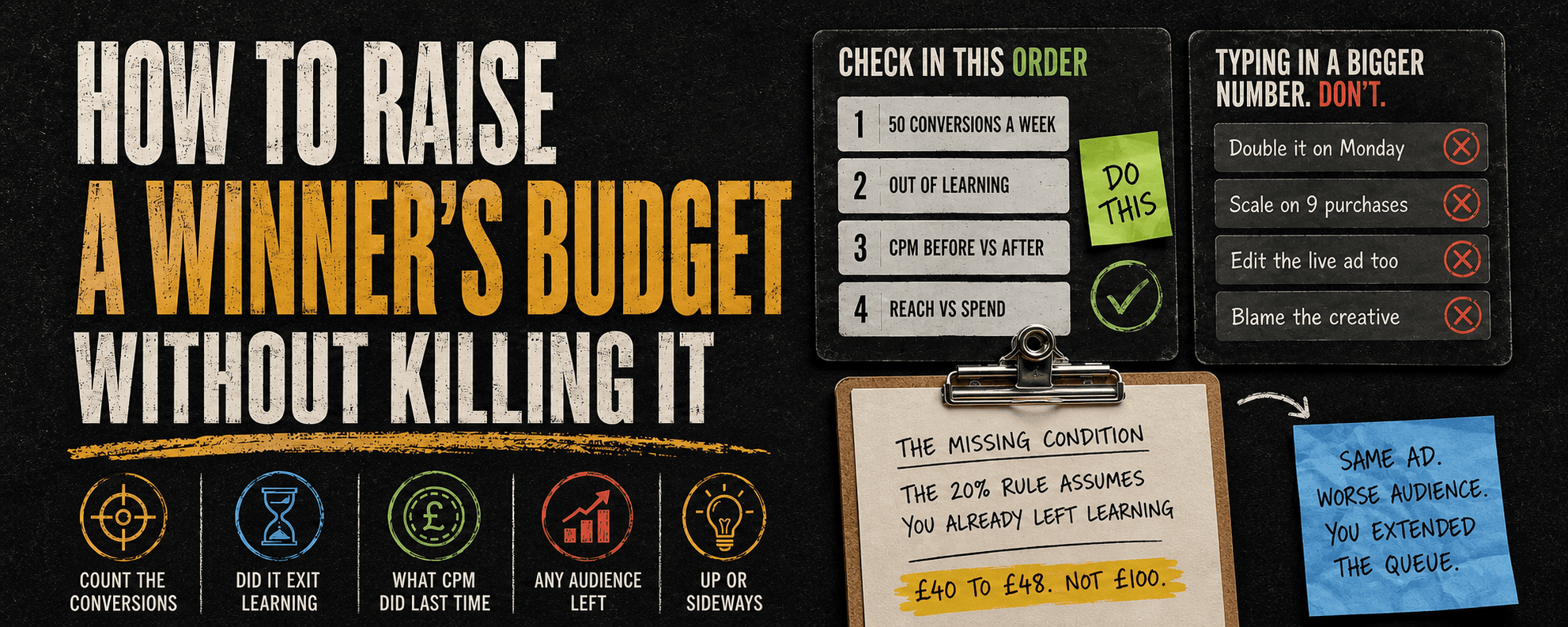
every time you raise the budget 20%, the ad dies.
i went looking and read 50 versions of the same complaint across 41 threads. an ad that worked, a budget that went up, and a winner that stopped winning within a couple of days. the room has a phrase for it already, and i read it more than once, word for word: "i raised the budget and it nuked my ad set."
the part that stuck with me is that the answer is already sitting in there. one person saying they have given up raising budgets because the ad always dies, and one person explaining the exact reason it happens, at the identical score. the complaint travels and the correction does not.
so here is the whole method, in the order to run it. four checks, about twenty minutes, using numbers already sitting in your account. three of the four can tell you not to raise it at all this week. the fourth tells you what the last rise actually cost you, which is usually not what people think it cost them.
nothing is held back and there is no gate on any of it. the only ask in this piece is here: if you want to see the tool i am building for this when it lands, the list is at https://clear-cortex.com/early-access?src=x-raise-budget
Turning up the budget is the easy part
start here, because the whole mistake lives in one assumption.
people treat a budget increase as more of the same thing. it is not. it is a different instruction to the auction, and the ad is the only part that stays the same.
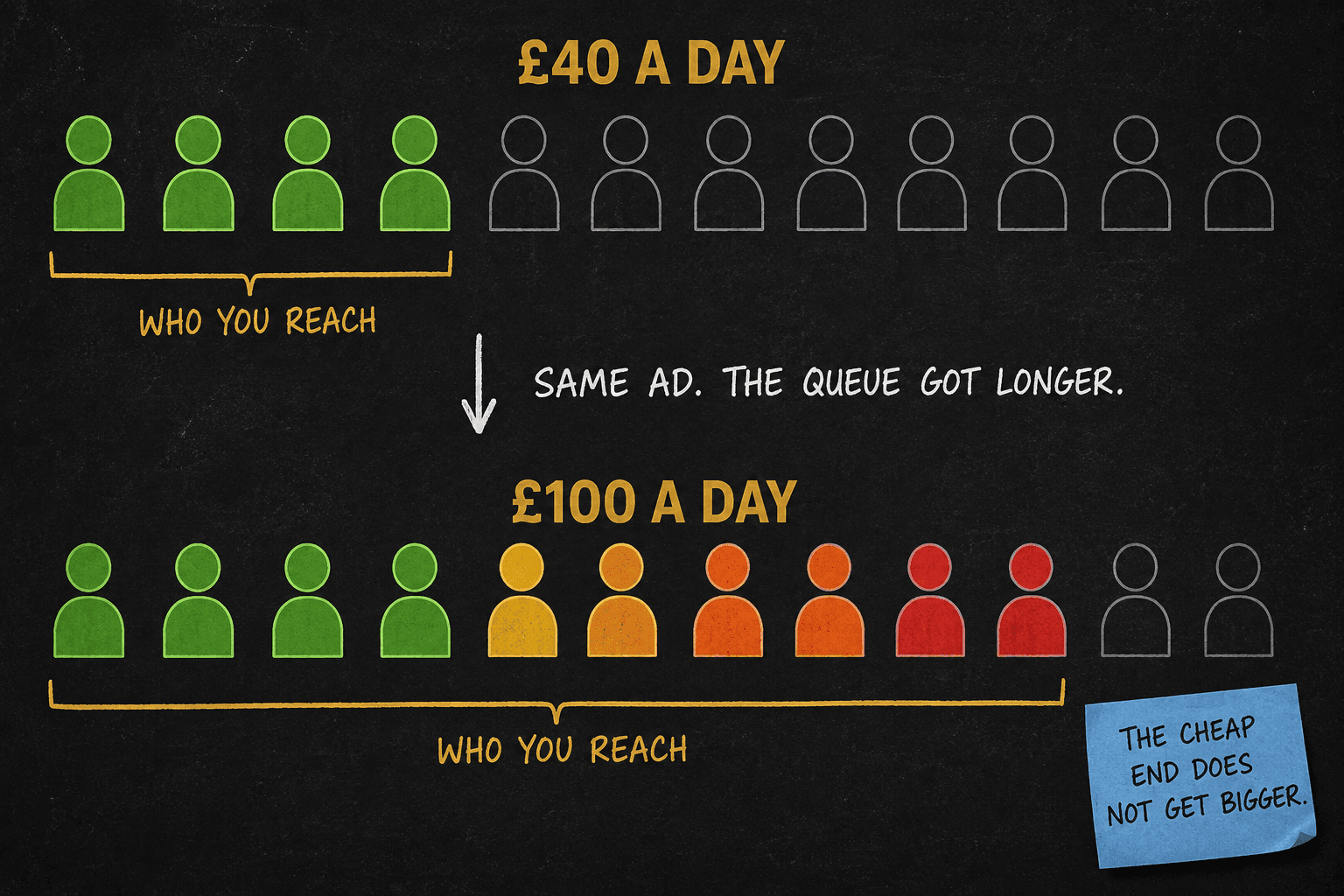
at £40 a day, meta finds you forty pounds' worth of the people most likely to convert. it takes the cheap end first. that is the whole job. cheapest available conversions, in order.
at £100 a day it has to keep going. the cheap end of that audience does not get bigger because you decided to spend more. so it works down the list, into people who are less likely to buy, who cost more to reach, or both. same creative, same targeting, same everything you can see in the interface — and a worse set of people, because you asked for more of them.
your cpa goes up. nothing broke. you did not fatigue the creative, you extended the queue.
the drop lands a day or two after you touch the budget. so the obvious reading is that the ad stopped working. people pull a perfectly good ad, commission a replacement, and hit the same wall a fortnight later with a more expensive video.
that is the single most useful thing here. it is also the opposite of what the interface implies when it tells you to keep raising the budget to get more conversions.
Check one: does it have enough results to be a winner
before anything else, count.
not roas, not ctr, not how good the ad feels. count the conversions the ad set got in the last seven days. roas is the number everybody quotes and it is the wrong one here. a good roas on nine purchases is still nine purchases.
meta's delivery system needs roughly 50 conversions a week per ad set before it has enough signal to optimise properly. under that number it is guessing. the results you are reading are a small sample dressed up as a trend.
so if the campaign did nine purchases last week and one of them was cheap, you do not have a winner. you have nine purchases. raising the budget on nine purchases is not scaling. it is sizing up a bet you have not read yet.
this is where most of the damage starts. nine good-looking purchases feel like a result, and the interface reports them with the same confidence as nine hundred.
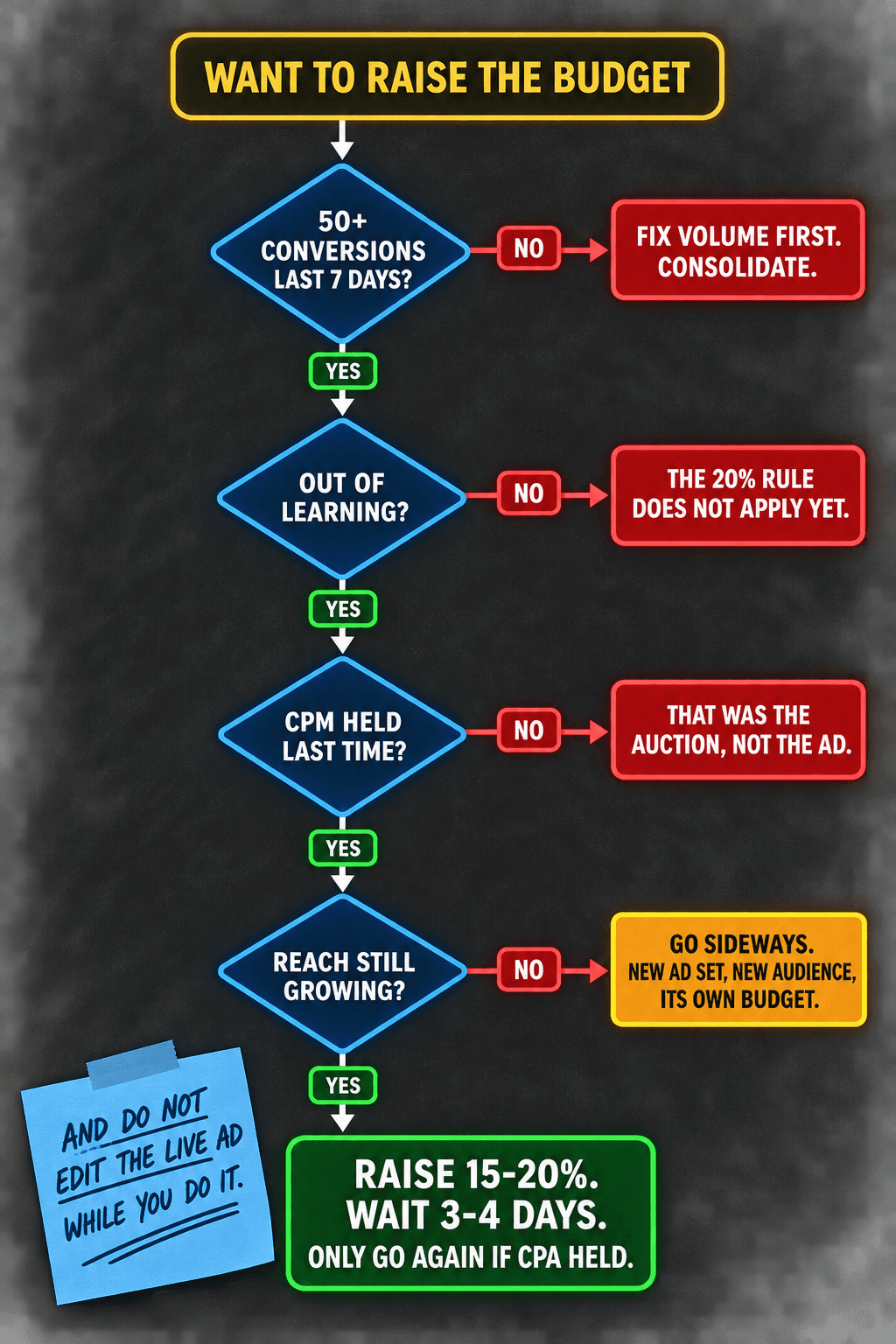
the number to write down: conversions in the ad set, last 7 days. if it is under about 50, stop here. the answer to "should i raise the budget" is no. and the reason is not the budget. it is that you cannot yet tell what you would be scaling.
this is also the answer to the campaign structure question that gets asked constantly — whether to run one campaign for testing and a second one for scaling. if the whole account is under the threshold, splitting it across two campaigns halves the signal in both. one campaign that clears 50 beats two that do not.
somebody asked exactly this and it is worth reading twice. is a two week read on one ad enough to trust before i scale it, or am i fooling myself. usually the second one.
Check two: has it actually exited learning
this is the check that makes the 20 percent rule make sense, and almost nobody runs it.
the folk rule is some version of: raise by 15 to 20 percent, no more than that, every three or four days. it gets repeated as though it were a law. it is not wrong. but one reply said the thing that makes it usable, and it is the most useful sentence i found anywhere on this:
the 20 percent rule assumes you are scaling something that already exited learning.
that is the whole conditional, and it changes what the rule is for. a small step is small enough not to look like a new ad set to the delivery system. a big step reads as a material change. the ad set re-enters learning, and everything it knew is worth less for the next few days. a small step slips under that.
but if it never exited learning in the first place, 20 percent every three days is not a gentle ramp. it is a reset every three days, forever, on something that never got stable enough to read. you can do that for a month and conclude that scaling does not work on your account.
so look at the delivery status before you touch anything. if it says learning, the 20 percent rule does not apply to you yet. what needs fixing is the conversion volume in check one, not the number in the budget field.
and this is why two people can follow the same rule and get opposite results, and both of them post about it.
Check three: what the last increase did to your CPM
now go back and look at what happened the last time.
pull the cpm for the seven days before your last budget increase and the seven days after. two numbers, about a minute.
if cpm went up and your cpa went up by roughly the same proportion, the creative is not your problem and a new one will not fix it. you paid more for the same impressions because you asked the auction to go further. that is the price of the extra volume. it is a real cost, but it is a cost of scale rather than a symptom of a dying ad.
if cpm held steady and your cost per result still went up, that is a different problem. the auction is charging you the same and the people are converting less. now you are looking at the ad or the audience, and the rest of this piece is not your answer.
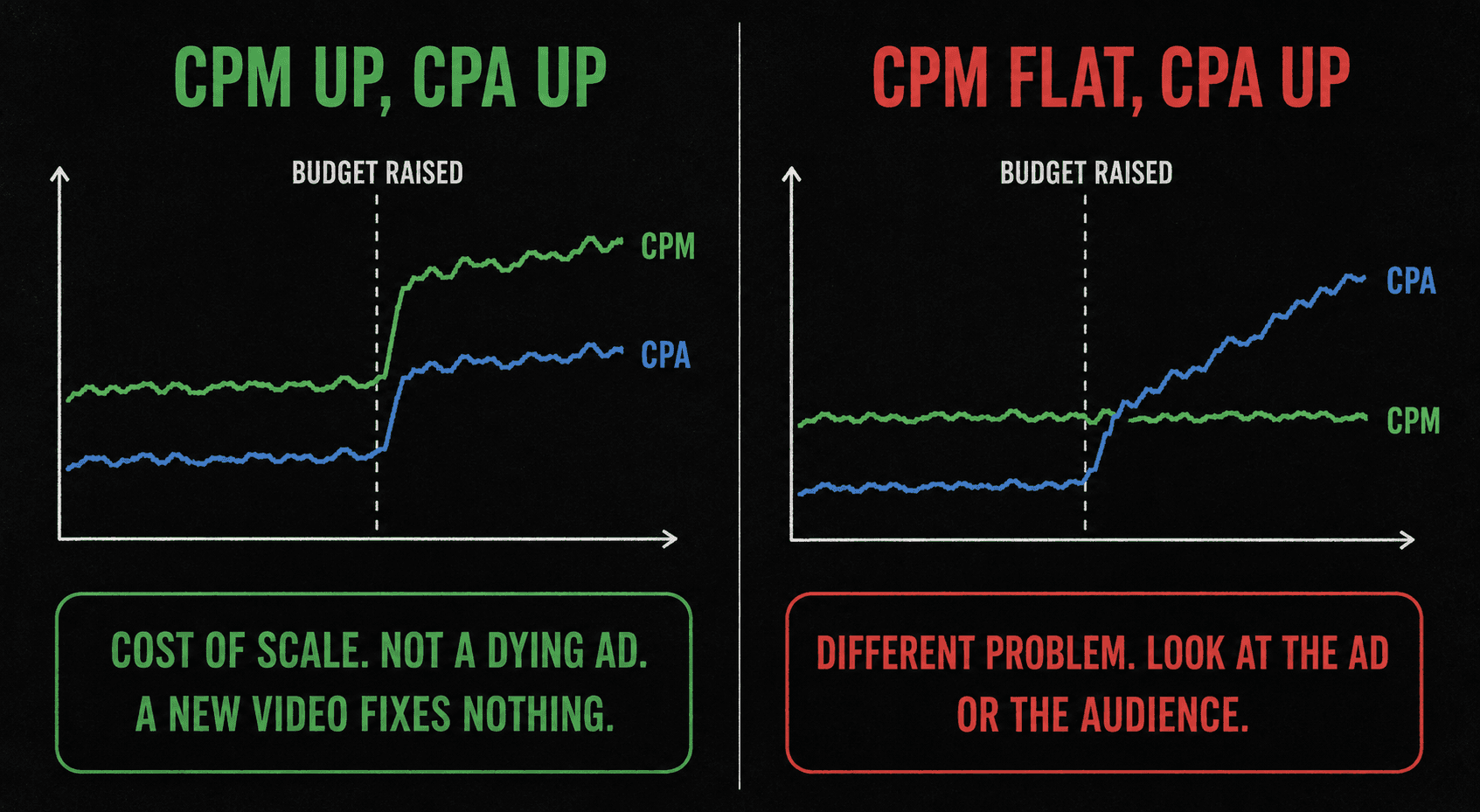
most people never run this comparison. that is why "i raised the budget and it died" and "my creative fatigued" get treated as the same event. they are not, and the two numbers that separate them are already sitting in the account.
Check four: has the audience got any room left
the last check before you touch it.
look at reach against spend over the last two weeks. if both went up together, there is room. if spend went up and reach flattened, you are buying the same people repeatedly and paying more each time for the privilege.
a flat reach curve under a rising spend line is the one case here where the honest answer is that the campaign cannot take more money. not this week, not with a bigger step, not with a duplicate. the audience is the constraint and the budget is downstream of it.
that is the point at which the answer stops being vertical and starts being sideways.
When two of these overlap
they are not mutually exclusive and the overlap is where people get stuck for months.
the common pair is check one and check two together. an ad set under 50 conversions a week is usually still in learning too, because those are two views of the same shortage. when both fire, the fix is one thing rather than two: consolidate. fewer campaigns, fewer ad sets, fewer ads inside them, all the conversion volume pointed at one place until something crosses the threshold. splitting a thin account into more ad sets to test properly makes both problems worse at once, and it is the most common thing people do at exactly this moment.
the harder pair is check three and check four. rising cpm and a flat reach curve together means you have saturated the audience and you are paying auction prices for the privilege. a budget rise here is the most expensive possible move. it is the exact situation behind the war stories — somebody's winner set at $700 a day, $4.6k gone in eight days, zero purchases. that was not a creative failure and a new video did not fix it.
when three and four both fire, the money goes into a new audience, not a bigger number.
So what do you actually do
if all four checks come back clean, here is the move.
raise it by 15 to 20 percent and leave it alone for three to four days. the step is small enough not to re-open learning. the wait is long enough to read. go again only if cpa held through the previous step. if it did not hold, go back to the last number that worked and stay there. that is a finding, not a failure.
if it is saturated, go sideways instead. duplicate into a new ad set on a different audience and keep the winning creative untouched inside it. give the duplicate its own budget rather than taking the money out of the original. you are not making one ad set bigger. you are looking for a second cheap end.
the version i read most often is a separate scaling campaign. duplicate the whole campaign with only the winning creatives in it, at roughly twice the testing budget, and let the original carry on testing. same idea, more moving parts. and it only works if the testing campaign is clearing enough conversions to produce winners worth moving.
and do not edit the winning ad while you are doing any of this. editing an ad that is already live counts as a material change on its own, budget or no budget. do both and you have made two changes and cannot tell which one did what.
The whole thing on one ad
worked example, so the order is concrete.
one campaign, one ad set inside it at £40 a day. one ad is clearly the best — £11 a purchase where everything else is around £24. you want to put it on £100.
check one. last seven days: 38 purchases. under 50, so it is thin, but not absurdly so. flag it and carry on. 38 is close enough that the next check decides it.
check two. delivery status says active, not learning. it exited eleven days ago and has not been edited since. good — the 20 percent rule applies to this ad set.
check three. last rise was three weeks ago, £30 to £40. cpm before, £14.20. cpm after, £14.80 — four percent. cpa over the same window went from £10.40 to £11.00, about six percent. both small, both moving together. the auction is not punishing you yet.
check four. spend up 33 percent over the fortnight, reach up 29 percent. moving together. there is room.
so: three clean, one flagged. you do not go to £100. you go to £48, which is 20 percent, and wait four days. if cpa holds around £11, you go to £57. the route to £100 is five steps and about three weeks. at any step where the cost stops holding, you stop and keep the last number that worked.
the version where you type 100 into the box on monday afternoon gets you to £100 immediately. it also tells you nothing about whether £100 was ever possible.
The part i cannot prove
the four checks are meta's documented delivery behaviour and ordinary practice. you can test every one of them against your own account this afternoon, which is the point of writing them in this order.
what i cannot give you is a measured hit rate. i do not have an account spending across enough products to say this order beats a different one. and i am not going to dress a method up as a study. if you run it and the third check is the one that keeps firing, i would like to know. that would be the first real evidence either way.
Where this goes next
the reason any of this is annoying is that the four numbers live in four different places. by the time you have found them all, you have lost the thread of why you made the ad in the first place.
i am building the thing where the brief, the creative and the numbers that came back all sit on one canvas. so the ad you are about to scale still has its reasoning attached three weeks later, and you are not reconstructing the decision out of a folder of exports.
if you want to see it when it lands: https://clear-cortex.com/early-access?src=x-raise-budget
and the fuller version of what it is for is here: https://clear-cortex.com/use-cases/ai-ad-creative