 Clear Cortex
What a video costs now, and how long the old price survives it
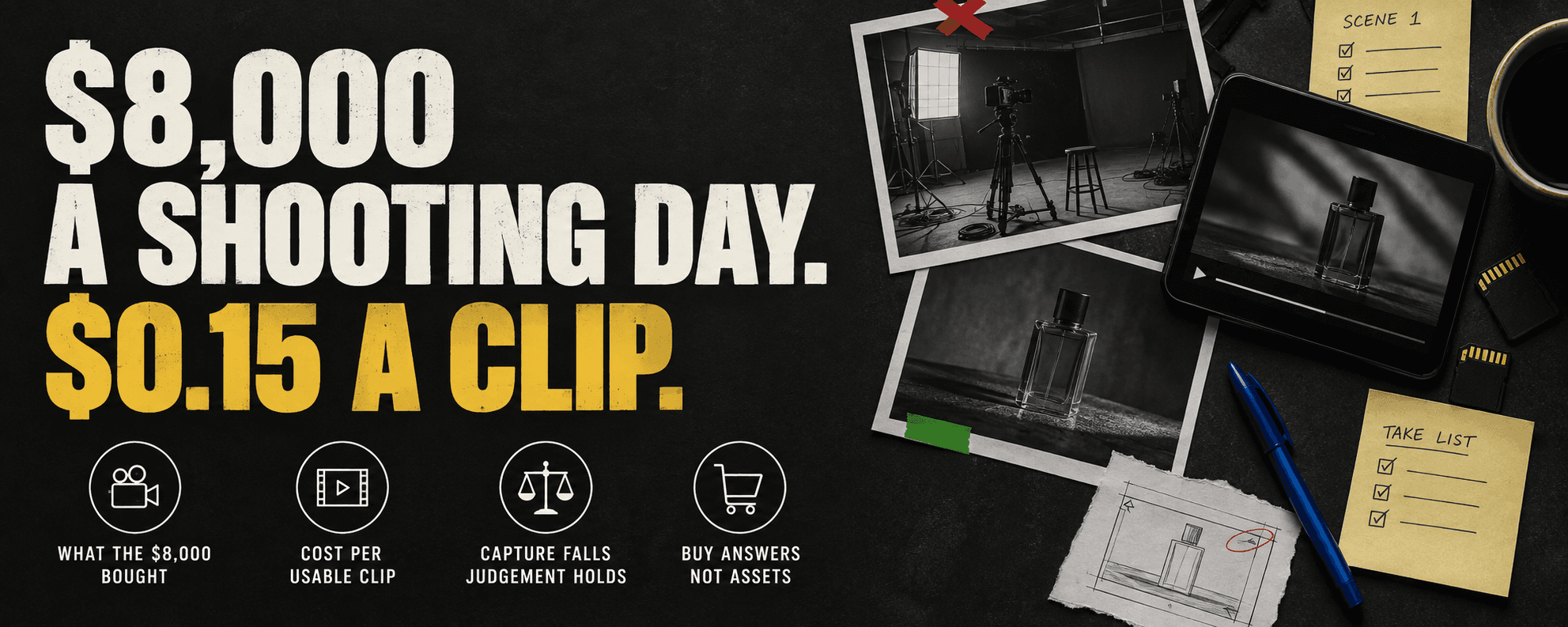
$8,000 a shooting day against $0.15 a clip.
i went looking for what people are actually paying for ad creative and read 472 lines with a number in them, across 110 threads. the prices in the corpus do not form a range. they form two clusters with nothing in between:
- agency shooting day — "$8,000 for a single day of shooting", "$8,000–10,000"
- production agency, whole project — "$5,000 to $50,000"
- real UGC creator, per video — "$150–$500", "$180 per video", "$200 to $600"
- creator, hourly — "$25 an hour on HourlyUGC"
- generated clip — "$0.15 per video", "$1.40" a generation
there is nothing between $25 an hour and $0.15 a clip. that gap is where the argument lives, and most of it is people at one end describing the other end's business as if it were their own.
so here is the whole thing: what the old price was actually buying, which parts of it survive at $0.15 and which do not, the real number to compare against an invoice, and what the shape of the market looks like once the arithmetic settles. about fifteen minutes, nothing held back, no gate on any of it.
what $8,000 was actually buying
the mistake in "why would anyone pay $8,000 when a clip is $0.15" is that it treats the two as the same product. they are not, and unbundling the invoice tells you which parts are genuinely gone.
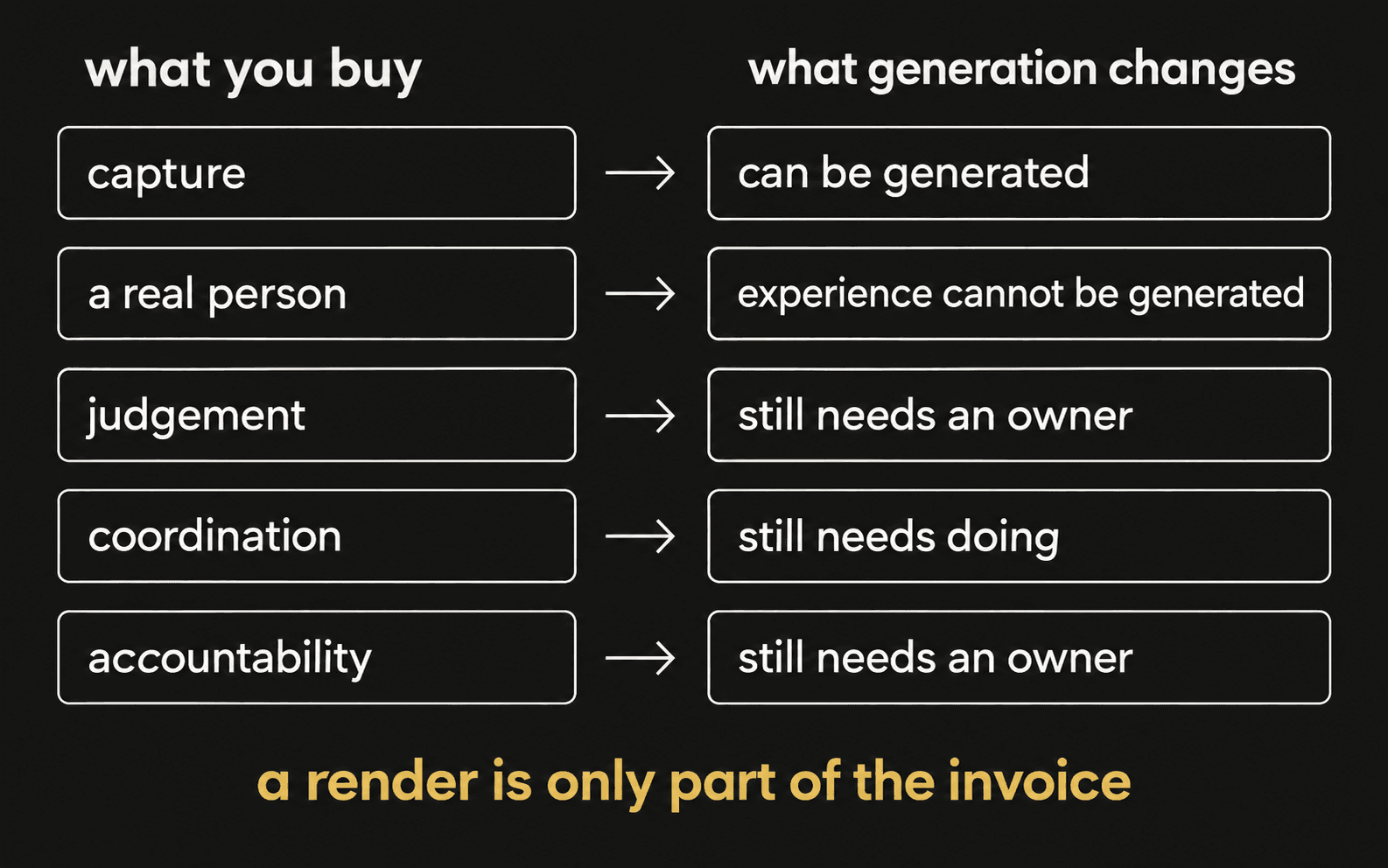
a shooting day bought five things at once:
- capture — cameras, lights, a location, someone who can operate them
- a person — an actual human on camera, with a real face and a real name
- judgement — somebody deciding what the ad should say and how it should feel
- coordination — scheduling, briefing, revisions, delivery, chasing
- accountability — a company you can shout at when it is wrong
generation replaces one of those completely, two partially, and none of the last two.
capture is gone. genuinely, and it is not coming back for this category — that is the $8,000 collapsing to $0.15, and it is real.
the person is gone only where the person was interchangeable. where the face is doing persuasive work — a testimonial, a founder, a practitioner — it is not replaced, it is removed, and the ad becomes a different kind of claim.
judgement is not replaced at all. it is relocated, which is the part almost everyone misreads as it being eliminated.
coordination and accountability are untouched, and if you do this in-house you have not removed them, you have absorbed them. there is a line in the cut that is the whole hidden cost:
"try to run it yourself and it eats 80% of your time and still fails"
the number to compare against an invoice
$0.15 is not comparable to $180. these are the adjustments, and they are all in the corpus.
the retries. "the AI clip is $20+ once you count regenerations". one usable clip is not one generation. if four in five come back with a warped hand or a drifting face, your real cost is five times the sticker — and a creator's fee already includes their retakes.
the time. "i wasted probably about 3k + credits before i gave up and switched to manually pasting prompts". that is one person's tooling detour, and their hours were not free.
the judgement, unbundled. the agency's $8,000 included somebody deciding what the ad says. at $0.15 you are deciding, or nobody is. the cut prices this too, from the other direction: "a generic engagement costs you $2k/client in revision rounds" — those revisions are the cost of judgement that was not applied up front.
so the honest comparison is cost-per-usable-clip, plus your own hours at whatever they are worth, against the invoice. it is still dramatically cheaper. it is not four orders of magnitude cheaper, and quoting the sticker in an argument is how people lose credibility with anyone who has actually run it.
how long the old price survives
the question everyone is really asking. the answer is that the price does not fall evenly, because the five things it bought do not fall together.
capture-only work loses its price first, and mostly already has. if what you sold was a camera, lights and a room, the market has moved and no amount of positioning fixes it. the cut is blunt about who is exposed: "Others have been bleeding for a year because they told themselves clients would keep booking real shoots rather than settle for AI slop."
work priced on judgement holds. what to say, to whom, and why — the part that decides whether the ad works at all — has not become cheaper, and generation makes it more valuable, because volume without judgement produces forty variations of a weak idea. the cut has someone pricing exactly this and it is not falling: "Average retainer: $2,800", and "The retainer is what closes it."
work priced on a person holds completely. a real face vouching for something is not substitutable, because the substitute is a different claim.
coordination is the surprise. it was priced as overhead and it survives as the actual service, because the in-house version costs 80% of somebody's time.
so the shape is not "agencies die". it is that the invoice gets re-cut: the line item that was capture disappears, the line item that was judgement grows, and whoever was selling the first as though it were the second has a bad year.
what to actually do with the saving
three uses, in descending order of how much they are worth.
1. buy answers instead of assets. the highest-value thing cheap generation gives you is not cheaper ads, it is the ability to test twenty claims for the price of one shoot. render all twenty, find the two that stop people, then spend real money making those two properly. you have bought the answer cheaply and paid for quality only where it will run.
2. cover the long tail you were never going to shoot. the fifteen variations, the seven languages, the seasonal versions. the cut has this working: "We took one script and one face, then instantly spun it into a dozen different languages, tones, and backgrounds." none of that was ever going to justify a shooting day, so this is not a saving, it is coverage you never had.
3. and only third, do the same thing for less money. it is the least valuable use, and it is the one everyone starts with.
what usually goes wrong
people bank the saving and cut the judgement at the same time. the $8,000 included somebody thinking. removing the $8,000 does not remove the need.
people compare the sticker to the invoice. cost-per-usable-clip or the comparison is dishonest.
people assume the price collapse applies to their whole service. it applies to capture. audit your own invoice against the five items above and you will usually find you were selling more than you charged for.
people absorb coordination without pricing it. 80% of somebody's time is not a saving.
the honest answer
how much longer do UGC agencies last charging $400 a video that now costs $5?
the ones selling capture, not long. the ones selling judgement and coordination, indefinitely — and at higher rates than before, because volume makes judgement scarcer rather than less necessary.
and the $5 is not $5. it is $5 times the number you discard, plus your hours, plus whatever the missing judgement costs you in revisions. it is still the biggest price change this category has ever had. it is just not the number people are quoting at each other.
i'm building the version of this where the brief, the renders and the test sit on one canvas, so cost-per-usable-clip is a figure you can read rather than one you reconstruct from a credit balance. if you want to see it when it lands: https://clear-cortex.com/early-access?src=x-06-price-400-to-5