 Clear Cortex
How to diagnose a dying ad without wasting money on video
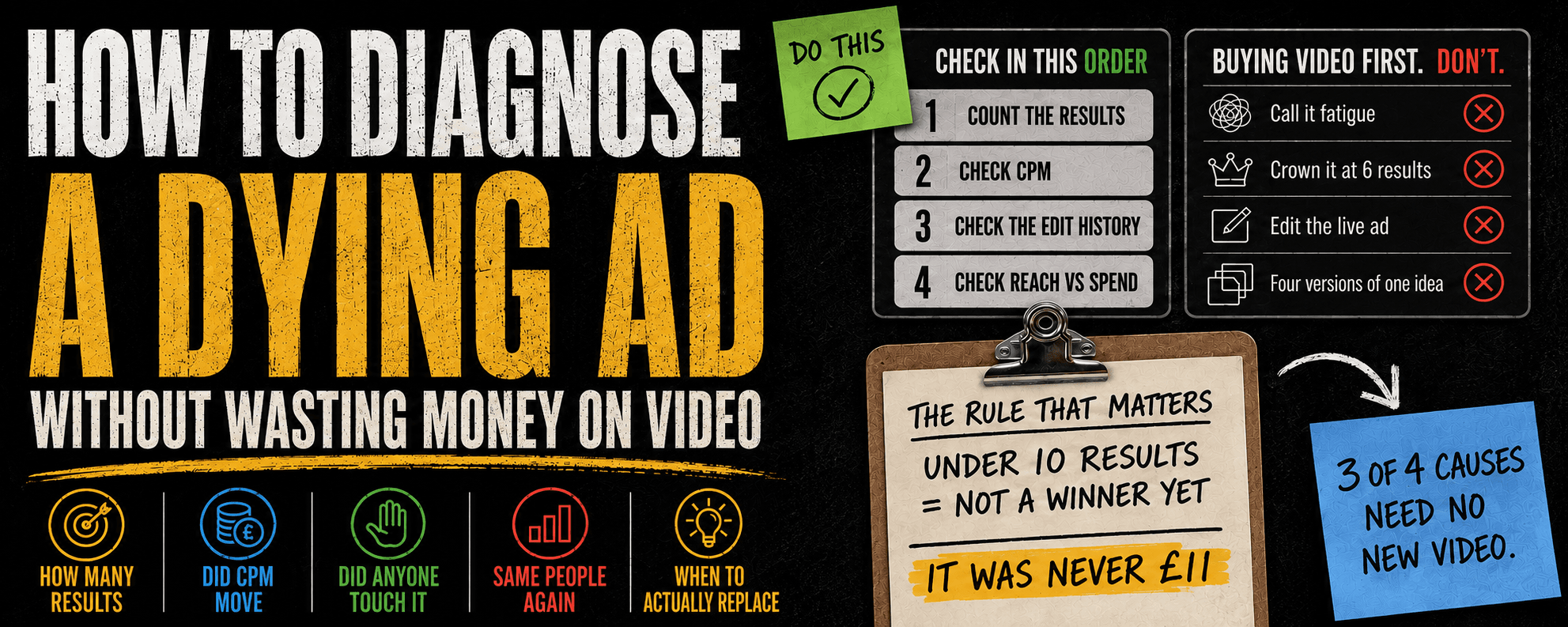
your winning ad has about four days left.
it runs, it works, the cost per sale looks great, and then somewhere around day four or five it stops looking great and you are back to square one. the reflex at that point is to call it creative fatigue and go and make more video.
i went looking and read 51 people describing that exact pattern. the two loudest both said the same thing: it is usually not fatigue, and the video you are about to buy will not fix it.
they are right, and it is an expensive thing to get wrong. new video is the priciest possible response to a problem you have not diagnosed yet.
so here is the whole diagnosis, in the order to run it. four checks, about twenty minutes, using numbers already sitting in your campaign. three of the four mean the creative is fine and new video would be wasted money. the twenty minutes exist to tell you which one you are in before you commission anything.
nothing is held back and there is no gate on any of it.
i am also building the tool this method ought to live in — if you want to see it when it lands, the list is here: clear-cortex.com/early-access. that is the only ask in the piece. everything below is the whole method.
first, count the results it had when you called it a winner
this is the check nobody does and it explains more dead ads than the other three put together.
an ad ran for three days at £11 a sale against your usual £30. brilliant. you called it a winner and you told people about it.
how many conversions was that off? if the answer is four, or six, or nine, you did not find a winner. you found a small number that happened to land on the good side. what happened on day five was not the ad dying — it was the average arriving.
this is the whole of it: small numbers bounce around, and the smaller the number the further it bounces. six conversions at £11 and six at £40 can be the same creative, in the same week, in front of the same audience.
put another way: you did not test that ad. you sampled it, and a sample that small tells you about the sample rather than about the creative.
worth doing the arithmetic once so it stops being abstract. your campaign is at £40 a day and a normal sale costs you £30. that is a conversion and a bit per day. so after three days, the ad you are about to crown has four conversions behind it. if one of those four was going to happen anyway, your £11 was never £11. no amount of new creative gets you back to a number that was not real.
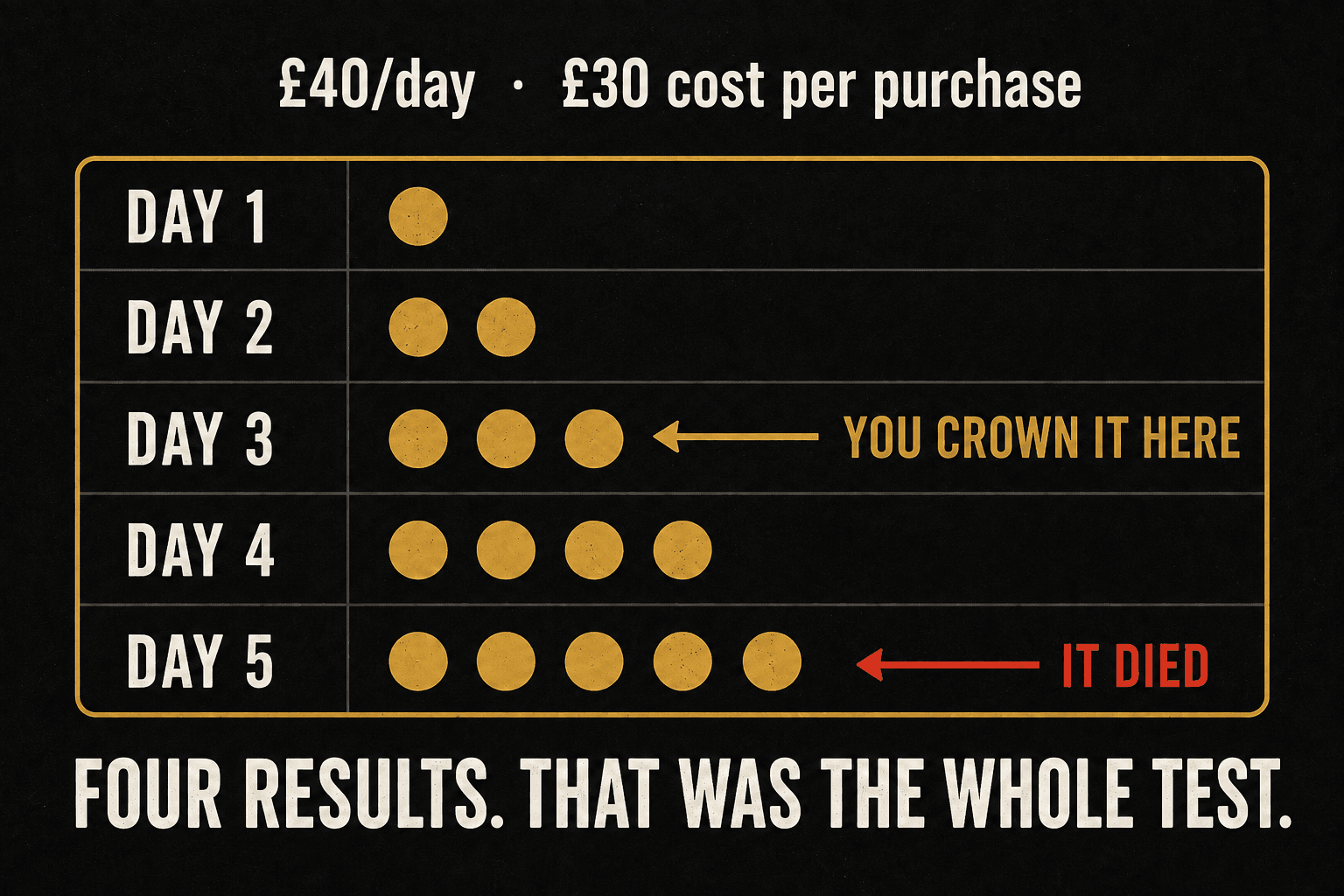
so before anything else, go and look at how many conversions the ad actually had when you decided it was good. if it is under about ten, nothing has died. you made a call too early and reality caught up with it. the fix is not new video, it is testing for longer before you get excited — and certainly before you scale it.
if it is comfortably into double figures and the cost per sale has genuinely doubled, carry on to check two.
second, check whether CPM moved
say your CPM went up forty per cent this week. an ad performing exactly as well as it did last week now costs you forty per cent more per sale, and your ROAS falls to match. nothing about the creative changed. the price of putting it in front of somebody changed.
this happens constantly and it happens for reasons that have nothing to do with you. a big retailer starts a sale. it is the run-up to a shopping weekend. a competitor with deeper pockets moves into your auction. everybody in your category is bidding for the same people you are and suddenly there are more of them.
it is worth being clear about why CPM is the number to look at and not CPC. CPC moves when the auction gets expensive and when your creative stops appealing to people, so a rising CPC tells you something is wrong without telling you which thing. CPM is the price of being shown at all. it moves when the market moves and it does not care how good your ad is. that is exactly what makes it useful here — it isolates the one cause you cannot do anything about.
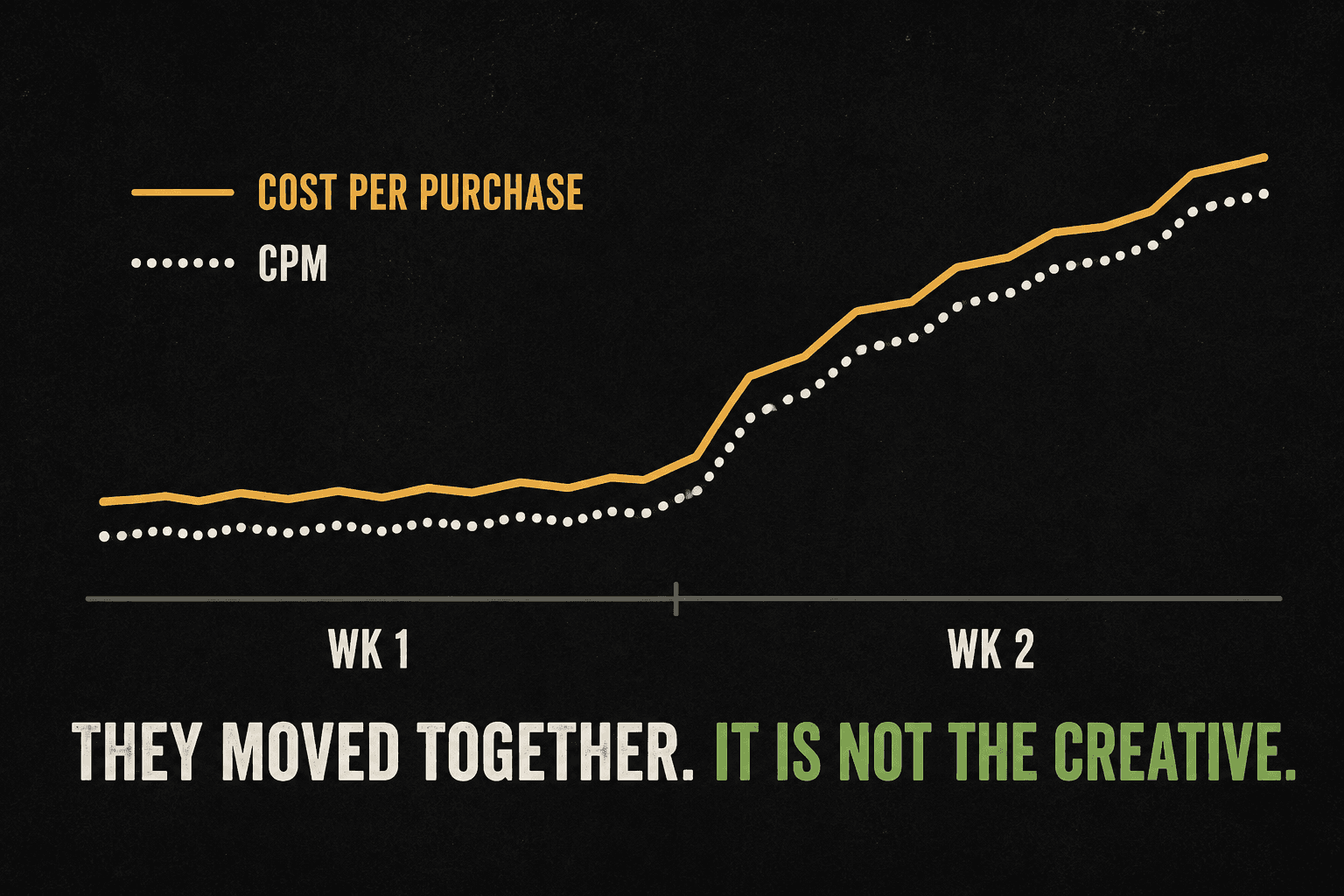
so pull up CPM for the last two weeks and put it next to what a sale costs you. if they moved together, you have your answer and it is not the creative. the ad is fine. the market got more expensive.
you cannot do much about the auction. you can do a lot about knowing it was the auction — because the alternative is commissioning three grand of video to fix something that resolves itself when the sale ends.
third, find out whether anybody touched it
this one is quick and it is embarrassing how often it is the answer.
did anyone edit the ad. did anyone move the daily number by a large amount. did anyone change the audience it was going to, or where it was allowed to show. did a rule fire overnight and change something automatically.
editing a live creative does not adjust it. it sends the system back to working out who to show it to, close to scratch. the few days after that look worse than the few days before — regardless of whether the change was an improvement. a large jump in the daily number does something similar, and so does switching the campaign's optimisation event.
the trap here is that the person who caused it is usually the person being careful. somebody does not want to disturb a campaign that is working, so rather than adding a new ad they tweak the copy on the one already running. that tweak is the reset. the person who piled three new ads on top and walked away did not cause one.
so check the change history before you conclude anything. if there is an edit or a big move in the two days before performance dropped, that is your cause. the ad did not get tired. it got interrupted, and the fix is to leave it alone and let it settle rather than to interrupt it again by swapping the video.
fourth, and only now, ask whether the same people keep seeing it
so: the results were real, CPM did not move, nobody touched it. only now are you in the situation everybody assumed they were in from the start.
what it looks like: the same money is buying fewer new people, and the ones you do reach have seen the ad before. reach flattens or falls while the daily number stays where it was. the audience you can profitably get to has run out, not the idea.
a falling click rate is the tell everybody reaches for here, and on its own it is not enough. CTR drifts down for all sorts of reasons, including the three checks above. what makes it saturation is the click rate falling while reach stalls and the daily number holds. one of those on its own is a hunch. the three together are a diagnosis.
that is real, it is unavoidable, and it is the one case where the answer genuinely is new creative.
but notice how far down the list it is, and notice that at most daily numbers it takes considerably longer than four days to arrive. if you are running a few hundred pounds a day at a normal-sized country, your audience is nowhere near exhausted. the ad that "died on day four" almost never died of this.
when two of them overlap
they do overlap, and this is where people give up and buy video anyway.
the common pair is a small conversion count and a moving CPM at the same time. your ad had seven conversions and CPM rose eighteen per cent. which one killed it? neither, on its own, and you cannot separate them at that volume — which is itself the answer. an ad with seven conversions and a shifting auction underneath it has not been tested yet. the honest read is "no verdict", and the action is to leave it running rather than to replace it.
the other pair worth naming is an edit plus genuine saturation on an old ad. something has been running six weeks, reach is flattening, and somebody also tweaked the headline on tuesday. here the order matters: undo nothing, wait four days for the edit to settle, and only then look at reach against spend. if you swap the creative now you will never know which of the two you were fixing, and you will do the same thing again next month.
the rule for overlaps is the same as the rule for everything else here: the cheapest thing you can do is wait a few more days, and the most expensive thing you can do is commission video.
what to actually do, per cause
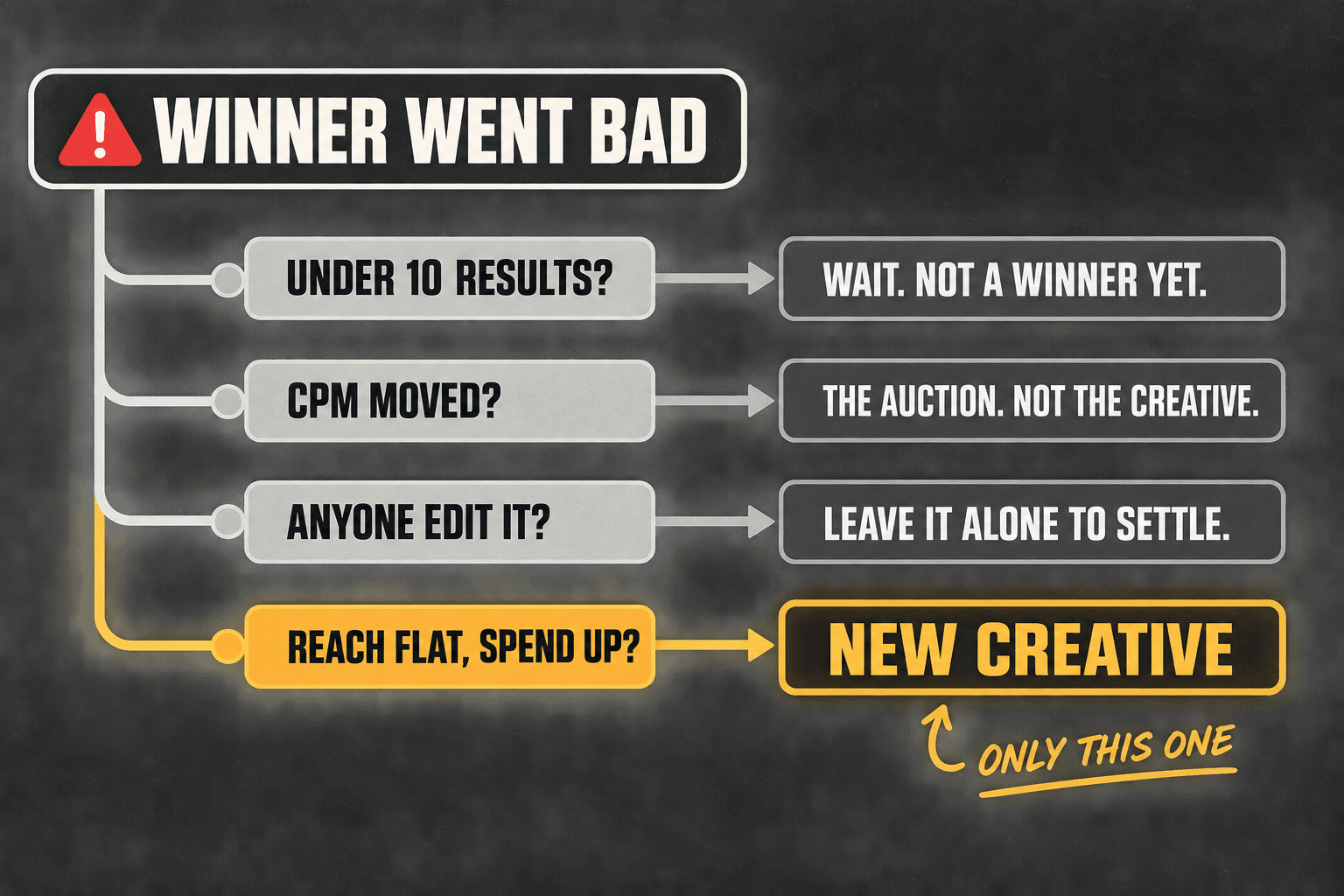
it was a small number. wait. set a floor of about ten conversions and do not make a decision about a creative before it clears that. testing to a floor costs you nothing except the discipline not to react, and it is the difference between scaling a winner and scaling a fluke.
the auction moved. wait, and if you cannot wait, lower what you are willing to pay rather than replacing the creative. you are being outbid, not out-created, and a new ad enters exactly the same expensive auction the old one was in.
somebody touched it. stop touching it. give the campaign three or four days to settle. if you must change something, build the change as a new ad next to the old one rather than editing the one that is running.
the same people keep seeing it. now make new creative, and make it genuinely different — a different reason to buy, not the same video with a new opening line. four versions of one idea will all saturate together because to the person seeing them they are the same ad.
a worked example, start to finish
here is the whole thing on one ad, because the checks are easier to trust when you have watched them run.
a video ad has been live eleven days. days one to seven it sat around £24 a sale against a £30 target. days eight to eleven it is at £61. the instinct is that it has burned out and needs replacing.
check one. over the eleven days it has 19 conversions, 13 of them in the first seven days. that is enough to have an opinion — comfortably into double figures — so this is not a small-number mirage. the drop is probably real. carry on.
check two. CPM over the same window went from £14 to £19. that is a thirty-five per cent rise, against a cost per sale that has gone up around a hundred and fifty per cent. so the auction explains some of it and nowhere near all of it. note it, do not stop.
check three. the change log shows the campaign went from £40 a day to £75 on day eight. there it is. a move that size lines up exactly with the point performance changed, and it is a big enough jump to send delivery back to working out who to show the ad to.
the verdict. two causes, and neither is fatigue. most of the damage is the jump, some of it is the more expensive auction, and none of it is the creative. commissioning new video here would have cost real money, produced an ad that tested equally badly for the same reason, and taught you nothing.
what you do instead. put it back to £40, or leave it and accept three or four flat days while the campaign settles. then re-read it. total cost of the diagnosis: about twenty minutes and no production money at all.
why this is worth the twenty minutes
the four checks take about twenty minutes with the numbers you already have. nobody does them, because "creative fatigue" is available, it sounds professional, and it points at a solution somebody is always happy to sell you.
but three times out of four the honest answer is that the creative is fine and the test was misread. in those three cases, every pound of new video solves a problem you did not have.
and that is only half the cost. the real cause is still sitting there when the new video goes live — so it does the same thing, four days later, and you learn nothing the second time either.
diagnose first. then act.
if you want the longer version of the thinking behind this, the ad creative writeup is here: clear-cortex.com/use-cases/ai-ad-creative
and the reason i am building the thing i mentioned at the top: every check above needs a number you recorded weeks ago, next to the reasoning you had at the time. most people have the numbers in one place and the reasoning nowhere. the brief, the creative and what came back should sit on one canvas, so the ad you are diagnosing still has its thinking attached three weeks later.
the list, once more, if it is useful: clear-cortex.com/early-access