 Clear Cortex
Ad creative: what it actually is, and what makes one work

almost every argument about ad creative is really an argument about where the boundary of the word sits. one person means the image. another means the concept behind the image. a third means the whole asset including the copy, the caption and the landing page it points at. so they agree on everything and still disagree.
worth fixing that first, because the boundary is where the money is.
an ad creative is the part a human being actually perceives. the image or video, the words on it, the words beside it, and — arguably, and in practice yes — the first thing they see after clicking. everything else is delivery: budgets, bidding, ad sets, audiences, placements. delivery decides who sees it. creative decides what happens when they do.
that division used to be roughly even. it isn't now, because the platforms have absorbed most of the delivery decisions. someone running paid social put it plainly:
"for context we run paid social for a dtc brand, mostly meta and tiktok, and creative is the thing that actually moves cac for us, not targeting."
which is why a definitional question turned into a commercial one. if creative is the lever, it is worth knowing what a creative is made of.
the anatomy
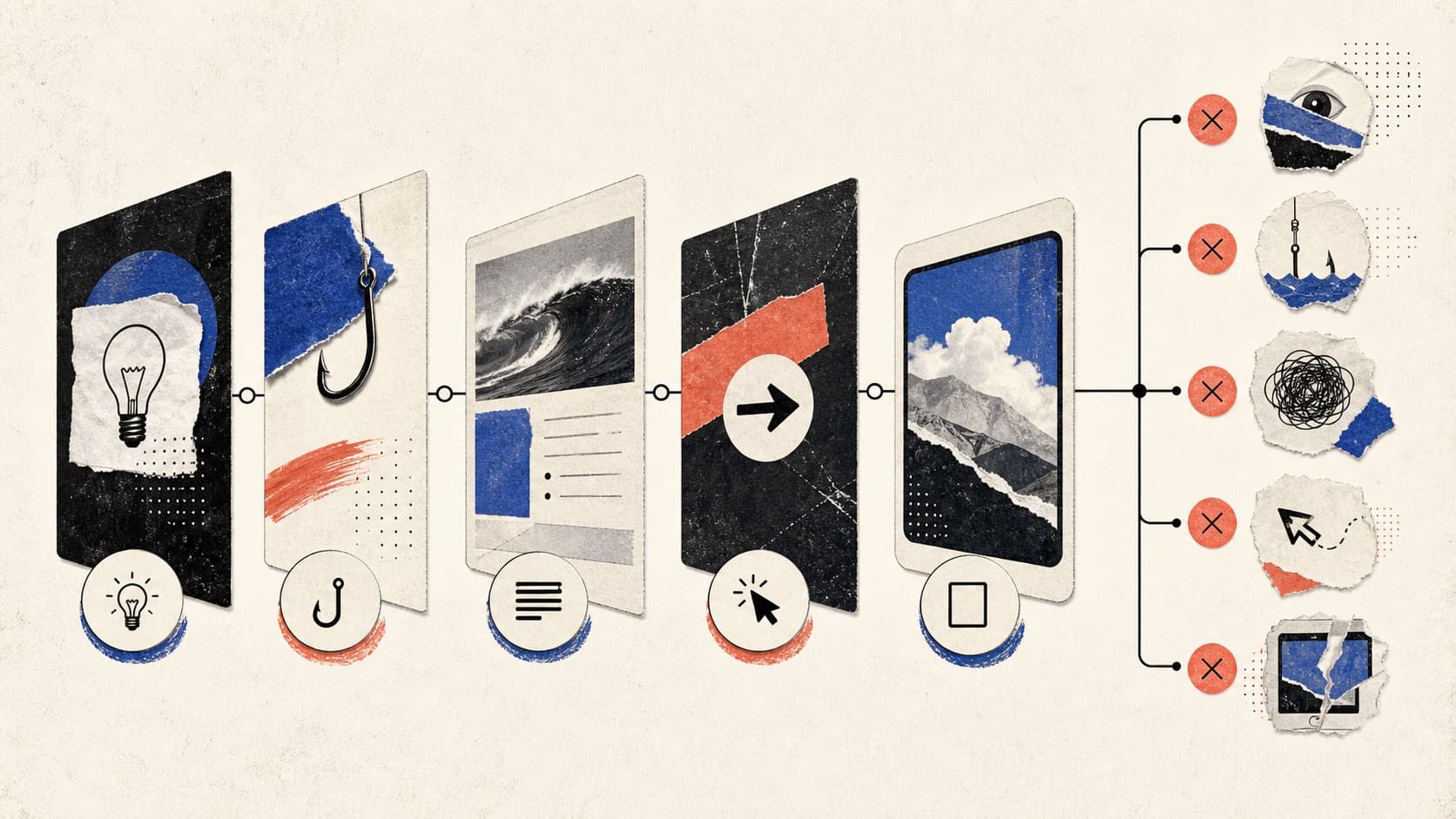
five parts, in the order the viewer meets them. they fail in different ways and get fixed by different people, which is the whole reason to separate them.
the concept — the argument the ad is making. not "we sell knives", but "your current one is annoying at exactly the moment you need it". this is the part that hardly anyone briefs explicitly and the part that most decides the outcome.
the hook — the first two or three seconds, or the top third of a static. its only job is to buy the next four seconds.
the body — the demonstration, the proof, the thing that makes the argument credible.
the call to action — what to do now.
the wrapper — the format, the visual treatment, the pacing, the captions, the aspect ratio. the thing that makes it feel like a UGC clip, a founder talk, a comparison table, a comic.
the reason to hold these apart is diagnostic. from someone reviewing an ad that was failing:
"You have a great hook, but a terrible body/CTA."
that is a completely different repair job from a weak concept, and if you treat both as "the creative isn't working" you will spend money regenerating the wrong layer. the corpus is full of people stuck exactly there:
"Is it usually the creative, the offer, the audience, the landing flow, or something else?"
what makes one work
it argues about a situation, not a product
the single best line on this in the corpus, and it applies to statics as much as scripts:
"the script describes the product instead of the situation nobody is moved by "premium stainless steel construction." they're moved by the 6pm moment where the thing they own doesn't work and they're annoyed."
that is the entire craft in two sentences. specification is not persuasion. a person recognises themselves in a situation and does not recognise themselves in a feature list.
the corresponding self-check, from someone giving other people a checklist:
"Does the script sound like a person?"
"Or does it sound like someone asked AI to write a 30-second advertisement?"
it is aimed at somebody specific, at a specific moment
"Who in the funnel is this actually for, and does the hook match where they are?"
an ad written for someone who has never heard of you and an ad written for someone who has already read your pricing page are different objects. most underperforming accounts are running one ad at both, and the tell is that it converts the warm audience fine and dies on cold.
it stops the scroll on its own merits
"Did the first 3 seconds actually stop the scroll, or did it start slow?"
there is no grace period. the first frame is competing with everything else in a feed, and a slow build is a decision to lose.
it does not look like an advert
this is the least intuitive one and it is well evidenced. two separate reports:
"Polish is killing your performance Professionally produced ads get scrolled past because the brain identifies the advertising pattern in under a second and scrolls before conscious attention is paid."
"Clean, aesthetic videos are great for your IG grid, but on paid social, "native" wins."
the pattern-recognition point is the important half. people are not evaluating your production values and finding them wanting. they are classifying the object as an ad before evaluating anything, and the classification is driven by exactly the signals that expensive production adds: the centred composition, the studio lighting, the graded colour, the confident voiceover.
this does not mean bad work wins. it means the polish should go into the argument and the proof, not the surface.
how creatives fail
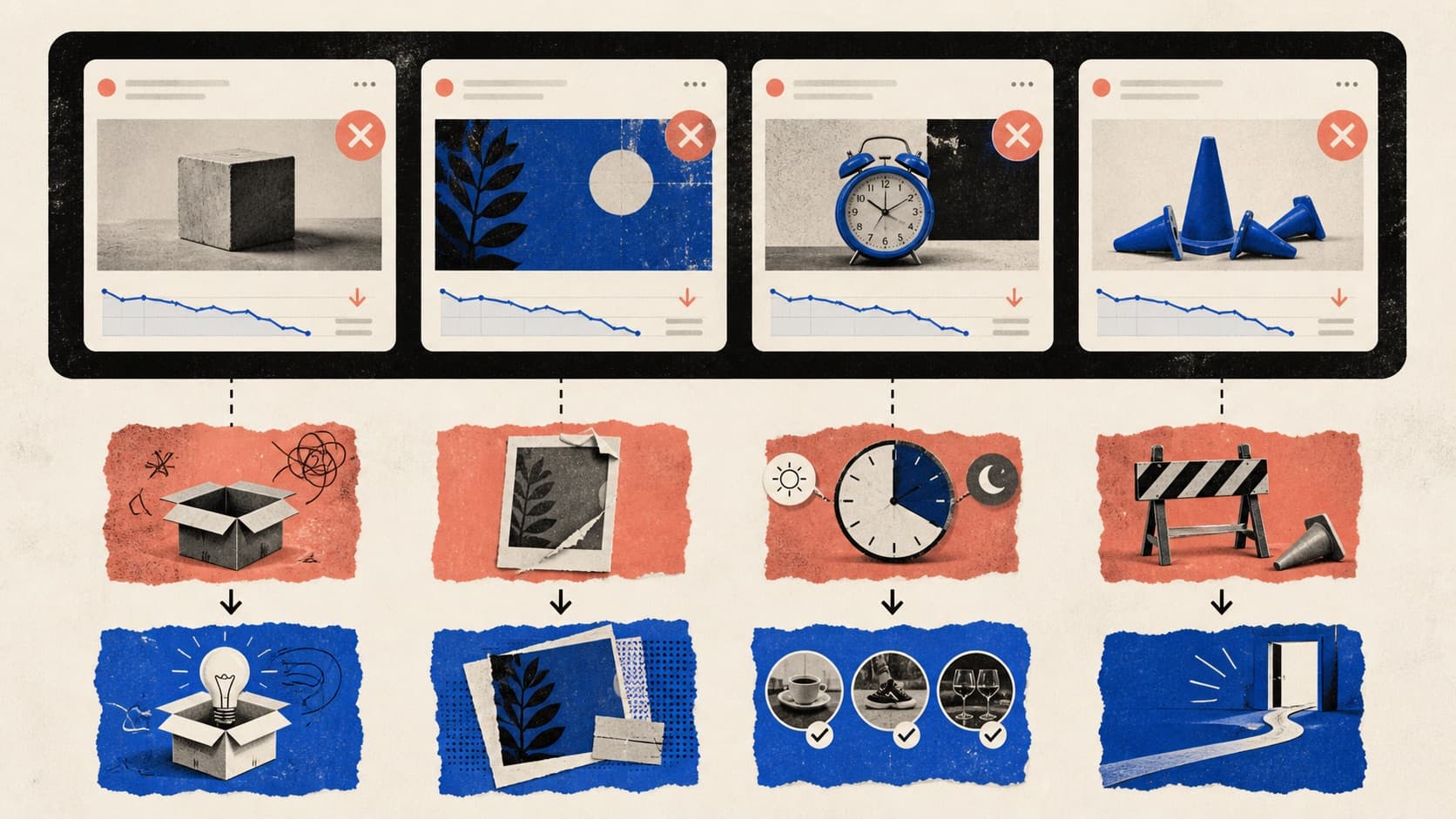
four failure modes. they look identical in the dashboard and they need opposite responses.
one: the concept was never there
"when nobody behind it actually knows the product or the customer, it reads clean and converts like garbage"
nothing at the wrapper layer rescues this. you can regenerate it forever.
two: the wrapper is the same shape as last time
the most useful mechanical explanation of "fatigue" in the corpus, and it is not fatigue:
"But what has happened however is they've seen your ads 2 times in the same FORMAT, THE SAME VISUAL, SAME TREATMENT, SAME WRAPPER ONTHE SAME OFFER and their brain has filed it as seen that shape before scroll pass and that's not exhaustion that's pattern recognition."
the fix here is a genuinely different shape, not another variation. which is exactly the question people keep asking and rarely get answered:
"How many creatives per persona before you admit you're just making variants?"
"And for SaaS specifically, where the ‘product’ is a UI and not a physical thing, what kind of variation actually resets fatigue vs just looks different?"
three: it was never a creative problem
this is the expensive one, because the reflex response makes it worse.
"“Creative fatigue” is one of the most overused diagnoses in Facebook advertising and it's causing people to waste money on new content they don't need"
"They are bad at understanding: where to send traffic what the traffic does there the offer that lives there Most businesses that come to me have been told over and over they have a creative problem."
"Doubling your ad budget is the most expensive way to fix the wrong thing"
before you brief anything: is the account getting enough conversions to optimise on at all? is the offer competitive? does the page the click lands on answer the question the ad raised? if the answer to any of those is no, more creative splits the same data further and makes everything look worse.
the diagnostic question worth asking every time:
"Is it usually the creative, the offer, the audience, the landing flow, or something else?"
four: it never got a fair test
this one is structural and it is badly underrated. even good creative dies if the delivery never gives it a chance:
"Once one ad gets a tiny early lead, it grabs almost all the budget and the rest barely gets shown, so you never really know if the others would have worked too."
"$46/day split across 6 ads means each creative barely gets enough data to optimize."
"So genuinely asking, how do you guys give every creative a real fair start these days, without needing crazy test budgets for every single variant?"
nobody in the corpus has a clean answer to that last one, and it would be dishonest to invent one. what is clear is the arithmetic constraint, which people do state precisely:
"Five to ten creatives in one ad set at $50 a day is $5 to $7 each."
"At a $20 CPA that's roughly one conversion every three days per creative."
three days per conversion per creative is not a test. it is noise you will read as a result. the practical implication is unwelcome but simple: the number of creatives you can honestly evaluate is set by your budget, not by your production capacity. most accounts are running more variants than they can read.
how many do you actually need
the honest answer is that volume is necessary and not sufficient, and the corpus says both halves loudly.
for the necessity:
"it is impossible to be successful without creative volume."
"the brands keeping CAC in check since iOS are shipping more ad creative per week than their competitors."
against it, the same people asking whether the volume is real work or busywork:
"Do you test completely different concepts first, or small variations of the same concept?"
"How many creatives would you test before deciding on a winner?"
the reconciliation is the distinction between concepts and variants. a concept is a new argument; a variant is the same argument in different clothes. concepts are what you need volume of, because most of them are wrong and you are sampling to find the small number that are not. variants are what you produce after a concept wins, to extend its life and to fit placements.
producing forty variants of one concept feels like volume and is not. it is the treadmill people describe when they say the wrapper stopped working — you have changed everything except the thing being said.
what a creative costs, and the number that actually matters
the market has moved fast enough that people are visibly confused about what normal is. one person laid out their own numbers over twelve months:
"when i started paying freelancers for statics early last year the going rate for decent work was $45-60 a creative."
"same tier of freelancer now quotes me $80-120, and two of them added minimum batch sizes."
and then asked the question that is the actual point of this section:
"what are you actually paying per static in 2026, and through what channel"
"whats your cost per USABLE creative"
cost per usable creative is the only number worth tracking, and almost nobody has it. it is the number that makes the human-versus-generated comparison honest, because both routes have a discard rate and only one of them makes it visible. the same logic shows up from the buying side of an agency relationship:
"for a while we paid a UGC agency around 4k a month for maybe 12 to 15 videos, which sounds fine until you realize half of them never beat the control and you're basically paying for swings."
paying for swings is the correct framing for all of it. you are buying attempts at a hit rate, and the price per attempt only matters relative to the hit rate it comes with.
the constraint that made all of this urgent, from an agency describing why they changed how they work:
"we could only ship four creative variants a month because every test needed a new shoot, talent booking, and edit cycle."
and the counterweight, which is that money stops being the binding constraint sooner than people expect:
"At what point did you stop worrying about budget and start worrying about whether your team could physically produce enough good creative to keep up?"
the part everyone skips: keeping the record
the last thing that makes creative work is not a property of any individual asset. it is whether you can say, three weeks later, what produced the one that won.
"Creative Learning / Iteration After ads have run, I want an easy way to capture: What actually won?"
"About three months ago I got fed up with burning money on shoots where the winning angle turned out to be something we did not even film."
that second line is the whole argument for testing cheaply before producing expensively — and also the whole argument for keeping the brief attached to the asset. if the concept, the reference, the script and the result live in four different places, every round of testing teaches you something you will not have in six weeks.
a creative library that nobody can search is a library of things you will accidentally make again.
the summary
- a creative is what the person perceives; everything else is delivery. and since the platforms took over delivery, this is the lever most accounts have left.
- five layers — concept, hook, body, CTA, wrapper — and they fail differently. naming which layer broke is most of the fix.
- argue about a situation, not a product. feature lists do not move anyone.
- polish is not the goal. the brain classifies an object as "advert" before it evaluates it, and production values are the strongest classification signal there is.
- most "we need more creative" problems are not creative problems. check budget, offer and landing page first, because more variants makes a starving account strictly worse.
- your budget sets how many creatives you can honestly read. at $5 to $7 a day per creative you are reading noise.
- volume belongs on concepts, not variants. forty versions of one argument is one test.
- track cost per usable creative, not cost per creative. every route has a discard rate and only one route hides it.
- keep the record of what won and why, or you will re-run last quarter's experiments at full price.